

Distribution network strategies are strengthening reach across agricultural input and commodity markets by improving access to seeds, fertilizers, crop protection products, equipment, grains, and other farm-linked goods. As agricultural markets expand, companies must manage fragmented rural demand, dealer networks, inventory planning, logistics efficiency, pricing structures, and last-mile delivery challenges.
A clear market entry strategy helps businesses evaluate channel readiness, partner capability, customer coverage, regional demand, and supply reliability before expansion. A focused Agricultural distribution network entry strategy supports scalable growth by aligning distribution models, market access routes, trade relationships, and service capabilities with evolving agricultural input and commodity market needs.
Agriculture logistics was valued at about USD 267.89 billion in 2025 and is projected to reach USD 330.20 billion by 2030, growing above 5% CAGR. Crop protection chemicals are also projected to grow from USD 53.0 billion in 2026 to USD 80.2 billion by 2033. These figures support Agricultural distribution network entry strategy planning by highlighting channel depth, input movement, warehousing needs, and last-mile market access.
Mapping Dealer and Distributor Networks for Agriculture Market Entry Planning
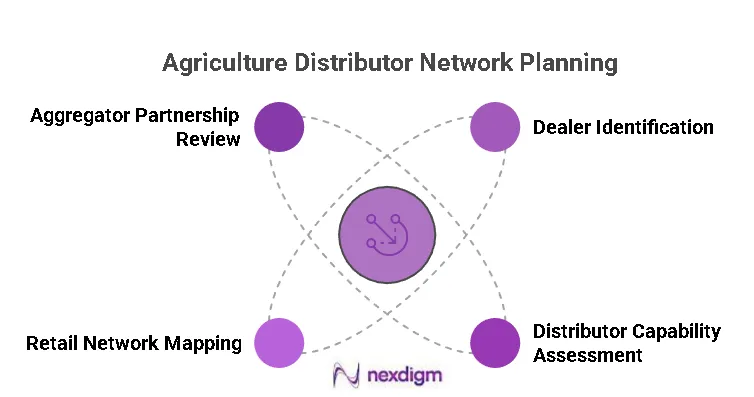
This involves identifying reliable dealers, distributors, retailers, aggregators, and channel partners to improve product reach, last-mile access, inventory movement, and agricultural market penetration:
-
Dealer Identification
Identify regional dealers with strong farmer relationships, local reach, category experience, and capacity to support market expansion.
-
Distributor Capability Assessment
Evaluate distributor coverage, warehousing strength, sales teams, credit capacity, and ability to manage agricultural product volumes.
-
Retail Network Mapping
Assess rural retailers, agri-input stores, trading points, and local outlets supporting last-mile agricultural market access.
-
Aggregator Partnership Review
Map aggregators handling farm produce, commodities, or input distribution to strengthen sourcing and demand linkages.
Nexdigm Seasonal Demand and Inventory Risk Assessment
Nexdigm can help agricultural distribution players assess seasonal demand cycles, stock movement patterns, inventory buildup risks, storage capacity, replenishment timelines, and regional sales fluctuations. This supports market entry strategy by improving demand forecasting, reducing stockouts, managing excess inventory, and aligning distribution planning with agricultural input and commodity market cycles.
Nexdigm Logistics Infrastructure Review for Commodity Distribution
Nexdigm can assess transport networks, warehousing capacity, route efficiency, handling facilities, storage risks, freight costs, and partner readiness to support scalable agricultural commodity distribution.
-
Transport Network Assessment
Evaluate road, rail, and port connectivity to support reliable agricultural commodity movement across target regions.
-
Warehousing Capacity Review
Assess warehouse availability, storage conditions, capacity gaps, and location suitability for commodity distribution planning.
-
Route Efficiency Analysis
Review freight routes, delivery timelines, congestion risks, and cost efficiency across key commodity movement corridors.
-
Handling Facility Evaluation
Assess loading, unloading, grading, packaging, and bulk-handling facilities required for efficient commodity movement.
Nexdigm’s case:
Nexdigm helped an agricultural commodity distributor review logistics infrastructure for market expansion. The analysis identified 20–25% route inefficiency, 15–18% warehousing capacity gaps, and 10–12% freight cost variation across key commodity corridors. These insights helped the company prioritize logistics partners, optimize storage locations, reduce distribution risks, and build a scalable commodity distribution entry strategy.
To take the next step, simply visit our Request a Consultation page and share your requirements with us.
Harsh Mittal
+91-8422857704