

Auto component manufacturing expansion is accelerating as OEMs increase localization investments to reduce supply chain risks, improve cost efficiency, and meet regional production requirements. As automakers enter or scale operations in global markets, demand is rising for locally manufactured components, supplier partnerships, and production-ready ecosystems.
A successful auto component manufacturing entry strategy must combine supplier capability assessment, localization planning, partner identification, and operational feasibility to support sustainable growth in evolving automotive manufacturing markets.
The global automotive parts and components market was valued at USD 629.81 billion in 2025 and is expected to reach USD 929.39 billion by 2030, growing at 6.70% CAGR. Global car manufacturing also reached 75.5 million units in 2025, creating sustained demand for localized component production and supplier ecosystem development.
Why OEM Localization Is Reshaping the Auto Component Manufacturing Landscape?
OEM localization is reshaping auto component manufacturing by increasing demand for local suppliers, reducing import dependence, improving cost efficiency, strengthening supply chains, and supporting region-specific production requirements.
- Rising Local Supplier Demand – OEM localization increases demand for nearby component suppliers that can support faster production, lower costs, and reliable deliveries.
- Reduced Import Dependence – Local component manufacturing helps OEMs reduce reliance on imported parts and manage global supply chain disruptions better.
- Cost Efficiency Through Localization – Producing components locally can lower logistics costs, duties, inventory costs, and currency fluctuation risks for OEMs.
- Stronger Regional Supply Chains – Localization supports development of supplier clusters, manufacturing hubs, and regional sourcing networks around OEM production facilities.
Nexdigm’s Cost Competitiveness Analysis for Localized Auto Component Production
Nexdigm’s Cost Competitiveness Analysis for Localized Auto Component Production helps manufacturers compare production costs across target regions. Nexdigm can assess labor costs, raw material availability, logistics expenses, import duties, utilities, supplier pricing, incentives, and tax structures. This enables auto component companies to identify cost-efficient manufacturing locations, improve localization decisions, and strengthen profitability while supporting OEM sourcing requirements.
Nexdigm’s Expansion Support for Scaling Auto Component Manufacturing Across Global Markets
Nexdigm’s expansion support helps auto component manufacturers assess global markets, identify scalable production locations, evaluate supplier ecosystems, manage entry risks, and build phased growth plans aligned with OEM localization demand:
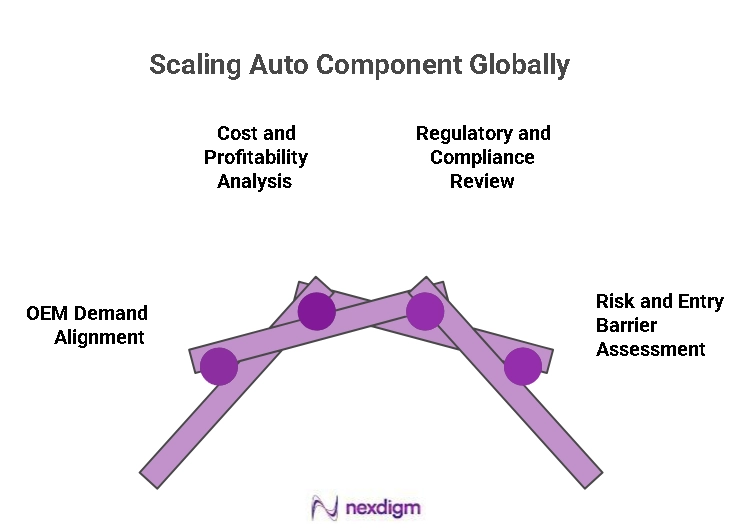
- OEM Demand Alignment – Nexdigm analyzes OEM production plans, component sourcing needs, localization targets, and supplier qualification requirements.
- Cost and Profitability Analysis – Nexdigm reviews production costs, duties, utilities, logistics expenses, tax benefits, and margin potential across markets.
- Regulatory and Compliance Review – Nexdigm assesses local content rules, manufacturing approvals, quality standards, import-export norms, and environmental compliance requirements.
- Risk and Entry Barrier Assessment – Nexdigm identifies supply chain risks, capacity gaps, policy uncertainty, competition, and operational challenges before expansion.
Nexdigm’s case:
Nexdigm supported a Tier-1 auto component supplier planning expansion into Southeast Asia and Eastern Europe to serve OEM localization programs. Nexdigm evaluated 12 manufacturing zones, benchmarked 60+ competitors, and assessed component demand across braking systems, interiors, electronics, and lightweight parts. The analysis helped the supplier identify two export-ready production hubs, reduce estimated logistics costs by 15–20%, and create a three-year expansion roadmap aligned with regional OEM sourcing requirements.
To take the next step, simply visit our Request a Consultation page and share your requirements with us.
Harsh Mittal
+91-8422857704