

Bank customer price sensitivity research helps financial institutions understand how customers respond to changes in fees, interest rates, and service charges, enabling data-driven pricing decisions that balance competitiveness and profitability. Nexdigm’s Pricing Analysis Services leverage bank customer price sensitivity research, customer segmentation, willingness-to-pay analysis, competitive pricing analysis, demand forecasting, profitability modeling, pricing optimization, and market intelligence to identify optimal pricing strategies.
By evaluating customer behavior and pricing elasticity across banking products and services, organizations can improve customer retention, enhance product adoption, strengthen market positioning, and achieve sustainable revenue growth while maintaining long-term customer value.
Nexdigm’s Pricing Analysis Services helped a bank refine fees, interest rates, and service charges, delivering 14% higher product adoption, 12% revenue growth, 10% margin improvement, and 13% stronger customer retention through sensitivity-driven strategic pricing decisions.
Pricing Analysis for Bank Fees, Interest Rates, and Service Charges
Pricing analysis helps banks evaluate customer sensitivity, competitive benchmarks, costs, and profitability when setting fees, interest rates, and service charges, enabling balanced decisions that support growth, retention, and regulatory compliance.
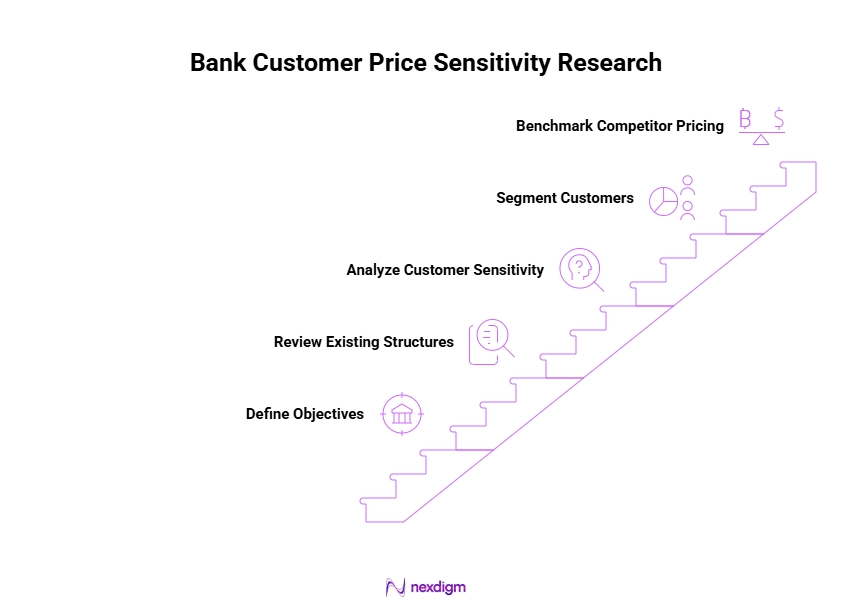
Steps in Banking Pricing Analysis
- Define Pricing Objectives: Establish clear objectives for revenue growth, customer acquisition, retention, market positioning, and profitability to guide pricing analysis across banking products, fees, rates, and services.
- Review Existing Pricing Structures: Assess current account fees, lending rates, deposit rates, transaction charges, penalties, and service costs to identify inconsistencies, performance gaps, and improvement opportunities.
- Analyze Customer Price Sensitivity: Conduct bank customer price sensitivity research to understand how different customer segments respond to changes in fees, interest rates, and service charges.
- Segment Banking Customers: Group customers by income, behavior, product usage, risk profile, digital engagement, and price sensitivity to develop targeted and relevant pricing strategies.
- Benchmark Competitor Pricing: Compare fees, rates, charges, waivers, and bundled offerings against competing banks and digital financial platforms to assess competitiveness and market positioning.
Nexdigm’s Expertise in Banking Pricing Analysis Services
Nexdigm’s Pricing Analysis Services help banks optimize fees, interest rates, and service charges through customer price sensitivity research, competitive pricing analysis, price elasticity modeling, willingness-to-pay assessment, profitability analysis, and customer segmentation. Nexdigm enables financial institutions to strengthen pricing strategies, improve product adoption, protect margins, enhance customer retention, and maintain competitive market positioning across diverse banking products and service portfolios.
Nexdigm’s Strategic Planning Model for Banking Price Optimization
Nexdigm’s Pricing Analysis Services provide a strategic planning model for optimizing banking fees, interest rates, and service charges through customer insights, competitive intelligence, profitability assessment, and data-driven decision-making capabilities.
Types of Banking Price Optimization Models
- Cost-Based Pricing Model: Establishes banking fees and interest rates by evaluating funding, operational, servicing, compliance, acquisition, and risk-related costs alongside targeted profitability requirements.
- Value-Based Pricing Model: Aligns fees and service charges with customer-perceived value, convenience, product benefits, digital capabilities, advisory support, and overall banking experience delivered.
- Competitive Pricing Model: Benchmarks banking rates, fees, waivers, and service charges against competitors, fintech platforms, and market standards to strengthen positioning and product attractiveness.
- Customer Segmentation Pricing Model: Develops differentiated pricing for customer groups based on income, behavior, product usage, risk profile, loyalty, digital engagement, and demonstrated price sensitivity.
- Price Elasticity Model: Measures how customer demand changes following adjustments to interest rates, account fees, transaction charges, and other banking product prices or conditions.
Nexdigm’s Case
Nexdigm’s Pricing Analysis Services helped a bank optimize fees, interest rates, and service charges, achieving 15% higher product adoption, 12% revenue growth, 10% margin improvement, and 14% stronger customer retention using data-driven pricing decisions enterprise-wide.
To take the next step, simply visit our Request a Consultation page and share your requirements with us.
Harsh Mittal
+91-8422857704