

Rapid growth in enterprise data is increasing the financial importance of storage architecture, consumption models, and provider pricing decisions. Cloud storage pricing strategy research helps businesses evaluate capacity charges, access tiers, retrieval fees, data transfer costs, redundancy options, and commitment structures across cloud environments.
Supported by cloud storage pricing analysis, competitive benchmarking, workload cost modeling, consumption analysis, and cloud cost optimization, enterprises can improve spend visibility, control expanding storage expenses, and build scalable pricing strategies aligned with long-term data growth.
Even a 10%–20% reduction in effective storage cost per terabyte can create substantial savings as enterprise data volumes scale. Pricing Analysis Services help benchmark storage tiers, retrieval charges, transfer costs, and commitments, improving cost efficiency, forecasting accuracy, and cloud-spend control.
Cloud Storage Cost Analysis for Enterprise Data Volume Expansion
Cloud storage cost analysis helps enterprises manage expanding data volumes by evaluating storage tiers, access patterns, retrieval charges, transfer costs, and capacity economics to improve efficiency and long-term scalability. Its core business benefits are:
- Optimized Storage Tier Analysis: Matching hot, cool, archive, and infrequent-access tiers with workload requirements helps businesses reduce unnecessary storage expenses while maintaining appropriate data accessibility.
- Reduced Retrieval Cost Exposure: Evaluating retrieval frequency, request charges, and archive-access costs helps enterprises avoid unexpected expenses and select storage models aligned with actual usage patterns.
- Improved Data Transfer: Pricing analysis identifies costly egress, inter-region transfers, and cross-cloud movements, helping businesses redesign data flows and reduce avoidable network-related storage expenditure.
- Improved Commitment Utilization: Analyzing reserved storage, volume commitments, and negotiated discounts help organizations capture contracted savings while avoiding excessive capacity commitments that may remain underutilized.
Nexdigm’s Pricing Analysis Assistance for Storage Tier and Capacity Optimization
Nexdigm helps enterprises optimize storage economics through data-driven pricing analysis services focused on capacity growth, access patterns, and lifecycle costs. Combining cloud storage pricing analysis, storage tier optimization, cloud cost benchmarking, capacity pricing analysis, retrieval cost assessment, data transfer pricing, workload cost modeling, and vendor pricing intelligence, Nexdigm supports scalable storage decisions, cost efficiency, and stronger cloud-spend control.
Nexdigm’s Strategic Blueprint for Storage Tier and Capacity Optimization
Nexdigm’s strategic blueprint combines storage pricing intelligence, workload behavior, capacity forecasting, lifecycle economics, and provider benchmarking through structured steps that help enterprises optimize cloud storage costs and scalability. These steps are:
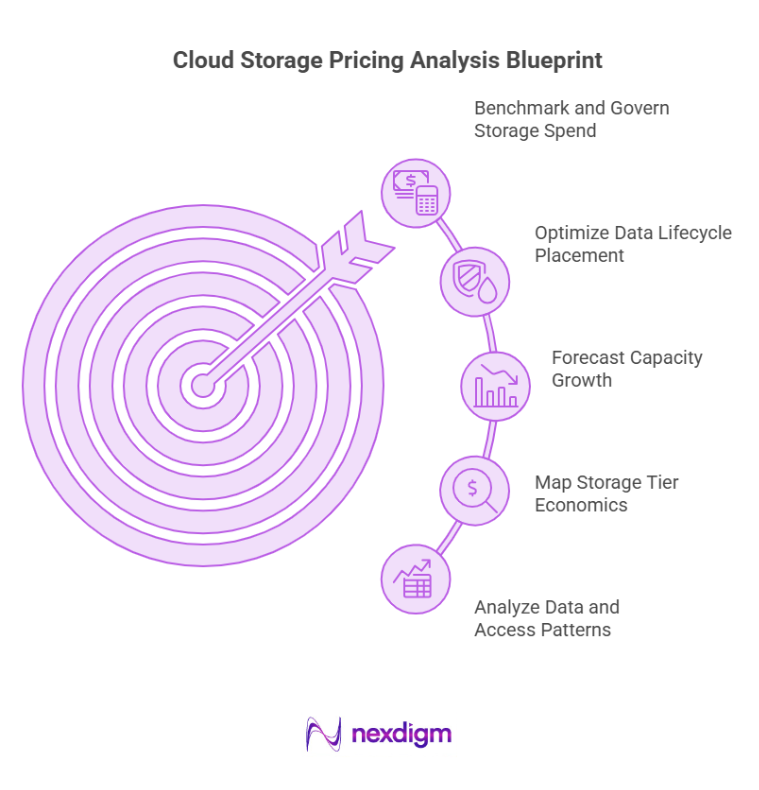
- Analyze Data and Access Patterns: Classify data by volume, growth rate, access frequency, retention period, and performance requirements to establish appropriate storage economics across enterprise workloads.
- Map Storage Tier Economics: Compare hot, cool, infrequent access, archive, and specialty tiers across capacity, retrieval, transaction, and transfer charges to identify cost-efficient placement options.
- Forecast Capacity Growth Requirements: Model expected data expansion, retention requirements, and workload changes to estimate future storage demand and support more accurate budgeting and commitment decisions.
- Optimize Data Lifecycle Placement: Define rules for moving data between storage tiers as access patterns change, reducing long-term costs while maintaining required availability and retrieval performance.
- Benchmark and Govern Storage Spend: Track provider pricing, cost per terabyte, retrieval expenses, capacity utilization, and commitment performance to continuously identify savings and maintain storage-cost discipline.
Nexdigm’s Case
Nexdigm supported a global enterprise in optimizing cloud storage tiers and capacity allocation across growing data workloads. The engagement identified opportunities for 24% lower storage costs, 18% higher capacity utilization, and 14% lower retrieval expenses, improving scalability, budget predictability, and long-term storage economics.
To take the next step, simply visit our Request a Consultation page and share your requirements with us.
Harsh Mittal
+91-8422857704