

Cold chain logistics pricing benchmarking helps pharmaceutical and food networks compare storage, transport, handling, compliance, and temperature-control costs across markets and service providers. Cold chain logistics pricing benchmarking combines pricing analysis with lane economics, refrigeration expenses, energy usage, spoilage risk, regulatory requirements, facility costs, and service-level benchmarks to support stronger commercial decisions.
By identifying cost gaps, premium service drivers, regional rate variations, and margin pressures, businesses can refine pricing structures, strengthen cost recovery, improve contract negotiations, and support profitable growth across temperature-sensitive supply chains with greater transparency and consistency globally.
Recent study shows an optimized perishable supply-chain model reduced average total costs by 20% and lowered average critical selling prices by 18%, demonstrating how data-led pricing analysis can improve cost efficiency, pricing competitiveness, and commercial sustainability across temperature-sensitive logistics networks.
Cold Chain Pricing Benchmarking for Storage and Transport Economics
Cold chain pricing intelligence integrates storage costs, refrigerated transport economics, compliance requirements, and service benchmarks to strengthen pricing decisions, improve cost recovery, protect margins, and support sustainable temperature-controlled operations. Steps followed for the structured process are:
- Map Temperature-Controlled Cost: Energy usage, refrigeration, specialized packaging, monitoring systems, labor, and facility expenses are separated to reveal the true cost base supporting cold chain pricing decisions.
- Benchmark Storage Temperature: Ambient, chilled, frozen, and ultra-low-temperature storage rates are compared across markets, helping businesses identify appropriate premiums for increasingly complex temperature-control requirements.
- Measure Refrigerated Transport Premiums: Vehicle refrigeration, fuel consumption, route duration, equipment utilization, and temperature stability are evaluated to determine transport premiums that accurately reflect cold chain operating intensity.
- Price Compliance and Risk Exposure: Validation, documentation, temperature monitoring, product integrity, spoilage exposure, and regulatory requirements are converted into pricing inputs, improving recovery of quality-assurance and compliance-related costs.
- Calibrate Service-Level Pricing: Delivery windows, temperature tolerances, monitoring frequency, emergency response, and handling requirements are matched with differentiated rates, helping businesses monetize higher-value cold chain service commitments.
Nexdigm’s Guidance for Temperature-Controlled Pricing Decisions
Nexdigm provides strategic guidance for temperature-controlled pricing decisions through pricing analysis, cold chain logistics pricing benchmarking, refrigerated transport pricing, cold storage cost analysis, and compliance cost assessment. By evaluating energy costs, temperature requirements, route economics, spoilage exposure, capacity, and service levels, Nexdigm helps businesses optimize cold chain rates, improve cost recovery, protect margins, strengthen pricing governance, and support sustainable pharma and food logistics operations.
Nexdigm’s Adaptive Pricing Model for Cold-Chain Logistics Networks
Nexdigm’s adaptive pricing model combines cost, demand, compliance, capacity, and service-value frameworks to help refrigerated logistics providers recalibrate rates, protect margins, and respond effectively to changing cold-chain economics. Major frameworks used in the pricing model to drive sustainable growth are:
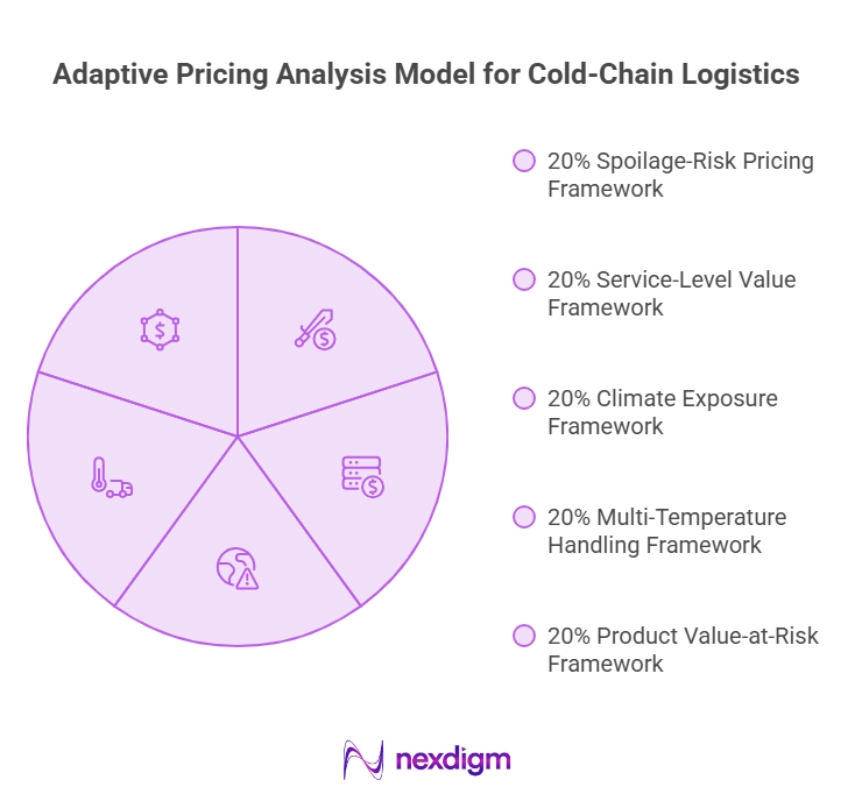
- Spoilage-Risk Pricing Framework: Product value, shelf life, temperature tolerance, excursion probability, and recovery costs are incorporated into rates to account for financial exposure associated with cold-chain failures.
- Service-Level Value Framework: Guaranteed delivery windows, continuous monitoring, emergency intervention, specialized handling, and temperature assurance are linked with differentiated premiums based on customer service expectations and risk sensitivity.
- Climate Exposure Framework: External temperatures, humidity, seasonal extremes, and route climate conditions are assessed to identify corridors requiring higher refrigeration intensity and stronger risk-adjusted pricing.
- Multi-Temperature Handling Framework: Shipments requiring frozen, chilled, and ambient zones within one movement are evaluated for added segregation, monitoring, and handling complexity, supporting differentiated bundled pricing.
- Product Value-at-Risk Framework: Shipment value, perishability, replacement cost, and temperature sensitivity are combined to determine pricing premiums proportional to financial exposure during refrigerated storage and transport.
With Nexdigm’s adaptive pricing model, businesses and refrigerated logistics providers can align rates with cost, capacity, compliance, risk, and service complexity, supporting stronger margins, responsive pricing decisions, and sustainable cold-chain growth.
Nexdigm’s Case
Nexdigm supported a refrigerated logistics provider with adaptive pricing, cold-chain benchmarking, and cost-to-serve analysis. The initiative improved reefer utilization by 14%, increased route margins by 9%, and reduced temperature-related cost leakage by 12%, strengthening profitability, pricing discipline, and network resilience.
To take the next step, simply visit our Request a Consultation page and share your requirements with us.
Harsh Mittal
+91-8422857704