

Cold chain providers must balance stringent quality standards, regulatory compliance, temperature-control requirements, specialized infrastructure, and service reliability while maintaining profitable operations. Cold chain pricing strategy consulting helps businesses evaluate cost-to-serve, storage conditions, transportation complexity, energy consumption, and customer requirements to develop sustainable pricing models.
With the help of pricing analysis, providers can identify margin leakage, assess contract profitability, refine surcharges, and differentiate pricing by service level, temperature range, and handling complexity. A data-driven pricing strategy enables cold chain operators to support reliable service delivery across complex pharmaceutical, food, and healthcare supply chains.
Industry estimates suggest cold chain logistics costs can be 2–5 times higher than standard logistics, depending on handling and temperature requirements. Effective Pricing Analysis Services help providers quantify these cost premiums, optimize rates, improve cost recovery, and strengthen margins across specialized services.
Cold Chain Pricing Analysis for Compliance, Quality, and Profitability
Cold chain pricing analysis helps providers align pricing with temperature-control requirements, regulatory obligations, and service reliability while improving margins and supporting sustainable growth. Some important characteristics of the same are:
- Temperature-Sensitive Cost Management: Pricing analysis accounts for refrigeration expenses, energy consumption, temperature ranges, and specialized handling requirements to establish pricing structures that accurately reflect operating costs.
- Regulatory Compliance Integration: Compliance costs related to food safety, pharmaceutical regulations, certifications, and quality audits are incorporated into pricing decisions to ensure sustainable cost recovery.
- Risk and Spoilage Cost Evaluation: Potential losses from spoilage, product damage, compliance failures, and temperature deviations are factored into pricing strategies to protect profitability.
- Customer and Product Segmentation: Customers and products are segmented according to handling complexity, regulatory requirements, service levels, and profitability to enable targeted and differentiated pricing strategies.
How Nexdigm Supports Smarter Cold Chain Pricing and Margin Optimization
Nexdigm helps cold chain providers strengthen profitability through pricing analysis services, cost-to-serve analysis, and pricing optimization strategies that improve cost recovery, operational efficiency, and commercial decision-making. Such an approach helps businesses with:
- Improved cost visibility through comprehensive pricing analysis and cost-to-serve assessments
- Stronger margin protection with data-driven pricing optimization consulting
- Better recovery of refrigeration, storage, and transportation expenses
- Enhanced contract profitability through customer and product segmentation
- Optimized pricing across temperature-controlled services and delivery models
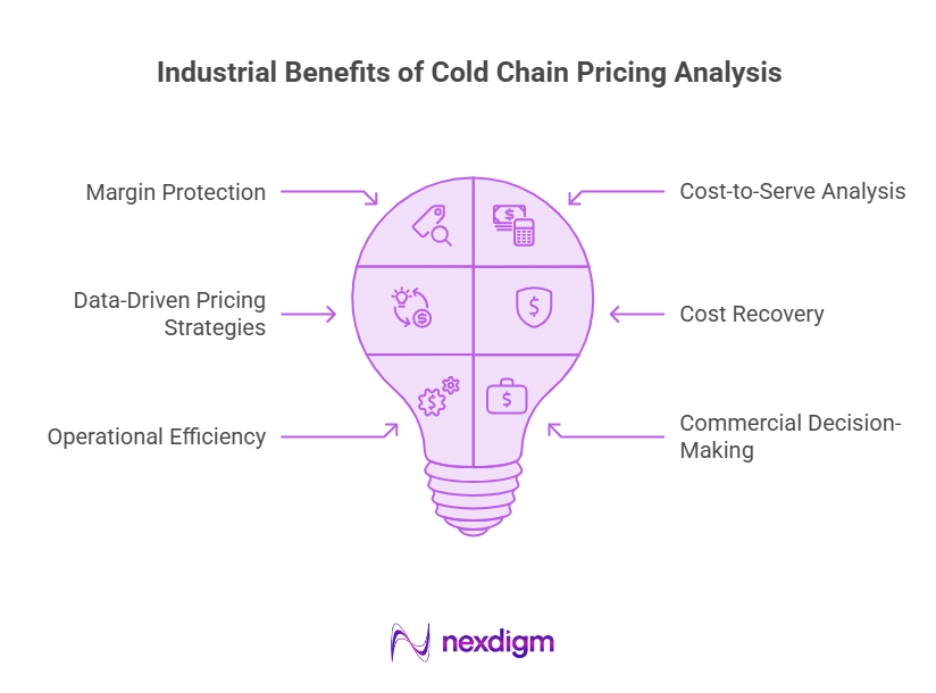
By combining data-driven pricing analysis services with cold chain cost insights, Nexdigm helps businesses strengthen pricing accuracy, protect margins, improve cost recovery, and build more sustainable, competitive operations.
Nexdigm’s Cold Chain Pricing Architecture for Cost Recovery and Margin Growth
Nexdigm’s cold chain pricing model helps providers evaluate cost drivers, service complexity, customer economics, and operational risks through structured steps that strengthen cost recovery and sustainable margin growth. Strategic steps of the architecture model are:
- Establish Service Metrics: Quantify the economics of storage, transport, handling, monitoring, and specialized services to determine the true profitability of each cold chain offering.
- Assess Risk and Compliance Premiums: Evaluate regulatory obligations, product sensitivity, spoilage exposure, and temperature-control risks to determine where additional pricing premiums or safeguards are commercially justified.
- Evaluate Capacity and Asset Utilization: Analyze refrigerated warehouse space, fleet utilization, equipment intensity, and demand patterns to improve pricing around scarce capacity and capital-intensive operating resources.
- Align Pricing with Customer Value: Assess reliability expectations, product criticality, turnaround requirements, and service differentiation to structure pricing around customer value rather than cost considerations alone.
- Strengthen Pricing Governance: Introduce review cycles, approval thresholds, escalation mechanisms, and profitability tracking to improve pricing consistency, prevent leakage, and support disciplined margin management.
Nexdigm’s Case
Nexdigm supported a cold chain provider with pricing and service economics analysis across temperature-controlled operations. The initiative identified opportunities for 10–14% margin improvement, 9% stronger cost recovery, and 7% better asset utilization, strengthening overall commercial performance.
To take the next step, simply visit our Request a Consultation page and share your requirements with us.
Harsh Mittal
+91-8422857704