

Delivery markets increasingly reward speed, but faster fulfilment also raises labor, routing, inventory, and capacity costs. An effective delivery service demand pricing strategy combines pricing analysis with customer urgency, delivery windows, order density, service reliability, competitor rates, and willingness to pay. By measuring demand across standard, same-day, and express options, businesses can set justified premiums, guide customers toward suitable services, improve capacity utilization, and protect margins. This approach supports responsive pricing, stronger conversion, reliable fulfilment, and scalable delivery operations across high-demand urban and regional markets during volatile peak demand periods.
A recent same-day delivery study using realistic operating scenarios found that dynamic pricing increased revenue by more than 5% and reduced missed deliveries by up to 40%, demonstrating stronger demand management, service reliability, and commercial performance across time-sensitive fulfilment networks.
Delivery Demand Strategic Pricing Analysis for Fulfillment Premiums
Delivery demand pricing analysis connects customer urgency, fulfilment speed, capacity constraints, and operating costs to establish justified premiums, improve service selection, protect margins, and strengthen delivery network performance sustainably overall. Major strategies of delivery demand pricing are:
- Delivery Window Pricing Strategy: Pricing analysis assesses same-day, scheduled, and flexible delivery windows receive differentiated rates, helping businesses recover scheduling complexity while directing price-sensitive customers toward operationally efficient fulfilment choices.
- Peak Demand Adjustment Strategy: Prices respond to seasonal surges, promotional events, limited driver availability, and network congestion, help businesses manage demand pressure while maintaining reliable delivery capacity and service quality.
- Order Density Pricing Strategy: Analysis of delivery rates reflects order concentration, stop frequency, route overlap, and consolidation potential, allowing dense service areas to receive competitive pricing without weakening network-level profitability.
- Performance-Linked Premium Strategy: Speed-based charges are connected to on-time delivery, order accuracy, visibility, and service recovery, ensuring customers receive measurable value from premium fulfilment commitments and pricing.
Nexdigm’s Strategic Guidance for Premium Delivery Pricing Analysis
Nexdigm delivers strategic advisory services for premium delivery rate optimization by combining pricing analysis, pricing intelligence, demand forecasting, customer segmentation, and logistics cost benchmarking. Through the assessment of fulfilment speed, customer urgency, route economics, capacity utilization, and competitive pricing, Nexdigm enables businesses to refine premium pricing strategies, strengthen margin management, improve service differentiation, maximize revenue opportunities, and develop sustainable same-day and express delivery models.
Nexdigm’s Integrated Architecture for Premium Delivery Pricing Analysis
Nexdigm’s integrated architecture combines customer demand, fulfilment speed, pricing analysis, and operational capabilities to create premium delivery strategies. Strategic steps of the integrated model, improving competitiveness and positioning are:
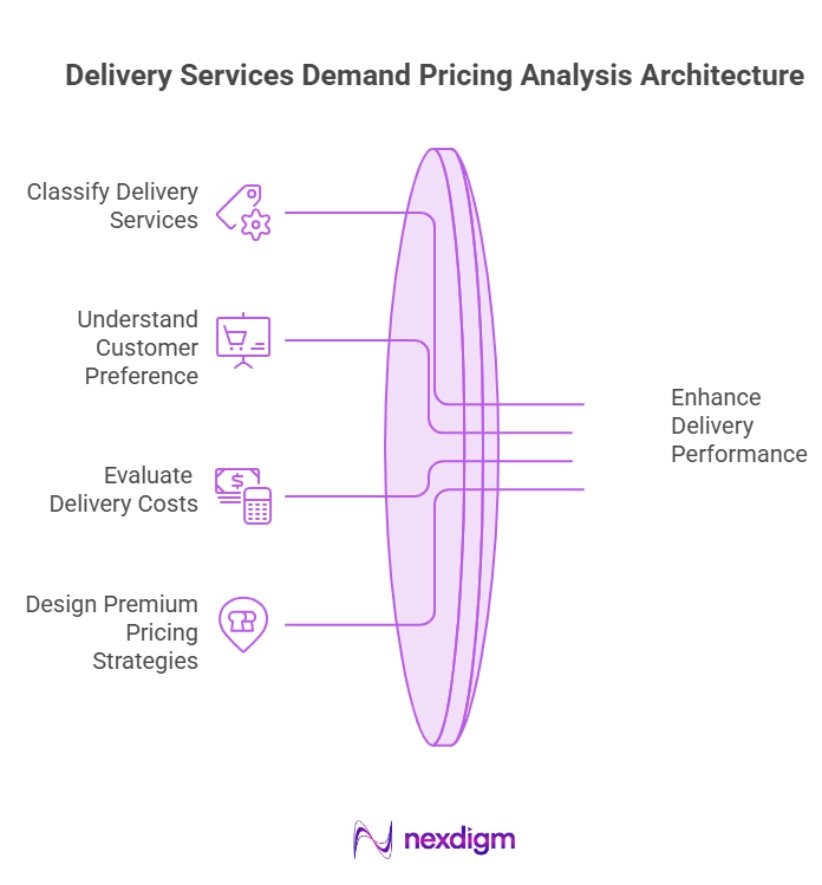
- Classify Delivery Services: Nexdigm categorizes standard, same-day, express, and priority services based on delivery speed, customer expectations, and fulfilment commitments, creating a structured foundation for premium pricing decisions.
- Understand Customer Preference and Trends: Customer segments are analyzed according to urgency, order frequency, service preferences, and willingness to pay, helping businesses identify opportunities for speed-based delivery premiums.
- Evaluate Delivery Costs: Fulfilment expenses, route complexity, labor requirements, and capacity constraints are assessed to ensure premium prices accurately reflect the cost of faster deliveries.
- Design Premium Pricing Strategies: Different pricing models, delivery windows, and service-level premiums are developed to balance customer demand, market conditions, and profitability objectives across delivery networks.
- Monitor and Enhance Performance: Revenue, delivery volumes, customer feedback, and operational efficiency are continuously monitored, enabling businesses to refine premium pricing strategies and strengthen commercial performance over time.
Nexdigm’s Case
Nexdigm supported a delivery service provider in refining premium pricing, service tiers, and capacity allocation. The initiative increased profit by 3%, enabled 10% of next-day orders to arrive early, and strengthened demand management, customer choice, and fulfilment efficiency across markets.
To take the next step, simply visit our Request a Consultation page and share your requirements with us.
Harsh Mittal
+91-8422857704