

Financial services willingness to pay analysis helps banks, lenders, insurers, and investment firms understand how customers value products, features, fees, interest rates, and service experiences. Through Pricing Analysis Services, financial institutions can evaluate price sensitivity, customer preferences, perceived value, competitive positioning, and demand patterns across diverse market segments. Techniques such as customer segmentation, conjoint analysis, price elasticity modeling, competitive pricing analysis, and profitability assessment support informed pricing decisions.
These insights enable organizations to design value-based pricing strategies, optimize product portfolios, improve customer acquisition and retention, protect margins, and align financial service offerings with evolving customer expectations and market conditions effectively.
Nexdigm’s Pricing Analysis Services helped a financial institution refine product fees using willingness-to-pay insights, resulting in 14% higher customer adoption, 12% revenue growth, 10% margin improvement, and 13% stronger retention across priority banking segments.
Pricing Analysis for Customer Willingness to Pay Across Banking and Financial Services
Pricing Analysis Services help financial institutions measure customer willingness to pay, evaluate perceived value, optimize fees, and develop competitive pricing strategies that strengthen adoption, profitability, retention, and market positioning.
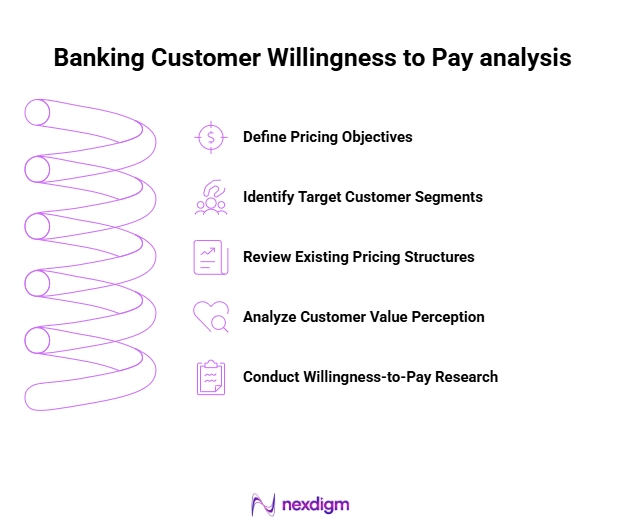
Steps in Customer Willingness-to-Pay Pricing Analysis
- Define Pricing Objectives: Establish clear goals for revenue growth, customer acquisition, product adoption, margin protection, and retention to guide willingness-to-pay research across banking and financial service offerings.
- Identify Target Customer Segments: Segment customers by demographics, income, behavior, product usage, risk profile, digital engagement, and financial needs to identify meaningful differences in price sensitivity and value perception.
- Review Existing Pricing Structures: Assess current fees, interest rates, commissions, service charges, discounts, and product bundles to identify pricing inconsistencies, customer concerns, and opportunities for value-based optimization.
- Analyze Customer Value Perception: Determine which product features, service benefits, convenience factors, advisory support, and digital capabilities customers value most when evaluating banking and financial service prices.
- Conduct Willingness-to-Pay Research: Use surveys, interviews, conjoint analysis, price testing, and customer feedback to estimate acceptable price ranges and understand purchasing responses across different financial products.
Nexdigm’s Role in Optimizing Banking and Financial Services Pricing
Nexdigm’s Pricing Analysis Services support banks and financial institutions in optimizing fees, interest rates, commissions, and service charges. Through financial services willingness-to-pay analysis, customer segmentation, price elasticity modeling, competitive pricing analysis, profitability assessment, and value-based pricing, Nexdigm helps organizations improve product adoption, strengthen market positioning, protect margins, enhance customer retention, and build sustainable, data-driven pricing strategies across portfolios.
Nexdigm’s Strategic Blueprint for Financial Services Willingness-to-Pay Analysis
Nexdigm’s Pricing Analysis Services provide a structured blueprint for evaluating customer willingness to pay, optimizing financial product pricing, strengthening value propositions, improving profitability, and supporting sustainable portfolio growth.
Steps in Financial Services Willingness-to-Pay Analysis
- Define Strategic Pricing Objectives: Establish measurable goals for revenue, profitability, adoption, retention, and competitive positioning to guide willingness-to-pay analysis across financial products and customer segments.
- Identify Priority Products and Services: Select banking, lending, insurance, investment, and payment offerings requiring pricing evaluation based on performance, market pressure, customer feedback, and strategic importance.
- Segment Target Customers: Group customers by income, behavior, needs, product usage, risk profile, digital engagement, and relationship value to identify distinct willingness-to-pay patterns.
- Assess Customer Value Perception: Evaluate how customers perceive product features, convenience, advisory support, service quality, digital capabilities, security, and financial outcomes when considering price.
- Conduct Willingness-to-Pay Research: Apply surveys, interviews, conjoint analysis, price testing, and behavioral research to estimate acceptable price ranges and customer preferences across targeted segments.
Nexdigm’s Case
Nexdigm’s Pricing Analysis Services applied willingness-to-pay research to refine financial product fees, delivering 16% higher adoption, 13% revenue growth, 11% margin improvement, and 14% stronger customer retention across priority segments while strengthening competitive positioning.
To take the next step, simply visit our Request a Consultation page and share your requirements with us.
Harsh Mittal
+91-8422857704