

Launching a food and beverage product into a new market can be an exciting growth opportunity, but success depends on much more than product quality or brand ambition. Even the most innovative offerings can struggle if the market lacks sufficient demand, pricing acceptance, or distribution readiness. Before committing resources, businesses must determine whether the market is truly prepared to embrace their product.
This is where food and beverage market feasibility study consulting plays a crucial role. At Nexdigm, the deep industry expertise provided by professionals help food and beverage companies assess market readiness through comprehensive evaluations of demand, competition, pricing dynamics, and commercial viability, enabling informed and confident market-entry decisions.
Market Readiness Is More Than Consumer Interest
Many businesses assume that a growing F&B category automatically represents a viable opportunity. However, actual market readiness is influenced by a combination of factors that extend beyond consumer curiosity. At Nexdigm, our feasibility assessments focus on four essential pillars:
- Demand Potential
- Competitive Landscape
- Pricing Acceptability
- Commercial Viability
Only when these elements align can a business move forward with confidence and a clear path to profitability.
Is the Market Ready for Your F&B Offering?
Before entering any market, organizations must answer a fundamental question: Can the product generate sustainable demand and profitable growth within the target market? The answer requires a structured assessment rather than assumptions. Through food and beverage market feasibility study consulting services, Nexdigm helps businesses evaluate:
- Whether sufficient customer demand exists
- How competitive the category has become
- Which pricing strategy is most effective
- Whether the business model is commercially viable
These insights help reduce market-entry risks while improving investment outcomes.
Understanding Demand Before Making the Move
Demand is often the first indicator of market readiness, but evaluating demand requires more than reviewing population statistics. Looking beyond basic demographics, a successful market entry requires an understanding of:
- Consumption habits
- Purchase frequency
- Consumer preferences
- Lifestyle shifts
- Health and wellness trends
- Category adoption rates
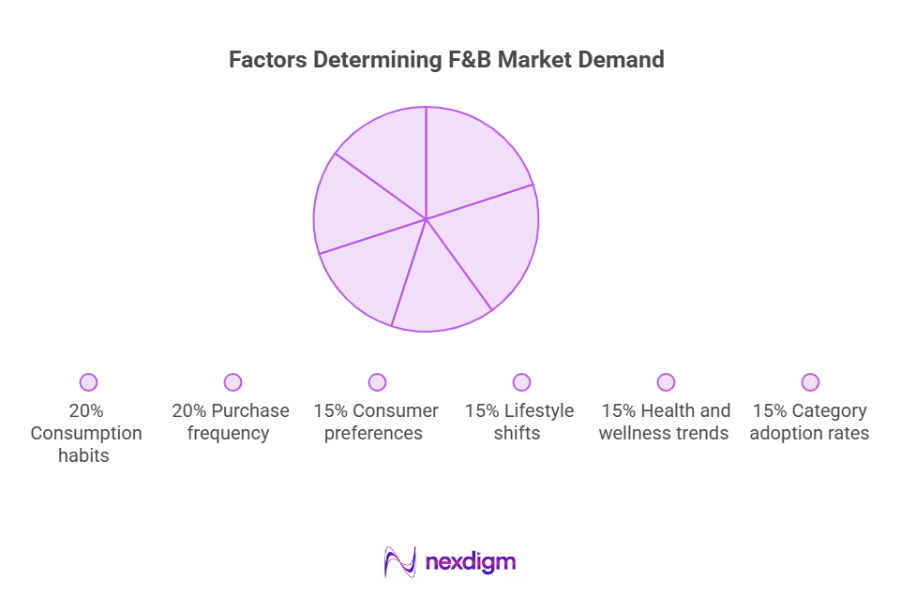
For example, a functional beverage or premium snack may perform exceptionally well in one region but struggle in another due to differences in purchasing behavior and consumer priorities.
The Nexdigm Demand Assessment Framework
As part of our food and beverage market feasibility study consulting, Nexdigm evaluates:
- Consumer demand forecasts
- Category growth trajectories
- Regional consumption patterns
- Customer segmentation opportunities
- Emerging food and beverage trends
This enables businesses to identify whether demand is strong enough to justify expansion or market entry.
Evaluating Competition
A high-demand category can still be difficult to penetrate if the competitive environment is overly saturated. Understanding the competitive landscape allows companies to assess market accessibility and identify areas for differentiation.
Key Questions Every F&B Brand Should Ask
- Who are the category leaders?
- How strong is brand loyalty?
- What are competitors charging?
- Which channels dominate sales?
- Are customer needs fully addressed?
Markets with strong demand but limited differentiation opportunities may require significantly higher marketing and distribution investments. At Nexdigm, the Competitive Intelligence approach helps organizations analyze:
- Local and international competitors
- Product portfolio positioning
- Distribution strength
- Market concentration levels
- Unserved customer segments
Through feasibility studies, the experts can identify opportunities where businesses can establish a distinctive and defendable market position.
Pricing: Factor determining Consumer Acceptance
Many market-entry strategies fail because pricing assumptions do not reflect local realities. Consumers may appreciate a product but still refuse to purchase it if the perceived value does not justify the price.
Market Readiness Includes Pricing Readiness
Businesses must determine:
- What customers are willing to pay
- How price-sensitive key segments are
- What competitors are charging
- Which pricing structure supports profitability
A successful price point balances adoption with financial sustainability.
Nexdigm’s Pricing Evaluation Methodology
Nexdigm’s integrated food and beverage market feasibility study consulting framework examines:
- Consumer willingness-to-pay levels
- Category price benchmarks
- Competitive pricing architecture
- Gross margin opportunities
- Promotional effectiveness
These insights help businesses enter markets with pricing strategies that support both demand generation and long-term profitability.
The Commercial Viability Test
Even when demand exists and pricing appears attractive, a business opportunity may still face commercial challenges. Commercial viability determines whether a market can realistically support sustainable operations and growth.
How Nexdigm Evaluates Commercial Viability
At Nexdigm. The specialists evaluate whether a business opportunity can deliver sustainable growth, competitive advantage, and long-term profitability under real-world market conditions. The assessment combines the following areas to provide a comprehensive view of market potential and investment feasibility:
- Route-to-market effectiveness
- Distribution economics
- Operating cost structures
- Revenue projections
- Investment requirements
- Risk exposure
This integrated approach ensures organizations understand not only market opportunities but also their ability to capture them successfully.
Turning Feasibility Insights into Market Success with Nexdigm
A feasibility study should not simply answer whether a market looks attractive. It should provide a clear roadmap for action. At Nexdigm, we help clients use feasibility insights to:
- Prioritize high-potential markets: Identify markets with strong demand, favorable economics, manageable competition, and growth prospects to maximize expansion success potential.
- Refine product positioning: Align product offerings with customer needs, market expectations, competitive gaps, and brand strengths to enhance differentiation.
- Optimize pricing strategies: Develop pricing approaches that balance customer affordability, competitive positioning, perceived value, and long-term profitability objectives.
- Strengthen distribution plans: Evaluate channel effectiveness, partner capabilities, market reach, and logistics requirements to improve product availability and sales.
- Improve investment decisions: Support informed capital allocation through financial analysis, risk assessment, market evaluation, and return-on-investment forecasting methodologies.
This ensures that businesses are not only entering the right market but entering it with the right strategy.
Nexdigm’s Case
In a recent engagement, Nexdigm supported an F&B client in evaluating market readiness through demand, competition, pricing, and commercial viability. Real-time insights improved demand validation by 32%, sharpened competitor mapping by 27%, optimized pricing by 23%, and increased launch confidence by 40%.
Nexdigm’s structured F&B market assessment approach enabled the client to validate commercial potential, refine pricing and positioning, and make confident market-entry decisions backed by actionable intelligence.
To take the next step, simply visit our Request a Consultation page and share your requirements with us.
Harsh Mittal
+91-8422857704