

Trade data is widely used in a data-driven business environment to evaluate market opportunities, monitor industry performance, and guide strategic decisions. Most analyses focus on numbers such as trade value, shipment volume, and growth rates. While these indicators provide valuable insight, they often reveal only a short part of the story.
To gain a deeper understanding of market dynamics, businesses must look beyond and analyze the broader insights hidden within Import Export Statistics. When interpreted, trade statistics can uncover supply chain shifts, competitive movements, emerging demand patterns, and long-term market opportunities.
The Growing Importance of Trade Numbers
Trade value, volume, and growth rates provide an insight of market activity, but they do not explain the factors driving those changes. A rise in imports, for example, may indicate growing demand, changing sourcing strategies, price fluctuations, or a combination of these factors. Analyzing Import Export Statistics in greater detail allows businesses to understand not only changes, but also why those changes occurred and what they may indicate for the future.
Looking Beyond the Trade Numbers
Effective trade analysis involves assessing multiple dimensions of trade data rather than relying on the numbers. While trade value, volume, and growth rates provide an overview of market activity, they often fail to explain the factors driving these changes. A deeper analysis of Import Export Statistics can reveal:
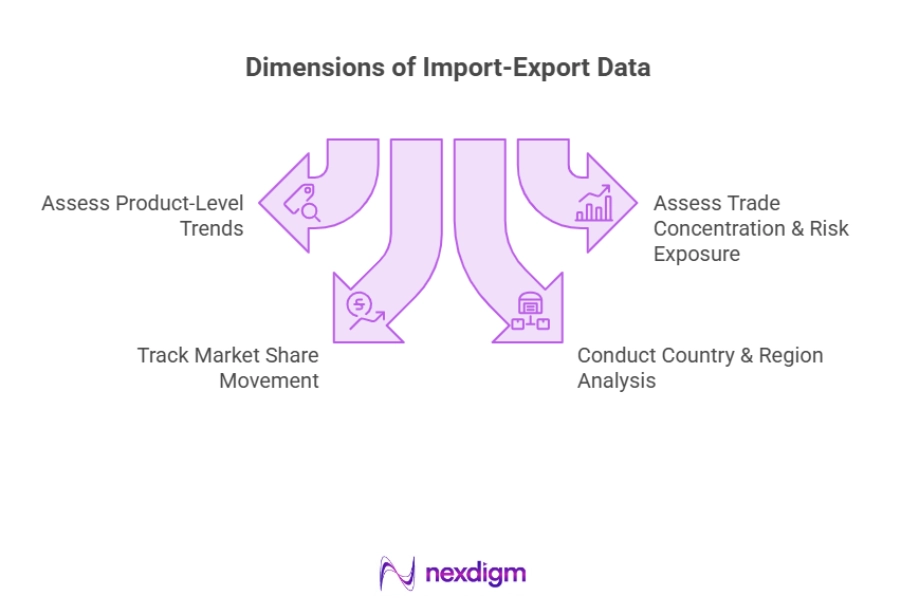
- Product-Level Trends: Analyzing trade data by product categories can reveal which sectors are gaining momentum, and which are experiencing slower growth. Product-level analysis helps businesses identify evolving demand patterns and emerging opportunities within larger markets.
- Country and Region Analysis: Trade statistics can highlight changing trade relationships between countries and regions. Understanding where imports and where exports are headed can provide insights into market expansion, sourcing diversification, and competitive positioning.
- Market Share Movement: Changes in trade volumes often influence market share distribution among countries, industries, and suppliers. Tracking these shifts helps businesses assess competitive dynamics within a market.
What Import-Export Statistics Reveal About Trade Concentration
One of the important aspects of Import Export Statistics is trade concentration. It refers to the extent to which a country’s or company’s trade is dependent on a limited number of suppliers, products, or markets. Analyzing trade concentration helps organizations understand and identify opportunities for diversification within their trade industry. Here, businesses should assess:
- Dependence on specific suppliers
- Reliance on limited export markets
- Geographic diversification of trade activities
- Exposure to regional risks and disruptions
A highly concentrated trade structure may increase vulnerability to regulatory changes, geopolitical events, or supply chain disruptions.
How Industries Leverage Import-Export Statistics for Strategic Planning
Organizations across industries use Import Export Statistics not just to track trade activity, but to make informed strategic decisions. Businesses can better understand market direction, anticipate industry shifts, identify emerging opportunities, and strengthen their competitive position with its help. When combined with market intelligence, trade statistics become a powerful tool for multiple industries in the following way:
- Manufacturing: Monitor sourcing trends, supplier networks, production shifts, and emerging manufacturing hubs to enhance operational efficiency.
- Retail and Consumer Goods: Evaluate product demand patterns, optimize inventory planning, and identify opportunities aligned with evolving consumer preferences.
- Logistics and Supply Chain: Forecast shipment volumes, analyze trade flow patterns, and improve transportation and resource allocation strategies.
- Financial and Investment Firms: Assess market attractiveness, evaluate industry performance, and identify high-growth sectors for investment opportunities.
- Government and Trade Bodies: Support policy development, monitor trade competitiveness, and assess economic and industry-level trade trends.
Nexdigm Approach in Deriving Insights from Import-Export Statistics
Nexdigm’s experts help organizations analyze trade statistics to uncover meaningful business insights. Through advanced analytics, market intelligence, and customized research solutions, businesses can leverage this data to better understand market dynamics and competitive positioning. Nexdigm’s trade intelligence capabilities help organizations:
- Identify emerging growth opportunities
- Evaluate competitive landscapes
- Assess supply chain risks and dependencies
- Support strategic planning and expansion decisions
- Understand changing trade relationships and global trade flows
- Support investment decisions through data-backed insights
- Benchmark trade performance against industry peers
Why Businesses Choose Nexdigm for Trade Intelligence
With a combination of deep industry expertise, latest research methodologies, and data-driven analysis, Nexdigm helps businesses move beyond trade numbers to uncover actionable insights. By translating complex Import Export Statistics into clear strategic recommendations, Nexdigm enables organizations to make informed decisions, mitigate risks, identify growth opportunities, and navigate evolving global markets with greater confidence.
Nexdigm’s Case
Nexdigm supported an industrial company by examining trade data beyond headline value, volume, and growth metrics. Analysis of shipment frequency, supplier concentration, unit prices, and sourcing patterns revealed a 17% demand increase, 13% procurement savings, and 9% market-share growth, enabling sharper competitor assessment, pricing decisions, and expansion planning.
To take the next step, simply visit our Request a Consultation page and share your requirements with us.
Harsh Mittal
+91-8422857704