

Comparing enterprise IT hardware requires more than reviewing headline prices because processor specifications, storage capacity, memory, warranties, service levels, and channel discounts can materially change total acquisition costs. IT hardware pricing analysis provides structured visibility into these differences by benchmarking equivalent configurations across vendors and procurement channels.
Applying pricing analysis services helps businesses identify pricing gaps, evaluate supplier competitiveness, understand cost drivers, and select configurations aligned with operational requirements and budgets. Combined with hardware cost benchmarking, vendor quote analysis, specification normalization, procurement pricing intelligence, and lifecycle cost research, this approach strengthens sourcing accuracy, negotiation leverage, and expenditure control.
Configuration normalization can reveal 10%–20% price gaps between apparently similar hardware offers once specifications, warranties, and service terms are aligned. Pricing Analysis Services help expose these differences, improve vendor comparisons, reduce overpayment risk, and strengthen enterprise sourcing decisions.
IT Hardware Pricing Benchmarking for Supplier Selection and Spend Control
IT hardware pricing benchmarking helps enterprises compare suppliers, normalize specifications, assess commercial terms, and understand lifecycle economics to improve sourcing accuracy, control expenditure, and select hardware configurations offering stronger value. Its key characteristics that contribute to sustainable business growth include:
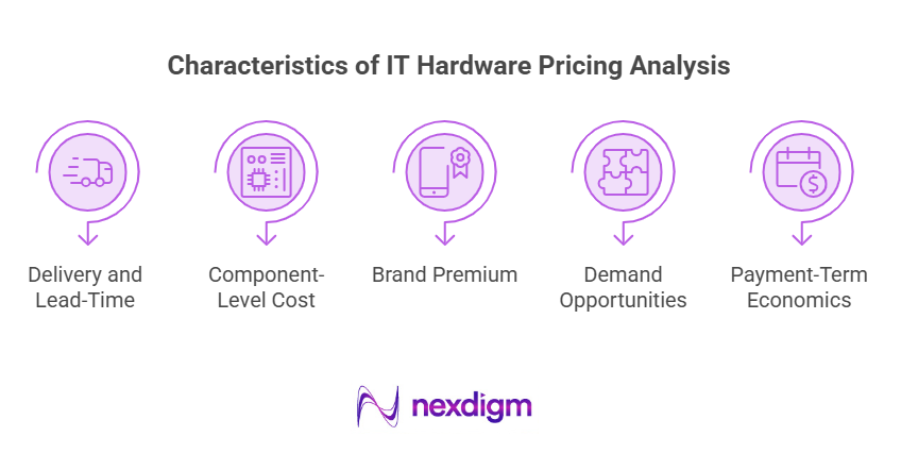
- Delivery and Lead-Time Evaluation: Assess supplier lead times, expedited delivery charges, inventory availability, and deployment schedules to understand how fulfillment conditions affect total procurement cost and project continuity.
- Component-Level Cost Assessment: Break hardware pricing into processors, memory, storage, graphics, networking, and peripherals to identify which components contribute most significantly to configuration cost differences.
- Brand Premium Assessment: Measure whether higher-priced brands deliver sufficient value through performance, reliability, support, warranty coverage, or lifecycle benefits to justify additional procurement expenditure.
- Identifying Demand Opportunities: Combine requirements across departments, locations, or projects to improve volume leverage, reduce fragmented purchases, and secure stronger enterprise-level supplier pricing.
- Payment-Term Economics: Compare upfront payments, credit periods, installment structures, and financing costs to determine how supplier payment conditions influence cash flow and total acquisition economics.
How Nexdigm Supports IT Hardware Pricing and Supplier Selection
Nexdigm helps enterprises strengthen hardware procurement through data-driven pricing analysis services focused on supplier economics, configurations, and total acquisition costs. Supporting IT hardware pricing analysis, hardware price benchmarking, supplier pricing intelligence, configuration cost analysis, procurement pricing research, vendor cost benchmarking, lifecycle cost analysis, and hardware spend optimization, Nexdigm supports better supplier selection, negotiation leverage, cost control, and technology investment decisions.
Nexdigm’s Strategic Planning Model for IT Hardware Pricing Analysis and Benchmarking
Nexdigm’s strategic sourcing model combines hardware pricing benchmarks, supplier economics, configuration analysis, and lifecycle costs to help businesses improve procurement decisions, cost control, and sourcing value across diverse sectors. The model can be applied across various industries to address sector-specific requirements in the following ways:
- Healthcare and Life Sciences: Healthcare organizations can compare device, workstation, server, and storage pricing to optimize clinical technology procurement while balancing performance, reliability, and compliance requirements.
- Manufacturing and Industrial Operations: Manufacturers can benchmark plant hardware, edge devices, servers, and networking equipment to control capital expenditure and improve sourcing across production facilities.
- Retail and Consumer Businesses: Retailers can compare POS systems, handheld devices, networking equipment, and store infrastructure costs to support standardized procurement across expanding branch networks.
- Telecommunications: Telecom companies can evaluate networking hardware, servers, storage, and edge infrastructure across suppliers to improve deployment economics and strengthen large-scale procurement negotiations.
Nexdigm’s Case
Nexdigm supported a multi-location enterprise in benchmarking hardware configurations and supplier economics across major procurement categories. The engagement identified 16% lower sourcing costs, 14% improved configuration value, and 11% stronger supplier discounts, improving budget control, procurement consistency, and technology investment efficiency.
To take the next step, simply visit our Request a Consultation page and share your requirements with us.
Harsh Mittal
+91-8422857704