

Enterprise technology buyers face complex pricing across software licenses, hardware configurations, cloud solutions, managed services, subscriptions, and support agreements. An IT pricing benchmark study helps organizations compare market rates, contract structures, discounts, and service costs across vendors and buyer segments.
Through pricing analysis services, businesses can identify pricing gaps, assess cost competitiveness and optimize technology procurement decisions. Supported by IT pricing analysis, organizations gain clearer visibility into prevailing market prices, enabling more informed budgeting, improved commercial terms, stronger cost control, and greater value realization across enterprise technology investments.
Worldwide IT spending is forecast to exceed $6.3 trillion in 2026, while IT services alone are expected to surpass $1.87 trillion. Thus, pricing Analysis Services help enterprise buyers benchmark substantial technology expenditures, compare vendor costs, strengthen negotiations, and improve procurement value across complex IT portfolios.
IT Pricing Benchmark Analysis for Smarter Enterprise Technology Spending
IT pricing benchmark analysis gives enterprise buyers clearer visibility into market rates, vendor economics, contract terms, and technology costs, supporting stronger negotiations, informed budgeting, and improved procurement value. It also has various key aspects to be taken care of during the process, these are:
- Software Licensing Cost Benchmarks: Compare license fees, subscription tiers, user-based pricing, renewal costs, and enterprise agreements to determine whether software expenditures remain aligned with prevailing market benchmarks.
- Hardware Configuration Price Comparisons: Evaluate servers, storage, networking equipment, endpoints, and infrastructure configurations against comparable market prices to identify cost variances and improve technology purchasing decisions.
- IT Services Rate Benchmarking: Benchmark consulting, implementation, managed services, maintenance, and support rates across vendors to assess commercial competitiveness and negotiate more appropriate service pricing.
- Vendor Discount and Incentive Analysis: Review enterprise discounts, rebates, volume incentives, credits, and promotional terms to determine whether negotiated concessions reflect purchasing scale and broader market practices.
How Nexdigm Supports Smarter IT Pricing Benchmarking and Procurement Decisions
Nexdigm helps enterprises optimize technology spending through data-driven pricing analysis services, combining IT pricing benchmarking, vendor cost analysis, contract assessment, and procurement intelligence to strengthen commercial decisions and maximize value. This helps businesses in the following ways:
- Improve Vendor Negotiations: Pricing analysis services provide visibility into industry pricing standards, discount structures, and commercial terms, enabling enterprises to negotiate stronger contracts and procurement agreements.
- Optimize Technology Procurement Budgets: By evaluating pricing trends, licensing models, and total ownership costs, businesses can allocate budgets more efficiently and improve spending discipline.
- Strengthen Contract and Renewal Decisions: Contract benchmarking and pricing intelligence help organizations assess renewal clauses, service commitments, and escalation mechanisms to reduce long-term financial exposure.
Nexdigm’s IT Pricing Intelligence Roadmap for Smarter Technology Procurement
Nexdigm’s IT pricing intelligence roadmap combines spend diagnostics, demand validation, commercial modeling, supplier intelligence, and governance to help enterprises improve procurement efficiency, cost control, and technology investment value. The structured steps of the roadmap model are:
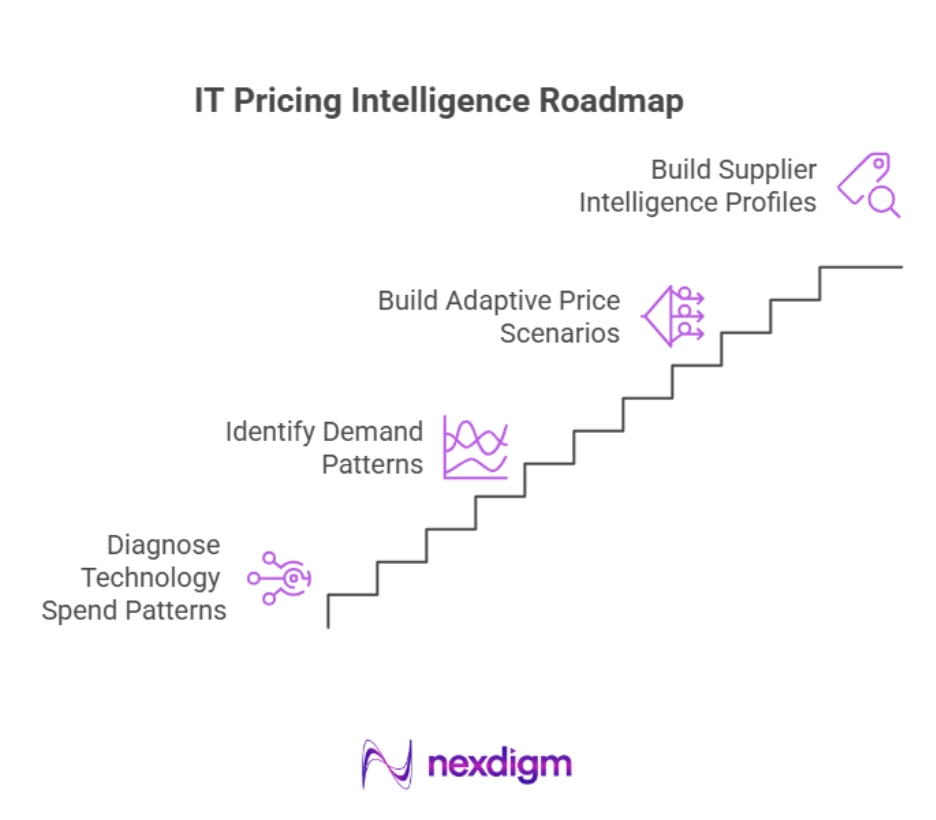
- Diagnose Technology Spend Patterns: Analyze historical purchases, category spend, vendor concentration, utilization, and cost trends to uncover fragmented buying patterns and prioritize technology categories requiring deeper pricing intervention.
- Validate Demand and Consumption Needs: Compare purchased capacity, licenses, subscriptions, and services against actual business usage to identify overprovisioning, redundant expenditure, and opportunities for more efficient procurement.
- Model Commercial Buying Scenarios: Evaluate volume commitments, contract duration, consumption forecasts, bundles, and payment structures to determine procurement scenarios offering stronger economics without compromising operational requirements.
- Build Supplier Intelligence Profiles: Assess vendor positioning, pricing behavior, service capabilities, switching considerations, and competitive alternatives to strengthen supplier selection and support more informed sourcing decisions.
Nexdigm’s Case
Nexdigm supported an enterprise buyer with IT pricing benchmarking across software, hardware, and services. The engagement identified opportunities for 12% procurement savings, 9% lower renewal costs, and 15% stronger vendor discounts, improving cost transparency, negotiation leverage, and technology investment value.
To take the next step, simply visit our Request a Consultation page and share your requirements with us.
Harsh Mittal
+91-8422857704