

Enterprise IT buying cycles can extend across technical evaluations, procurement reviews, commercial negotiations, legal approvals, and executive decisions, creating substantial pricing complexity. IT software pricing intelligence provides structured insights into vendor rates, licensing models, discounts, and renewal economics throughout the purchasing process.
By applying pricing analysis services, businesses can benchmark proposals, identify negotiation headroom, compare total ownership costs, and assess commercial competitiveness before commitments are finalized. Supported by enterprise software pricing analysis, this approach improves decision quality and technology investment outcomes.
During multi-stage software buying cycles, negotiated pricing can shift by 10%–20% between initial and final proposals depending on scope, volume, and contract terms. Pricing Analysis Services help track these movements and strengthen commercial decision-making throughout procurement.
Pricing Analysis for Software Buying Cycles and Vendor Economics
Software pricing analysis helps enterprises evaluate vendor proposals, contract structures, negotiation stages, and total ownership economics to improve purchasing decisions, cost transparency, commercial leverage, and long-term technology investment value. Key strategies helping businesses in driving sustainable growth are:
- Total Cost Evaluation Strategy: Assesses licensing, implementation, integration, support, renewal escalation, and switching costs together to determine the complete economic impact of competing vendor proposals.
- Buying-Stage Pricing Strategy: Tracks price movements across evaluation, negotiation, legal review, and approval stages to identify when enterprises have stronger leverage for securing commercial concessions.
- Vendor Shortlisting Strategy: Compares pricing, functional coverage, implementation requirements, support models, and commercial flexibility early to eliminate weak-fit vendors before entering resource-intensive negotiation stages.
- Stakeholder Value Alignment Strategy: Connects pricing decisions with IT, finance, procurement, legal, and business priorities to ensure selected vendors deliver acceptable economics across enterprise stakeholder requirements.
Nexdigm’s Pricing Intelligence Expertise for Software Sourcing and Negotiation
Nexdigm supports software sourcing and negotiation through data-driven pricing analysis services, helping enterprises evaluate vendor proposals, benchmark commercial terms, and strengthen purchasing decisions. Combining IT software pricing intelligence, software pricing analysis, vendor price benchmarking, contract pricing analysis, software cost benchmarking, procurement pricing intelligence, and competitive pricing analysis, Nexdigm helps improve negotiation leverage, cost transparency, vendor selection, and long-term commercial value.
Nexdigm’s IT Software Pricing Decision Architecture for Vendor Economics
Nexdigm’s IT software pricing architecture combines pricing intelligence, vendor benchmarks, contract economics, and commercial evaluation to help businesses improve sourcing decisions, negotiation leverage, cost control, and long-term technology value. It’s important features contributing to business profit and valuable growth are:
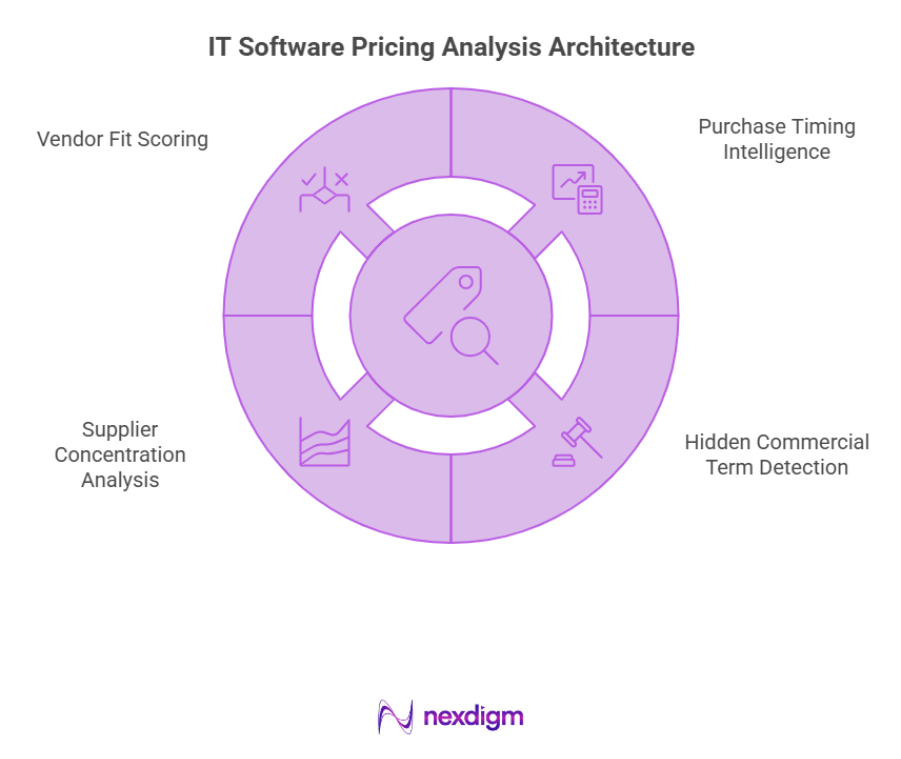
- Vendor Fit Scoring: Evaluates cost, functionality, service quality, implementation capability, flexibility, and strategic alignment to help businesses prioritize vendors offering stronger overall economic value.
- Supplier Concentration Analysis: Evaluates technology spend across strategic vendors to identify excessive concentration and determine where competitive sourcing could improve commercial leverage and procurement resilience.
- Purchase Timing Intelligence: Examines renewal schedules, budget cycles, vendor fiscal periods, and competitive bidding windows to identify sourcing moments that may provide stronger negotiating leverage.
- Hidden Commercial Term Detection: Surfaces non-obvious fees, usage restrictions, support conditions, overage charges, and renewal obligations that can materially alter the economics of competing software agreements.
Nexdigm’s Case
Nexdigm supported an enterprise software sourcing initiative by comparing vendor economics and commercial terms. The engagement delivered 22% faster vendor evaluation, 16% greater pricing transparency, and 12% lower total ownership exposure, improving procurement efficiency, commercial confidence, and sourcing outcomes.
To take the next step, simply visit our Request a Consultation page and share your requirements with us.
Harsh Mittal
+91-8422857704