

Logistics providers must understand how rate changes influence shipment demand, customer retention, service selection, and capacity utilization across freight and delivery markets. Logistics price elasticity analysis combines pricing analysis with historical volumes, customer segments, lane characteristics, service levels, competitor rates, and economic conditions.
By measuring demand responsiveness at different price points, businesses can forecast revenue impact, identify profitable thresholds, and manage peak capacity. This approach strengthens commercial planning, protects margins and supports responsive freight and delivery strategies across changing market conditions and customer expectations.
A logistics company improved customer service levels by 9% and reduced logistics costs as a share of sales by 1.8 percentage points. The results show how stronger forecasting and pricing analysis support capacity planning, cost control, and sustainable profitability.
Pricing Analysis Planning for Freight and Delivery Demand Forecasting
Pricing intelligence combines demand signals, customer behavior, market rates, and capacity data to help freight and delivery providers forecast volumes, improve pricing decisions, and protect revenue across complex service networks. Key aspects of the analysis are:
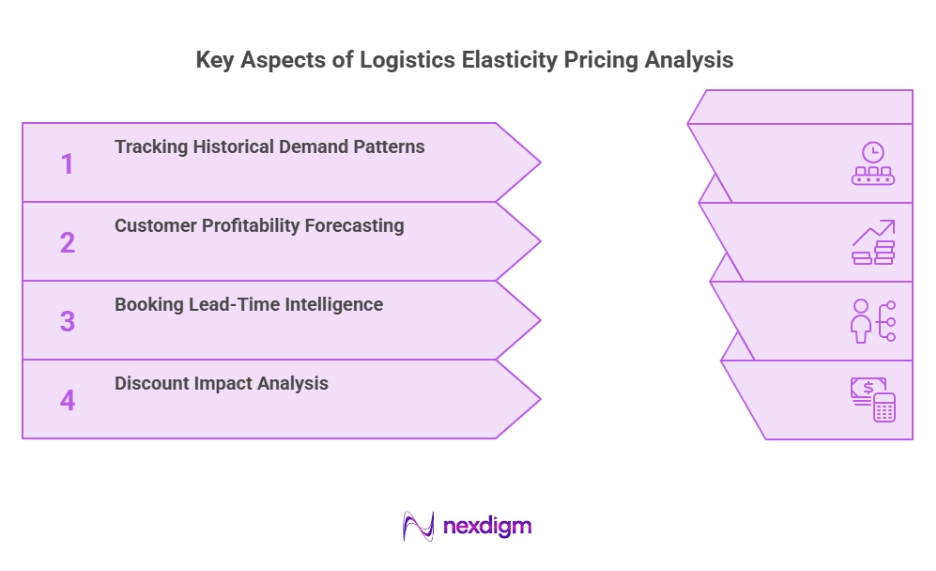
- Tracking Historical Demand Patterns: Historical shipment volumes, booking patterns, cancellations, and seasonal movements are analyzed to establish reliable demand baselines across freight lanes, delivery zones, customer groups, and service categories.
- Customer Profitability Forecasting: Future demand projections are combined with cost-to-serve and margin analysis, enabling businesses to prioritize customers and services that generate sustainable profitability.
- Booking Lead-Time Intelligence: Booking windows, order frequency, and advance reservation trends are examined to forecast demand patterns and optimize pricing decisions across freight and delivery operations.
- Discount Impact Analysis: Temporary discounts, promotional offers, and incentive programs are assessed to determine their effect on shipment volumes, customer retention, and overall revenue performance.
Nexdigm’s Advisory Support for Logistics Demand Pricing Analysis
Nexdigm supports logistics demand sensitivity analysis through pricing analysis, elasticity modeling, demand forecasting, customer segmentation, and scenario testing, helping businesses to grow and improve their positioning in the competitive market, in the following ways:
- Identify customer price sensitivity
- Forecast demand after rate changes
- Protect freight and delivery margins
- Improve logistics pricing strategies
- Support profitable price thresholds
Through pricing intelligence, Nexdigm helps businesses balance demand, rates, capacity, and profitability through data-driven logistics price elasticity analysis.
Nexdigm’s Integrated Architecture for Demand-Based Logistics Pricing Analysis
Nexdigm’s integrated architecture combines pricing analysis, customer behavior, capacity economics, and market intelligence to create responsive logistics pricing that improves revenue, margins, utilization, and commercial resilience. Key steps of the architecture model are:
- Review Demand Patterns: Nexdigm examines shipment volumes, seasonal peaks, customer orders, and service usage to understand where demand changes and which logistics services require pricing adjustments.
- Group Customers by Needs: Customers are grouped by shipment size, frequency, delivery speed, and price sensitivity, helping businesses create practical pricing options for different service and demand requirements.
- Test Pricing Changes: Different rates, discounts, and surcharges are tested to estimate how customers may change booking volumes, service choices, and purchasing decisions across logistics offerings.
- Match Prices with Capacity: Forecast demand is compared with fleet, warehouse, and carrier availability, helping businesses adjust prices when capacity is limited, underused, or affected by seasonal pressure.
- Track Results and Refine: Actual bookings, revenue, margins, and customer responses are monitored after pricing changes, enabling businesses to improve future rates and maintain demand, capacity, and profitability.
Nexdigm’s Case
Nexdigm supported a logistics provider with demand-based pricing, customer segmentation, and forecasting analytics. The initiative reduced forecast error by 25%, lowered excess capacity exposure by 40%, and improved service levels, strengthening revenue planning, pricing accuracy, and operational responsiveness.
To take the next step, simply visit our Request a Consultation page and share your requirements with us.
Harsh Mittal
+91-8422857704