

Logistics businesses operating in volatile markets require continuous visibility into freight and delivery of pricing movements. Logistics price monitoring analytics combines pricing analysis, market benchmarking, competitor tracking, cost-to-serve assessment, and demand intelligence to monitor rate fluctuations across routes, carriers, and service categories.
By analyzing historical trends, capacity shifts, fuel costs, and customer demand patterns, businesses can identify pricing anomalies, optimize commercial decisions, protect margins, and improve procurement strategies. This data-driven approach strengthens pricing governance and enables organizations to respond proactively to changing logistics and transportation market conditions.
A study shows that a transport operator implemented logistics price monitoring analytics to track market changes, which reduced transportation costs by 13.12% and vehicle requirements by 11.27%, while improving pricing responsiveness, highlighting positive impact of pricing analysis.
Pricing Analysis Strategy for Real-Time Freight and Delivery Rate Monitoring
Real-time pricing analysis tracks freight and delivery rate movements across routes, providers, and services, enabling faster commercial responses, stronger cost control, improved negotiations, and sustainable margin protection in dynamic markets. Core benefits of the same are:
- Stronger Margin Protection: Real-time pricing analysis identifies cost increases, underpriced routes, and unrecovered surcharges, helping businesses revise customer rates promptly and prevent avoidable margin leakage across transportation services.
- Earlier Rate Spike Detection: Pricing analysis identifies sharp carrier increases, delivery premiums, and surcharge changes early, allowing businesses to respond before temporary market movements become embedded in commercial pricing.
- Stronger Budget Control: Current rate data improves transport budgets and cost forecasts, reducing unexpected variances and helping finance teams plan expenditure more accurately across freight and delivery operations.
- More Consistent Customer Quotes: Live market and cost inputs support standardized quotation processes, reducing rate differences between sales teams, regions, and customer segments while maintaining appropriate commercial flexibility.
Nexdigm’s Data-Led Expertise in Logistics Price Monitoring Analytics
Nexdigm delivers data-led expertise in logistics price monitoring analytics by integrating real-time pricing analysis, freight rate tracking, delivery price benchmarking, competitor pricing intelligence, and cost-to-serve analysis. By monitoring market movements, carrier rates, surcharges, capacity shifts, and route economics, Nexdigm helps businesses improve pricing accuracy, protect margins, strengthen negotiations, optimize transport costs, and make responsive commercial decisions across dynamic logistics markets.
Nexdigm’s Strategic Blueprint for Real-Time Logistics Pricing Analysis
Nexdigm’s strategic blueprint combines live rate data, market signals, cost intelligence, and pricing controls to improve freight decisions, strengthen negotiations, and respond quickly across dynamic logistics markets. Key strategic steps followed within the model are:
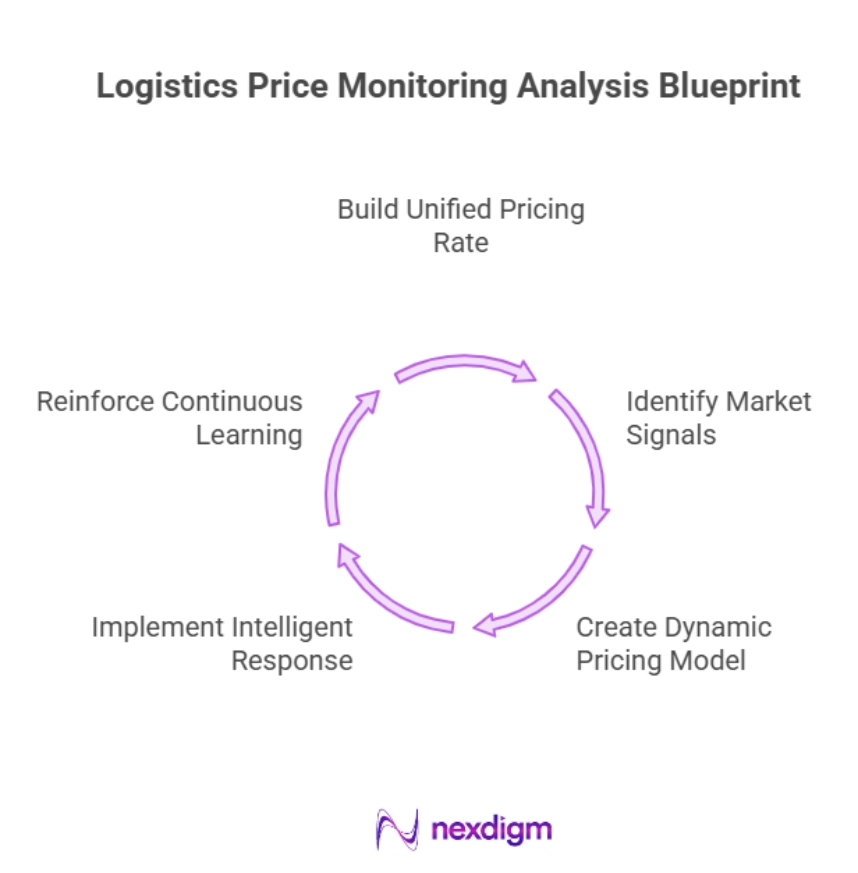
- Build a Unified Pricing Rate: Carrier rates, spot prices, fuel indexes, surcharges, and delivery charges are integrated into a centralized platform, creating a single source of truth for logistics price monitoring analytics.
- Identify Real-Time Market Signals: Capacity utilization, demand fluctuations, route congestion, competitor pricing, and operational disruptions are analyzed continuously to uncover pricing shifts and emerging commercial opportunities across markets.
- Create Dynamic Pricing Model: Acceptable price ranges are established using route economics, service commitments, customer sensitivity, and market benchmarks, enabling faster decisions without compromising profitability or competitiveness.
- Intelligent Response Mechanisms: Automated triggers flag abnormal price movements, margin erosion, and contract deviations, helping commercial teams initiate negotiations, revise quotations, and optimize pricing actions immediately.
- Reinforce Continuous Learning: Pricing outcomes, customer responses, route profitability, and market changes are tracked regularly, enabling businesses to refine pricing strategies and strengthen long-term logistics performance.
Nexdigm’s Case
Nexdigm supported a delivery network with real-time rate monitoring, dynamic pricing, and location-based incentives. The initiative reduced costs by 19.9%, outperformed static pricing by 7%, and improved customer choice, operational efficiency, margin visibility, and delivery network responsiveness across markets.
To take the next step, simply visit our Request a Consultation page and share your requirements with us.
Harsh Mittal
+91-8422857704