

Logistics pricing benchmarking consulting helps providers evaluate whether transportation, warehousing, and distribution rates remain competitive and profitable across diverse markets. Logistics pricing benchmarking consulting combines pricing analysis with competitor benchmarking, cost-to-serve assessment, lane economics, freight pricing intelligence, surcharge structures, customer segmentation, and demand patterns to establish commercially sustainable rate strategies.
By analyzing route profitability, capacity utilization, operating costs, and regional pricing variations, businesses can optimize price structures, strengthen margin protection, improve quotation accuracy, and support long-term growth in increasingly competitive logistics networks worldwide while enabling data-driven decisions across logistics ecosystems.
Recent study reveals that coordinated freight pricing and benchmarking delivered approximately 10% procurement savings versus status-quo methods in a major digital freight marketplace, highlighting how data-led rate comparisons can improve sourcing efficiency, strengthen pricing decisions, and support more profitable logistics operations.
Pricing Analysis for Logistics Cost, Competition, and Revenue Alignment
Pricing analysis connects operating costs, competitor benchmarks, customer value, and revenue targets to build balanced logistics rates, strengthen profitability, improve market positioning, and support commercially sustainable pricing decisions across various networks. The structured process takes place through the following steps:
- Map Network Cost Drivers: Route complexity, fuel consumption, labor intensity, and asset utilization are evaluated to understand their impact on logistics pricing structures.
- Benchmark Service and Rate Performance: Competitor rates, delivery capabilities, service quality, and market trends are compared to establishing competitive pricing positions.
- Prioritize High-Value Revenue Segments: Customer profitability, shipment volumes, and service requirements are assessed to focus pricing efforts on the most attractive segments.
- Develop Adaptive Pricing Models: Cost fluctuations, market shifts, and demand changes are incorporated into pricing strategies to improve commercial responsiveness.
- Strengthen Pricing Governance: Performance metrics, approval controls, and profitability reviews are implemented to maintain alignment between costs, competition, and revenue goals.
How Nexdigm Supports Competitive and Profitable Logistics Pricing Analysis
Nexdigm combines pricing analysis, logistics pricing benchmarking consulting, cost intelligence, and market insights to help businesses optimize rates, strengthen competitiveness, improve profitability, and align pricing with revenue objectives. Strategic initiatives of Nexdigm helping businesses grow rapidly are:
- Improve logistics margin protection
- Strengthen competitive rate positioning
- Enhance route and customer profitability
- Increase quotation accuracy and speed
- Reduce pricing inconsistencies and leakage
- Improve cost recovery across services
By combining pricing analysis with benchmarking intelligence and commercial insights, Nexdigm helps logistics providers establish competitive and profitable pricing structures that support long-term growth and stronger financial performance.
Nexdigm’s Strategic Model for Logistics Pricing Benchmarking and Analysis
Nexdigm’s strategic model connects operating costs, customer value, market benchmarks, and revenue priorities to strengthen margin control, and support sustainable commercial performance across logistics networks. Major strategies used to drive growth and profitability are:
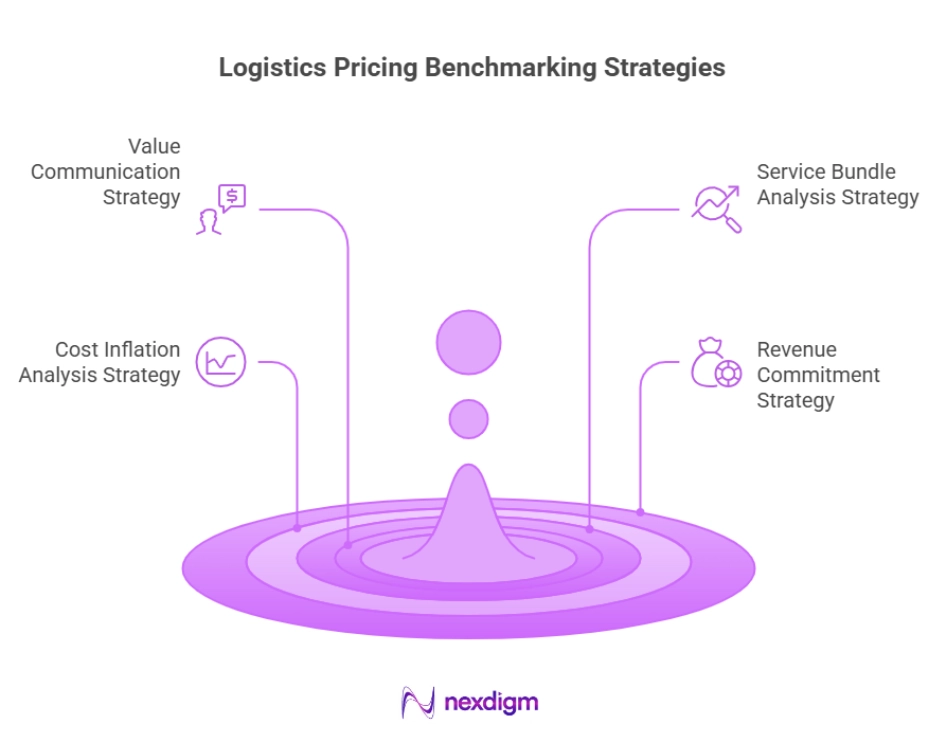
- Cost Inflation Analysis Strategy: Changes in wages, fuel, utilities, maintenance, and supplier charges are monitored and translated into structured pricing adjustments to prevent gradual margin compression.
- Value Communication Strategy: Customer-facing pricing narratives connect rates with reliability, speed, visibility, flexibility, and service quality, helping commercial teams justify premiums and reduce price-based negotiation pressure.
- Service Bundle Analysis Strategy: Freight, warehousing, customs, fulfillment, tracking, and delivery services are bundled based on customer needs, creating stronger revenue opportunities and improving account-level commercial value.
- Revenue Commitment Strategy: Contracted customers receive differentiated rates against minimum shipment or revenue commitments, improving demand predictability while protecting network utilization and financial returns.
Nexdigm’s Case
Nexdigm supported a logistics provider with cost-to-serve analysis, rate benchmarking, and revenue alignment. The initiative improved realized pricing by 8%, reduced revenue leakage by 11%, and increased contribution margins by 7%, strengthening pricing discipline, commercial visibility, and sustainable network profitability.
To take the next step, simply visit our Request a Consultation page and share your requirements with us.
Harsh Mittal
+91-8422857704