

Logistics rate comparison research helps businesses evaluate freight, warehousing, fulfilment, and delivery charges in markets characterized by frequent capacity shortages and volatile operating costs. Combining logistics rate comparison research with pricing analysis, competitive benchmarking and market intelligence enables organizations to identify pricing gaps and optimize commercial decisions.
By comparing rates across services, routes, providers, and regions, businesses can strengthen negotiations, improve pricing governance, protect margins, and respond effectively to fluctuations in fuel prices, labor costs, demand patterns, and transportation capacity constraints.
A recent study shows that freight-pricing simulation using Uber Freight data reduced costs by 6%, cut empty miles by 25%, and more than halved unmatched loads. The results demonstrate how dynamic pricing analysis can improve logistics profitability overall.
Pricing Analysis for Logistics Rate Volatility Across Services and Capacity Cycles
Pricing analysis tracks rate movements across freight, warehousing, fulfilment, and delivery services, helping businesses respond to capacity cycles, control costs, protect margins, and maintain competitive commercial decisions more consistently. Key steps of the analytical process are:
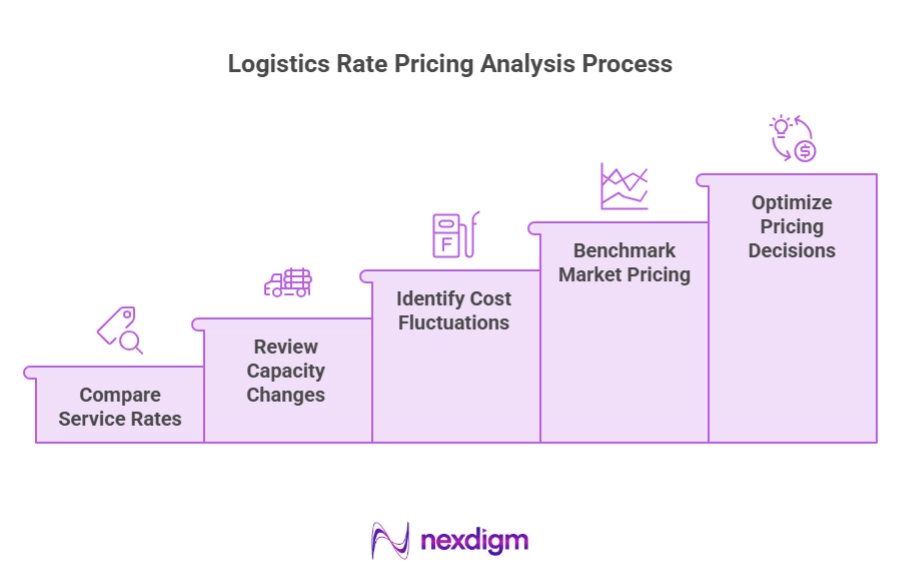
- Compare Service Rates: Freight, warehousing, fulfilment, and delivery charges are compared across providers, regions, and service categories to establish a baseline for logistics pricing analysis and rate volatility assessment.
- Review Capacity Changes: Vehicle availability, warehouse occupancy, labor supply, and shipment demand are monitored to understand how capacity cycles influence logistics rates and pricing decisions.
- Identify Cost Fluctuations: Fuel prices, handling expenses, labor costs, toll charges, and operating overheads are evaluated to determine the factors driving logistics rate changes.
- Benchmark Market Pricing: Current rates are benchmarked against competitors, historical prices, and market averages to identify pricing gaps, negotiation opportunities, and commercially viable alternatives.
- Optimize Pricing Decisions: Insights from logistics rate comparison and pricing analysis are used to refine procurement strategies, strengthen negotiations, protect margins, and improve commercial performance.
Nexdigm’s Data-Led Advisory for Logistics Pricing and Rate Comparison
Nexdigm delivers data-led logistics cost benchmarking through pricing analysis, logistics rate comparison research, competitor benchmarking, cost-to-serve assessment, and pricing intelligence. By evaluating freight, warehousing, fulfilment, and delivery expenses across markets, the advisory helps businesses identify pricing gaps, strengthen pricing optimization, improve procurement decisions, protect margins, and enhance commercial performance amid changing capacity and cost conditions across complex global supply networks.
Nexdigm’s Strategic Blueprint for Logistics Pricing and Rate Benchmarking
Nexdigm’s strategic blueprint integrates market rates, service costs, capacity trends, and operational data to benchmark logistics expenses, identify pricing gaps and improve commercial decision-making across networks. Key strategies of the blueprint model are:
- Cost Driver Analysis Strategy: Fuel, labor, handling, utilities, technology, tolls, and compliance expenses are mapped by service, helping businesses understand the operational factors behind logistics rate differences.
- Market Benchmarking Strategy: Current logistics rates are compared with competitor prices, historical trends, regional averages, and market indices to identify overpricing, underpricing, and commercially reasonable pricing ranges.
- Total Logistics Estimation Strategy: Freight, storage, fulfilment, delivery, surcharges, and support costs are consolidated to create a complete spending view and reveal opportunities for enterprise-wide cost improvement.
- Geographic Cost Comparison Strategy: Logistics costs are compared across cities, regions, trade lanes, and warehouse clusters to identify location-based differences and support more efficient network decisions.
Nexdigm’s Case
Nexdigm supported a logistics operator with data-led dispatch planning, cost benchmarking, and capacity analysis. The initiative reduced transportation costs by 13.12%, lowered vehicle requirements by 11.27%, and improved resource utilization, service efficiency, and scalable network planning across complex operations.
To take the next step, simply visit our Request a Consultation page and share your requirements with us.
Harsh Mittal
+91-8422857704