

Revenue pricing optimization helps logistics providers improve profitability by aligning rates with customer value, service performance, capacity, and market conditions. A value- based logistics pricing strategy combines pricing analysis with cost-to-serve insights, demand sensitivity, competitive benchmarks, service differentiation, and account profitability.
By identifying underpriced services, refining discount structures, and setting up defensible pricing corridors, businesses can target margin improvement. This approach strengthens revenue quality, supports better negotiations, protects strategic relationships, and enables sustainable growth across freight, warehousing, fulfilment, and delivery operations in volatile markets.
A road-freight operator used data-led pricing optimization to rebalance spots and contract businesses. The approach indicated potential EBIT improvement of 15% to 30%, demonstrating how disciplined rate decisions can strengthen margins, capacity allocation, and commercial performance across volatile markets.
Pricing Analysis for Logistics Revenue Growth and Margin Optimization
Pricing analysis combines service economics, customer value, demand patterns, and market intelligence to help logistics providers expand revenue, protect margins, strengthen commercial discipline, and improve profitability across integrated service portfolios. Some key strategies for logistics revenue growth are:
- Account Profitability Strategy: Customer revenue is assessed against route costs, handling requirements, discounts, and support demands, enabling providers to reprice weak accounts and prioritize relationships delivering sustainable commercial value.
- Service Portfolio Strategy: Freight, warehousing, fulfilment, and delivery offerings are compared by revenue potential, margin contribution, demand growth, and operational complexity to guide profitable service expansion decisions.
- Value-Based Rate Strategy: Rates are aligned with delivery reliability, speed, visibility, flexibility, and business impact, helping providers justify premiums and capture greater value from differentiated logistics capabilities.
- Discount Control Strategy: Volume concessions, promotional offers, contract discounts, and sales exceptions follow defined approval rules, reducing unnecessary price reductions and preventing avoidable margin leakage across customer agreements.
Nexdigm’s Strategic Guidance for Logistics Pricing and Revenue Growth
Nexdigm delivers strategic guidance for logistics pricing and EBIT growth by combining pricing analysis, value based logistics pricing strategy, market benchmarking, cost-to-serve assessment, revenue optimization, and profitability analytics. By evaluating customer segments, service performance, route economics, competitive pricing, and demand patterns, Nexdigm helps businesses improve pricing decisions, strengthen margin protection, optimize revenue streams, increase EBIT, and support sustainable growth across freight, warehousing, fulfilment, and delivery networks.
Nexdigm’s Integrated Logistics Pricing and Revenue Growth Framework
Nexdigm’s integrated framework combines pricing analysis, value-based pricing strategies, cost intelligence, and profitability analytics to strengthen revenue growth, expand EBIT, optimize margins, and improve commercial performance across logistics networks. Major characteristics of the integrated model are:
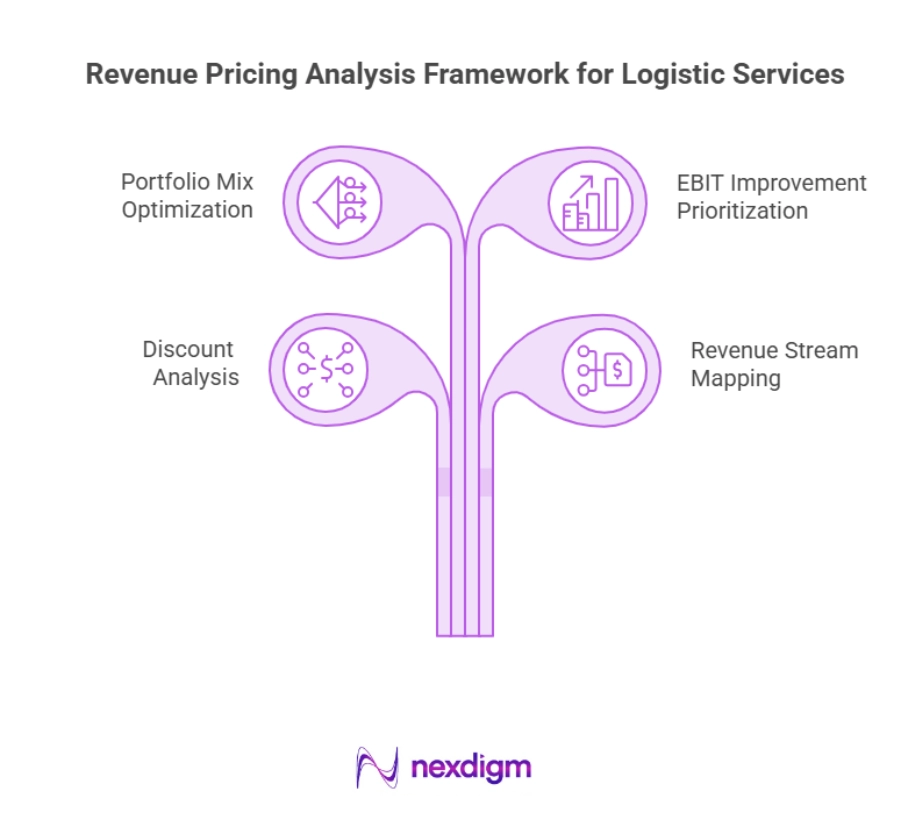
- EBIT Improvement Prioritization: High-impact pricing initiatives are ranked according to expected revenue gains, margin expansion potential, implementation complexity, and operational feasibility to accelerate EBIT growth.
- Revenue Stream Mapping : Revenue sources across freight, warehousing, fulfilment, and delivery operations are mapped and categorized to identify profitable segments, eliminate inefficiencies, and establish priorities for margin expansion.
- Discount Analysis: Historic concessions, promotional rates, and account-specific discounts are examined to remove unsupported reductions, improve price realization, and reduce preventable margin erosion across logistics contracts.
- Portfolio Mix Optimization: Standard, premium, contract, spot, and bundled services are balanced to improve revenue quality, strengthen capacity utilization, and reduce dependence on consistently low-margin logistics activities.
Nexdigm’s Case
Nexdigm supported a logistics provider with pricing governance, account segmentation, and rate optimization. The initiative increased revenue by 2% to 4% and operating profit by 30% to 60%, while strengthening price realization, margin control, commercial discipline, and EBIT growth.
To take the next step, simply visit our Request a Consultation page and share your requirements with us.
Harsh Mittal
+91-8422857704