

Logistics customers value service attributes differently, making uniform pricing less effective across freight and delivery markets. Logistics willingness to pay analysis combines pricing analysis with customer segmentation, service preferences, shipment urgency, tracking expectations, reliability needs, and competitive alternatives.
By measuring the premium customers accept for faster delivery, dependable performance, and real-time visibility, businesses can design differentiated service tiers, validate value-based rates, improve conversion, and protect margins. This approach also supports stronger negotiations and customer-focused logistics strategies across evolving channels, regions, markets, and operating conditions.
A recent logistics pricing study found that pricing transformation can increase revenue by 2% to 4% and improve EBIT margins by 30% to 60%, demonstrating how willingness-to-pay insights strengthen service design, value capture, customer segmentation, and sustainable commercial performance.
Pricing Analysis for Customer Demand for Reliable Logistics Services
Pricing analysis connects demand forecasts, customer behavior, service costs, and available capacity, helping logistics providers balance network resources, protect margins, and respond effectively to market changes. Some important advantages of the same are:
- More Effective Customer Offers: Customer demand patterns and price sensitivity help businesses design targeted discounts, service bundles, and rate structures that encourage bookings without creating unnecessary margin erosion.
- Lower Capacity Waste: Accurate pricing analysis reduces empty vehicles, idle equipment, excess warehouse space, and unnecessary labor costs, improving resource utilization across freight and delivery operations.
- More Effective Discount Management: Pricing analysis helps businesses distinguish customers requiring commercial incentives from those willing to pay for reliability, reducing unnecessary discounting and protecting logistics margins.
- Better Resource Prioritization: Capacity, labor, vehicles, and customer support can be allocated toward services generating stronger demand and commercial value, improving network efficiency and service consistency.
Nexdigm’s Advisory Support for Service-Level Logistics Pricing Analysis
Nexdigm provides advisory support for service-level logistics pricing through pricing analysis, logistics cost benchmarking, cost-to-serve modeling, and pricing intelligence. By evaluating delivery speed, reliability, shipment visibility, customer preferences, route economics, and service commitments, Nexdigm helps businesses optimize logistics pricing strategies, validate premium rates, strengthen contract negotiations, protect margins, improve service differentiation, and build commercially sustainable freight and delivery offerings.
Nexdigm’s Structured Blueprint Model for Logistics Service Pricing Analysis
Nexdigm’s blueprint combines service economics, customer expectations, market benchmarks, and performance data to strengthen competitiveness, cost recovery, profitability, and long-term commercial sustainability. Some important characteristics of the blueprint model are:
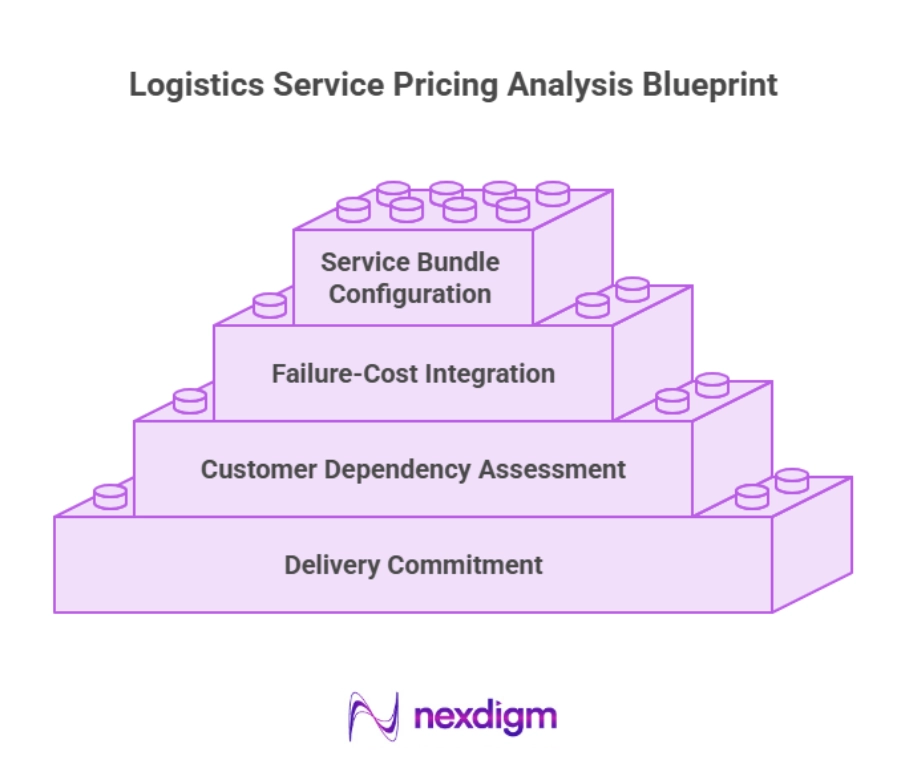
- Delivery Commitment Structuring: Pricing is aligned with cut-off times, delivery windows, guaranteed transit, and recovery obligations, ensuring stronger cost recovery for demanding service-level commitments.
- Customer Dependency Assessment: The framework evaluates how strongly customers depend on logistics continuity, urgent replenishment, and service consistency, helping identify segments with higher willingness to pay.
- Failure-Cost Integration: Redelivery, claims, refunds, support effort, lost sales, and service recovery expenses are included in pricing decisions, revealing the true cost of unreliable logistics performance.
- Service Bundle Configuration: Speed, reliability, visibility, support, and flexibility are combined into distinct service packages, helping customers select suitable options while improving revenue capture across logistics offerings.
Nexdigm’s Case
Nexdigm supported a logistics provider in redesigning service tiers, reliability premiums, and customer-specific rates. The initiative increased revenue by 3%, improved EBIT margins by 35%, and reduced pricing inconsistencies, strengthening service differentiation, contract discipline, and commercial performance.
To take the next step, simply visit our Request a Consultation page and share your requirements with us.
Harsh Mittal
+91-8422857704