

Enterprises operating across multiple cloud providers face complex pricing structures spanning compute, storage, data transfer, managed services, commitments, and usage-based charges. A multi cloud pricing comparison study helps businesses normalize vendor rates, compare workload economics, assess discount structures, and identify cost differences across platforms.
Through pricing analysis services, organizations can evaluate total cloud spend, benchmark provider pricing, improve workload placement, and strengthen negotiation decisions. Supported by cloud pricing analysis and cloud spend optimization, enterprises can improve cost transparency, budget control, sourcing flexibility, and long-term cloud economics.
Recent cloud-finops research commonly shows that organizations can leave 20%–30% of cloud spend inefficiently utilized or avoidable through idle resources, overprovisioning, and weak commitment alignment. Pricing Analysis Services help benchmark vendors, identify cost leakage, optimize workload placement, and strengthen multi-cloud spending decisions.
Multi-Cloud Pricing Analysis for Vendor and Workload Cost Optimization
Multi-cloud pricing analysis helps enterprises compare provider rates, workload economics, usage patterns, commitments, and service costs to improve cloud allocation and long-term financial performance across environments. Its key benefits strengthening cloud cost governance and workload decisions are:
- Lower Cloud Cost Leakage: Analyzing idle resources, overprovisioning, unused capacity, and inefficient configurations helps organizations identify avoidable expenditure and improve overall utilization of cloud budgets.
- Better Data Transfer Economics: Assessing ingress, egress, inter-region, and cross-cloud transfer charges helps businesses understand hidden connectivity costs and optimize architectures with substantial data movement requirements.
- Improved Multi-Cloud Negotiation Leverage: Provider benchmarks, usage patterns, and alternative workload scenarios give procurement teams stronger evidence to negotiate discounts, credits, support terms, and contractual flexibility.
- Greater Budget Predictability: Combining usage forecasts, provider rates, commitment terms, and growth assumptions helps enterprises anticipate future cloud expenditure and reduce unexpected budget variances.
How Nexdigm Helps Optimize Multi-Cloud Pricing and Vendor Decisions
Nexdigm supports enterprises with data-driven pricing analysis services to evaluate cloud provider economics, workload costs, and commercial commitments across complex multi-cloud environments. Combining multi-cloud pricing comparison studies, cloud pricing analysis, vendor cost benchmarking, usage-based pricing analysis, commitment pricing assessment, cloud spend optimization, and competitive pricing intelligence, Nexdigm helps improve cost transparency, workload allocation, negotiation leverage, and long-term cloud value.
Nexdigm’s Multi-Cloud Pricing Intelligence Roadmap for Vendor and Usage Decisions
Nexdigm’s multi-cloud Pricing intelligence roadmap combines strategic steps and provider benchmarks insights to help enterprises strengthen vendor decisions, control spending, and improve long-term cloud value. These steps are:
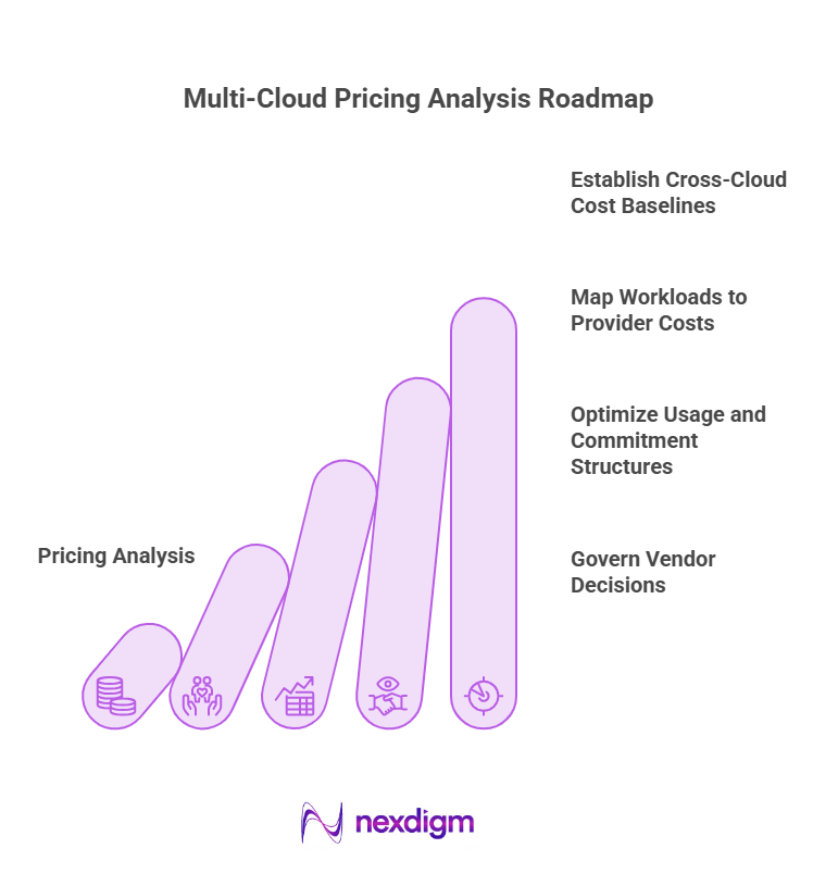
- Establish Cross-Cloud Cost Baselines: Normalize compute, storage, networking, support, and managed-service charges across providers to create comparable cost benchmarks for evaluating multi-cloud workload economics accurately.
- Map Workloads to Provider Costs: Assess workload intensity, regional deployment, performance needs, data movement, and service dependencies to identify cloud providers offering stronger cost-to-value alignment.
- Optimize Usage and Commitment Structures: Compare on-demand rates, reserved capacity, savings plans, committed spend, and utilization patterns to improve discounts while reducing overcommitment and unused capacity.
- Govern Vendor and Spend Decisions: Track provider pricing, workload growth, cost variances, contract terms, and optimization opportunities to continuously refine sourcing decisions and strengthen multi-cloud financial governance.
Nexdigm’s Case
Nexdigm supported an enterprise managing multiple cloud providers by benchmarking workload costs, usage patterns, and commitment structures. The analysis contributed to lower cloud spend, 17% better resource utilization, and 12% stronger commitment savings, improving cost governance and vendor decisions.
To take the next step, simply visit our Request a Consultation page and share your requirements with us.
Harsh Mittal
+91-8422857704