

Infrastructure buyers often face substantial complexity when network vendors package performance, security, management tools, licenses, and support differently across product portfolios. Network equipment pricing strategy helps enterprises standardize these variables and determine whether pricing differences reflect genuine capability, service value, or commercial premiums.
With pricing analysis, organizations can compare suppliers, benchmark equipment configurations, evaluate security feature costs, and identify negotiation opportunities which can help strengthen sourcing accuracy, control capital spending, improve commercial leverage, and select network solutions aligned with operational requirements.
Recent infrastructure cost guidance indicates that maintenance and support contracts can represent around 15%–20% of original hardware purchase prices annually. Pricing Analysis Services help enterprises evaluate these recurring costs alongside acquisition prices, security requirements, and vendor support terms.
Network Infrastructure Pricing Analysis for Performance and Security Value
Network infrastructure pricing analysis helps enterprises compare equipment costs, security capabilities, performance specifications, support structures, and lifecycle economics to improve sourcing decisions and long-term technology value. The following advantages offer valuable opportunities to strengthen overall network value:
- Better Security Investment Alignment: Evaluating firewalls, threat protection, encryption, access controls, and security licenses helps enterprises direct spending toward capabilities that address relevant operational risks.
- Stronger Configuration Optimization: Benchmarking ports, bandwidth, processing capacity, redundancy, and management features helps businesses avoid over configured equipment while maintaining required network performance and scalability.
- Improved Support Value: Compare response times, technical assistance, replacement commitments, and maintenance coverage against support fees to identify service packages delivering appropriate operational value.
- Better Network Standardization: Benchmark equipment across sites and business units to identify opportunities for standardized configurations, reducing procurement complexity, support costs, and infrastructure management requirements.
How Nexdigm Strengthens Network Procurement Through Pricing Analysis
Nexdigm combines network pricing intelligence, configuration benchmarking, vendor economics, security requirements, and lifecycle analysis to help enterprises improve procurement decisions, control infrastructure costs, and maximize long-term technology value, in the following ways:
- Stronger Negotiation Leverage: Market benchmarks, supplier comparisons, and commercial intelligence give procurement teams stronger evidence to challenge vendor premiums, negotiate discounts, and secure better contractual terms.
- Lower Total Ownership Costs: Evaluating maintenance, subscriptions, support renewals, energy consumption, upgrades, and replacement requirements helps businesses control network expenditure throughout the complete infrastructure lifecycle.
- Better Security Investment Decisions: Comparing security features, licensing costs, threat protection, and access capabilities helps organizations prioritize investments that deliver appropriate protection relative to overall infrastructure spending.
Nexdigm’s Strategic Model for Network Equipment Pricing and Vendor Evaluation
Nexdigm’s strategic model combines effective strategies with pricing intelligence, technical benchmarking and lifecycle analysis to help businesses evaluate network equipment, strengthen sourcing decisions, and improve long-term infrastructure value. These strategies are:
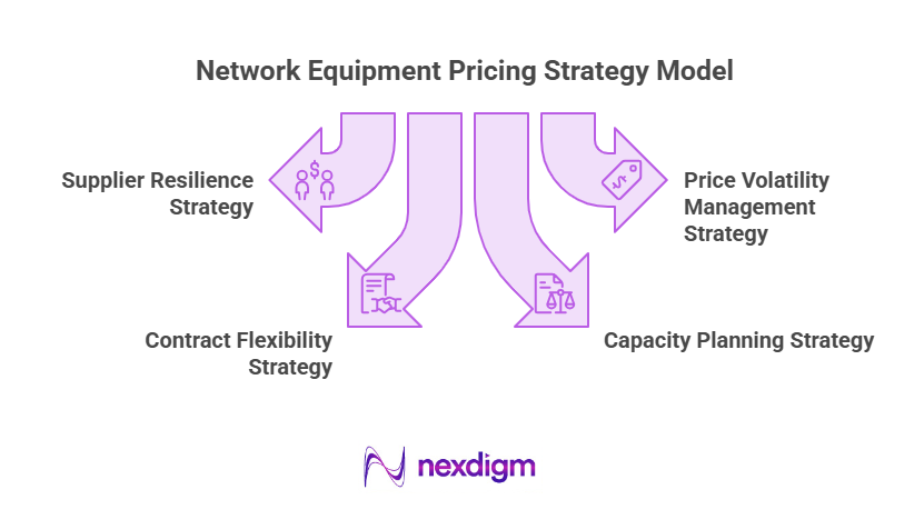
- Supplier Resilience Strategy: Assesses product availability, lead times, channel strength, service continuity, and supplier concentration to reduce procurement disruption and improve network sourcing resilience.
- Contract Flexibility Strategy: Evaluates payment terms, volume adjustments, upgrade rights, warranty extensions, and termination provisions to secure network equipment agreements that adapt to changing requirements.
- Capacity Planning Strategy: Aligns bandwidth growth, device volumes, site expansion, and traffic forecasts with equipment pricing to avoid both underinvestment and unnecessary infrastructure overprovisioning.
- Price Volatility Management Strategy: Tracks component costs, product cycles, inventory conditions, and vendor revisions to help businesses manage timing risks and avoid unfavorable network procurement pricing.
Nexdigm’s Case
Nexdigm supported an enterprise network procurement initiative by benchmarking equipment, security licenses, support, and vendor terms. The analysis contributed to 15% procurement savings, 14% lower lifecycle cost exposure, and 20% stronger pricing visibility, improving sourcing confidence and infrastructure value.
To take the next step, simply visit our Request a Consultation page and share your requirements with us.
Harsh Mittal
+91-8422857704