

Perishable transport networks must balance competitive freight rates with strict shelf-life requirements, temperature control, delivery speed, and waste reduction goals. Effective perishable goods transport price comparison combines pricing analysis with route duration, refrigeration intensity, product sensitivity, load utilization, carrier reliability, packaging needs, and spoilage risk.
This approach helps businesses benchmark providers, identify hidden cost gaps, validate premium charges, and negotiate commercially balanced contracts. It also supports better lane selection, stronger margin control, improved freshness retention, and scalable distribution strategies across food, agriculture, retail, and other time-sensitive supply chains globally and efficiently.
A 2026 anonymous ten-node cold-chain case reduced total logistics costs by 8.02% compared with experience-based planning. Integrated routing, shipment, inventory, and vehicle-utilization decisions improved transportation efficiency while accounting for deterioration, supporting stronger price benchmarking, shelf-life protection, waste reduction, and commercial outcomes.
Perishable Transport Pricing Analysis for Shelf-Life Protection
Perishable transport pricing benchmarking helps businesses compare carrier rates, service quality, refrigeration requirements, and spoilage risks, improving cost transparency, shelf-life protection, supplier negotiations, and overall distribution efficiency across networks. Core benefits of the same are:
- Longer Marketable Shelf Life: Benchmarking helps businesses select transport services that preserve freshness for longer, increasing the sellable period, reducing markdowns, and improving revenue recovery across perishable product categories.
- Lower Product Rejection Rates: Comparing carrier handling, temperature stability, and delivery performance reduces damaged or noncompliant shipments, helping businesses avoid customer rejections, replacement costs, and lost commercial opportunities.
- Improved Forecasting Accuracy: Reliable transport cost and service benchmarks support better budgeting, demand planning, and inventory decisions, reducing uncertainty across seasonal, regional, and product-specific perishable distribution networks.
- Faster Response to Disruptions: Benchmarking alternative carriers, lanes, and service models helps businesses quickly redirect shipments during delays, equipment failures, weather events, or capacity shortages without compromising product quality.
Nexdigm’s Strategic Support for Perishable Transport Pricing Analysis
Nexdigm supports perishable transport cost-to-serve analysis through pricing analysis, logistics cost benchmarking, route economics, and carrier rate assessment. By evaluating refrigeration expenses, transit time, spoilage risks, packaging costs, load utilization, and service performance, Nexdigm helps businesses optimize transport pricing, strengthen supplier negotiations, improve margin visibility, reduce waste, and protect product shelf life across time-sensitive distribution networks and markets.
Nexdigm’s Strategic Architecture for Shelf-Life and Logistics Pricing Analysis
Nexdigm’s strategic architecture combines shelf-life intelligence, cost-to-serve analysis, waste metrics, and carrier benchmarks to help businesses establish accurate pricing, protect product value, and improve perishable logistics profitability sustainably. Some important features of the architecture model are:
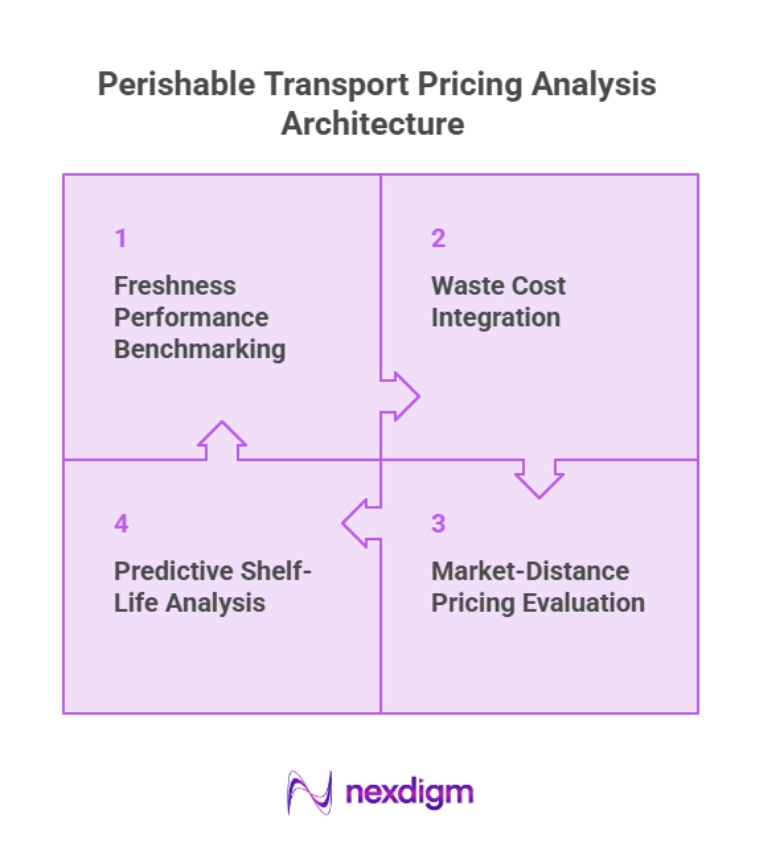
- Freshness Performance Benchmarking: Carrier rates are compared with freshness retention, delivery punctuality, temperature stability, rejection levels, and damage rates, helping businesses select providers delivering stronger value and product protection.
- Waste Cost Integration: Spoilage, markdowns, rejected shipments, disposal, and replacement expenses are incorporated into cost-to-serve models, revealing the full financial impact of underperforming logistics services.
- Market-Distance Pricing Evaluation: Transport rates are adjusted according to distance from production centers, freshness requirements, infrastructure quality, and available carrier capacity across regional and urban markets.
- Predictive Shelf-Life Analysis: It includes use of forecasting tools to flag shipments at risk of delay, spoilage, or rejection, enabling earlier intervention, pricing adjustments, and better allocation of priority transport capacity.
Nexdigm’s Case
Nexdigm supported a multinational food distributor in optimizing shelf-life- sensitive logistics through route benchmarking, transport pricing analysis, and carrier performance monitoring. The initiative reduced product spoilage by 18% and improved on-time deliveries by 24%, strengthening freshness retention, margin visibility, and network efficiency.
To take the next step, simply visit our Request a Consultation page and share your requirements with us.
Harsh Mittal
+91-8422857704