

A well-defined portfolio management pricing strategy helps firms balance investment performance, service quality, client expectations, and profitability in increasingly competitive markets. Through specialized Pricing Analysis Services, portfolio managers can evaluate fee structures, benchmark competitors, assess client willingness to pay, and align pricing with portfolio complexity and service levels.
Effective portfolio management pricing analysis supports asset-based fees, performance-linked pricing, fixed advisory charges, and hybrid models. It also improves client segmentation, value communication, revenue optimization, and retention. By using market intelligence, cost analysis, profitability assessment, and pricing optimization, firms can create transparent, competitive, and sustainable portfolio management fee structures.
Nexdigm’s Pricing Analysis Services helped a portfolio management firm refine performance-linked fees, achieving a 15% increase in advisory revenue, 12% improvement in client retention, 10% higher margins, and 14% growth in premium-service adoption.
Pricing Analysis for Performance-Driven Portfolio Management Services
Pricing analysis helps portfolio management firms align fees with investment performance, service quality, client value, competitive benchmarks, and profitability through structured, data-driven Pricing Analysis Services and optimization strategies. Some major steps are:
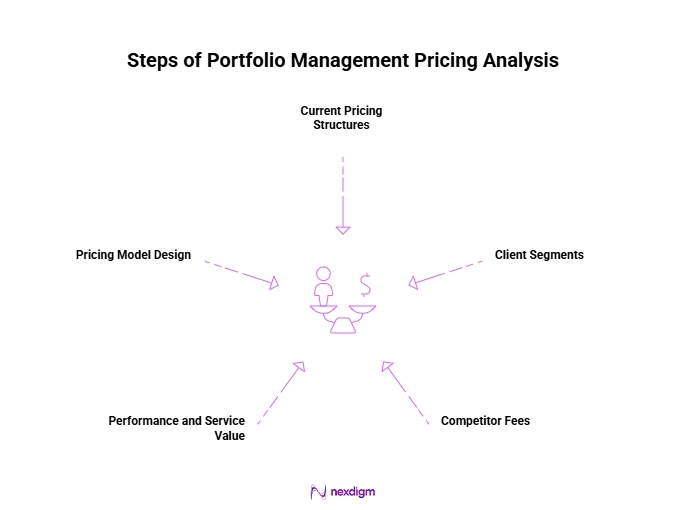
Step 1: Assess Current Pricing Structures
Evaluate existing management fees, performance charges, discounts, service tiers, and profitability to identify pricing gaps, inconsistencies, revenue leakage, and improvement opportunities across client segments.
Step 2: Analyze Client Segments
Segment clients by portfolio value, investment objectives, service requirements, risk profiles, and willingness to pay, enabling differentiated pricing aligned with value and delivery complexity.
Step 3: Benchmark Competitor Fees
Compare asset-based fees, performance incentives, advisory charges, and premium-service pricing against competitors to determine market positioning and identify opportunities for stronger differentiation.
Step 4: Evaluate Performance and Service Value
Measure investment outcomes, reporting quality, advisory access, personalization, and relationship support to establish fees that reflect both financial performance and overall client experience.
Step 5: Design the Pricing Model
Develop asset-based, performance-linked, fixed-fee, tiered, or hybrid pricing structures that balance client affordability, service value, revenue stability, and long-term portfolio profitability.
Nexdigm’s Strategic Support for Performance-Linked Portfolio Pricing
Nexdigm supports portfolio management firms with comprehensive Pricing Analysis Services that optimize performance-linked pricing through portfolio management pricing strategy, competitive fee benchmarking, pricing optimization, profitability analysis, client segmentation, value-based pricing, market intelligence, and portfolio fee structure assessment. By aligning pricing with investment performance, service quality, and client expectations, Nexdigm helps strengthen profitability, improve client retention, enhance competitive positioning, and drive sustainable business growth.
Nexdigm’s Strategic Roadmap for Portfolio Management Fee Transformation
Nexdigm’s strategic roadmap guides portfolio management firms through structured fee transformation, combining Pricing Analysis Services, performance benchmarking, client segmentation, profitability assessment, and implementation planning for sustainable growth. Data Driven steps followed by Nexdigm’s experts are:
Step 1: Evaluate Existing Fee Structures
Assess current management fees, performance charges, discounts, service tiers, and revenue contribution to identify pricing inconsistencies, margin pressures, and transformation opportunities.
Step 2: Benchmark Market Pricing
Compare portfolio management fees, incentive structures, service inclusions, and competitor positioning to determine market gaps and establish commercially relevant pricing reference points.
Step 3: Segment Clients by Value
Group clients according to portfolio size, service complexity, investment objectives, profitability, and willingness to pay, supporting differentiated and value-aligned fee structures.
Step 4: Assess Performance and Service Economics
Evaluate investment outcomes, advisory effort, reporting requirements, relationship support, and delivery costs to align fees with performance, service quality, and economic value.
Step 5: Design the Target Pricing Model
Develop asset-based, performance-linked, fixed, tiered, or hybrid pricing models that improve transparency, competitiveness, revenue stability, and portfolio management profitability.
Nexdigm’s Case
Nexdigm’s Pricing Analysis Services helped a portfolio management firm transform its fee strategy, resulting in a 17% increase in advisory revenue, 13% higher client retention, 10% improvement in operating margins, and 15% growth in premium portfolio service adoption.
To take the next step, simply visit our Request a Consultation page and share your requirements with us.
Harsh Mittal
+91-8422857704