

Comparing replacement parts pricing across OEM and independent aftermarket channels is essential in understanding cost differences, quality perceptions, and value positioning in the automotive ecosystem. A replacement parts price comparison study helps businesses and consumers evaluate how identical or equivalent components are priced differently across branded OEM suppliers and independent manufacturers.
Through pricing analysis, stakeholders can assess factors such as production costs, warranty coverage, distribution margins, and brand premiums. This comparison supports better purchasing decisions, improves transparency, and enhances competitiveness in the automotive parts market. As global supply chains evolve, pricing differences between channels significantly influence affordability, profitability, and customer choice.
The global automotive replacement parts market is valued at approximately USD 450–500 billion in 2025, with OEM parts accounting for nearly 55–60% of total value share, while independent aftermarket channels contribute around 40–45% of supply volume but often offer 20–35% lower pricing.
Studies show that price differences for identical components, such as brake systems and electronic modules, can vary by 15–50% across OEM and independent channels, depending on brand positioning and warranty coverage.
Replacement Parts Pricing Analysis Across OEM and Independent Channels
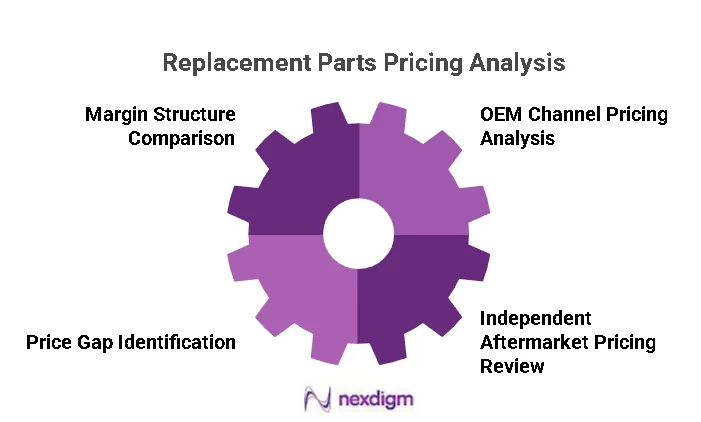
Replacement parts pricing analysis across OEM and independent channels compares costs, margins, and pricing structures to identify gaps, optimize purchasing decisions, enhance competitiveness, and improve transparency in automotive parts markets:
-
OEM Channel Pricing Analysis
Evaluates manufacturer-set prices, warranty premiums, and brand value effects on replacement parts costs.
-
Independent Aftermarket Pricing Review
Compares lower-cost alternatives, identifying savings opportunities and competitive advantages for buyers.
-
Price Gap Identification
Analyzes differences between OEM and independent channels to highlight cost disparities and optimization potential.
-
Margin Structure Comparison
Assesses profit margins across channels to understand pricing efficiency and profitability drivers.
Nexdigm’s Value-Based Pricing Advisory for Automotive Parts Businesses
Nexdigm’s value-based pricing advisory helps automotive parts businesses set prices based on perceived customer value rather than only costs. Using pricing analysis, it evaluates OEM and aftermarket benchmarks, quality differences, and demand patterns to optimize pricing strategies, improve margins, enhance competitiveness, and support sustainable profitability in replacement parts markets.
Nexdigm’s Data-Driven Pricing Analysis for Automotive Parts Market Comparison
Nexdigm’s data-driven pricing analysis compares OEM and aftermarket automotive parts using market data, cost structures, and competitor benchmarks to optimize pricing strategies, improve margins, and enhance market competitiveness effectively.
-
Cost Structure Evaluation
Analyzes manufacturing, logistics, and distribution costs to identify pricing inefficiencies across automotive parts.
-
Competitor Price Benchmarking
Compares rival pricing strategies to position automotive parts competitively in the market.
-
Margin Optimization Insights
Assesses profit margins across products to improve pricing efficiency and revenue performance.
-
Strategic Pricing Recommendations
Provides data-backed pricing strategies to enhance competitiveness and long-term profitability.
Nexdigm’s case:
Nexdigm supported a global automotive parts manufacturer operating across 14 countries and 180 distributors to improve pricing decisions using data-driven pricing analysis. The study revealed a 12% price variation between OEM and aftermarket channels and a 9% margin inefficiency due to inconsistent pricing structures. By implementing optimized pricing benchmarks and competitive positioning strategies, Nexdigm helped the company improve global parts profitability by 11% and achieve more consistent pricing alignment across markets.
To take the next step, simply visit our Request a Consultation page and share your requirements with us.
Harsh Mittal
+91-8422857704