

Retail banking product pricing optimization enables banks to align deposit rates, loan pricing, account fees, card charges, and bundled offers with customer value, competitive conditions, risk, and profitability objectives. Through advanced Pricing Analysis, institutions can evaluate price sensitivity, product margins, customer behaviour, cost-to-serve, competitor positioning, and market demand.
Such valuable insights support targeted pricing decisions, stronger cross-selling, improved customer retention, and higher product profitability. A structured pricing approach also strengthens market responsiveness and helps banks expand market share across digital and competitive retail banking environments.
Reuters reported Societe Generale’s second-quarter 2026 net income increased 23% year-on-year to €1.79 billion, while retail banking net interest income rose nearly 15%, demonstrating how disciplined product management and pricing strategies can strengthen profitability, revenue performance, and competitive market positioning.
Pricing Analysis for Retail Banking Product and Portfolio Optimization
Pricing intelligence enables retail banks to optimize products and portfolios using customer, market, risk, and profitability insights, strengthening pricing precision, product performance, competitive positioning, and sustainable growth across banking channels. Key aspects of the intelligence process are:
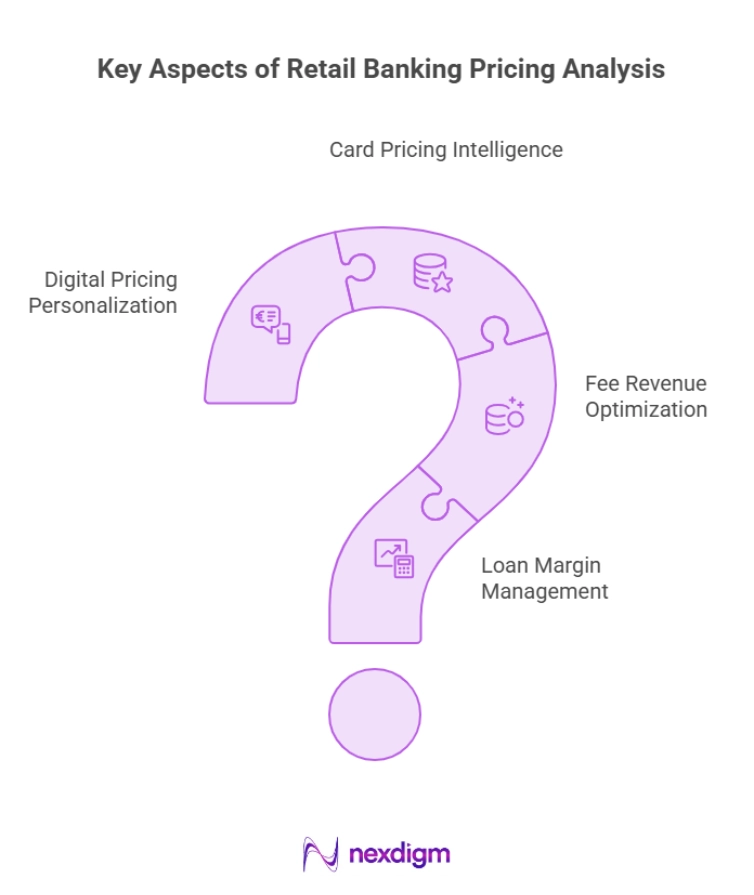
- Loan Margin Management: Evaluate funding costs, credit risk, capital consumption, and borrower demand to optimize loan pricing while protecting profitability and competitive market positioning.
- Fee Revenue Optimization: Review account charges, transaction fees, service costs, and customer acceptance to strengthen non-interest income without reducing transparency or customer satisfaction.
- Card Pricing Intelligence: Assess annual fees, interest rates, rewards, interchange income, and customer usage to improve card profitability, activation, retention, and portfolio contribution.
- Digital Pricing Personalization: Apply behavioural data, transaction patterns, and digital engagement insights to present relevant product prices, incentives, and bundles through personalized customer journeys.
Nexdigm’s Retail Banking Pricing Expertise for Margin and Market Expansion
Nexdigm helps retail banks improve margins and expand market share through advanced Pricing Analysis, retail banking product pricing optimization, and portfolio profitability assessment. Its expertise combines customer segmentation, price elasticity analysis, competitive benchmarking, risk-adjusted pricing, and pricing intelligence to optimize deposits, loans, cards, and fee-based products. By leveraging data-driven pricing analytics and market insights, Nexdigm enables stronger product profitability, enhanced customer retention, sustainable revenue growth, and competitive retail banking performance.
Nexdigm’s Retail Banking Product Pricing Analysis Roadmap
Nexdigm’s roadmap helps retail banks assess product economics, understand customer behaviour, optimize rates and fees, validate market response, strengthen profitability, and continuously improve portfolio performance across competitive banking environments. Steps of the roadmap are:
- Step 1: Decode Customer Pricing Behaviour: Analyze product usage, balance patterns, price sensitivity, switching behaviour, and relationship depth to understand how different customer segments respond to pricing changes.
- Step 2: Quantify Product Value Contribution: Measure revenue, funding costs, risk charges, servicing expenses, and cross-sell potential to determine each product’s contribution to portfolio profitability.
- Step 3: Architect Differentiated Price Propositions: Design segment-specific rates, fees, benefits, and bundles that reflect customer value, competitive positioning, affordability, and targeted product growth objectives.
- Step 4: Activate Pricing Across Channels: Implement consistent pricing propositions across branches, digital platforms, contact centres, and partner channels while managing approvals, exceptions, and customer communications.
- Step 5: Optimize Portfolio Value Continuously: Monitor margins, acquisition, retention, migration, and market share to recalibrate product pricing and improve long-term portfolio value creation.
Nexdigm’s Case
Nexdigm supported a bank in redesigning retail product pricing through fee benchmarking, customer sensitivity analysis, and portfolio profitability assessment. Within nine months, the engagement increased customer retention, improved cross-sell conversion, delivered 11% fee-income growth, and raised digital product adoption by 24%, strengthening margins and market expansion.
To take the next step, simply visit our Request a Consultation page and share your requirements with us.
Harsh Mittal
+91-8422857704