

Enterprise software licensing costs can vary considerably even for comparable agreements, driven by contract size, deployment scope, discounting, renewal provisions, and negotiation leverage. With negotiation variance, software licensing pricing analysis provides businesses with clearer visibility into prevailing rates and commercial terms.
Combining pricing analysis services, enterprise license benchmarking, software pricing intelligence, contract pricing analysis, discount benchmarking, and renewal pricing assessment enables organizations to identify pricing gaps and establish more consistent commercial benchmarks for enterprise software investments.
Where comparable enterprise software agreements show 10%–25% negotiation variance, structured Pricing Analysis Services can reveal substantial optimization potential. Benchmarking license rates, discounts, renewal terms, and contract commitments help businesses strengthen negotiations, reduce pricing leakage, and improve long-term licensing economics.
Enterprise Software Pricing Analysis for Licensing and Contract Benchmarking
Enterprise software pricing analysis helps organizations benchmark license rates, discounts, contract structures, and renewal terms to improve negotiation effectiveness, cost transparency, procurement discipline, and long-term software investment value, by offering the following benefits:
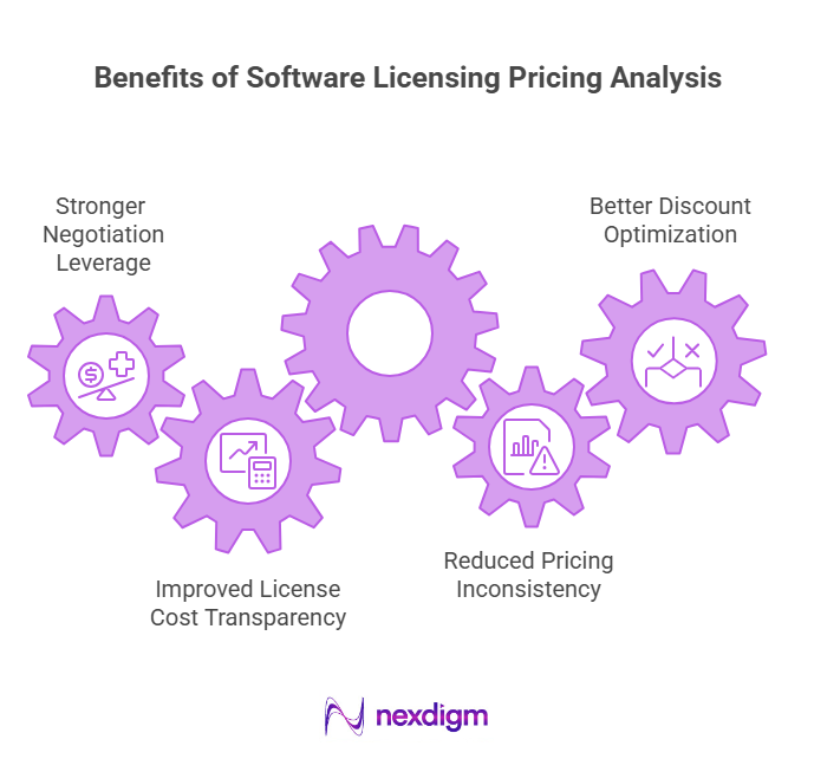
- Stronger Negotiation Leverage: Benchmarking comparable enterprise agreements gives procurement teams clearer evidence on prevailing rates, discounts, and concessions, supporting more informed and commercially stronger vendor negotiations.
- Improved License Cost Transparency: Pricing analysis clarifies effective per-user, per-device, enterprise, and usage-based license costs, helping businesses understand what they are actually paying across software portfolios.
- Reduced Pricing Inconsistency: Comparing contracts across business units, regions, and vendors helps identify unexplained pricing differences and supports more consistent commercial terms across enterprise software agreements.
- Better Discount Optimization: Assessing volume discounts, promotional concessions, and negotiated reductions helps businesses determine whether available discounts are competitive and aligned with contract size and commitments.
How Nexdigm Supports Enterprise Software Pricing and License Benchmarking
Nexdigm combines pricing intelligence, contract benchmarking, licensing economics, and commercial analysis to help businesses evaluate software agreements, strengthen negotiations, optimize costs, and improve long-term value from enterprise technology investments. With this structured approach business get assistance with:
- Benchmarking enterprise software license rates
- Comparing vendor pricing and commercial terms
- Identifying pricing and discount variances
- Assessing license utilization and unused entitlements
- Optimizing subscription and licensing structures
Overall, Nexdigm’s pricing analysis support helps businesses make more informed licensing decisions and derive greater value from enterprise agreements.
Nexdigm’s Pricing Strategy Model for Software Licensing and Renewal Economics
Nexdigm’s strategic planning model integrates license utilization, contract benchmarks, renewal economics, vendor terms, and pricing intelligence to help businesses improve software cost control, negotiation outcomes, and long-term commercial value. This includes utilizing valuable strategies to drive growth, they are:
- License Right-Sizing Strategy: Assessing active users, deployed licenses, usage patterns, and unused entitlements to align license volumes with actual requirements and reduce unnecessary software expenditure.
- Renewal Timing Strategy: Reviewing contract expiries, notice periods, usage trends, and vendor timelines early to strengthen negotiation readiness and avoid rushed or commercially unfavorable renewal decisions.
- Portfolio Consolidation Strategy: Identifying overlapping applications, duplicate capabilities, and fragmented contracts to consolidate software demand, improve purchasing leverage, and reduce unnecessary licensing complexity.
Nexdigm’s Case
Nexdigm supported an enterprise in benchmarking software licensing and renewal economics across major vendor agreements. The engagement identified opportunities for 18% lower licensing costs, 14% stronger renewal savings, and 11% improved license utilization, enhancing negotiation leverage, budget predictability, and contract value.
To take the next step, simply visit our Request a Consultation page and share your requirements with us.
Harsh Mittal
+91-8422857704