

Greater feature parity across software markets is shifting customer decisions toward price, packaging, usability, service levels, and perceived business value. Software price competitiveness analysis enables companies to understand how their offers compare against alternatives across subscription rates, feature bundles, discounts, and commercial terms.
Using pricing analysis services, businesses can assess willingness to pay, identify overpricing or underpricing risks, refine tier structures, and improve competitive value propositions. Combined with software pricing analysis, value-based pricing research, discount analysis, and market intelligence, this approach supports stronger customer acquisition, retention, price realization, and sustainable revenue performance.
Research scenarios where competitors offer comparable functionality may reveal 17% or greater differences in effective customer pricing after discounts and bundles. Pricing Analysis Services help normalize these differences, clarify relative value, improve negotiation discipline, and support more competitive software pricing decisions.
Software Pricing Analysis for Competitive Positioning and Value Differentiation
Software pricing analysis helps businesses compare market positioning, customer value, feature parity, pricing structures, and competitor offers to strengthen differentiation, improve commercial relevance, protect margins, and support sustainable revenue growth. The key benefits that can strengthen business growth and commercial performance include:
- Market Price Convergence Tracking: Monitor how competitor prices change as feature sets become more alike, helping businesses anticipate commoditization pressure and adjust positioning before margins deteriorate.
- Feature-to-Price Efficiency: Compare the economic value delivered per feature, capability, or usage allowance to determine which software offers stronger value within highly comparable competitive sets.
- Channel Pricing Alignment: Compare direct, partner, reseller, and marketplace pricing structures to reduce channel conflicts and maintain consistent value positioning across different routes to market.
- Differentiation Premium Assessment: Measure whether superior integrations, usability, service, security, automation, or performance can support higher pricing when competing products offer broadly comparable features.
Nexdigm’s Strategic Support for Competitive Software Pricing and Monetization
Nexdigm combines pricing intelligence, competitor benchmarking, customer value analysis, and monetization insights to help software businesses strengthen market positioning, improve price realization, protect margins, and support sustainable revenue growth. Its applications across key software segments include:
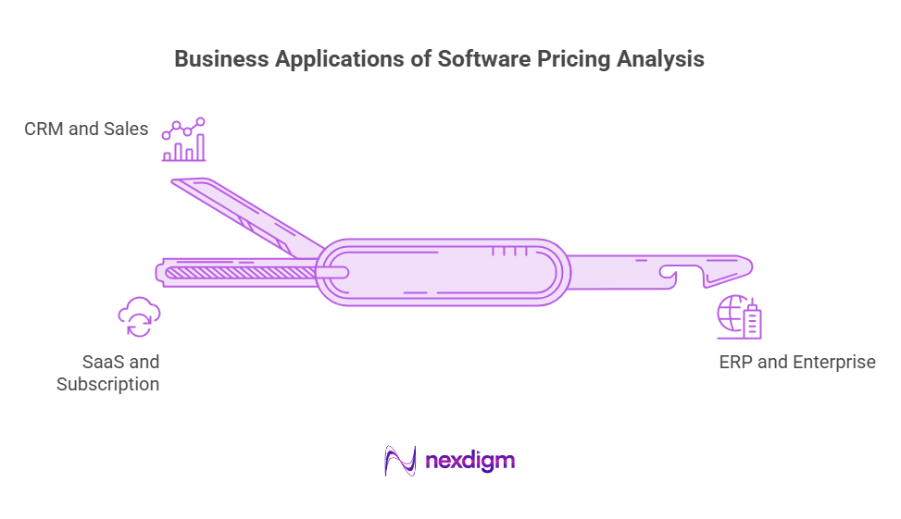
- SaaS and Subscription Platforms: Support subscription tier design, feature packaging, renewal pricing, and competitive benchmarking to help SaaS providers improve conversion, retention, and recurring revenue performance.
- ERP and Enterprise: Evaluate license structures, module pricing, implementation economics, and vendor benchmarks to help enterprise software providers strengthen commercial positioning and contract value.
- CRM and Sales Technology: Analyze seat-based pricing, premium features, usage patterns, and competitor packages to support stronger tier differentiation and monetization across customer segments.
Thus, Nexdigm’s pricing analysis support helps software businesses adapt monetization strategies across industries, improve commercial discipline, and capture greater value from evolving customer and market requirements.
Nexdigm’s Pricing Analysis Methodology for Software Revenue Optimization
Nexdigm’s competitive pricing methodology uses structured steps to combine market benchmarking, customer value, feature differentiation, and monetization analysis, helping software businesses improve price positioning and sustain commercial competitiveness. These steps are:
- Normalize Comparable Software Offers: Standardize competitor products by functionality, user limits, service levels, contract terms, and pricing metrics to create accurate like-for-like market comparisons.
- Measure Customer Value Gaps: Compare perceived benefits, business outcomes, and willingness to pay across customer segments to identify where current pricing overstates or understates delivered value.
- Prioritize Revenue Pricing: Select the strongest monetization opportunities across repricing, premium features, upgrades, add-ons, bundles, and discount controls based on commercial impact.
- Validate Market Response: Measure customer acceptance, conversion, retention, and competitor reactions after pricing changes to ensure revenue gains remain commercially sustainable.
Nexdigm’s Case
Nexdigm supported a software provider in assessing competitive pricing, feature parity, and monetization opportunities. The engagement identified potential for 14% higher price realization, 11% stronger conversion, and 9% improved gross margins, strengthening competitive positioning, revenue performance, and commercial differentiation.
To take the next step, simply visit our Request a Consultation page and share your requirements with us.
Harsh Mittal
+91-8422857704