

The retail grocery sector continues to evolve as consumers seek greater convenience, wider product choices, better value, and enhanced shopping experiences. As a result, retailers are increasingly exploring new supermarket formats, from compact neighborhood stores and value-driven concepts to premium and experience-led models.
However, launching a new supermarket format involves significant investment, making new market format attractiveness equally important. The market format win lies in a structured feasibility assessment that goes beyond market potential and examines local demand, competition, consumer spending patterns, and store-level economics.
Through supermarket entry feasibility research services, businesses can evaluate whether a market can support a new retail concept before committing valuable resources. At Nexdigm, retailers gain access to market intelligence and commercial insights that help validate expansion opportunities and reduce market-entry risks.
Can a New Supermarket Format Win?
Success in grocery retail depends on more than having an attractive store design or product assortment. A supermarket format must fit the needs of the local market while generating sufficient revenue to support operational and financial objectives. Before entering a new market, retailers should evaluate:
- Is there enough customer demand within the catchment area?
- How intense is the competitive landscape?
- What is the likely customer basket size?
- Can the store achieve sustainable profitability?
- Does the format address an unmet market need?
Through its supermarket entry feasibility research services, Nexdigm helps businesses answer these questions using a structured and data-backed framework.
Understanding the Catchment Area
A supermarket’s success is often determined by the community it serves. Here,s when Catchment Areas assessment becomes important. The catchment area represents the population likely to visit a store based on location, accessibility, and convenience. Understanding this area provides valuable insights into the potential customer base and purchasing power. Nexdigm evaluates factors such as:
- Population density
- Household demographics
- Income levels
- Consumer spending patterns
- Traffic flow and accessibility
- Residential and commercial developments
A detailed catchment assessment helps determine whether sufficient demand exists to support a new supermarket format.
Assessing Demand Potential
Demand assessment forms the foundation of every supermarket feasibility study. The most important aspect of measuring demand potential comes from identifying customer demand drivers. Consumer demand can vary significantly across locations. Understanding local needs helps retailers align their offerings with customer expectations. Nexdigm here assesses:
- Grocery purchasing habits
- Shopping frequency
- Preferred product categories
- Brand preferences
- Convenience expectations
- Value versus premium purchasing behavior
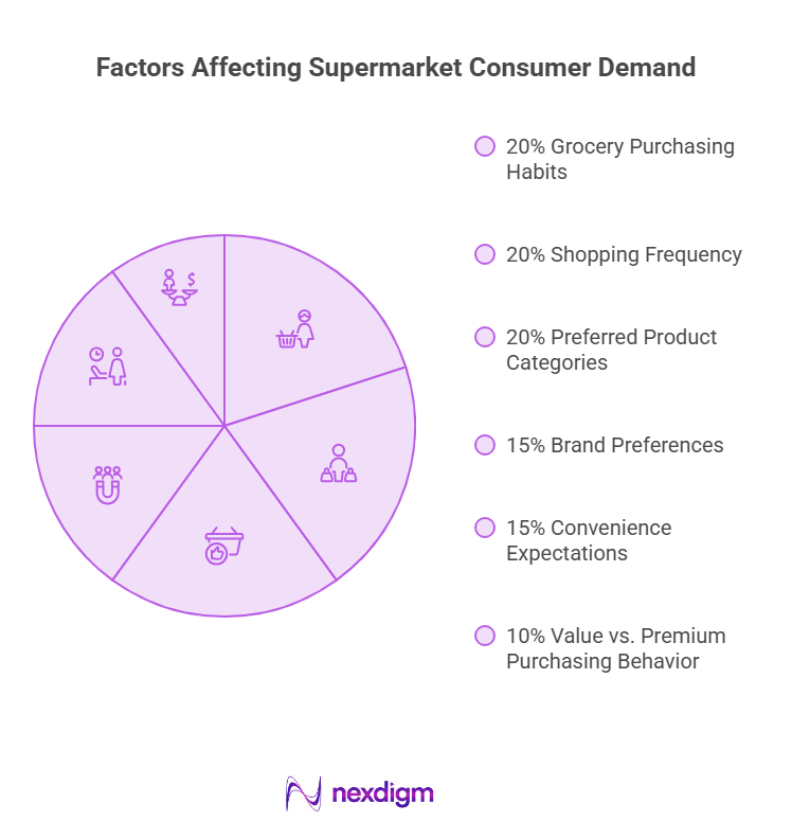
These insights help retailers evaluate whether the proposed format matches local customer requirements.
Analyzing the Competitive Landscape
Even strong demand may not guarantee success if the market is already saturated with established players. Understanding the competitive environment is therefore critical before making market-entry decisions. A detailed assessment of competitors helps businesses determine how they can differentiate themselves effectively. It involves thorough understanding of the following factors:
Who Is Competing for the Shopper?
Understanding who competes for the same customer is essential for evaluating market attractiveness and identifying opportunities for differentiation. Through detailed competitive assessments, Nexdigm helps businesses gain a comprehensive view of the market landscape by analyzing:
- Existing supermarkets and hypermarkets
- Local grocery retailers
- Discount store formats
- Specialty food retailers
- Online grocery platforms
This analysis helps identify the level of market concentration and potential barriers to entry.
Finding Market Gaps
Beyond evaluating competitors, Nexdigm helps retailers identify opportunities where customer needs remain underserved. These opportunities may include:
- Limited premium offerings
- Lack of convenience formats
- Insufficient product variety
- Poor customer experience
- Underserved residential areas
Identifying these gaps can help retailers position their supermarket format more effectively.
Understanding Basket Size and Spending Behaviour
One of the most important determinants of retail performance is the average customer basket. It refers to the collection of products a shopper typically purchases in a single shopping trip, helping retailers understand buying behavior, spending patterns, and value perception. The analysis can help businesses answer questions such as:
What Will Customers Actually Spend?
Customer traffic alone does not guarantee profitability. Retailers must understand how much customers are likely to purchase during each visit. Nexdigm evaluates:
- Average transaction value
- Category-wise spending
- Shopping frequency
- Cross-category purchasing patterns
- Promotional responsiveness
This analysis helps estimate revenue potential and develop realistic sales projections.By combining basket size data with customer footfall estimates, retailers can better understand expected sales volumes, monthly revenue potential, long term growth perspective and many more. These insights are critical for making informed investment decisions.
Understanding the Store Economics
A successful supermarket format must be commercially sustainable. Strong sales performance alone may not guarantee profitability if operating costs remain high. Hence, Nexdigm evaluates:
- Rental and occupancy costs
- Staffing requirements
- Inventory investments
- Logistics expenses
- Utility and operational costs
- Store-level profitability
This helps businesses understand whether the proposed format can generate attractive financial returns.
Building the Right Market Entry Strategy with Nexdigm
Once feasibility has been established, the next step is developing an effective execution plan. A successful market entry requires more than identifying opportunity; it involves making strategic decisions that align with the long-term business objectives. Nexdigm helps businesses develop practical and scalable entry strategies through a structured approach focused on the following key considerations:
- Optimal store format: Determines the most suitable retail format, such as supermarket, hypermarket, convenience store, or specialty outlet, based on market demand and customer preferences.
- Product assortment strategy: Identifies the right mix of products to meet customer needs, differentiate from competitors, and maximize sales potential.
- Pricing approach: Develops pricing strategies that balance customer expectations, competitive positioning, and profitability objectives.
- Location prioritization: Evaluates and ranks target locations based on factors such as demand potential, demographics, accessibility, and competitive presence.
- Expansion roadmap: Creates a phased growth plan that outlines expansion priorities, investment requirements, and scalability opportunities for sustainable growth.
- Customer acquisition strategy: Defines the most effective methods for attracting, engaging, and retaining target customers through marketing, promotions, loyalty initiatives, and channel selection.
This ensures that market entry decisions are supported by both operational and commercial intelligence.
Why Choose Nexdigm as your Partner?
Launching a new supermarket format requires careful evaluation of market demand, competitive intensity, customer spending behavior, and financial sustainability. Nexdigm combines market research, retail expertise, and commercial advisory capabilities to help businesses assess opportunities with confidence. Through its supermarket entry feasibility research services, Nexdigm enables organizations to validate market opportunities, evaluate catchment potential, assess store economics, and develop practical expansion strategies that support sustainable growth.
Driving Confident Supermarket Entry Decisions with Nexdigm
Choosing the right market is only the first step in launching a successful supermarket format. Long-term performance depends on translating market insights into practical business decisions. Nexdigm helps retailers move beyond feasibility assessment to create actionable growth strategies. By evaluating how customers shop, where demand is concentrated, and what drives store profitability, Nexdigm enables retailers reduce expansion risks, optimize investments, and improve the likelihood of achieving targeted sales and profitability outcomes.
Nexdigm’s Case
In a recent engagement, Nexdigm supported a retail client in evaluating a new supermarket format through catchment demand, competition analysis, basket size, and store economics. Real-time insights increased site evaluation accuracy by 35%, improved customer potential assessment by 28%, and reduced expansion risks by 25%.
Nexdigm’s integrated retail assessment approach enabled the client to identify viable locations, optimize store economics, and make confident expansion decisions supported by actionable market intelligence.
To take the next step, simply visit our Request a Consultation page and share your requirements with us.
Harsh Mittal
+91-8422857704