

Technology markets often present products with overlapping features but widely different price points, performance levels, service packages, and ownership economics. Technology price comparison research helps businesses determine whether these differences represent genuine value or pricing inefficiencies.
Combined with technology pricing benchmarking, competitive pricing analysis, product feature comparison, price-value assessment and total cost analysis, businesses can sharpen product selection, improve competitive positioning, strengthen negotiations, reduce overpayment, and make more evidence-based technology investment decisions.
Comparative assessment studies revealed 8%–18% pricing premiums are not fully supported by equivalent improvements in features or performance. Pricing Analysis Services help quantify these value gaps, challenge unjustified premiums, strengthen negotiations, and improve price-value alignment across competing technology products.
Competitive Pricing Analysis for Technology Features and Cost Efficiency
Competitive pricing analysis helps businesses compare technology features, performance, service levels, and competitor pricing to identify value gaps and strengthen purchasing and positioning decisions. Its key pricing drivers determining how technology products are valued include:
- Competitive Market Benchmarks: Competitor prices, packages, specifications, and commercial terms establish reference points that influence acceptable pricing ranges and reveal potential overpricing or underpricing.
- Product Lifecycle Economics: Expected useful life, upgrade cycles, maintenance requirements, obsolescence risk, and replacement frequency influence pricing by determining long-term value and ownership economics.
- Scalability Economics: Costs associated with expanding users, capacity, transactions, workloads, or infrastructure influence whether technology products remain economically attractive as customer requirements increase.
- Brand and Vendor Value: Vendor reputation, product reliability, ecosystem strength, innovation track record, and service consistency can support pricing premiums when customers perceive lower operational and implementation risk.
Nexdigm’s Strategic Pricing Support for Technology Product Comparison
Nexdigm supports technology businesses with structured pricing analysis services to compare product features, performance, competitive prices, and total ownership economics. Through technology pricing analysis, competitive pricing analysis, product price benchmarking, price-to-performance analysis, technology cost comparison, pricing intelligence, and total cost of ownership analysis, Nexdigm helps organizations identify value gaps, validate premiums, strengthen cost efficiency, and improve commercial decision-making.
Nexdigm’s Strategic Pricing Blueprint for Technology Cost and Value Alignment
Nexdigm’s strategic pricing blueprint combines cost intelligence, competitive benchmarks, performance insights, and customer value to help technology businesses align pricing decisions. Its structured steps help assess cost, performance, and value insights into practical pricing decisions across technology products and markets, including:
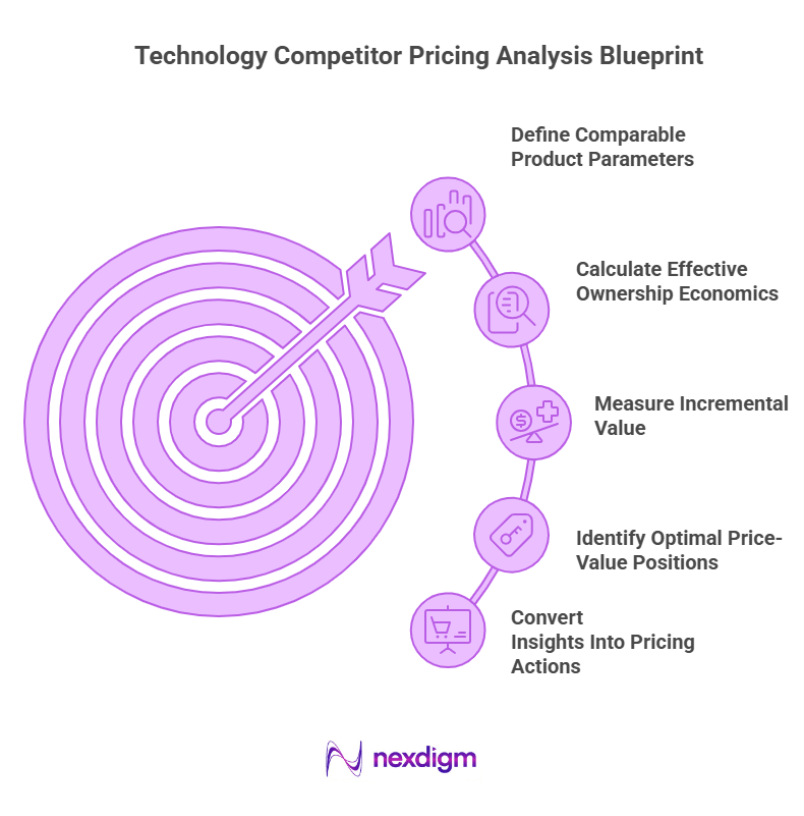
- Define Comparable Product Parameters: Standardize features, specifications, capacity, performance, service inclusions, and deployment requirements to create consistent comparison criteria across competing technology products and configurations.
- Calculate Effective Ownership Economics: Combine purchase prices with implementation, integration, maintenance, support, upgrades, and replacement expenditure to understand the complete financial impact of competing technology options.
- Measure Incremental Value Against Cost: Assess whether additional functionality, performance, reliability, scalability, or service benefits generate sufficient incremental value to justify higher prices across competing technology offerings.
- Identify Optimal Price-Value Positions: Map competing products across cost and value levels to identify offerings, configurations, or pricing positions delivering stronger economics for targeted customer requirements.
- Convert Insights Into Pricing Actions: Use product benchmarks, value gaps, ownership economics, and competitive positioning to refine prices, negotiate premiums, optimize configurations, and strengthen commercial decision-making.
Nexdigm’s Case
Nexdigm supported a technology provider in comparing product costs, performance, features, and lifecycle economics. The engagement identified 16% price-value gaps, enabled 12% improvement in cost efficiency, and increased value realization by 14%, strengthening product positioning and commercial decisions.
To take the next step, simply visit our Request a Consultation page and share your requirements with us.
Harsh Mittal
+91-8422857704