

Technology companies increasingly compete across premium, value, and enterprise segments where customer expectations, purchasing power, feature priorities, and perceived value differ substantially. Technology willingness to pay analysis helps businesses understand buyer price tolerance, identify acceptable price ranges, and align offerings with segment-specific value perceptions.
Supported by technology pricing analysis, willingness-to-pay research, price positioning studies, competitive pricing analysis, customer value analysis, and pricing benchmarking, businesses can refine price points, strengthen differentiation, improve revenue realization, and support sustainable margin growth across diverse customer segments.
Pricing research indicates that small improvements in realized pricing can generate disproportionately higher profit gains, with commonly cited analyses suggesting a 1% pricing improvement may increase operating profit by roughly 8%–11% under certain conditions. Pricing Analysis Services help businesses identify and capture these opportunities.
Technology Price Positioning Analysis for Segment-Based Revenue Growth
Technology price positioning analysis helps businesses align customer value, willingness to pay, competitive benchmarks, and segment economics to strengthen pricing precision, differentiation, revenue realization, and sustainable growth across markets. Its key benefits support stronger segment positioning and commercial performance in the following ways:
- Higher Willingness-to-Pay Capture: Identifies customers with stronger value perception and lower price sensitivity, helping businesses capture additional revenue without over-discounting high-value segments.
- Reduced Cannibalization Risk: Creates sufficient differentiation between pricing tiers to prevent lower-priced offers from unnecessarily displacing premium or enterprise products within the portfolio.
- Stronger Market Entry Decisions: Uses segment economics and willingness-to-pay insights to determine appropriate launch positions when introducing technology offerings into new customer groups or markets.
- Better Margin Mix: Encourages a healthier revenue balance across value and premium offerings by aligning price levels with segment economics, service intensity, and contribution potential.
Nexdigm’s Advisory Role in Technology Pricing and Market Segmentation
Nexdigm provides strategic pricing advisory to help technology businesses align price positioning with customer value, market segments, and competitive dynamics. Through pricing analysis services, technology willingness-to-pay analysis, competitive pricing analysis, price positioning research, customer segmentation analysis, pricing benchmarking, and value-based pricing strategies, Nexdigm supports premium, value, and enterprise pricing decisions that strengthen differentiation, revenue realization, market competitiveness, and sustainable commercial growth.
Nexdigm’s Pricing Analysis Architecture for Technology Segment Economics
Nexdigm’s price positioning architecture integrates customer value, willingness to pay, competitive benchmarks, and segment economics to help technology businesses strengthen differentiation and market positioning across customer segments. Its core features providing a structured foundation for technology segments, includes:
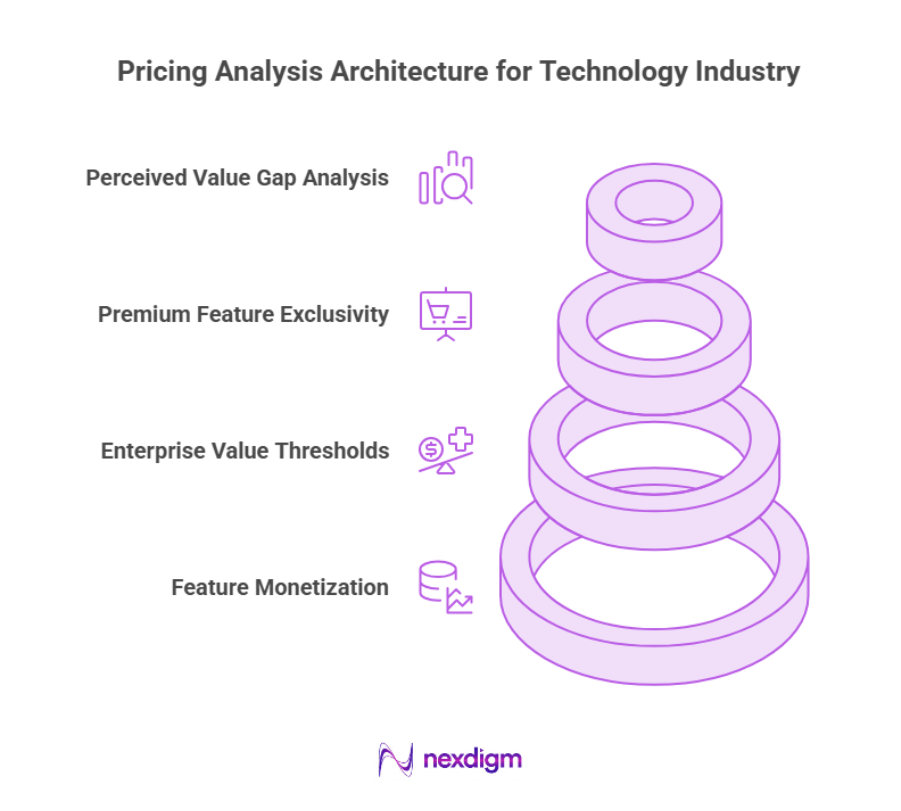
- Enterprise Value Thresholds: Establishes the level of complexity, scale, integration, security, or support required before customers perceive sufficient value to justify enterprise-level pricing.
- Premium Feature Exclusivity: Identifies capabilities that should remain exclusive to higher-priced tiers to preserve differentiation and prevent lower-cost offerings from weakening premium positioning.
- Feature Monetization: Determines which advanced capabilities can command additional pricing by assessing customer demand, perceived differentiation, and willingness to pay across target segments.
- Perceived Value Gap Analysis: Compares actual pricing with customer-perceived benefits to identify segments where technology offerings may be underpriced, overpriced, or insufficiently differentiated.
Nexdigm’s Case
Nexdigm supported segment-level pricing optimization for a technology business. The engagement contributed to 15% stronger price acceptance, 9% lower discount dependency, and 17% higher enterprise deal value, improving competitive positioning, pricing discipline, and overall segment economics.
To take the next step, simply visit our Request a Consultation page and share your requirements with us.
Harsh Mittal
+91-8422857704