

Telemedicine expansion is transforming healthcare access across underserved regions by reducing geographic, financial, and infrastructure-related barriers to care. Through digital consultations, remote monitoring, and virtual follow-ups, patients in rural and low-resource areas can connect with qualified healthcare providers without long travel times.
A strong Telemedicine service expansion strategy supports inclusive care delivery by aligning technology, provider networks, affordability, and local patient needs. From a market entry strategy perspective, telemedicine enables healthcare organizations to enter underserved regions efficiently, build trust through accessible services, and scale operations sustainably while improving early diagnosis, treatment continuity, and overall health outcomes.
In 2025, around 2.6 billion people, nearly one-third of the global population, remained offline, limiting their ability to access digital healthcare services. Internet usage exceeded 90% in high-income countries but remained close to 27% in low-income countries. This digital divide makes it essential for any Telemedicine service expansion strategy to address connectivity, affordability, and local partnerships as part of a practical market entry strategy for underserved regions.
Impact of Telemedicine Expansion in Underserved Regions
Telemedicine expansion improves healthcare access in underserved regions by reducing travel barriers, enabling faster consultations, supporting continuous care, lowering patient costs, and connecting remote communities with qualified medical professionals:
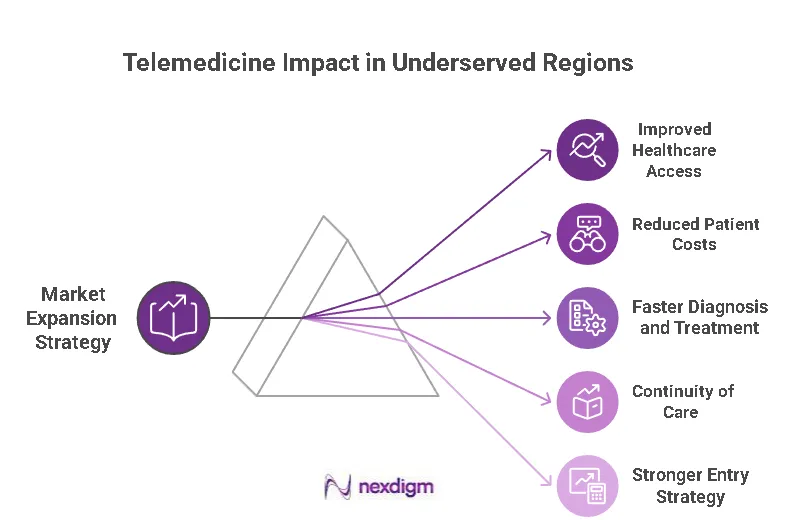
- Improved Healthcare Access: Connects underserved communities with doctors remotely, reducing distance barriers and improving access to timely medical consultations.
- Reduced Patient Costs: Lowers travel, accommodation, and wage-loss expenses, making healthcare more affordable for rural and low-income patients.
- Faster Diagnosis and Treatment: Enables earlier medical advice, quicker referrals, and timely treatment decisions where local specialists are limited.
- Continuity of Care: Supports regular follow-ups, chronic disease monitoring, and medication guidance without repeated hospital visits.
- Stronger Market Entry Strategy: Helps healthcare providers enter underserved regions through digital platforms, local partnerships, and scalable telemedicine service models.
Nexdigm’s Feasibility Assessment for Underserved Healthcare Markets
Nexdigm’s Feasibility Assessment for Underserved Healthcare Markets evaluates the demand, infrastructure readiness, regulatory environment, competition, affordability, and patient access gaps in target regions. This helps healthcare providers understand market potential, identify operational risks, and design a practical telemedicine expansion approach that aligns with local needs, investment priorities, and long-term service scalability.
Nexdigm’s help in Evaluating Infrastructure Gaps Affecting Telemedicine Adoption
Nexdigm helps evaluate infrastructure gaps such as internet connectivity, device availability, healthcare facility readiness, data security systems, and digital literacy, enabling providers to design practical telemedicine adoption strategies for underserved regions.
- Connectivity Assessment: Nexdigm evaluates internet availability, network reliability, and bandwidth limitations that may affect smooth telemedicine consultations in underserved regions.
- Device and Technology Readiness: Nexdigm assesses access to smartphones, computers, diagnostic tools, and digital platforms required for effective telemedicine adoption.
- Healthcare Facility Preparedness: Nexdigm reviews clinic infrastructure, staff readiness, patient support systems, and workflow capacity for virtual healthcare delivery.
- Data Security and Compliance: Nexdigm identifies gaps in privacy systems, cybersecurity controls, and regulatory compliance for safe digital healthcare operations.
Nexdigm’s case:
Nexdigm engaged with a digital healthcare company to assess infrastructure gaps before entering underserved regional markets. The assessment found that nearly 40% of target locations had unstable internet connectivity, 35% lacked adequate digital devices, and 50% of frontline healthcare staff required telemedicine training.
Based on these findings, Nexdigm supported the company in designing a phased telemedicine expansion plan, prioritizing high-readiness districts and local partnerships to improve adoption and service delivery.
To take the next step, simply visit our Request a Consultation page and share your requirements with us.
Harsh Mittal
+91-8422857704