

Transport pricing decisions become more complex when customers demand lower costs without compromising delivery speed, reliability, flexibility, or coverage. A transport price sensitivity study applies pricing analysis to measure how customers respond to rate changes across service levels, shipment profiles, lanes, and delivery commitments.
By combining elasticity testing, cost-to-serve modeling, market benchmarking, and scenario analysis, businesses can identify acceptable price thresholds, protect margins, refine customer segments, and design differentiated transport offerings. This approach supports balanced commercial decisions across evolving logistics networks.
A 2026 network-optimization benchmark reported transportation-spend reductions of 5% to 10% while improving service reliability and lead times. The findings show that sensitivity testing can strengthen pricing decisions, reduce avoidable costs, and preserve customer service across complex transport networks.
Pricing Analysis for Transport Cost-to-Serve and Service-Level Optimization
Pricing analysis helps transport businesses align customer rates with delivery costs, service expectations, and operational complexity, enabling stronger competitive positioning, and sustainable network performance across the logistics market. Some important strategies followed during analytical process are:
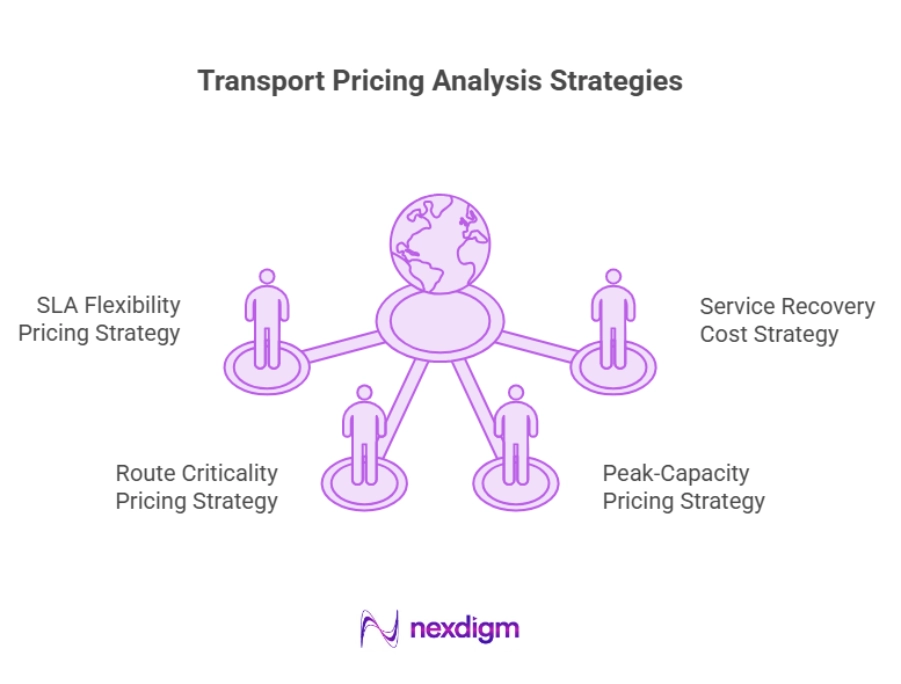
- SLA Flexibility Pricing Strategy: Customers receive alternative pricing based on relaxed cut-off times, wider delivery windows, or fewer guarantees, creating savings opportunities without reducing essential transport reliability.
- Route Criticality Pricing Strategy: Rates are differentiated by business importance, supply continuity, product urgency, and disruption exposure, ensuring critical lanes receive appropriate service and commercial treatment.
- Peak-Capacity Pricing Strategy: Demand surges, limited carrier capacity, urgent bookings, and seasonal congestion are evaluated to establish transparent premiums that reflect temporary operating pressure and service availability.
- Service Recovery Cost Strategy: The cost of refunds, redelivery, claims, and customer support is incorporated into pricing analysis, revealing whether lower-priced services create higher total commercial costs.
Nexdigm’s Strategic Assistance for Transport Service Pricing Analysis
Nexdigm provides strategic assistance for transport service pricing through pricing analysis, transport price sensitivity studies, cost-to-serve modeling, logistics rate benchmarking, and pricing intelligence. By assessing customer demand, service levels, lane economics, operating costs, and competitor rates, Nexdigm helps businesses optimize pricing strategies, improve margin visibility, strengthen contract negotiations, design differentiated services, and support sustainable transport network profitability.
Nexdigm’s Strategic Architecture for Differentiated Transport Pricing Analysis
Nexdigm’s strategic architecture combines customer value, service complexity, price sensitivity, and route economics to create differentiated transport pricing that improves margin control and commercial scalability across networks. Some key features of the architecture model are:
- Network Density Pricing: Rates are differentiated using shipment concentration, stop frequency, route overlap, and consolidation potential, allowing denser transport zones to benefit from improved cost efficiency.
- Modal Choice Differentiation: Road, rail, air, and multimodal services are compared by speed, reliability, cost, and customer acceptance, supporting differentiated pricing across distinct transport requirements.
- Contract Commitment Pricing: Customers receive pricing based on contract duration, committed volumes, forecasting accuracy, and capacity guarantees, improving revenue predictability while rewarding dependable commercial commitments.
- Exception Service Pricing: Urgent dispatches, rerouting, partial loads, after-hours delivery, and special handling are priced separately, improving transparency and preventing nonstandard activities from weakening transport margins.
- Demand Elasticity Estimation: Historical volumes and customer responses are analyzed to estimate how pricing changes may influence shipment frequency, service selection, and retention across different transport segments.
Nexdigm’s Case
Nexdigm supported a transport operator using differentiated pricing, customer segmentation, and deal-level elasticity analysis. The initiative improved EBIT margin by 10%, strengthened cost recovery, reduced pricing inconsistencies, and enabled commercially sustainable service tiers aligned with customer value and network economics.
To take the next step, simply visit our Request a Consultation page and share your requirements with us.
Harsh Mittal
+91-8422857704