

Logistics providers increasingly differentiate services through dependable delivery, faster fulfilment, shipment visibility, and responsive support. A value-based logistics pricing strategy combines pricing analysis with customer willingness to pay, service performance, reliability metrics, urgency, and competitive alternatives.
By aligning rates with measurable customer outcomes rather than costs alone, businesses can justify premiums, improve segmentation, protect margins, and strengthen retention. This approach supports clearer service tiers, disciplined negotiations, and sustainable revenue growth across freight, warehousing, fulfilment, and delivery markets.
A logistics pricing benchmark found that comprehensive pricing transformation can increase revenue by 2% to 4% and operating profit by 30% to 60%, demonstrating how value-led pricing, service differentiation, and disciplined execution can strengthen margins and overall commercial performance.
Pricing Strategy Analysis for Time-Critical Logistics Services
Pricing strategy analysis helps logistics providers value urgency, guaranteed capacity, rapid fulfilment, and service reliability, enabling defensible premiums, stronger margins, clearer differentiation, and responsive commercial decisions across time-sensitive delivery markets. Some important strategies for logistics services pricing are:
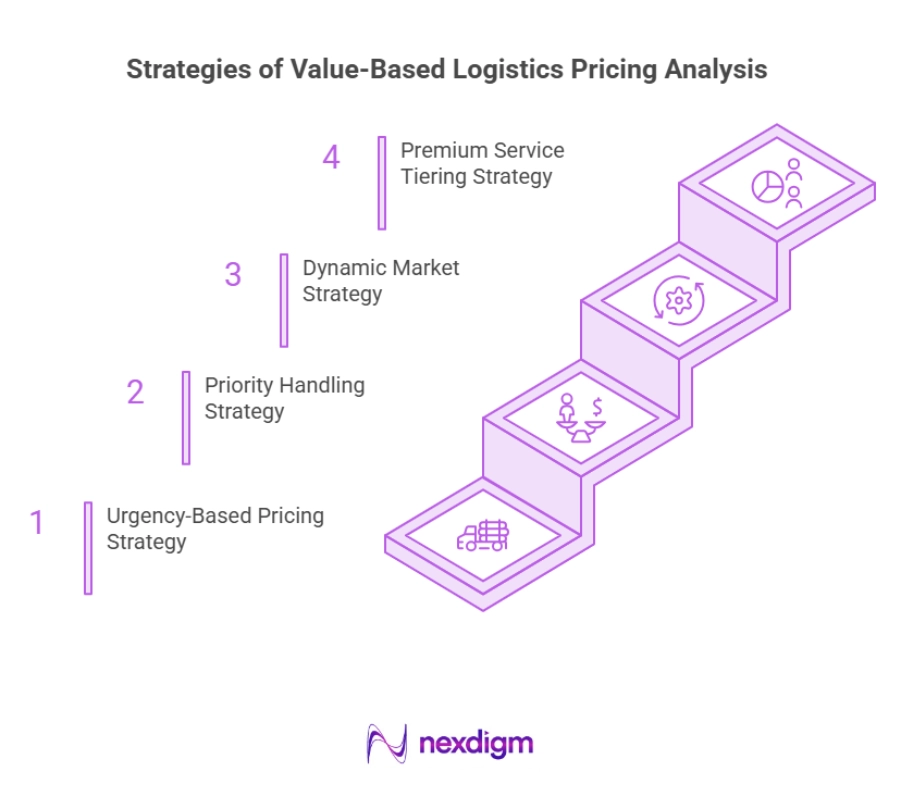
- Urgency-Based Pricing Strategy: Rates are differentiated by delivery deadlines, shipment criticality, and customer urgency, enabling providers to capture appropriate premiums for services requiring immediate coordination and accelerated execution.
- Priority Handling Strategy: Expedited loading, dedicated teams, faster documentation, and preferential processing are assigned structured charges, ensuring additional operational effort is recovered without creating unclear or inconsistent premiums.
- Dynamic Market Strategy: Real-time capacity, route congestion, carrier availability, fuel movements, and demand intensity influence urgent service rates, supporting responsive pricing across rapidly changing logistics market conditions.
- Premium Service Tiering Strategy: Same-day, next-day, express, and guaranteed delivery options are organized into clear tiers, helping customers compare value while enabling providers to protect margins across differentiated services.
Nexdigm’s Pricing Strategy Support for Value-Based Logistics Services
Nexdigm provides pricing strategy support for mission-critical logistics by combining pricing analysis, value-based logistics pricing strategy, market benchmarking, customer value assessment, and service-level intelligence. By evaluating delivery urgency, reliability, capacity commitments, route economics, and willingness to pay, Nexdigm helps businesses optimize premium pricing, strengthen margin protection, improve commercial negotiations, and differentiate time-critical logistics services through data-driven pricing decisions and sustainable revenue strategies.
Nexdigm’s Integrated Pricing Model for Urgency, Capacity, and Logistics Value
Nexdigm’s integrated model combines pricing analysis, capacity intelligence and urgency assessment to optimize premium positioning, protect margins, and strengthen commercial performance in time-critical logistics markets. Some important frameworks used in the model are:
- Willingness-to-Pay Framework: Customer interviews, historical purchase behavior, service choices, and price sensitivity are analyzed to estimate acceptable premiums for speed, reliability, visibility, and guaranteed capacity.
- Delay Impact Framework: Potential production losses, inventory shortages, contractual penalties, missed sales, and customer disruption are estimated to align logistics prices with the financial consequences of late delivery.
- Reliability Premium Framework: On-time performance, contingency coverage, tracking accuracy, and recovery capability are assessed to determine suitable premiums for logistics services offering greater delivery certainty.
- Priority Access Framework: Customers receive differentiated rates for immediate dispatch, reserved capacity, dedicated handling, and priority routing, ensuring scarce logistics resources are allocated to the highest-value requirements.
Nexdigm’s Case
Nexdigm supported a mission-critical logistics operator with route optimization, priority scheduling, and capacity planning. The initiative reduced distribution mileage by 21%, lowered fuel consumption, shortened delivery time by 16%, and increased on-time performance by 7%–12% overall.
To take the next step, simply visit our Request a Consultation page and share your requirements with us.
Harsh Mittal
+91-8422857704