

Warehousing pricing benchmarking reports help logistics providers, retailers, and manufacturers evaluate whether storage and fulfilment rates remain competitive and commercially sustainable across changing markets. Warehousing pricing benchmarking reports combine pricing analysis with storage utilization, fulfilment costs, labor expenses and customer demand patterns to support data-driven pricing decisions.
By assessing warehouse operating costs, value-added services, regional pricing variations, and capacity constraints, businesses can optimize pricing structures, improve cost recovery, strengthen profitability, and support scalable growth amid rising storage and fulfilment demand globally.
Recent studies show that data-driven warehousing pricing and fulfilment benchmarking improved warehouse utilization by 13%, increased order-processing productivity by 17%, and reduced storage-cost inefficiencies, highlighting how pricing analysis and benchmark-led decisions can strengthen profitability, operational efficiency, and competitiveness across rapidly growing warehousing markets.
Warehousing Pricing Analysis for Storage and Fulfilment Benchmarking
Warehousing pricing analysis benchmarks storage, handling, fulfilment, labor, and capacity costs across markets to improve rate competitiveness, strengthen margins, enhance cost recovery, and support scalable warehouse operations globally. Some core benefits of the same are:
- Improved Storage Rate: Benchmarking occupancy charges, pallet rates, cubic utilization, and regional warehouse prices helps businesses establish competitive storage rates without weakening margins or under recovering facility costs.
- Stronger Fulfilment Cost Recovery: Picking, packing, sorting, labeling, returns, and dispatch costs are evaluated separately, enabling fulfilment prices to reflect actual activity requirements and protect service-level profitability.
- Improved SKU-Level Pricing: SKU dimensions, turnover rates, handling frequency, and storage duration are incorporated into pricing, helping warehouses recover costs more accurately across diverse product profiles.
- Higher E-Commerce Margins: High order frequency, small picks, packaging intensity, returns, and delivery cut-offs are incorporated into rates, improving profitability across fast-moving e-commerce fulfilment operations.
Nexdigm’s Commercial Advisory for Warehouse Pricing Benchmarking
Nexdigm provides commercial advisory services through pricing analysis, warehousing pricing benchmarking reports, cost-to-serve assessment, fulfilment cost benchmarking, and market intelligence. By evaluating storage costs, labor expenses, inventory turnover, warehouse utilization, and regional pricing dynamics, Nexdigm helps businesses optimize warehouse rates, strengthen cost recovery, improve pricing governance, enhance profitability, and establish competitive pricing strategies across evolving storage and fulfilment markets.
Nexdigm’s Strategic Model for Warehouse Pricing Analysis and Benchmarking
Nexdigm’s strategic model combines pricing analysis, fulfilment economics, cost intelligence and market benchmarking to optimize warehouse rates, strengthen profitability, improve cost recovery, and support scalable operations. Strategic steps of pricing analytical process are:
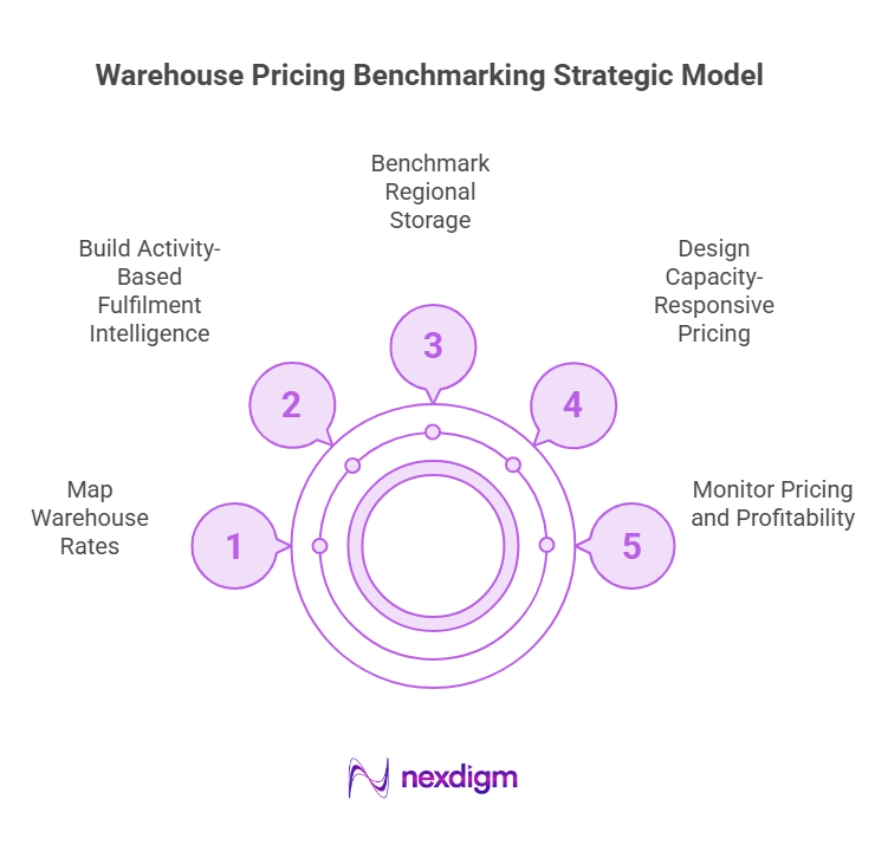
- Map Warehouse Cost Structures: Storage expenses, labor costs, utilities, technology investments, equipment usage, and facility overheads are estimated to establish accurate cost baselines for warehouse pricing decisions.
- Build Activity-Based Fulfilment Intelligence: Picking, packing, sorting, labeling, returns processing, and dispatch activities are measured individually, helping businesses align prices with operational complexity and service intensity.
- Benchmark Regional Storage: Warehouse rents, occupancy costs, labor availability, and market rates are benchmarked across regions, enabling businesses to develop location-specific pricing strategies and competitive positioning.
- Design Capacity-Responsive Pricing: Storage utilization, seasonal demand, inventory levels, and space constraints are incorporated into pricing models, helping warehouses maximize revenue from available capacity while protecting margins.
- Monitor Pricing and Profitability: Occupancy trends, fulfilment productivity, price realization, customer profitability, and margin performance are tracked continuously, enabling businesses to recalibrate warehouse rates and strengthen commercial outcomes.
Nexdigm’s Case
Nexdigm supported a warehousing provider with pricing analysis, fulfilment benchmarking, and capacity-based rate optimization across multiple distribution centers. The initiative increased warehouse utilization by 16%, improved fulfilment margins by 12%, and reduced storage-cost leakage, enabling stronger pricing governance, higher profitability, and more sustainable commercial growth.
To take the next step, simply visit our Request a Consultation page and share your requirements with us.
Harsh Mittal
+91-8422857704