

In a fast-changing logistics environment, operators are under constant pressure to optimize warehouse capacity, control labor expenses, and maximize returns on automation investments. Warehousing pricing strategy consulting helps businesses develop data-driven pricing models that align operational costs with customer demand and market conditions.
By leveraging pricing analysis services, warehouse operators can evaluate storage utilization, workforce productivity, transportation expenses, and automation efficiency to create profitable pricing structures. Effective pricing strategies improve cost recovery, strengthen competitiveness, and support long-term scalability.
Studies show that labor accounts for nearly 50–70% of total warehouse operating costs, while automation can improve productivity by up to 30%. Advanced Pricing Analysis Services enable operators to identify cost drivers, optimize pricing models, and improve profit margins through data-backed decisions.
Warehousing Pricing Analysis for Capacity, Labor, and Automation Optimization
Warehousing pricing analysis helps operators align pricing with capacity utilization, labor expenses, and automation investments, enabling stronger margins, efficient resource allocation, competitive rates, and sustainable operational growth. Core benefits of warehousing pricing analysis can be mentioned as:
- Optimize Warehouse Capacity Utilization: Pricing analysis identifies underused and high-demand storage capacity, helping operators establish differentiated pricing structures that improve space utilization, increase revenue per location, and reduce capacity-related inefficiencies.
- Control Labor-Driven Operating Costs: By assessing labor requirements, productivity, overtime, and fulfillment complexity, pricing analysis helps warehouses accurately recover workforce costs while protecting margins and maintaining competitive service pricing.
- Improve Returns on Automation Investments: Pricing analysis connects automation costs with productivity gains and service volumes, enabling operators to structure prices that recover technology investments while capturing efficiencies generated through automated warehouse processes.
- Strengthen Pricing Accuracy and Profit Margins: Detailed cost and profitability analysis helps operators determine appropriate pricing for storage, handling, fulfillment, and value-added services, reducing underpricing risks and strengthening contribution margins across customer accounts.
Nexdigm’s Pricing Analysis Expertise for Profitable Warehouse Operations
Nexdigm delivers specialized pricing analysis services to help warehouse operators evaluate cost structures, capacity utilization, labor expenses, automation investments, and customer profitability. Through data-driven pricing strategy analysis, cost-to-serve analysis, profitability analysis, and pricing optimization consulting, Nexdigm supports informed pricing decisions that strengthen margins, improve cost recovery, enhance operational efficiency, and enable sustainable growth across increasingly complex warehousing operations.
Nexdigm’s Strategic Planning Model for Warehouse Pricing and Margin Improvement
Nexdigm’s strategic planning model helps warehouse operators align pricing with costs, capacity, labor, and automation through structured strategies that improve margins, competitiveness, and long-term profitability. Some important strategies referred by experts, for this model are:
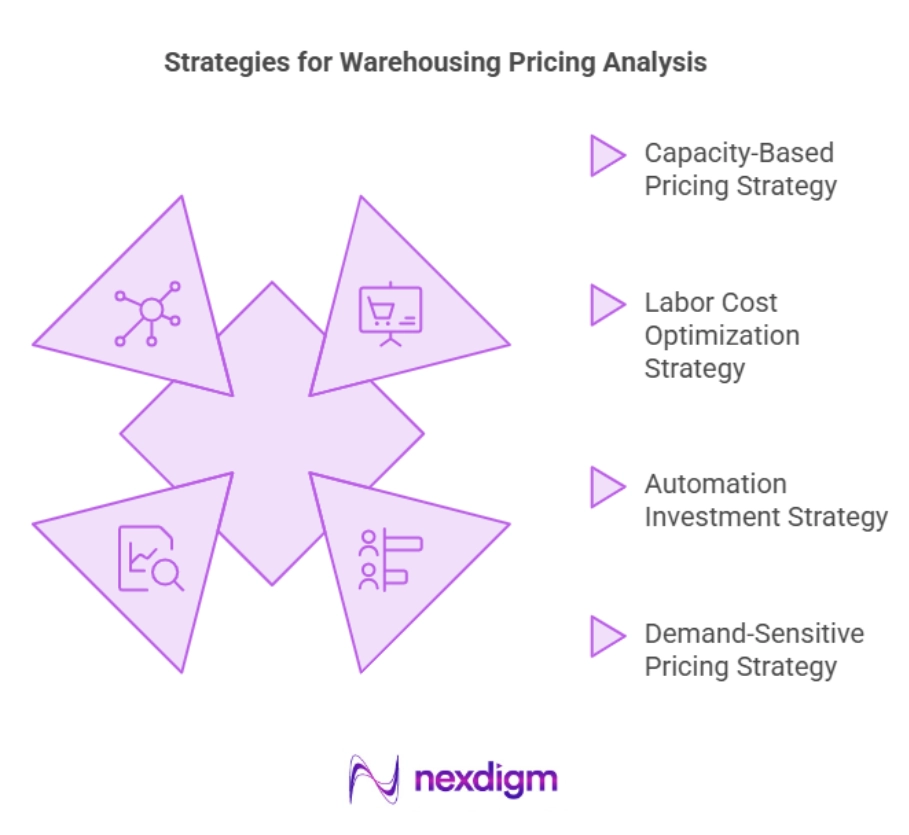
- Capacity-Based Pricing Strategy: Use warehouse utilization, demand patterns, and available capacity to develop flexible pricing strategies that improve space efficiency and maximize revenue opportunities.
- Labor Cost Optimization Strategy: Assess workforce productivity, overtime, service complexity, and labor intensity to create pricing structures that recover staffing costs while maintaining competitive customer rates.
- Automation Investment Strategy: Link automation investments with productivity improvements and transaction volumes to design pricing strategies that support technology cost recovery and stronger investment returns.
- Demand-Sensitive Pricing Strategy: Adjust pricing according to seasonal demand, storage pressure, order volumes, and service urgency to capture revenue opportunities while maintaining operational flexibility and profitability.
Nexdigm’s Case
Nexdigm supported a warehouse operator with cost-to-serve and pricing analysis, identifying potential pricing gaps across customer segments. The resulting pricing roadmap indicated opportunities for approximately 8–12% margin improvement and 10% better capacity monetization, subject to implementation and operating conditions.
To take the next step, simply visit our Request a Consultation page and share your requirements with us.
Harsh Mittal
+91-8422857704