

 Download PDF
Market Overview
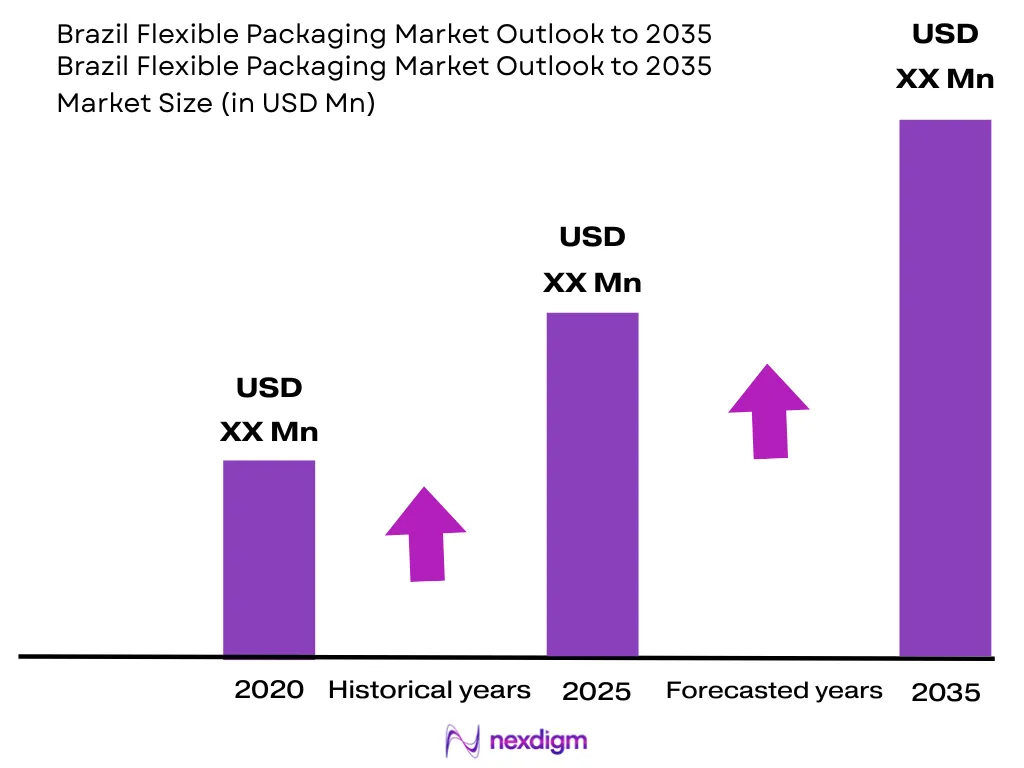
The Brazil Flexible Packaging Market was valued at USD ~ Million in 2024 and is anticipated to expand at a CAGR of ~% during 2026–2035. The market is primarily driven by rising demand for packaged and snacked food products, growing adoption of recyclable polyethylene by domestic manufacturers, and continued capacity expansion by multinational food companies operating in Brazil. According to Knowledge Sourcing Intelligence, the Brazil Flexible Packaging Market is projected to grow from USD ~ billion in 2026 to USD ~ billion by 2031, a CAGR of 4.59%, while Mordor Intelligence separately estimates the Brazil Flexible Plastic Packaging Market at 0.87 million tonnes in 2025, growing to 1.07 million tonnes by 2030 at a 4.16% CAGR. Brazil represents the largest single market within the broader Latin America flexible packaging industry, which Expert Market Research values at USD ~ million in 2024, growing at a CAGR of 2.90% through 2034.
Market Segmentation
By Material
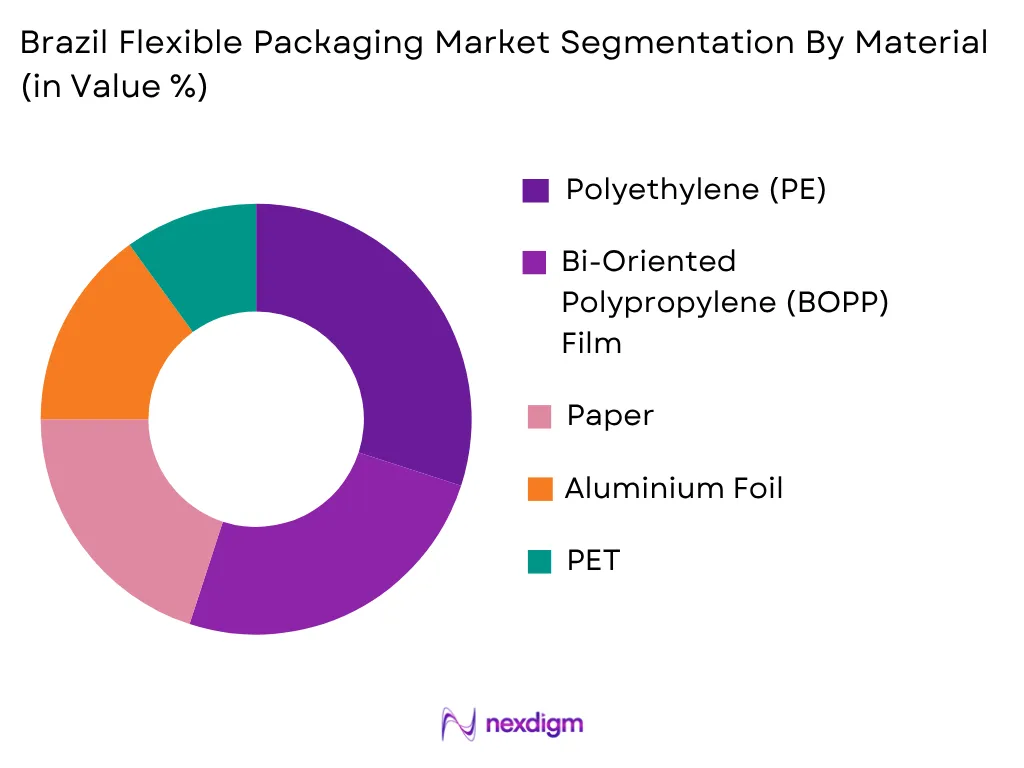
Among these, Polyethylene (PE) dominates the Brazil Flexible Packaging Market owing to its lightweight versatility, cost efficiency, and suitability across food, beverage, and industrial packaging applications. Many Brazilian manufacturers are increasingly embracing recyclable polyethylene to respond to a rising tide of eco-conscious consumers, reducing waste and lessening dependence on virgin materials, according to Mordor Intelligence. Bi-Oriented Polypropylene (BOPP) Film also maintains a significant share, particularly across snack food and confectionery packaging, while Aluminium Foil remains important for high-barrier applications in pharmaceutical and premium food packaging. Brazil produced 53,390 tonnes of forestry resin in 2022, according to Expert Market Research, providing a domestic feedstock base that complements the country’s reliance on imported plastic resins, with Brazil’s plastic imports surging 1.42% in 2023 compared to the previous year, driven notably by shipments from Uruguay, Paraguay, and China, according to the International Trade Centre.
By Application
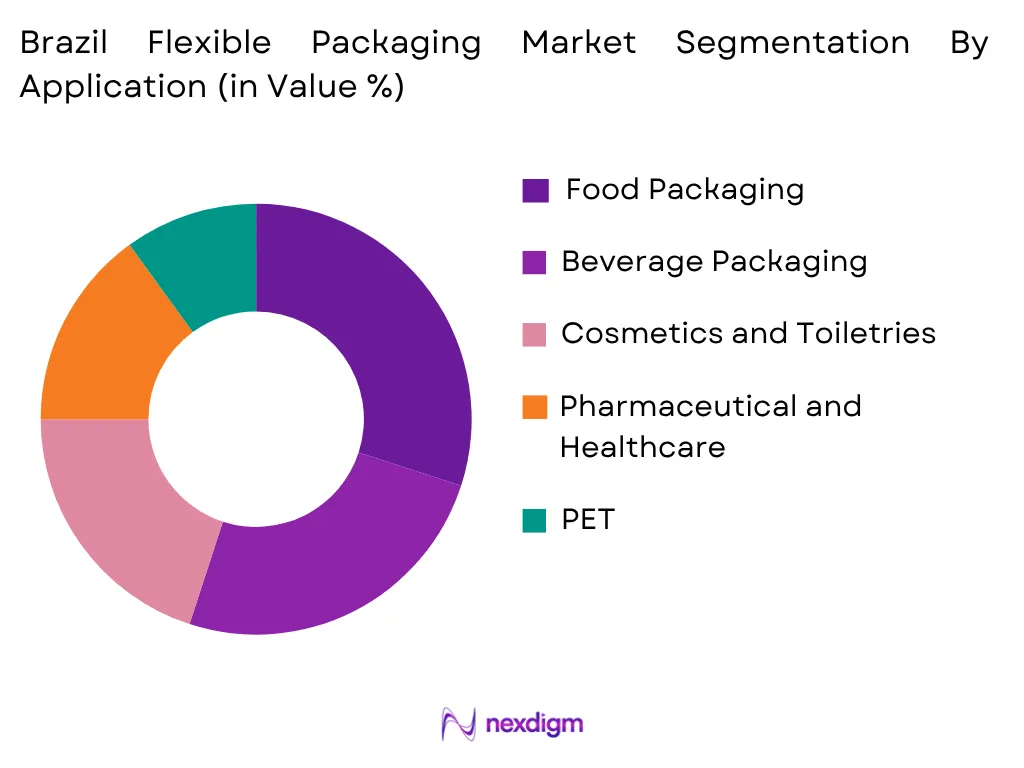
The Food Packaging segment, encompassing processed food products, bakery products, pet food products, and fruits and vegetables, commands the largest share of the Brazil Flexible Packaging Market, driven by changing consumer food preferences, a surge in food industry innovation, and heightened awareness of healthy eating that is fuelling Brazil’s escalating food consumption. This shift is underscored by rising demand for snacked goods, as time-pressed consumers seek convenient eating options, driving a notable uptick in preference for bags and pouches across the country. The introduction of novel flavours, including salt, pepper, cheese, and barbecue variants in the Brazilian savoury snacks segment, resonates strongly with consumers and has prompted global players such as PepsiCo to expand their Brazilian manufacturing footprint, announcing in October 2023 plans to expand its snacking plant to produce popular products including Cheetos and Cebolitos. The Beverage Packaging segment is also expanding, exemplified by SIG Group’s March 2024 strategic alliance with Brazilian dairy firm DPA Brasil to roll out spouted pouch packaging, featuring a SIG CloverCap closure, for the Chamyto yogurt brand.
Competitive Landscape
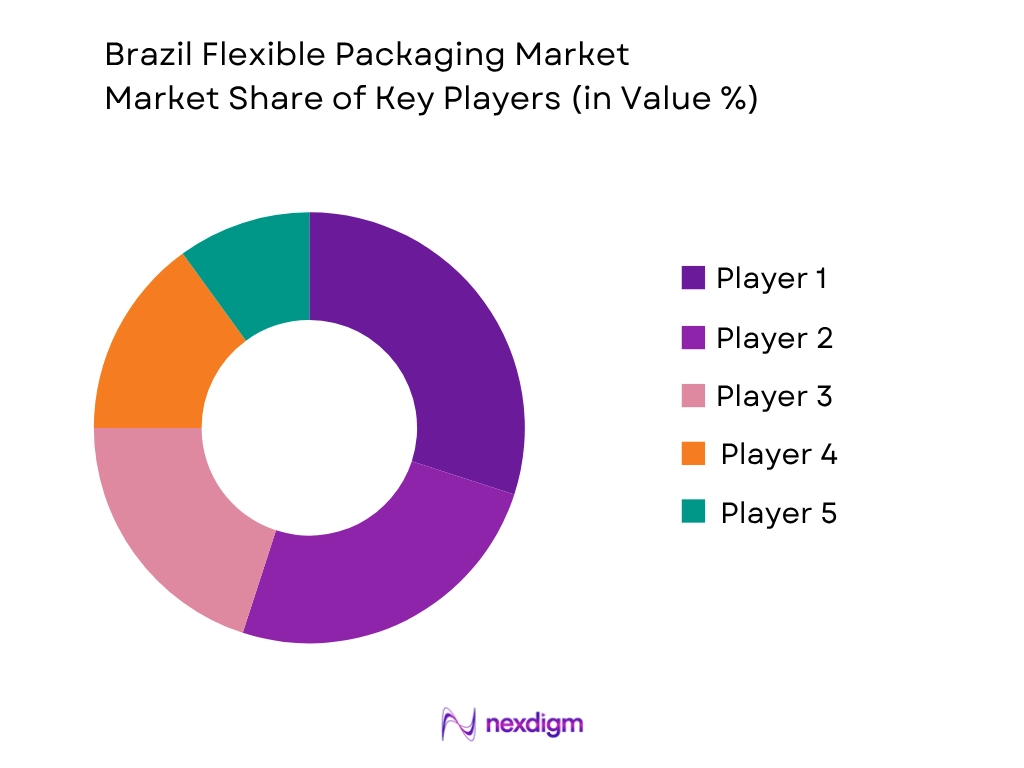
The Brazil Flexible Packaging Market combines large multinational packaging companies with established domestic manufacturers built up over decades of Brazilian industrial history. Videplast, founded in 1986 in Videira, Santa Catarina, has grown into one of the largest flexible plastic packaging producers in Brazil, operating multiple industrial sites across the country including Videira, Várzea Grande, Três Rios, and União da Vitória. Klabin S.A., founded in 1899 and headquartered in São Paulo, is Brazil’s largest paper producer and exporter, operating 24 industrial plants and supplying packaging paper and board across the food, beverage, and industrial sectors. Multinational players have been particularly active in Brazilian M&A: Sonoco Products Company acquired the remaining one-third stake in its Sonoco do Brasil Participacoes joint venture in April 2022 and further acquired Inapel Embalagens Ltda. in December 2023 to expand its flexible packaging service capabilities, while Amcor PLC and Huhtamaki Oyj maintain substantial manufacturing operations serving Brazil’s food, beverage, and personal care industries.
| Company | Establishment Year | Headquarters | Primary Product Portfolio | Flexible Packaging Portfolio
|
Manufacturing Presence | Major End-Use Industries | Key Strategic Focus | Certifications & Compliance |
| Videplast | 1986 | ~ | ~ | ~ | ~ | ~ | ~ | ~ |
| Klabin S.A. | 1899 | ~ | ~ | ~ | ~ | ~ | ~ | ~ |
| Sonoco Products Company | 1899 | ~ | ~ | ~ | ~ | ~ | ~ | ~ |
| Amcor PLC | 1896 | ~ | ~ | ~ | ~ | ~ | ~ | ~ |
| Huhtamaki Oyj | 1920 | ~ | ~ | ~ | ~ | ~ | ~ | ~ |
Brazil Flexible Packaging Market Analysis
Growth Drivers
Mandatory Cattle Traceability under MAPA’s National Livestock Traceability Plan
Brazil’s Flexible Packaging market is experiencing sustained growth due to the phased implementation of MAPA’s National Livestock Traceability Plan, launched in December 2024, which establishes mandatory individual identification for Brazil’s entire cattle and buffalo herd by 2032. Under the plan’s implementation schedule, a federal traceability system became operational in 2025, with integration of state-level systems planned for 2026 and mandatory individual identification phased in progressively across Brazilian states between 2027 and 2029, expanding to full national coverage by 2032. Decree No. 12,189 has introduced significantly stricter non-compliance penalties, with property owners failing to meet traceability requirements facing fines of up to BRL 50 million, with penalties potentially doubled in more severe cases, creating strong regulatory pressure for ranch operators and meatpacking plants to invest in compliant identification and tracking infrastructure. This regulatory mandate, combined with Brazil’s existing SISBOV program used for animals destined for premium export markets, continues to drive substantial investment in RFID ear tags, electronic identification readers, and integrated database systems throughout the country’s livestock supply chain.
Rising Export Compliance Demands from Key Trading Partners
Brazil’s role as one of the world’s largest exporters of beef, soybeans, and coffee continues to expose the country’s agricultural supply chains to increasingly stringent traceability requirements from major trading partners. The European Union’s Deforestation Regulation, which took effect on December 30, 2025, requires operators and traders exporting cattle, soy, coffee, palm oil, timber, rubber, and cocoa to the EU to provide verifiable production information, including geolocation data of areas of origin, and to demonstrate compliance with environmental and legal requirements in the country of production. China, which accounts for approximately 48% of Brazil’s beef export volume, has also intensified traceability requirements, with a 2024 pilot beef traceability project between Brazilian and Chinese authorities exploring alignment of emission measurement methodologies and integration with China’s General Administration of Customs e-CIQ digital inspection framework. Brazilian beef exports reached record levels in 2025, with export revenue growing approximately 40%, reinforcing the commercial importance of maintaining robust traceability systems capable of satisfying diverse international regulatory requirements simultaneously.
Market Challenges
Fragmented Implementation and Smallholder Cost Burden
Brazil’s Flexible Packaging market faces significant implementation challenges stemming from the fragmented and gradual rollout of the National Livestock Traceability Plan across a cattle herd of more than 238 million animals. Industry investigations have found that many Brazilian farmers, particularly smallholders, view the 2032 mandatory compliance timeline as unworkable given the substantial cost and infrastructure requirements associated with individual electronic identification. Animal identification in Brazil has historically relied on ranch branding rather than individual traceability, and current voluntary systems such as SISBOV allow feedlot operators to apply export-eligible tags to animals without verified correlation to their birth location or movement history, undermining the credibility of end-to-end traceability claims. Without strong buy-in from the full spectrum of Brazilian producers, from large-scale commercial operations to smallholder ranches, achieving the traceability coverage required to meet both domestic regulatory targets and increasingly strict export market requirements remains a substantial implementation challenge for technology providers and policymakers alike.
Interoperability Gaps Across Federal, State, and Private Systems
Brazil’s Flexible Packaging ecosystem currently comprises multiple parallel systems, including MAPA’s SISBOV individual identification program, the Animal Transport Guide (GTA), the Agricultural Management Platform (PGA) used to collect livestock transport data, various state-level Animal Health Agency (OESA) systems, and private supplier-tracking protocols independently developed by major meatpacking companies. This fragmentation creates significant interoperability challenges, as data captured in one system frequently cannot be seamlessly cross-referenced with records in another, complicating efforts to build a unified, auditable traceability record from farm to export. A 2024 European Commission audit found that it could not guarantee that Brazilian beef imports to the EU originated exclusively from hormone-free cattle, highlighting persistent gaps in the verification chain despite Brazil’s existing traceability infrastructure. Reconciling federal, state, and private systems into a coherent, internationally credible traceability framework remains a significant technical and institutional challenge for both government agencies and private technology providers operating in the Brazilian market.
Market Opportunities
Expansion of Satellite-Based Deforestation Monitoring Solutions
The European Union’s Deforestation Regulation, requiring verifiable geolocation data and deforestation-free sourcing documentation for commodities including cattle, soy, and coffee exported to the EU, has created substantial opportunity for Brazilian and international technology providers specializing in satellite-based monitoring and geospatial compliance verification. Companies such as Agrotools have developed platforms that cross-reference Rural Environmental Registry (CAR) data, satellite imagery, and environmental embargo lists maintained by IBAMA to help exporters demonstrate deforestation-free supply chains. The Federal Data Processing Service (SERPRO) has also begun developing platforms intended to organize and standardize access to public compliance databases in support of EUDR alignment. As more Brazilian exporters across the cattle, soy, and coffee sectors seek to maintain access to the European market ahead of and following the EUDR’s December 2025 effective date, demand for integrated satellite monitoring, geolocation verification, and deforestation risk-screening technologies is expected to expand substantially across Brazil’s major agricultural export regions.
China Market Access and Bilateral Traceability Protocol Development
Brazil’s deepening trade relationship with China, which accounts for approximately 48% of the country’s beef export volume, creates significant opportunity for traceability technology providers supporting bilateral compliance protocols. The 2024 pilot beef traceability project between Brazilian and Chinese regulatory authorities, focused on aligning emission measurement methodologies and integrating with China’s General Administration of Customs e-CIQ digital inspection framework, signals growing institutional interest in deeper traceability integration between the two countries. RFID-based systems capable of supporting batch reading at port facilities such as Santos and Paranaguá, combined with tamper-evident cold-chain monitoring for refrigerated exports, are increasingly positioned to meet both MAPA’s SISBOV requirements and China’s import protocols simultaneously. As negotiations progress on joint protocols for meat and soy certification, technology providers capable of delivering interoperable solutions that satisfy multiple export market requirements through a single integrated system are well positioned to capture growing demand from Brazilian exporters seeking to diversify and deepen their access to the Chinese market.
Future Outlook
The Brazil Flexible Packaging Market is expected to witness sustained expansion over the forecast period, supported by the phased implementation of MAPA’s National Livestock Traceability Plan through 2032, growing compliance requirements under the EU Deforestation Regulation, and deepening bilateral traceability cooperation with China. Continued investment in satellite monitoring, blockchain-based verification, and RFID identification infrastructure will further accelerate market growth as Brazilian exporters work to maintain access to increasingly demanding international markets. The market is also likely to benefit from growing integration between traceability platforms and precision agriculture technologies, as Brazil’s agricultural sector continues to digitalize across both large-scale commercial operations and, gradually, smallholder production.
Major Players
- Allflex Livestock Intelligence
- IBM
- SGS SA
- Bureau Veritas
- Agrotools
- Zoetis
- Datamars
- SAP
- TE-FOOD (FoodChain ID)
- Neogen Corporation
- Where Food Comes From, Inc.
- FoodLogiQ
- Trustwell
- Solinftec
- GS1 Brasil
Key Target Audience
- Flexible Packaging Technology Providers
- Meatpacking Plants & Slaughterhouses
- Grain & Soybean Exporters
- Coffee Producers & Cooperatives
- Food Retailers & Supermarkets
- Investment and Venture Capitalist Firms
- Government and Regulatory Bodies (Ministry of Agriculture, Livestock and Supply (MAPA), National Health Surveillance Agency (ANVISA), Federal Data Processing Service (SERPRO))
- Logistics, Cold Chain, and Port Operators
Research Methodology
Step 1: Identification of Key Variables
The research process begins with identifying the complete ecosystem of the Brazil Flexible Packaging Market, including technology providers, hardware manufacturers, certification bodies, food producers and exporters, logistics operators, and regulatory authorities. Extensive secondary research is conducted using company annual reports, government publications, trade associations, customs statistics, industry journals, and proprietary databases to determine the variables influencing market demand, pricing, deployment volumes, and technological developments.
Step 2: Market Analysis and Construction
Historical market information is collected and analyzed to estimate market size, deployment volumes, export compliance activity, application-wise demand, and pricing trends. A combination of top-down and bottom-up approaches is used to estimate market revenues and validate segment-level performance. Adoption patterns across livestock, grain, coffee, and processed Flexible Packaging are evaluated to establish an accurate representation of the industry.
Step 3: Hypothesis Validation and Expert Consultation
The preliminary findings are validated through Computer-Assisted Telephone Interviews (CATIs) and structured discussions with traceability technology providers, export compliance managers, certification auditors, agricultural cooperatives, regulatory experts, and senior executives operating within the Brazilian agribusiness sector. These interviews help verify market assumptions, competitive developments, technology adoption trends, pricing dynamics, and future investment opportunities while refining the overall market estimates.
Step 4: Research Synthesis and Final Output
The final stage integrates insights obtained from primary interviews with quantitative information collected through secondary sources. Data triangulation techniques are applied to reconcile differences between supply-side and demand-side estimates, ensuring robust market forecasting. The report is then reviewed through multiple quality assurance checkpoints to deliver a comprehensive analysis covering market size, segmentation, competitive landscape, future outlook, and strategic recommendations for industry stakeholders.

- Executive Summary
- Research Methodology (Market Definitions and Assumptions, Abbreviations, Market Sizing Approach, Top-Down Analysis, Bottom-Up Analysis, Demand-Side Assessment, Supply-Side Assessment, Primary Industry Interviews, Secondary Research Validation, Data Triangulation, Forecasting Framework, Limitations and Future Conclusions)

- Definition and Scope
- Market Evolution and Industry Genesis
- Timeline of Major Industry Developments
- Flexible Packaging Industry Value Chain Analysis
- Supply Chain Analysis

- Growth Drivers (Growth of Packaged Snack Food Consumption, Rising Adoption of Recyclable Polyethylene, Expansion of E-Commerce Fulfilment Packaging, Growth of Dairy and Beverage Pouch Packaging, Multinational Snack Manufacturer Capacity Expansion, Convenience-Oriented Consumer Lifestyles)
- Market Challenges (Recycling Complexity of Multi-Layer Structures, Rising Plastic Import Dependency, Environmental and Regulatory Pressure on Plastics, Raw Material Price Volatility, Currency Fluctuation Risk, High Capital Cost of Recycling Technology)
- Market Opportunities (Mono-Material Recyclable Film Development, Spouted Pouch Format Expansion, Aseptic Carton Recycling Technology, Sustainable Packaging Certification Growth, Digital Printing for Short-Run Customisation, Export-Oriented Flexible Packaging Manufacturing)
- Market Trends (Shift Toward Mono-Material Recyclable Films, Growth of Spouted and Stand-Up Pouches, Lightweighting of Flexible Formats, Easy-Open and Resealable Feature Adoption, Consolidation Through Acquisitions, Aluminium-Polymer Separation Recycling Technology)
- Government Regulations (National Solid Waste Policy (PNRS), ANVISA Food Contact Packaging Regulations, INMETRO Packaging Standards, Extended Producer Responsibility Requirements, Recycling and Reverse Logistics Mandates, Import Compliance)
- Import and Export Analysis (Plastic Resin Import Volume, Major Import Sources (Uruguay, Paraguay, China), Export Destinations, HS Code Analysis, Trade Balance)
- Raw Material Availability Analysis (Domestic Forestry Resin Production, Polyethylene Resin Supply, BOPP Film Supply, Recycled Polymer Availability, Aluminium Foil Supply)
- Technology Landscape (Cast and Blown Film Extrusion, Multi-Layer Lamination, Flexographic and Rotogravure Printing, Aluminium-Polymer Separation Recycling, Spouted Pouch Filling Technology)
- Sustainability Assessment (Recyclable Polyethylene Adoption, Mono-Material Film Development, Aseptic Carton Recycling, Reverse Logistics and Collection Programmes, Reduced-Layer Packaging Design)
- PESTLE Analysis
- SWOT Analysis
- Porter’s Five Forces Analysis
- Stakeholder Ecosystem
- Competition Ecosystem

- By Market Value (2020-2025)
- By Volume Consumption (2020-2025)
- By Average Selling Price (2020-2025)

- By Material (In Value %)
Polyethylene (PE)
Bi-Oriented Polypropylene (BOPP) Film
Paper
Aluminium Foil
PET
Others (CPP, PVC, EVOH) - By Product Type (In Value %)
Pouches
Bags and Sacks
Films and Wraps
Sachets
Stick Packs
Labels - By Application (In Value %)
Food Packaging
Beverage Packaging
Cosmetics and Toiletries
Pharmaceutical and Healthcare
Others - By End User (In Value %)
Food and Beverage Manufacturers
Personal Care and Cosmetics Manufacturers
Pharmaceutical Manufacturers
Retailers and E-Commerce Fulfilment
Industrial and Agricultural Users - By Region (In Value %)
Southeast Brazil
South Brazil
Northeast Brazil
Central-West Brazil
North Brazil

- Market Share of Major Players (By Value, Volume, Material Type, Application Industry, Product Category)
- Cross Comparison Parameters (Product Portfolio Breadth, Recyclable Material Capability, Printing Technology Range, Application Technical Support Capability, Manufacturing Capacity, Regulatory Compliance & Certifications, Customer Base Across Industries, Innovation & New Product Launch Frequency)
- SWOT Analysis of Major Players
- Pricing Analysis by Product Category and Material
- Production Capacity Analysis
- Manufacturing Footprint Analysis
- Distribution Network Analysis
- Innovation Benchmarking
- Detailed Profiles of Major Companies
Amcor PLC
Sonoco Products Company
Huhtamaki Oyj
Berry Global Inc.
Sealed Air Corporation
SIG Group AG
Constantia Flexibles Group GmbH
Mondi plc
Gualapack S.p.A.
Guala Pack S.p.A.
Graphic Packaging Holding Company
Klabin S.A.
Videplast
Plaszom Zomer Indústria de Plásticos Ltda.
Saberpack Embalagens Flexíveis

- Consumption Pattern Analysis (Industrial Usage, Batch Size, Product Category Penetration, Seasonal Demand, Reformulation Activity)
- Purchasing Criteria (Barrier Performance, Recyclability, Cost Efficiency, Print Quality, Supply Consistency, Shelf Life Extension)
- Procurement and Supplier Selection Analysis
- Sustainable Packaging Adoption Assessment
- Premium vs Conventional Packaging Demand
- Product Attribute Preference Analysis (Barrier Properties, Seal Integrity, Recyclability, Print Definition, Lightweighting, Ease of Opening)
- Consumer Sustainability Influence on Packaging Choice
- Pain Point Analysis
- Decision-Making Process

- By Market Value (2026-2035)
- By Volume Consumption (2026-2035)
- By Average Selling Price (2026-2035)


 Request a Sample
 Ask for Customization
 Get a Quote
 Enquire Now