

 Download PDF
Market Overview
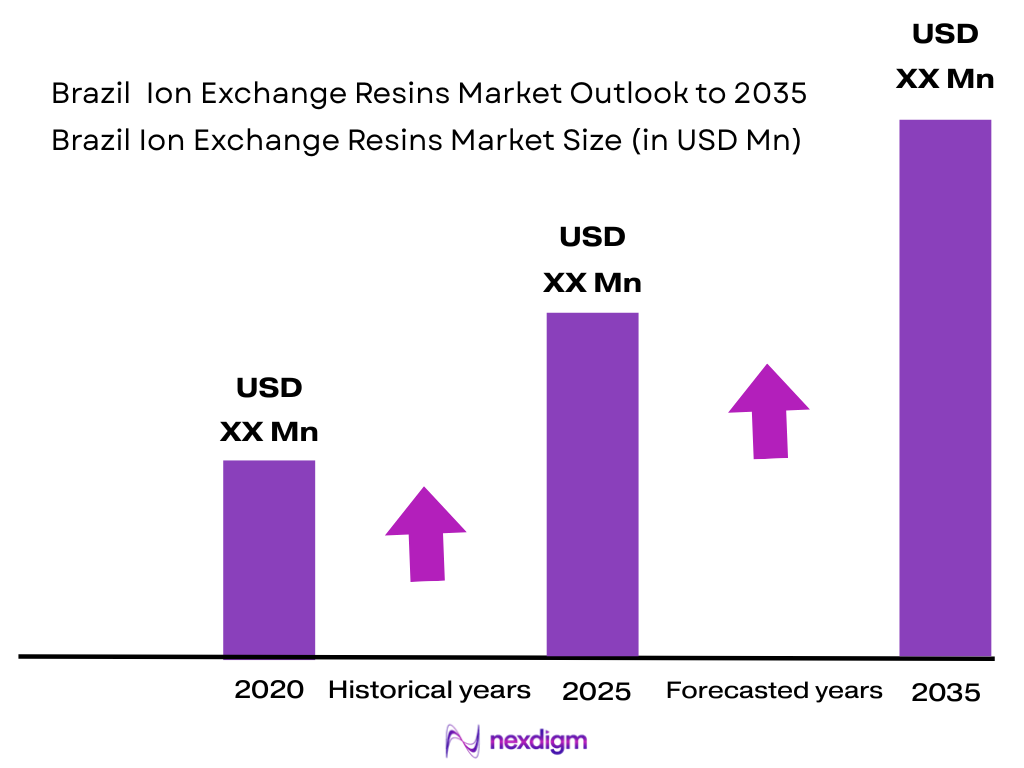
The Brazil Ion Exchange Resins Market expanded from approximately USD ~ million to USD 49.4 million across the two latest historical observations, reflecting sustained demand from industrial water treatment, demineralization, sugar processing, power utilities, mining, pharmaceuticals, and chemical processing. Grand View Research reports the latest market value at USD 49.4 million, with cationic resin identified as the leading product category. Expansion of water-reuse systems, replacement of exhausted resin beds, and higher process-water quality requirements continue supporting consumption.
São Paulo and Minas Gerais are the principal demand centers, supported by their concentration of industries requiring treated process water and ion-selective purification. São Paulo is Brazil’s largest industrial state and has substantial chemical, pharmaceutical, food-processing, machinery, sugar and ethanol operations, while Minas Gerais has a large mining, metallurgy and industrial-processing base. Brazil’s Center-South also produces more than 40 million tonnes of sugar, reinforcing demand for purification and decolorization technologies used within sugar-processing operations.
Market Segmentation
By Resin Type
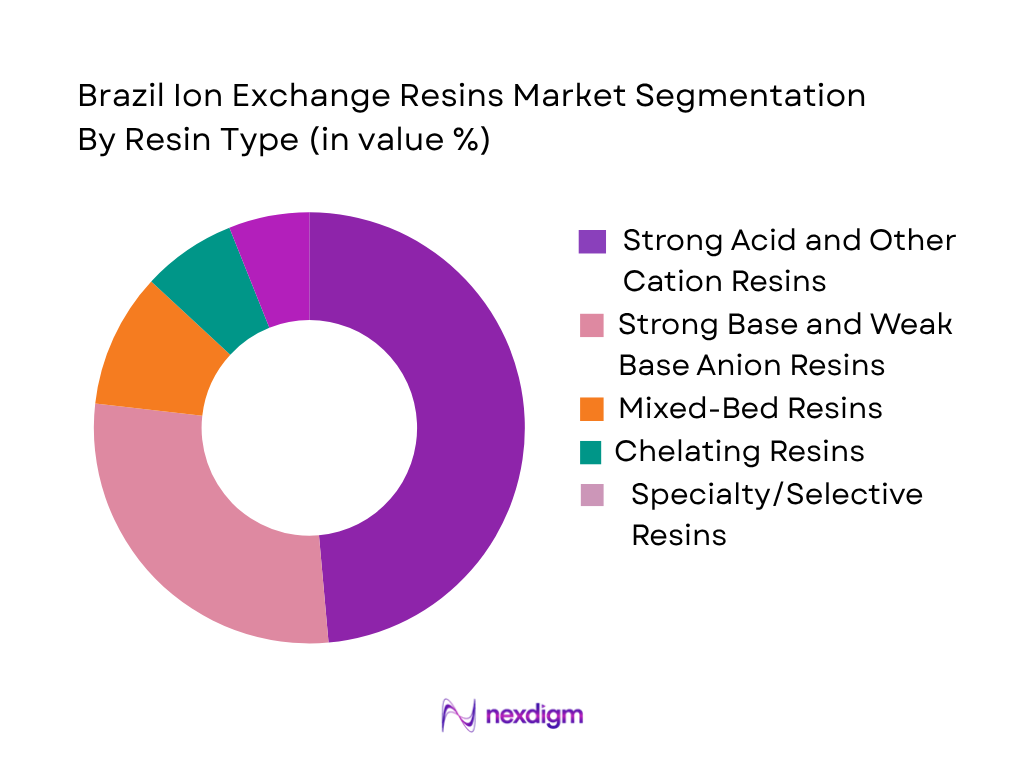
The Brazil Ion Exchange Resins Market is segmented by resin type into Strong Acid Cation Resins, Weak Acid Cation Resins, Strong Base Anion Resins, Weak Base Anion Resins, Mixed-Bed Resins, Chelating Resins, and Specialty/Selective Resins. Within this segmentation, cationic ion exchange resins represent the dominant individual category, supported by extensive utilization in industrial water softening, boiler feed-water conditioning, demineralization and hardness removal. Grand View Research identifies cationic resin as the largest revenue-generating product category in Brazil, with a reported share of 48.18%. Strong-acid cation systems are particularly important because Brazilian industrial users frequently require removal of calcium, magnesium and other positively charged ions before downstream membrane, boiler or process systems. Their mature operating economics, regenerability using acid or sodium chloride solutions, broad compatibility with industrial treatment systems and large installed base sustain recurring replacement demand. Weak-acid cation and specialty chelating products address narrower dealkalization, metal recovery and selective-removal applications.
By Application
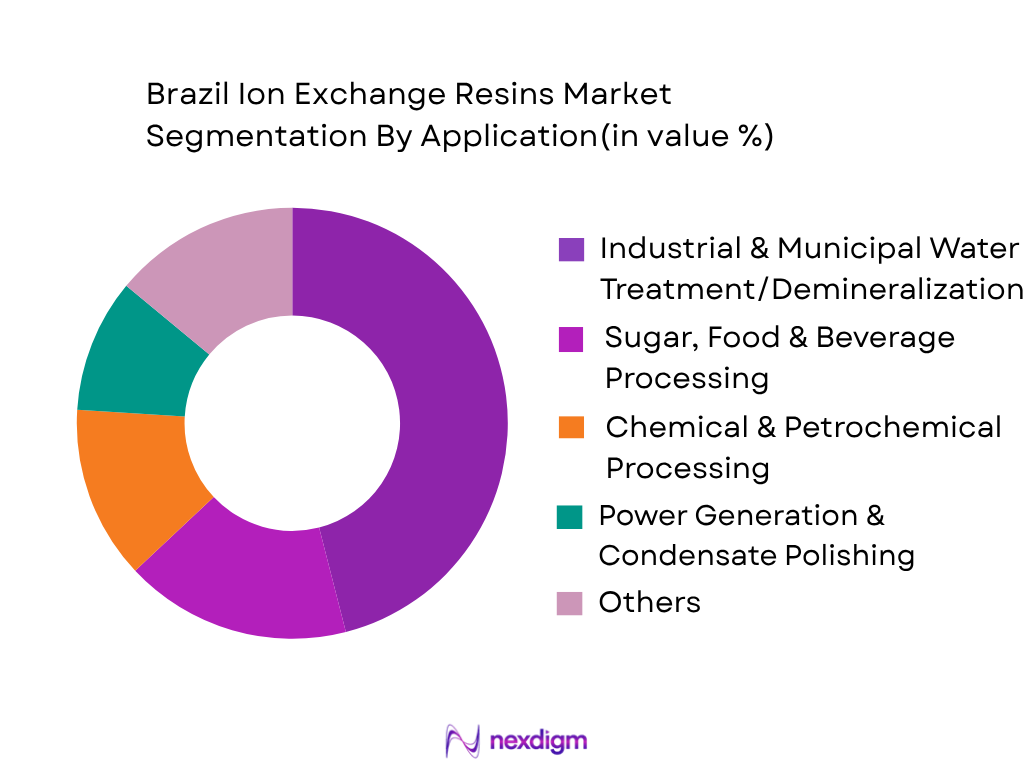
The Brazil Ion Exchange Resins Market is segmented by application into water softening and demineralization, boiler feed-water and condensate polishing, municipal and industrial water treatment, sugar and food processing, chemical and petrochemical processing, mining and metal recovery, pharmaceutical purification, and other specialty applications. Water treatment and demineralization form the principal application base, reflecting Brazil’s extensive industrial processing infrastructure and the recurring need to control hardness, conductivity, silica and dissolved ionic contaminants. International ion-exchange studies similarly identify water treatment as the largest end-use base, while Brazil-specific market coverage emphasizes the role of industrial water-treatment investment. Demand is reinforced by power plants, refineries, chemical plants and manufacturing facilities operating ion-exchange beds after pretreatment or reverse osmosis. Sugar and ethanol processing provides an additional Brazil-specific demand pool because resins are employed in demineralization, deashing and purification. Mining creates demand for chelating and selective grades used for metals separation and wastewater polishing.
Competitive Landscape
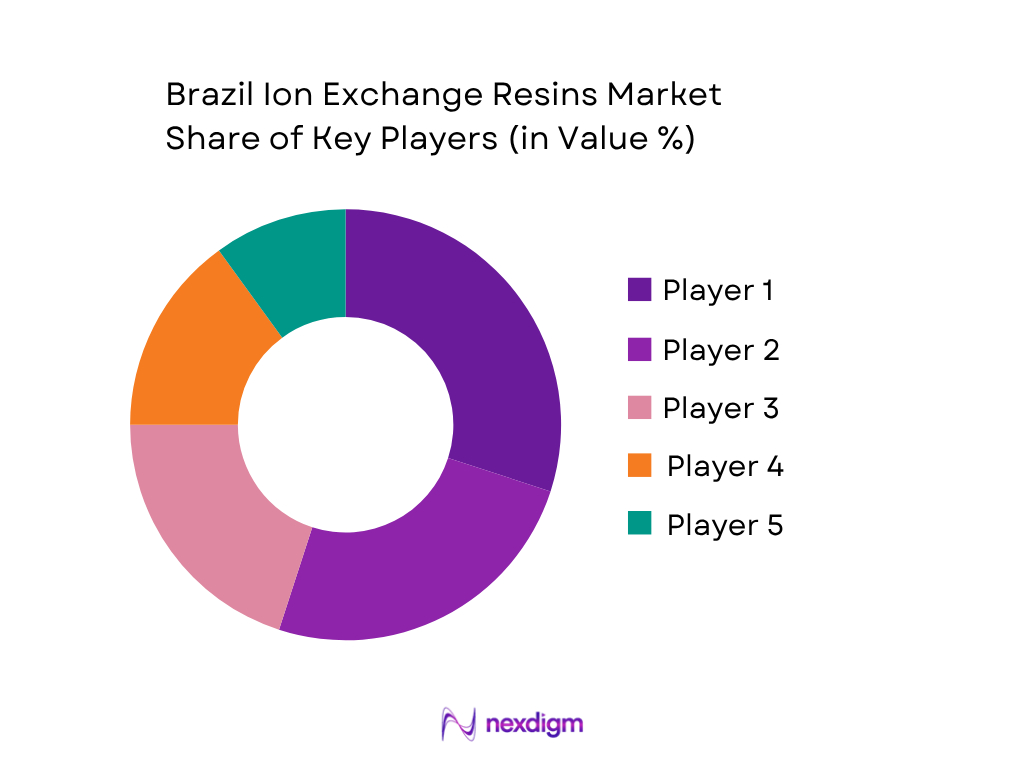
The Brazil Ion Exchange Resins Market has a combination of multinational resin manufacturers and specialist Asian and international suppliers serving customers through direct sales, distributors, water-treatment OEMs and EPC partners. DuPont, LANXESS, Ecolab/Purolite, Mitsubishi Chemical Group and Samyang Corporation constitute an important competitive group because of their broad resin portfolios, established ion-exchange technologies and ability to serve industrial, ultrapure-water and specialty purification applications. Mordor Intelligence also identifies DuPont, LANXESS, Mitsubishi Chemical, Ecolab and Samyang among the key participants relevant to the Brazilian market.
| Company | Establishment | Headquarters | Major Resin Brand | Core Resin Capability | Polymer/Technology Coverage | Key Applications | Specialty Capability | Brazil Market Approach |
| LANXESS AG | 2004 | Cologne, Germany | ~ | ~ | ~ | ~ | ~ | ~ |
| DuPont | 1802 legacy | Wilmington, USA | ~ | ~ | ~ | ~ | ~ | ~ |
| Ecolab / Purolite | 1923 / Purolite platform | St. Paul, USA | ~ | ~ | ~ | ~ | ~ | ~ |
| Mitsubishi Chemical Group | 1933 legacy | Tokyo, Japan | ~ | ~ | ~ | ~ | ~ | ~ |
| Samyang Corporation | 1924 group roots | Seoul, South Korea | ~ | ~ | ~ | ~ |
Brazil Ion Exchange Resins Market Analysis
Growth Drivers
Industrial Water, Wastewater Treatment and Sanitation Infrastructure Expansion
Brazil’s expanding water and wastewater infrastructure is a direct demand driver for ion exchange resins used in softening, demineralization, polishing and selective contaminant removal. The World Bank records Brazil’s 2024 GDP at USD 2.1858 trillion, supported by a population of approximately 205.3 million, demonstrating the industrial and utility scale supporting water-treatment consumption. BNDES reported 10 sanitation projects under preparation during 2024, while projects under structuring across Pará, Pernambuco, Rondônia, Paraíba, Maranhão, Goiás, Minas Gerais, Alagoas, Rio Grande do Norte and Porto Alegre collectively covered about 35 million people. The Sergipe water and sewage concession was designed to serve 2.3 million people, while the Pará concession covers approximately 5.1 million people. Separately, BNDES-backed Águas de Manaus infrastructure is designed to provide an additional 1.47 million inhabitants with sewer-network access and another 250,000 inhabitants with treated-water access. This expanding treatment footprint increases the addressable installed base for ion-exchange systems, particularly for industrial polishing, municipal contaminant removal, tertiary treatment and water-reuse applications. Sources: World Bank World Development Indicators; BNDES Annual Report 2024.
Large Sugar, Ethanol and Process-Industry Base Supporting Resin Consumption
Brazil’s large sugar-energy processing base creates recurring demand for ion exchange resins used in process-water conditioning, demineralization, deashing, condensate treatment, ionic impurity removal and specialty purification. According to Brazil’s Energy Research Office, EPE, 686 million tonnes of sugarcane were processed during 2024, alongside 17.3 million tonnes of corn consumed for ethanol manufacture. National sugar production reached 44.3 million tonnes, while ethanol output reached a record 37.3 billion litres, comprising 29.7 billion litres produced from sugarcane and 7.7 billion litres produced from corn. Hydrous ethanol production totaled 24.4 billion litres, while anhydrous ethanol output reached 13.0 billion litres. These operating volumes create substantial requirements for boiler feed-water preparation, condensate polishing, process-water purification and treatment of recycled process streams across mills and integrated biorefineries. The supporting macroeconomic environment is also substantial: World Bank data place Brazil’s 2024 GDP at USD 2.1858 trillion and GDP per capita at USD 10,310.5. The combination of high-throughput agro-industrial processing and stringent internal water-quality requirements supports recurring consumption of strong-acid cation, strong-base anion and specialty separation resins. Sources: EPE Biofuels Current Outlook 2024; World Bank World Development Indicators.
Market Challenges
High Dependence on Imported Ion Exchange Resin Supply
Brazil’s reliance on imported ion exchange materials presents a structural challenge for industrial buyers requiring stable availability, qualification continuity and short replacement lead times. World Bank WITS data based on UN Comtrade show that Brazil imported 3,405,440 kilograms of polymer-based ion exchangers under HS 391400 during 2024, while exports amounted to only 315,675 kilograms. China supplied 1,443,240 kilograms, followed by the United States with 806,736 kilograms, Italy with 293,474 kilograms, South Korea with 247,057 kilograms, France with 209,085 kilograms, Germany with 154,319 kilograms, India with 147,097 kilograms and Japan with 43,356 kilograms. This geographically dispersed procurement base means Brazilian distributors and industrial end users must manage overseas production schedules, ocean freight, customs clearance, safety inventories and application-specific product qualification. The exposure is particularly relevant for specialty chelating, high-purity, mixed-bed and selective resins that cannot always be substituted immediately with another grade. Against a 2024 national GDP of USD 2.1858 trillion and an industrial economy operating across a territory of 8.5 million square kilometres, reliable regional inventory becomes commercially important. Sources: World Bank WITS/UN Comtrade; World Bank Brazil Country Data.
Dependence on Imported Polymer Feedstocks and Complex Resin Chemistry Supply Chains
The Brazil Ion Exchange Resins Market also faces upstream supply-chain exposure because resin manufacturing depends on polymer chemistry inputs such as styrenic feedstocks, crosslinking agents and functionalization chemicals. UN Comtrade data reported through the United Nations statistical system show that Brazil imported 225,986,048 kilograms of styrene during 2024. At the finished-product level, another 3,405,440 kilograms of polymer-based ion exchangers entered Brazil during the same period. This combination illustrates a market exposed both to internationally sourced finished resins and to imported inputs relevant to styrenic polymer manufacturing. Supply disruption is especially consequential for strong-acid cation, strong-base anion, uniform-particle, macroporous and specialty grades, where bead structure, crosslink density and functional-group consistency determine treatment performance. Brazil’s large economic base amplifies the operational significance of reliable supply: the World Bank records national GDP at USD 2.1858 trillion in 2024 and a population of 205.3 million. For industrial water-treatment operators, unplanned resin shortages can affect scheduled bed replacement, plant maintenance and qualification programs. Consequently, stocking strategy, multiple-country sourcing, distributor inventory and approved alternate grades remain essential competitive considerations for suppliers operating in Brazil. Sources: United Nations Comtrade; World Bank WITS; World Bank World Development Indicators.
Market Opportunities
Water-Reuse and Advanced Treatment Infrastructure Creates Specialty Resin Opportunity
Brazil’s active sanitation and water-treatment project pipeline creates a future opportunity for ion exchange suppliers positioned in polishing, reuse and contaminant-specific treatment rather than only conventional softening. BNDES reported 10 water and sanitation projects in preparation during 2024, with projects across several states and Porto Alegre collectively addressing approximately 35 million people. The institution’s approved Águas de Manaus project is designed to extend sewer-network access to more than 1.47 million inhabitants and treated-water access to another 250,000 inhabitants. The Verde Ambiental project in Alagoas is expected to provide sewer access to 195,000 additional inhabitants and treated water to 47,000 inhabitants, while the Sanesul project targets another 11,000 inhabitants for sewer connections and 1,900 inhabitants for treated-water service. Such projects enlarge Brazil’s treatment infrastructure and create opportunities for advanced polishing stages where ionic contaminants must be removed after conventional treatment or membranes. This opportunity is supported by Brazil’s 2024 economic scale of USD 2.1858 trillion in GDP and its 205.3 million inhabitants. Specialty anion, mixed-bed and selective resins can increasingly participate in water reuse, tertiary purification and decentralized industrial treatment systems. Sources: BNDES Annual Report 2024; World Bank World Development Indicators.
Mining and Metallurgical Processing Expands the Addressable Market for Selective Resins
Brazil’s mineral-processing scale provides a strong future opportunity for chelating and selective ion exchange resins used in metal recovery, impurity removal, hydrometallurgical separation, process-water purification and mine-water polishing. The Agência Nacional de Mineração reported that Brazilian beneficiated iron-ore production reached exactly 447,201,687 tonnes during 2024, compared with 436,839,409 tonnes in the preceding reporting period. Minas Gerais and Pará constitute the country’s principal iron-ore production centers, creating concentrated industrial zones where large volumes of process water circulate through beneficiation, concentration, utility and effluent-treatment systems. The ANM also received more than 13,500 Annual Mining Reports during its 2024 reporting campaign, illustrating the breadth of Brazil’s active mining ecosystem. These industrial operations create applications beyond conventional water softening: chelating resins can target dissolved metals, selective resins can separate specific ionic species, and conventional cation-anion systems can prepare process and boiler water. The opportunity operates within an economy that generated USD 2.1858 trillion of GDP in 2024, according to the World Bank. As mines pursue higher water recovery and more controlled process chemistry, specialty resin suppliers can target technically demanding, higher-value separation applications. Sources: Agência Nacional de Mineração; World Bank World Development Indicators.
Future Outlook
The Brazil Ion Exchange Resins Market is expected to maintain steady expansion as industrial users increase investment in process-water quality, wastewater recycling, demineralized water and higher-efficiency purification systems. Replacement demand from existing resin beds will remain an important recurring revenue source, while new industrial treatment capacity can increase fresh-fill resin requirements. Growth is also expected to become progressively more application-specific. Conventional strong-acid cation and strong-base anion grades will continue supporting large-volume industrial water treatment, whereas mixed-bed, chelating, uniform-particle-size and selective resins are likely to gain strategic importance in high-purity water, mining, pharmaceutical manufacturing and resource recovery.
Brazil’s sugar and bioenergy industry represents a distinctive demand opportunity. The country produced 679.68 million tonnes of sugarcane, 44 million tonnes of sugar and 37.3 billion litres of ethanol in the latest reported crop cycle, creating a substantial process-industry base in which water purification, demineralization, decolorization and specialty separation technologies can be deployed. Competitive differentiation will therefore increasingly depend on resin operating capacity, regeneration efficiency, fouling resistance, expected service life, local inventory availability and technical troubleshooting support rather than resin acquisition price alone. Hybrid systems combining reverse osmosis with ion exchange or EDI are also expected to shift ion exchange toward polishing and higher-value applications rather than eliminate resin demand.
Major Players
- LANXESS AG – Lewatit™
- DuPont de Nemours, Inc. – AmberLite™
- Ecolab Inc. / Purolite – Purolite™
- Mitsubishi Chemical Group Corporation – DIAION™
- Samyang Corporation – TRILITE™
- Thermax Limited – Tulsion™
- Ion Exchange (India) Limited – INDION™
- Sunresin New Materials Co., Ltd.
- ResinTech, Inc.
- Jacobi Carbons Group / Jacobi Resins
- Graver Technologies LLC
- Jiangsu Suqing Water Treatment Engineering Group
- Zhejiang Zhengguang Industrial Co., Ltd.
- Aldex Chemical Company Limited
- Ovivo Inc.
Key Target Audience
- Ion Exchange Resin Manufacturers and Specialty Resin Producers
- Industrial Water Treatment Equipment Manufacturers and EPC Companies
- Chemical, Petrochemical, Mining, Power, Sugar-Ethanol, Food and Pharmaceutical End Users
- Ion Exchange Resin Importers, Distributors and Specialty Chemical Suppliers
- Municipal Water, Wastewater and Industrial Water-Reuse Operators
- Investments and Venture Capitalist Firms
- Government and Regulatory Bodies
- Private Equity Firms, Strategic Investors and Industrial Infrastructure Funds
Research Methodology
Step 1: Identification of Key Variables
The initial phase involves constructing a complete ecosystem map for the Brazil Ion Exchange Resins Market, covering resin producers, importers, distributors, EPC companies, system integrators and major industrial end users. Desk research is conducted using company disclosures, customs and trade databases, industrial statistics, water-treatment indicators and industry publications. Key variables include resin consumption, replacement frequency, application mix, import dependency, pricing and installed treatment capacity.
Step 2: Market Analysis and Construction
Historical market demand is reconstructed through a combination of top-down and bottom-up analysis. The top-down approach evaluates Brazilian industrial activity, water-treatment demand, relevant resin imports and end-use production indicators, while the bottom-up approach estimates resin volumes consumed across softening, demineralization, condensate polishing, sugar processing, mining and specialty purification. Value estimates are validated by applying resin-specific average selling prices and distributor-level checks.
Step 3: Hypothesis Validation and Expert Consultation
Initial hypotheses concerning resin demand, product mix, replacement cycles, distributor margins and supplier positioning are validated through computer-assisted telephone interviews and direct discussions with industry participants. Respondents may include resin suppliers, water-treatment EPC companies, distributors, industrial utility managers, procurement professionals and application engineers. These interviews help verify operating resin life, regeneration practices, customer preferences, pricing patterns and supplier-selection criteria.
Step 4: Research Synthesis and Final Output
The final stage triangulates secondary research, trade statistics and primary interview findings into a unified market model. Manufacturer-level and distributor-level checks are compared with demand generated from Brazil’s industrial water treatment, sugar and ethanol, mining, chemical, power, food and pharmaceutical industries. Discrepancies are reconciled through iterative validation, producing the final market size, segment shares, competitive structure and long-term forecast.

- Executive Summary
- Research Methodology (Market Definition and Scope, Ion Exchange Resin Classification, Market Boundary Assessment, Abbreviations, Market Sizing Methodology, Top-Down Market Estimation, Bottom-Up Market Validation, Demand-Side Assessment, Supply-Side Assessment, Domestic Production Assessment, Import-Based Market Reconstruction, Distributor Sales Assessment, Installed Resin Bed Assessment, Resin Replacement Cycle Analysis, End-User Consumption Assessment)

- Definition and Scope
- Evolution of Brazil Ion Exchange Resins Industry
- Ion Exchange Resin Industry Genesis and Market Development
- Brazil Ion Exchange Resins Industry Ecosystem Analysis
- Installed Ion Exchange System Base Assessment
- Resin Regeneration and Replacement Ecosystem
- High-Purity and Ultrapure Water Treatment Ecosystem

- Market Growth Drivers (Expansion of Industrial Water Treatment Infrastructure, Increasing Municipal Water and Sanitation Investment, Growth of Sugar and Ethanol Processing, Rising Boiler Feedwater and Demineralized Water Requirements, Increasing Industrial Water Reuse, Expansion of Mining and Metallurgical Processing)
- Market Challenges (Volatility in Styrene-Divinylbenzene and Acrylic Feedstock Prices, BRL–USD Exchange Rate Volatility, Resin Price Volatility, Competition from Reverse Osmosis and Electrodeionization, Resin Fouling from Organic Matter Iron and Metal Contaminants)
- Market Opportunities (High-Purity Water Resins for Pharmaceutical and Process Industries, Sugar Decolorization and Demineralization Resins, Industrial Wastewater Recycling, Heavy Metal and Selective Chelating Resins, Mining and Hydrometallurgical Applications, Condensate Polishing Resins, Resin Replacement Services)
- Market Trends (Shift from Commodity to High-Performance Resins, Adoption of Uniform Particle Size Resins, RO–Ion Exchange–EDI Hybridization, Growth of Mixed Bed Polishing, Increasing Demand for Low-Leachable and High-Purity Resins, Application-Specific Resin Qualification, Longer Resin Life Optimization, Reduced Chemical Regeneration Consumption)
- Regeneration Economics Analysis
- SWOT Analysis of Major Players
- Porter’s Five Forces Analysis
- PESTLE Analysis

- By Market Value (2020-2025)
- By Consumption Volume (2020-2025)
- By Average Selling Price (2020-2025)
- By Domestic Production Value (2020-2025)
- By Import Valuev (2020-2025)
- By Import Volume (2020-2025)
- By Installed Resin Bed Volume (2020-2025)
- By Fresh Resin Consumption versus Replacement Resin Demand (2020-2025)

- By Resin Type
Strong Acid Cation Resins
Weak Acid Cation Resins
Strong Base Anion Resins – Type I
Strong Base Anion Resins – Type II
Weak Base Anion Resins
Mixed Bed Resins
Chelating Resins
Selective Ion Exchange Resins
Adsorbent and Specialty Separation Resins
Ultrapure Water Grade Resins
Food and Pharmaceutical Grade Resins
Condensate Polishing Resins - By Polymer Matrix
Styrene-Divinylbenzene Resins
Acrylic Resins
Polystyrenic Resins
Macroporous Resins
Gel-Type Resins
Specialty Polymeric Matrices - By Application
Water Softening
Demineralization and Deionization
Condensate Polishing
Ultrapure Water Production
Boiler Feedwater Treatment
Process Water Purification
Drinking and Municipal Water Treatment
Wastewater Treatment and Water Reuse
Nitrate Removal
Heavy Metal Removal
Boron and Selective Contaminant Removal
Sugar Decolorization and Demineralization
Food and Beverage Purification
Pharmaceutical Purification and Separation
Biopharmaceutical Process Water Treatment
Chemical Processing and Catalysis
Metal Recovery and Hydrometallurgy - By Supply Source
Brazil
China
South Korea
Japan
India
United States
Germany
Other European Markets
Other Asia-Pacific Markets
Domestic and Locally Repacked Supply - By Geography
São Paulo
Minas Gerais
Rio de Janeiro
Paraná
Rio Grande do Sul
Bahia
Pernambuco
Goiás and Center-West Brazil
Southeast Industrial Cluster
Other Industrial and Manufacturing Clusters

- Market Share Analysis of Major Players
- Cross Comparison Parameters (Product Portfolio Breadth, Ion Exchange Capacity and Resin Performance Range, Industrial Water and Sugar-Ethanol Application Capability, Brazil Distributor and Inventory Coverage, Mining–Chemical–Pharmaceutical Application Coverage, Resin Qualification and Technical Support Capability, Price Positioning and Total Cost of Ownership, Regeneration Efficiency and Expected Resin Service Life)
- Competitive Benchmarking Analysis (Product Innovation Capability, Pricing Strategy, Brazil Market Presence, Supply Chain Efficiency, Customer Base Strength, Product Grade Coverage, Application-Specific Resin Capability, Distribution and Technical Service Strength)
- SWOT Analysis of Major Players
- Pricing Analysis
- Major Companies
LANXESS AG – Lewatit™
DuPont de Nemours, Inc. – AmberLite™
Ecolab Inc. / Purolite – Purolite™
Mitsubishi Chemical Group Corporation – DIAION™
Samyang Corporation – TRILITE™
Thermax Limited – Tulsion™
Ion Exchange (India) Limited – INDION™
Sunresin New Materials Co., Ltd.
ResinTech, Inc.
Jacobi Carbons Group / Jacobi Resins
Graver Technologies LLC
Jiangsu Suqing Water Treatment Engineering Group
Zhejiang Zhengguang Industrial Co., Ltd.
Aldex Chemical Company Limited
Ovivo Inc.


 Request a Sample
 Ask for Customization
 Get a Quote
 Enquire Now