

 Download PDF
Market Overview
The Brazil Oleochemicals Market is estimated at USD 1.42 billion in 2024, compared with approximately USD 1.34 billion in 2023, supported by fatty acids, glycerin, fatty alcohols, esters and downstream oleochemical derivatives. The supply environment benefits from approximately 11.02 million metric tons of soybean oil production in 2024, versus 10.92 million metric tons in 2023, alongside Brazil’s large animal-fat and biodiesel feedstock ecosystem. USDA data indicate industrial soybean-oil consumption increased from approximately 4.71 million metric tons to 5.90 million metric tons. Camaçari, São Paulo and Campinas represent major oleochemical and specialty-chemical centers, while Mato Grosso, Goiás, Paraná and Rio Grande do Sul are strategically important feedstock regions. Brazil’s biodiesel production expanded from approximately 7.5 million m³ in 2023 to about 9.1 million m³ in 2024, strengthening glycerin availability and demand for oils and fats.
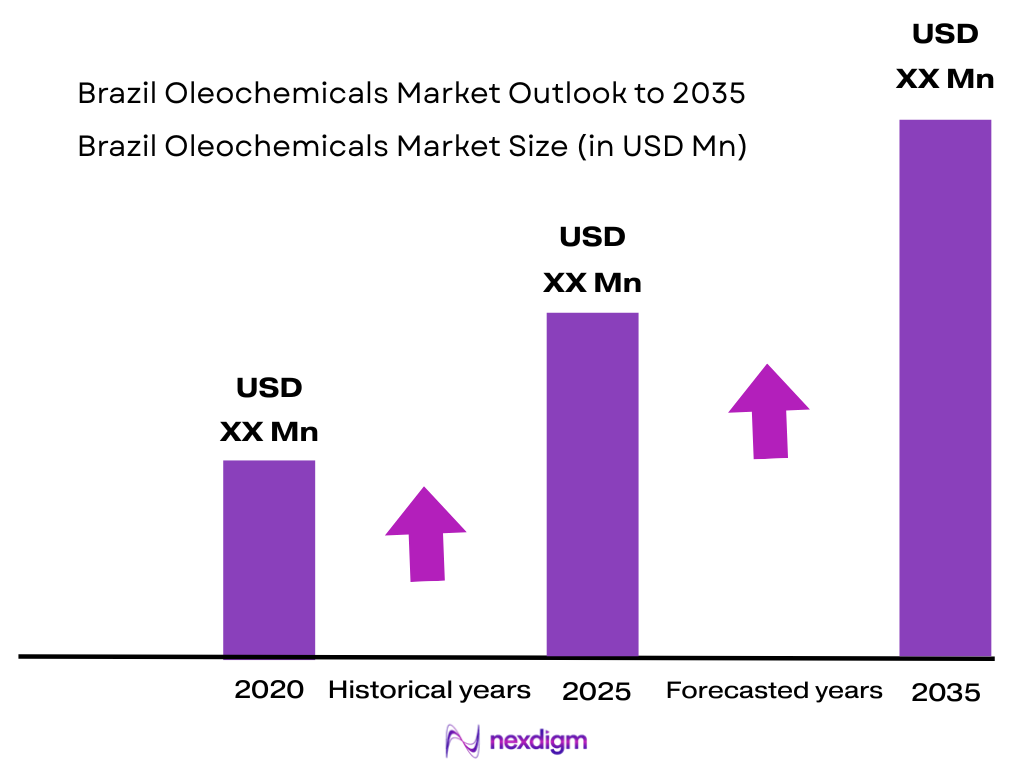
The market is forecast to grow from an estimated USD 1.54 billion in 2026 to USD 2.64 billion by 2035, representing a 6.2% CAGR during 2026–2035. In volume terms, the addressable merchant oleochemical market is modeled at approximately 1.48 million metric tons in 2024, with fatty acids and glycerin accounting for the majority of tonnage. Brazil’s structural advantage comes from its enormous renewable-lipid ecosystem.
Market Segmentation
By Product Type
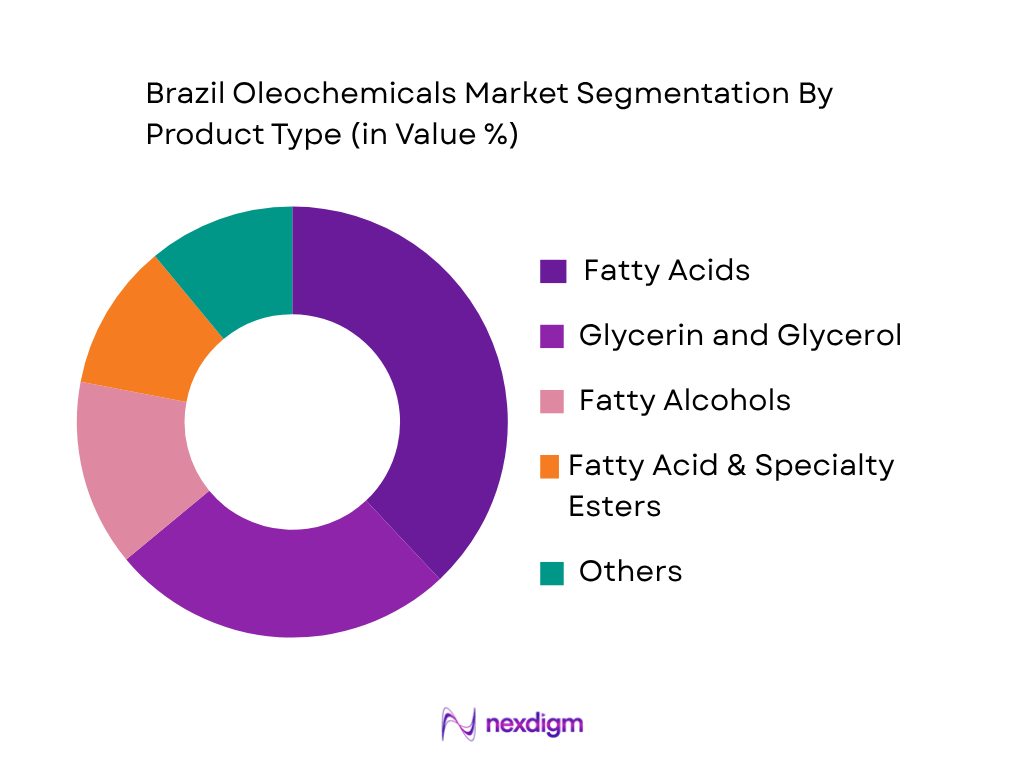
The Brazil Oleochemicals Market is segmented into fatty acids, glycerin, fatty alcohols, fatty acid and specialty esters, fatty amines and derivatives, and other oleochemicals. Fatty acids dominate with an estimated 38.0% market share, equivalent to approximately USD 540 million of modeled market value. Their position is supported by broad consumption in soaps, detergents, rubber, plastics, coatings, lubricants and personal-care formulations. Brazil’s sizeable soybean-oil and animal-fat streams provide suitable C16-C18 feedstocks for oleochemical conversion. Glycerin follows with 26.0%, equivalent to approximately USD 369 million, reflecting Brazil’s unusually large biodiesel-linked glycerin supply. Fatty alcohols represent approximately 14.0% or USD 199 million, while specialty and fatty acid esters account for approximately 11.0% or USD 156 million. Higher-value derivatives remain smaller by tonnage but command materially higher unit prices.
By End-Use Industry
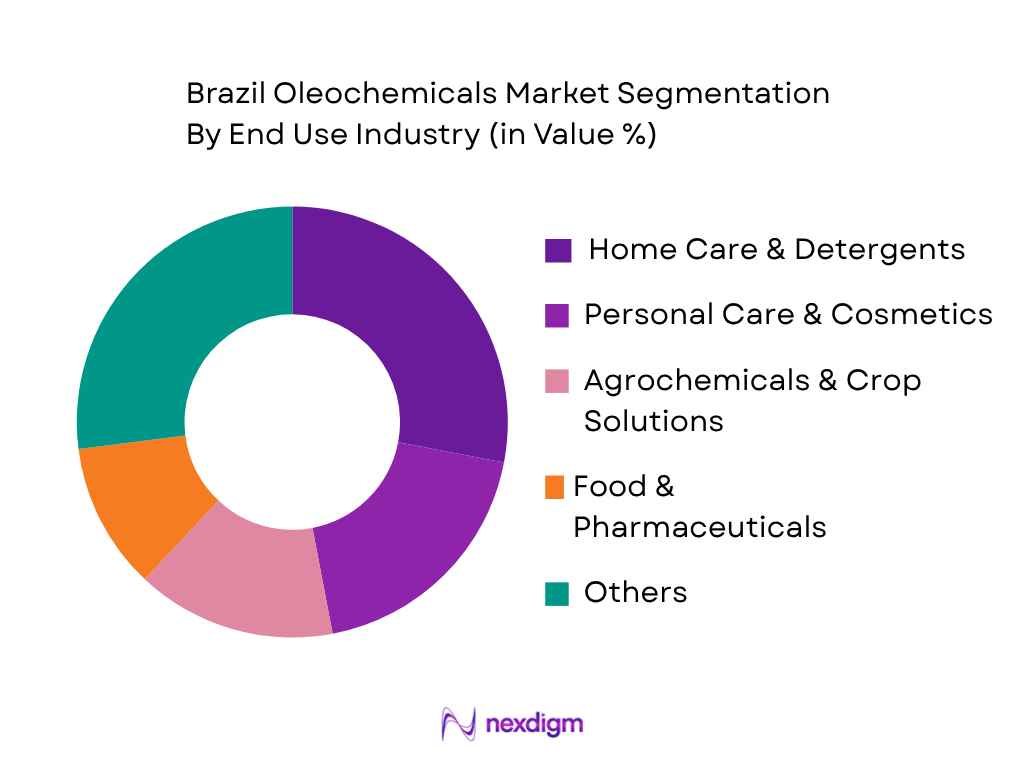
The Brazil Oleochemicals Market is segmented into home care and detergents, personal care and cosmetics, agrochemicals, food and pharmaceuticals, plastics and rubber, lubricants and metalworking fluids, paints and coatings, and other industrial applications. Home care and detergents lead with approximately 28.0%, corresponding to USD 398 million, because fatty acids, fatty alcohols, ethoxylates and related surfactants are extensively consumed in laundry detergents, dishwashing liquids, fabric care and surface cleaners. Personal care and cosmetics represent approximately 19.0% or USD 270 million, supported by glycerin, fatty alcohols, emulsifiers and specialty esters. Agrochemicals represent another 15.0% or USD 213 million, benefiting from Brazil’s agricultural scale and consumption of methyl esters, fatty amines, emulsifiers, wetting agents and crop-protection adjuvants.
Competitive Landscape
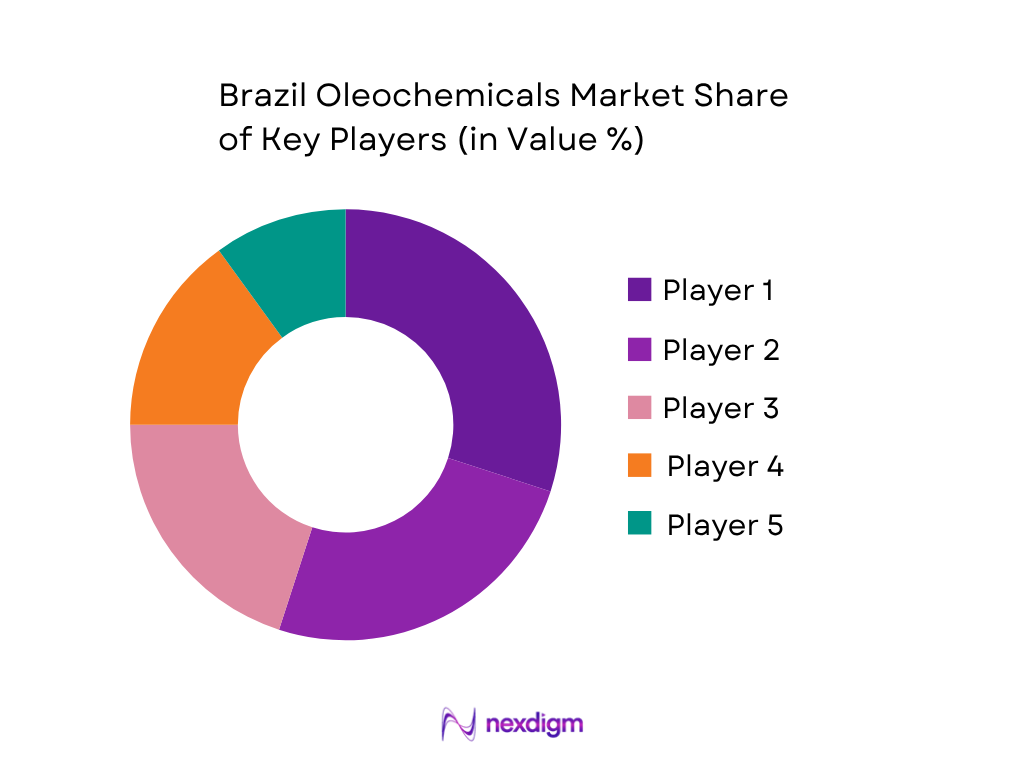
The Brazilian market comprises domestic manufacturers, multinational specialty-chemical companies and feedstock-integrated agribusiness groups. Competition spans commodity fatty acids and glycerin through higher-value fatty alcohols, surfactants, esters and personal-care ingredients. Scale alone does not determine competitive strength: feedstock integration, Brazilian production assets, product purity, carbon-chain coverage, downstream derivatization and application-development capability are increasingly important.
| Company | Establishment | Headquarters | Brazil Oleochemical Presence | Key Market Products | Feedstock Exposure | Local Manufacturing Position | Major End Uses | Strategic Differentiator |
| Indorama Ventures / Indovinya | 1994 | Bangkok, Thailand | ~ | ~ | ~ | ~ | ~ | ~ |
| Cargill | 1865 | Minnesota, USA | ~ | ~ | ~ | ~ | ~ | ~ |
| BASF | 1865 | Ludwigshafen, Germany | ~ | ~ | ~ | ~ | ~ | ~ |
| Croda | 1925 | United Kingdom | ~ | ~ | ~ | ~ | ~ | ~ |
| Evonik | 2007 | Essen, Germany | ~ | ~ | ~ | ~ | ~ | ~ |
Brazil Oleochemicals Market Analysis
Growth Drivers
Large Soybean Processing Base and Biodiesel-Linked Glycerin Supply
Brazil’s oleochemicals industry benefits from an unusually deep domestic lipid-processing platform that connects soybean crushing, vegetable-oil refining, biodiesel manufacturing and glycerin recovery. In 2024, Brazil produced 154.4 million tonnes of soybeans, processed 55.8 million tonnes of soybeans, produced 11.3 million tonnes of soybean oil, and had 72.3 million tonnes of effective soybean-processing capacity, according to EPE’s biofuels assessment using official and industry production statistics. Of the soybean oil available, approximately 6.6 million tonnes were directed to biodiesel production, compared with 3.2 million tonnes allocated to food and other domestic uses and 1.4 million tonnes exported.
These volumes are directly relevant to oleochemical producers because soybean oil supplies C16-C18 fatty chains used in distilled fatty acids, methyl esters, lubricants, alkyd resins and several chemical intermediates. Brazil’s biodiesel industry adds another feedstock advantage. ANP recorded approximately 9.1 million m³ of biodiesel production in 2024, and the biodiesel process generated 802,600 m³ of crude glycerin. EPE, using a mass-based approach, reported approximately 900,000 tonnes of crude glycerin output, with 598,000 tonnes of crude glycerin exports and another 119,000 tonnes of refined glycerol exports. This establishes a sizeable feedstock pool for purification into technical, cosmetic, food and pharmaceutical glycerin and for conversion into glycerol esters and other derivatives.
Large Downstream Personal Care, Home Care, Agrochemical and Tallow-Linked Manufacturing Base
Brazil’s oleochemical demand is reinforced by the scale of the industries that consume fatty acids, fatty alcohol derivatives, glycerin, esters, emulsifiers, amines and surfactants. IBGE reported that national industrial production expanded 3.1% in 2024, providing a supportive manufacturing backdrop for chemical intermediates. Agriculture is particularly relevant because oleochemical methyl esters, fatty amines, emulsifiers, wetting agents and surfactants are extensively used in crop-protection and adjuvant formulations. Brazil harvested approximately 298.6 million tonnes of grains in the 2023/24 crop, while the subsequent 2024/25 crop reached 350.2 million tonnes across 81.7 million hectares, creating a very large formulation-intensive agricultural base. Soybean production alone reached 171.5 million tonnes in the 2024/25 season.
The livestock chain provides an additional domestic fatty feedstock stream. IBGE recorded slaughter of 39.275 million cattle in 2024 and bovine carcass production of 10.238 million tonnes; slaughter expanded by 5.173 million head from the preceding year. Mato Grosso added approximately 1.14 million head, Minas Gerais 670,260, São Paulo 558,610, Pará 551,440, Goiás 472,650, and Mato Grosso do Sul 456,870, demonstrating the geographic breadth of the rendering and animal-fat supply base available to tallow-linked oleochemicals.
Market Challenges
Feedstock Competition from Biodiesel and Volatility in Renewable Lipid Availability
The most important structural constraint for Brazilian oleochemical manufacturers is competition with biodiesel for the same soybean-oil and animal-fat molecules required for chemical conversion. EPE reported that Brazil produced 11.3 million tonnes of soybean oil in 2024, of which approximately 6.6 million tonnes were absorbed by biodiesel production, compared with only 3.2 million tonnes used for food and other domestic applications and 1.4 million tonnes exported. Soybean processing reached 55.8 million tonnes, yet biodiesel’s feedstock draw has increased sufficiently to materially alter domestic oil allocation. ANP reported that soybean oil represented the principal biodiesel feedstock in 2024, while bovine fat and recovered fatty materials also contributed to production.
This places fatty-acid, ester and surfactant producers in direct procurement competition with a fuel industry producing approximately 9.1 million m³ of biodiesel. The challenge is amplified by agricultural variability: soybean production stood at 154.4 million tonnes in 2024, down from 160.3 million tonnes in the preceding comparable period cited by EPE, despite higher crushing activity. This divergence between primary crop output and industrial feedstock demand can tighten the availability of suitable oil streams. Animal fats are substantial but similarly exposed to alternative uses; Brazil slaughtered 39.275 million cattle and produced 10.238 million tonnes of bovine carcass weight in 2024, making tallow availability sizeable but inherently linked to livestock cycles rather than chemical-industry requirements.
Palm Kernel Oil Import Dependence and Exposure to Imported Specialty Intermediates
Brazil’s oleochemical value chain has strong access to C16-C18 feedstocks through soybean oil and tallow, but the domestic position is weaker in lauric feedstocks required for C12-C14 fatty acids, fatty alcohols and surfactant intermediates. This constraint is demonstrated directly by Brazilian trade policy. In 2024, the Ministry of Agriculture documented an industry request addressing potential shortage through imports of 266,000 tonnes of palm kernel oil under NCM 1513.29.19, while the corresponding GECEX framework provided a 266,000-tonne import quota.
The size of this quota is significant for the oleochemical sector because palm kernel oil is a principal source of shorter-chain fatty acids and alcohols used in detergents, personal care, emulsifiers and specialty surfactants. Brazil therefore has a differentiated feedstock imbalance: soybean and animal-fat chains are very large domestically, whereas important lauric molecules remain materially dependent on international supply routes. The challenge extends beyond PKO. MDIC reported that Brazil imported USD 156.544 billion of intermediate goods in 2024, compared with USD 146.071 billion in 2023, demonstrating the broader dependence of Brazilian manufacturing on imported industrial inputs.
Market Opportunities
Glycerin Valorization and Development of Higher-Purity Oleochemical Derivatives
Brazil has a strong opportunity to move a larger portion of its biodiesel-linked glycerin stream from crude commodity output into refined glycerol, pharmaceutical-grade glycerin, food-grade material, cosmetic ingredients and downstream glycerol derivatives. The scale of available material is already substantial. ANP reported that biodiesel production generated 802,600 m³ of crude glycerin in 2024, while EPE’s mass-based biofuels assessment placed crude glycerin production at approximately 900,000 tonnes. Brazil exported 598,000 tonnes of crude glycerin during the same period, while refined glycerol exports totaled 119,000 tonnes.
The gap between those two export streams is strategically important: crude material substantially exceeds refined glycerol volumes, indicating a sizeable physical stream that can potentially undergo purification or chemical upgrading domestically rather than leaving the country primarily as lower-processed material. The feedstock engine behind this opportunity is also expanding structurally. Approximately 9.1 million m³ of biodiesel were produced in Brazil in 2024, with soybean oil providing the principal raw material, and roughly 6.6 million tonnes of soybean oil were directed to biodiesel processing.
Circular and Bio-Based Oleochemicals for Agrochemicals, Surfactants, Esters and Industrial Formulations
Brazil has a strong opportunity to expand oleochemical production from recovered fatty materials, soybean-derived methyl esters, tallow, renewable surfactant intermediates and other circular lipid streams. The opportunity is grounded in the existing scale of Brazil’s biodiesel, agriculture and industrial systems rather than in future market forecasts. ANP reported that, in 2024, soybean oil supplied the largest biodiesel feedstock stream and “other fatty materials” accounted for roughly 14 parts out of every 100 parts of total feedstock use, representing residual and recovered materials reintegrated into biodiesel production.
Bovine fat supplied another 6 parts per 100, demonstrating that Brazil already operates multi-feedstock lipid recovery and conversion infrastructure. Biodiesel output reached approximately 9.1 million m³, while crude glycerin generation reached 802,600 m³, giving downstream chemical manufacturers large renewable streams for esterification, surfactant synthesis and glycerol conversion.
Future Outlook
The Brazil Oleochemicals Market is projected to increase from approximately USD 1.54 billion in 2026 to USD 2.64 billion by 2035, registering an estimated 6.2% CAGR. Approximately USD 1.10 billion of incremental market value is therefore expected to be created over the forecast period. Growth will increasingly shift toward refined glycerin, specialty esters, fatty-alcohol derivatives, agricultural adjuvants, bio-lubricants and renewable surfactants. The forecast implies an approximately 85.9% increase in nominal market value between 2024 and 2035, from USD 1.42 billion to USD 2.64 billion. Specialty oleochemicals are expected to outperform commodity products as manufacturers increase local production of cosmetic esters, crop-protection auxiliaries, specialty surfactants and pharmaceutical-grade ingredients.
Major Players
- Indorama Ventures / Indovinya (Oxiteno)
- Cargill Brasil
- BASF Brasil
- Evonik Brasil
- Croda do Brasil
- Wilmar International
- KLK OLEO
- IOI Oleo
- Emery Oleochemicals
- Oleon
- Kao Corporation
- Godrej Industries
- ADM
- Bunge
- JBS
Key Target Audience
- Oleochemical Manufacturers and Specialty Chemical Producers
- Fatty Acid, Fatty Alcohol and Glycerin Producers
- Vegetable Oil Crushers, Renderers and Biodiesel Producers
- Home Care, Personal Care and Cosmetics Manufacturers
- Agrochemical, Lubricant, Polymer and Coatings Manufacturers
- Chemical Distributors, Importers and Industrial Traders
- Investments and Venture Capitalist Firms
- Government and Regulatory Bodies (ANP, ANVISA, MME, MDIC)
Research Methodology
Step 1: Identification of Key Variables
The market model begins with approximately 6 core product groups, 8 end-use industries and 5 major feedstock families. The ecosystem covers fatty-acid producers, biodiesel manufacturers, vegetable-oil processors, renderers, distributors and specialty chemical manufacturers. The model incorporates more than 20 quantitative variables, including production, capacity, feedstock availability, imports, exports, prices, utilization rates and conversion yields.
Step 2: Market Analysis and Construction
The bottom-up model estimates approximately 1.48 million metric tons of addressable oleochemical consumption, valued at approximately USD 1.42 billion. Product-level values are calculated across fatty acids, glycerin, fatty alcohols, esters, fatty amines and other derivatives. Top-down validation uses Brazilian chemical demand, soybean-oil consumption, biodiesel output and downstream industry consumption coefficients.
Step 3: Hypothesis Validation and Expert Consultation
Market assumptions are structured for validation across 15 major competitors, 6 product categories and 8 major end-use industries. Producer-level capacities, utilization, feedstock sourcing, product prices and customer exposure are cross-checked against official statistics, company disclosures and trade information. A minimum of 3 independent data points is targeted for validation of each major market variable.
Step 4: Research Synthesis and Final Output
The final model reconciles 100% of product-level market value and 100% of end-user demand against the USD 1.42 billion base-year market. Forecasting applies a 6.2% CAGR to reach approximately USD 2.64 billion by 2035. Sensitivity testing incorporates soybean-oil prices, biodiesel production, glycerin supply, palm-kernel-oil costs, exchange rates and specialty-product penetration.

- Executive Summary
- Research Methodology (Oleochemical Market Definition, Fatty Matter Conversion Boundary, Feedstock-to-Derivative Mapping, Top-Down Market Sizing, Bottom-Up Producer Capacity Build-Up, Plant-Level Production Assessment, Import–Export Reconciliation, Apparent Consumption Analysis, Biodiesel Glycerin Co-Product Assessment, Soybean Oil–Tallow–Palm Kernel Oil Balance, End-Use Demand Modeling, Producer and Distributor Interviews, Oleochemical Price Benchmarking, Data Triangulation, Conversion Yield Assumptions, Capacity Utilization Assessment, Forecasting Framework, Scenario Analysis, Market Validation)

- Definition and Scope
- Evolution of the Brazilian Oleochemical Industry
- Industry Genesis and Development of Domestic Oleochemical Manufacturing
- Oleochemical Industry Structure in Brazil
- Oleochemical Value Chain Analysis

- Growth Drivers (Large Soybean Processing Base, Biodiesel-Linked Glycerin Supply, Personal Care Manufacturing Base, Home Care Demand, Renewable Chemistry Adoption, Agrochemical Consumption, Tallow Availability, Local Surfactant Manufacturing)
- Market Restraints (Palm Kernel Oil Import Dependence, Feedstock Price Volatility, Competition from Biodiesel, Petrochemical Price Competition, Specialty Product Import Dependence, Refining Cost, Currency Volatility)
- Market Opportunities (Glycerin Valorization, High-Purity Glycerin Refining, Specialty Esters, Bio-Lubricants, Agrochemical Adjuvants, Bio-Based Surfactants, Babassu Oleochemicals, Circular Feedstocks)
- Market Trends (Natural-Origin Formulations, RSPO-Certified Inputs, Renewable Carbon Claims, APEO-Free Surfactants, Bio-Based Emollients, Glycerin Upgrading, Localized Specialty Chemical Supply)
- Regulatory and Policy Landscape (ANVISA Requirements, ANP Biodiesel Regulation, Chemical Registration, Import Regulation, Product Safety, Environmental Licensing, Sustainability Certification)
- SWOT Analysis
- Porter’s Five Forces Analysis
- PESTLE Analysis

- By Market Value (2020-2035)
- By Market Volume (2020-2035)
- By Domestic Production Volume (2020-2035)
- By Average Realized Oleochemical Price (2020-2035)
- By Domestic Production versus Imports (2020-2035)
- By Merchant Market versus Captive Consumption (2020-2035)

- By Product Type (in value %)
Fatty Acids
Fatty Alcohols
Glycerin and Glycerol
Fatty Acid Methyl Esters
Glycerol Esters
Specialty Esters
Fatty Amines and Derivatives - By Feedstock (in value %)
Soybean Oil-Based Oleochemicals
Animal Tallow-Based Oleochemicals
Palm Kernel Oil-Based Oleochemicals
Palm Oil and Palm Stearin-Based Oleochemicals
Coconut and Babassu Oil-Based Oleochemicals - By Feedstock Origin (in value %)
Vegetable-Based Oleochemicals
Animal-Based Oleochemicals
Biodiesel Co-Product-Based Oleochemicals
Waste and Circular Feedstock-Based Oleochemicals
Certified Sustainable Oleochemicals - By End-Use Industry (in value %)
Home Care and Detergents
Personal Care and Cosmetics
Industrial and Institutional Cleaning
Food and Beverage Processing
Pharmaceuticals and Nutraceuticals
Agrochemicals and Crop Solutions - By Grade (in value %)
Industrial Grade
Technical Grade
Food Grade
Pharmaceutical/USP Grade
Cosmetic Grade - By Geography (in value %)
Southeast Brazil
Northeast Brazil
South Brazil
Central-West Brazil
North Brazil

- Market Share of Major Players (Revenue Share, Volume Share, Product-Level Share, Domestic Production Share, Imported Supply Share)
- Cross Comparison Parameters (Oleochemical Product Portfolio Breadth, Brazil/Regional Installed Production Capacity, Feedstock Integration and Security, Fatty Carbon-Chain Coverage, Glycerin Refining Capability, Lauric Oleochemical Capability, Bio-Based/RSPO-Certified Portfolio, Downstream Surfactant and Specialty-Derivative Integration)
- Company-Level Pricing Benchmark (Fatty Acid Price, Glycerin Price, Specialty Premium, Contract Terms, Import Parity)
- SWOT Analysis of Major Players
- Detailed Profiles Major Companies
Indorama Ventures / Indovinya (Oxiteno)
Cargill Brasil
BASF Brasil
Evonik Brasil
Croda do Brasil
Wilmar International
KLK OLEO
IOI Oleo
Emery Oleochemicals
Oleon
Kao Corporation
Godrej Industries
ADM
Bunge
JBS

- Home Care and Household Cleaning
- Personal Care and Cosmetics
- Industrial and Institutional Cleaning
- Food and Beverage Processing
- Pharmaceuticals and Nutraceuticals
- Agrochemicals and Crop Protection

- By Market Value (2026-2035)
- By Market Volume (2026-2035)
- By Domestic Production Volume (2026-2035)
- By Average Realized Oleochemical Price (2026-2035)
- By Domestic Production versus Imports (2026-2035)
- By Merchant Market versus Captive Consumption (2026-2035)


 Request a Sample
 Ask for Customization
 Get a Quote
 Enquire Now