

 Download PDF
Market Overview
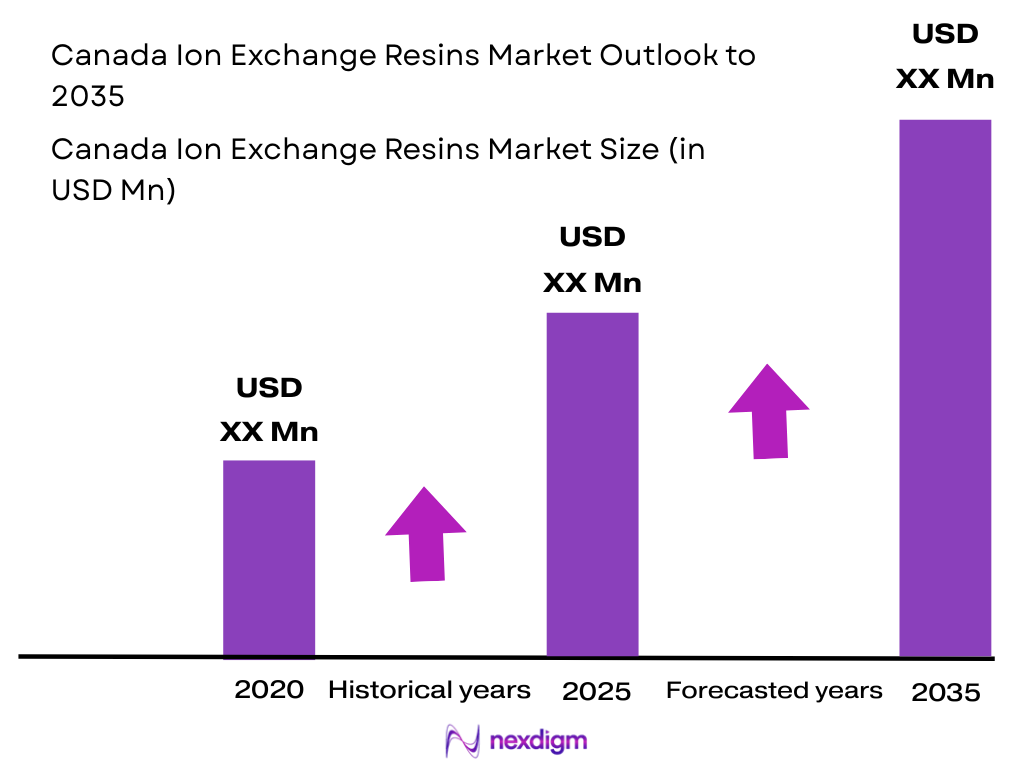
The Canada Ion Exchange Resins Market generated USD 83.8 million in 2024, according to Grand View Research’s Canada market dataset, with cationic resins identified as the largest product segment at 48.69% of revenue. The market is supported by demand for water softening, demineralization, industrial process-water purification, pharmaceutical processing, power-generation water treatment, and metals and mining applications. Canada’s mineral sector produced more than 60 minerals and metals worth CAD 64.3 billion in 2024, creating a substantial industrial base for water treatment and selective separation technologies.
Market Segmentation
By Product Type
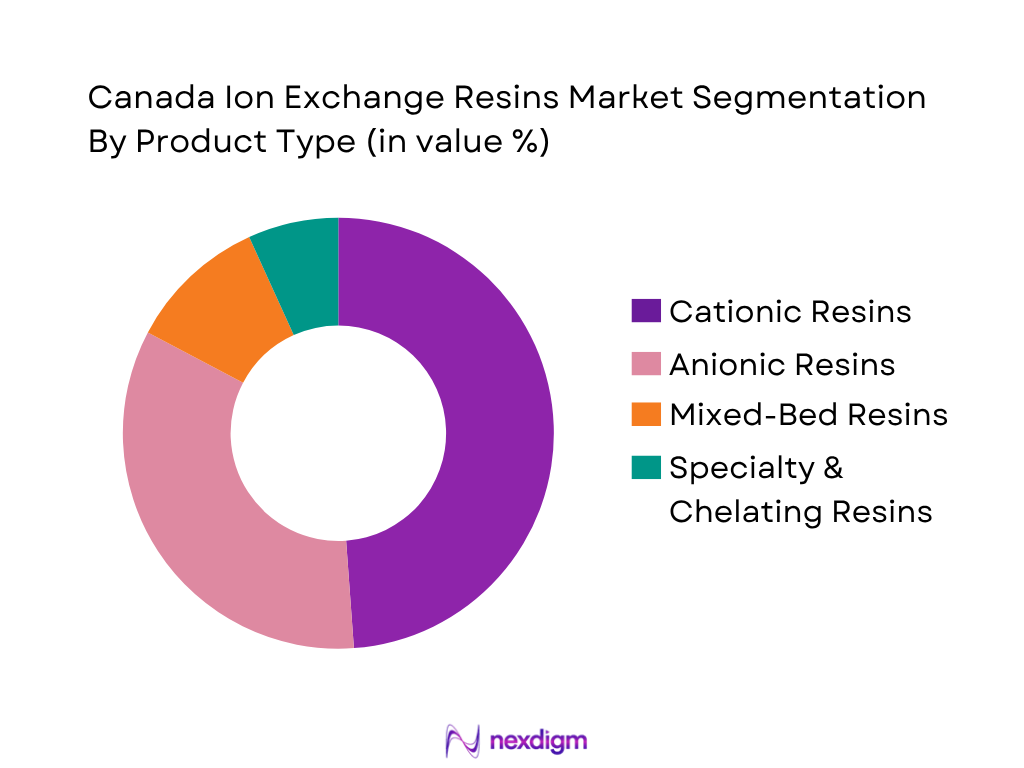
The Canada Ion Exchange Resins Market is segmented by product type into cationic resins, anionic resins, mixed-bed resins, and specialty/chelating resins. Cationic resins represent the dominant product category, accounting for 48.69% of Canadian market revenue in 2024, according to Grand View Research. Their broad use in water softening, demineralization, boiler-feedwater treatment, condensate polishing, and industrial water purification supports their leading position. Cationic resins remove positively charged ions including calcium and magnesium and are also combined with anionic resins in two-bed and mixed-bed deionization systems. Canada’s extensive industrial water-treatment base, power-generation infrastructure, mining operations, chemical processing facilities, and pharmaceutical manufacturing activities provide recurring demand for these resins. Replacement requirements also contribute to recurring consumption because resin performance can decline through fouling, oxidation, organic contamination, and repeated regeneration. Specialty and chelating resins serve more targeted applications, including selective metal recovery and pharmaceutical purification, but their narrower application base keeps them below conventional cationic products.
By End-Use Industry
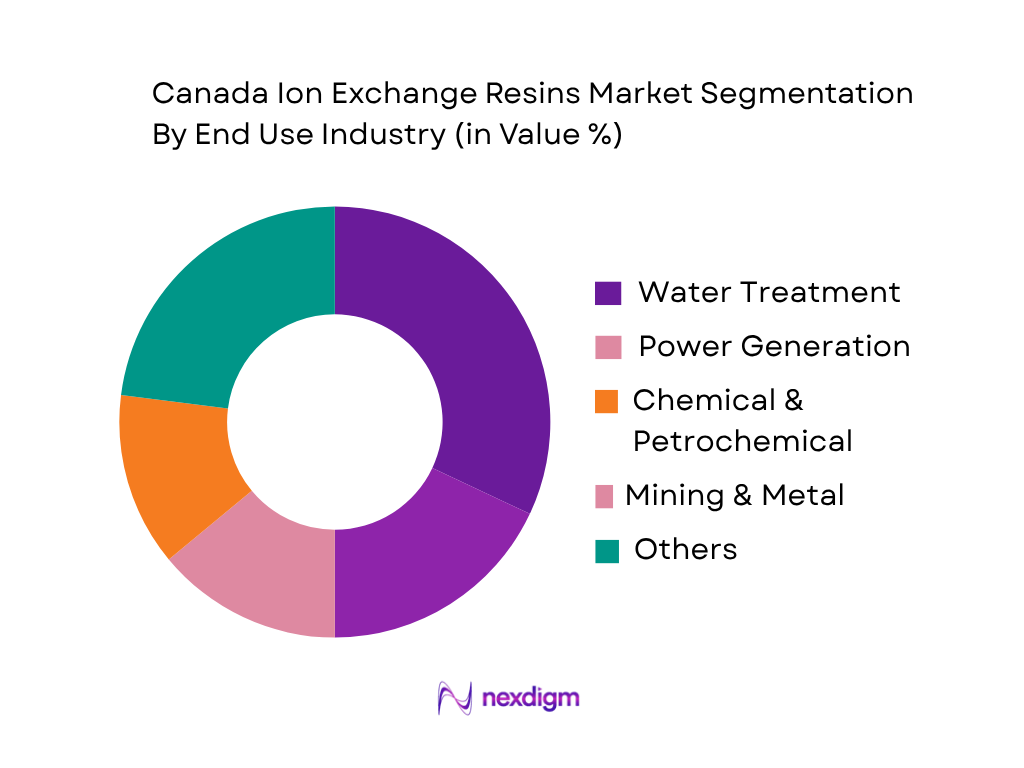
The Canada Ion Exchange Resins Market is segmented by end-use industry into water treatment, power generation, chemical and petrochemical processing, mining and metals, pharmaceuticals and biotechnology, food and beverage, electronics, and other industrial applications. Water treatment represents the leading application because ion exchange is an established technology for hardness removal, demineralization, deionization, contaminant removal, and high-purity water production. The application is particularly important in industrial facilities where water chemistry directly affects equipment reliability and production quality. Power-generation facilities use ion exchange for boiler-feedwater and condensate treatment, while pharmaceutical manufacturers require purified water for manufacturing and cleaning processes. Mining provides another important application base: Canada’s mineral production exceeded CAD 64.3 billion in 2024, and domestic mineral exports reached CAD 153.0 billion. Ion exchange can be used for process-water treatment, selective metal recovery, and hydrometallurgical separation. Canada’s broad industrial footprint therefore creates demand across both conventional water-treatment applications and higher-value specialty resin applications.
Competitive Landscape
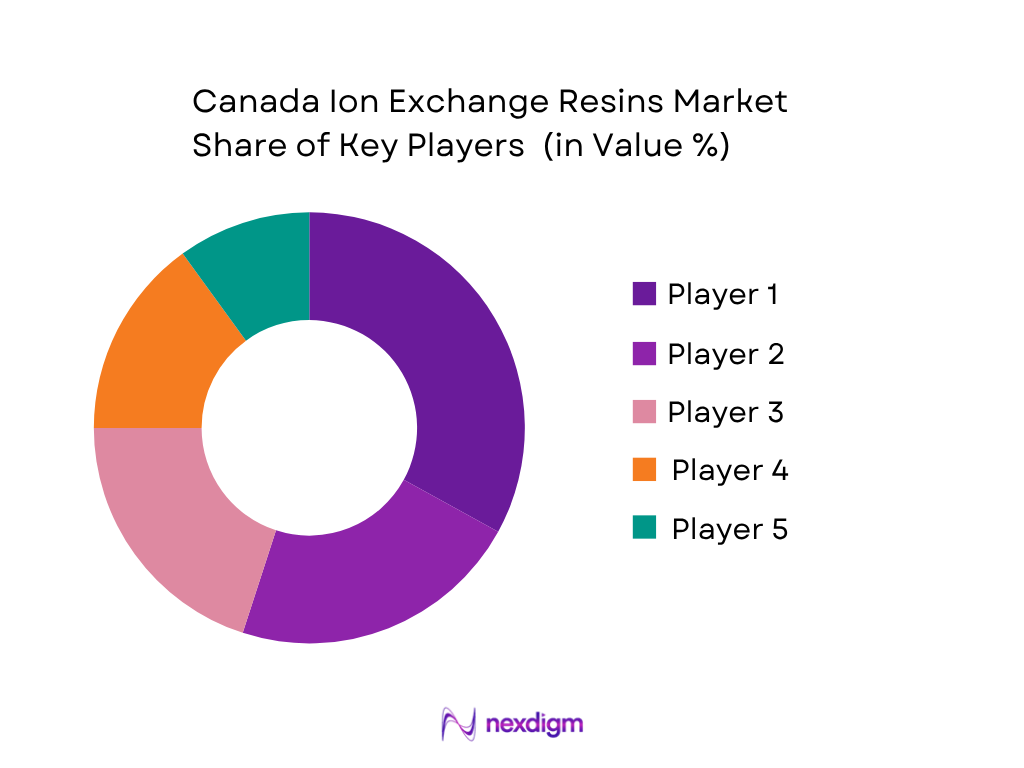
The Canada Ion Exchange Resins Market comprises global resin manufacturers, specialty separation companies, and water-treatment technology providers. DuPont, LANXESS, Mitsubishi Chemical Group, Purolite, and ResinTech are among the most relevant competitive benchmarks because their portfolios cover conventional cationic and anionic resins as well as specialty materials. Competition is based on exchange capacity, selectivity, resin stability, regeneration performance, application-specific grades, technical support, and supply reliability. The market also includes companies with differentiated capabilities in pharmaceutical purification, mining and hydrometallurgy, ultrapure water, and contaminant removal. Grand View Research identifies DuPont and LANXESS among the major companies associated with the broader ion exchange resin industry.
| Company | Establishment Year | Headquarters | Key Resin Portfolio | Principal Applications | Specialty Capability | Canadian Market Relevance | Technical-Service Strength | Key Competitive Parameter |
| DuPont | 1802 | Wilmington, USA | ~ | ~ | ~ | ~ | ~ | ~ |
| LANXESS | 2004 | Cologne, Germany | ~ | ~ | ~ | ~ | ~ | ~ |
| Mitsubishi Chemical Group | 1933 | Tokyo, Japan | ~ | ~ | ~ | ~ | ~ | ~ |
| Purolite / Ecolab | 1981 | King of Prussia, USA | ~ | ~ | ~ | ~ | ~ | ~ |
| ResinTech | 1986 | Camden, USA | ~ | ~ | ~ | ~ | ~ | ~ |
Canada Ion Exchange Resins Market Analysis
Market Growth Drivers
Industrial Water Purification Requirements
Canada’s industrial base creates a substantial requirement for water treatment, demineralization, softening, and high-purity process water, directly supporting demand for ion exchange resins. Statistics Canada reported that Canada’s 2024 Biennial Industrial Water Survey covers manufacturing, mining, and thermal-electric power generation, specifically measuring water intake, treatment, recirculation, reuse, and discharge, demonstrating the scale and regulatory importance of industrial water management. The latest available industrial water-use baseline covers 27.36 billion cubic metres of water intake across these three sectors, with thermal-electric power generation accounting for 22.90 billion cubic metres, manufacturing 4.05 billion cubic metres, and mining and quarrying 406.9 million cubic metres. The manufacturing requirement is particularly relevant because primary metals, paper, chemicals, food, and petroleum and coal products together accounted for approximately 3.48 billion cubic metres of manufacturing water intake. Canada’s mineral sector adds another substantial treatment requirement, with 60 minerals and metals produced at almost 200 mines and 6,500 quarries in 2024. Mineral production reached CAD 64.3 billion, while the sector directly employed 438,000 people. These industrial water flows support recurring requirements for ion exchange systems used for hardness removal, demineralization, deionization, condensate polishing, and process-water purification.
Power Generation and Nuclear Water-Chemistry Requirements
Power-generation and nuclear operations provide a technically demanding application base for ion exchange resins because reactor, boiler, steam-cycle, and condensate systems require controlled water chemistry to protect equipment and maintain operational reliability. Statistics Canada identified thermal-electric power generation as Canada’s largest industrial water user, with 22.90 billion cubic metres of water intake in the latest industrial-water dataset, while its 2024 Industrial Water Survey continues to specifically collect information on water treatment, cooling, steam generation, and discharge from thermal-electric power facilities. Canada’s nuclear ecosystem provides an additional specialty-resin opportunity. Natural Resources Canada reports that Canada produced 14.3 kilotonnes of uranium in 2024, with approximately 90% exported, while domestic CANDU reactor consumption represented roughly 10% of national production. Canada’s nuclear generating fleet comprises 19 operating reactors, with major facilities including Bruce, Darlington, Pickering, and Point Lepreau. The installed nuclear fleet requires ongoing water-quality management across reactor coolant purification, makeup-water treatment, condensate systems, and associated plant processes. Ion exchange resins are particularly relevant where removal of dissolved ionic contaminants and maintenance of high-purity water are required. The combination of 19 operating reactors, 14.3 kilotonnes of uranium production, and large thermal-power water requirements establishes a sizeable technically specialized customer base for high-performance cationic, anionic, mixed-bed, and nuclear-qualified resins.
Market Challenges
Imported Resin Dependency
Import dependence represents a structural challenge for the Canada Ion Exchange Resins Market because Canadian users rely substantially on international supply for ion-exchange products classified under HS 3914. Innovation, Science and Economic Development Canada’s Canadian Importers Database records CAD 104.23 million of Canadian imports under HS 391400 in 2024, covering ion exchangers based on polymers of headings 39.01 to 39.13 in primary forms. The database identifies 91 importers accounting for approximately CAD 83.88 million of the reported import value captured within its major-importer concentration analysis. Imports from the United States alone were approximately CAD 23.39 million, while imports from France were approximately CAD 3.71 million. The presence of multiple international sources provides Canadian buyers with product availability but also creates exposure to cross-border logistics, manufacturing disruptions, currency movements, trade restrictions, and lead-time variability. The challenge is particularly relevant for specialty grades because nuclear, pharmaceutical, ultrapure-water, and selective-metal applications can require technically qualified products that cannot always be substituted immediately. Canada’s critical-mineral processing expansion increases the importance of resilient resin supply because new hydrometallurgical facilities can require specialized ion-exchange media. The import structure therefore creates a strategic requirement for diversified suppliers, Canadian inventory, regional distribution centres, and domestic or North American production capacity to reduce supply interruption risk.
Resin Regeneration and Spent-Resin Management
Regeneration and spent-resin management create operational complexity because ion exchange systems require controlled chemical regeneration and generate resin residues that may require specialized handling depending on the contaminants captured. Canada’s federal hazardous-waste classification framework explicitly identifies ion-exchange column residue and ion-exchange resins within controlled waste streams, while also identifying regeneration of ion exchange resins as a recognized recovery activity. This becomes particularly important for resins used in mining, chemical processing, nuclear operations, and contaminated-water treatment, where spent media can contain concentrated metals, radionuclides, or other regulated substances. Canada’s National Pollutant Release Inventory received reports from 7,887 facilities for its 2024 inventory, covering more than 300 substances and approximately 5.47 million tonnes of pollutants, illustrating the scale of industrial material-management obligations. Separately, Statistics Canada’s 2024 Waste Management Survey recorded 27.5 million tonnes of non-hazardous waste sent to disposal facilities, including 16.4 million tonnes from non-residential sources. These figures are not measurements of spent ion exchange resin specifically, but they demonstrate the scale of Canada’s industrial waste-management infrastructure within which spent-resin handling occurs. Regeneration can extend resin usability, but requires appropriate chemicals, monitoring, separation equipment, wastewater management, and technical expertise. This creates additional operational requirements for remote mines, industrial plants, and facilities handling contaminant-loaded resins.
Market Opportunities
Critical Mineral Recovery and Hydrometallurgical Processing
Critical-mineral processing represents a major opportunity for specialty ion exchange resins because selective ion capture can be applied to metal-bearing process solutions, refining streams, leachates, and hydrometallurgical circuits. Canada’s updated Critical Minerals List contains 34 minerals, following the addition of high-purity iron, phosphorus, and silicon metal in 2024, while **6 minerals—lithium, graphite, nickel, cobalt, copper, and rare earth elements—**are identified as initial priorities for economic development. Natural Resources Canada reports that 56 active mines producing critical minerals and 31 critical-mineral processing facilities were operating as of March 2025, alongside 171 advanced critical-mineral projects, including 28 processing projects. Critical-mineral exploration spending reached CAD 2.1 billion in 2024, representing 51% of Canada’s total mineral-exploration spending. Canada also produced 5,983 tonnes of lithium from two operating mines in 2024 and 514,582 tonnes of copper in concentrate, while uranium production reached 14.3 kilotonnes. These operating volumes create current industrial streams in which selective separation and purification technologies can be deployed. Ion exchange resins can complement precipitation, solvent extraction, membrane separation, and other hydrometallurgical processes by targeting specific dissolved ions. The combination of 34 critical minerals, 171 advanced projects, CAD 2.1 billion in critical-mineral exploration spending, and active lithium, copper, uranium, nickel, cobalt, and other mineral production creates a broad current opportunity base for specialty chelating and selective ion-exchange technologies.
Advanced Municipal Water Treatment and Selective Contaminant Removal
Advanced municipal water treatment represents an opportunity for ion exchange resins as Canadian water authorities respond to increasingly stringent contaminant-management requirements, particularly for PFAS and other persistent substances. Health Canada published its Canadian drinking-water objective for PFAS in August 2024, establishing a treatment-based objective of 30 nanograms per litre for the combined concentration of 25 specified PFAS in drinking water. The objective explicitly considers treatment achievability and identifies treatment options for municipal water systems, creating a defined technical requirement for utilities evaluating adsorption, ion exchange, membrane treatment, and other technologies. The opportunity extends beyond PFAS because ion exchange can selectively remove ions such as nitrate, arsenic species, hardness ions, and other dissolved contaminants depending on resin chemistry and water composition. Canada’s industrial water infrastructure is also substantial: Statistics Canada’s industrial-water program tracks water treatment, recirculation, reuse, and discharge across manufacturing, mining, and thermal-electric power generation. The latest national industrial dataset records 27.36 billion cubic metres of industrial water intake. In addition, Canada’s 2024 National Pollutant Release Inventory included 7,887 reporting facilities and more than 300 substances, demonstrating the breadth of contaminant-management activity across Canadian industry. These current regulatory and industrial conditions create opportunities for high-selectivity resins, specialty anion exchangers, mixed-bed systems, and engineered resin configurations designed for difficult feedwater conditions.
Future Outlook
The Canada Ion Exchange Resins Market is projected to expand at a ~5.2% CAGR during 2026–2035, with growth supported by industrial water purification, municipal water treatment, power-generation applications, mining and hydrometallurgical processing, pharmaceutical manufacturing, and specialty separation requirements. Canada’s mineral sector provides an important opportunity base: the country produced more than 60 minerals and metals worth CAD 64.3 billion in 2024 and invested CAD 4.1 billion in mineral exploration.
Future demand is expected to shift toward higher-capacity and application-specific resins rather than conventional products alone. Specialty applications involving selective metal recovery, ultrapure water, pharmaceutical purification, and advanced contaminant removal are expected to gain importance. Canada’s mineral exports reached CAD 153.0 billion in 2024, while critical-mineral and advanced-material supply-chain development is increasing the strategic importance of separation technologies.
Major Players
- DuPont de Nemours, Inc.
- LANXESS AG
- Mitsubishi Chemical Group Corporation
- Purolite, an Ecolab company
- ResinTech, Inc.
- Jacobi Group
- Kuraray Co., Ltd.
- Thermax Limited
- Ion Exchange (India) Limited
- Samyang Corporation
- Sunresin New Materials Co., Ltd.
- Evoqua Water Technologies LLC
- Veolia Water Technologies
- Syensqo
- Sorbent Technologies, Inc.
Key Target Audience
- Ion exchange resin manufacturers and specialty resin producers
- Municipal and industrial water-treatment operators
- Mining, mineral-processing and hydrometallurgical companies
- Power-generation and nuclear facility operators
- Pharmaceutical and biotechnology manufacturers
- Chemical, petrochemical, food and beverage processing companies
- Investments and venture capitalist firms (Water-technology funds, cleantech investors, industrial-technology investors, mining-technology investment firms)
- Government and regulatory bodies (Environment and Climate Change Canada, Health Canada, Natural Resources Canada, Canadian Nuclear Safety Commission, provincial environmental ministries)
Research Methodology
Step 1: Identification of Key Variables
The initial phase involves mapping the Canada Ion Exchange Resins Market ecosystem across manufacturers, distributors, water-treatment companies, municipal utilities, mining companies, power generators, pharmaceutical manufacturers, chemical processors, and regulatory stakeholders. The research establishes resin chemistry, application, end-use, trade, replacement, regeneration, and technical-performance variables. Public industry statistics are used to establish the Canadian industrial demand base.
Step 2: Market Analysis and Construction
Historical market data are compiled across product types, applications, end-use industries, and customer categories. The market model evaluates revenue, resin consumption, replacement requirements, installed treatment capacity, industrial production, mining activity, imports, distribution channels, and application-specific demand. The USD 83.8 million 2024 market value and 48.69% cationic segment share are incorporated as published market benchmarks.
Step 3: Hypothesis Validation and Expert Consultation
Market hypotheses are validated through discussions with resin manufacturers, distributors, water-treatment system providers, industrial purchasers, mining operators, power-generation companies, pharmaceutical manufacturers, and specialty chemical users. Interviews assess resin-selection criteria, exchange capacity, replacement cycles, regeneration requirements, purchasing processes, application performance, and competitive differentiation.
Step 4: Research Synthesis and Final Output
The final stage integrates primary findings with secondary market data, company information, Canadian industrial statistics, mineral-production data, and trade indicators. The analysis is triangulated across supplier-side revenue, downstream industrial demand, product segmentation, and application-level requirements. The resulting model provides the basis for assessing market structure, competitive positioning, growth opportunities, and the 2026–2035 outlook.

- Executive Summary
- Research Methodology (Market Definition and Scope, Ion Exchange Resin Classification, Market Boundary and Inclusion Criteria, HS Code 391400 Mapping, Top-Down Market Sizing, Bottom-Up Revenue Reconstruction, Resin Volume Conversion, Demand-Side Assessment, Supply-Side Assessment, Import-Export Validation, Manufacturer and Distributor Interviews, End-User Validation, Data Triangulation, Forecasting Framework, Scenario Analysis, Assumptions, Research Limitations)

- Definition and Scope
- Canada Ion Exchange Resins Industry Evolution
- Canada Ion Exchange Resins Ecosystem
- Canada Ion Exchange Resins Value Chain
- Canada Ion Exchange Resins Application Landscape

- Market Growth Drivers (Industrial Water Purification Requirements, Stringent Water Quality Standards, Power Generation Demineralization Demand, Nuclear Fleet Water Chemistry Management, Critical Mineral Processing, Pharmaceutical Manufacturing Expansion, High-Purity Water Requirements)
- Market Challenges (Imported Resin Dependency, Resin Regeneration Requirements, Spent Resin Management, Regenerant Chemical Consumption, Alternative Membrane Technologies, Feedwater Fouling, Resin Degradation, Remote-Site Logistics)
- Market Opportunities (Critical Mineral Recovery, Lithium and Brine Processing, Uranium and Hydrometallurgy Applications, Advanced Municipal Water Treatment, PFAS and Selective Contaminant Removal, Pharmaceutical-Grade Resin Demand, Nuclear Refurbishment, Industrial Water Reuse)
- Market Trends (High-Capacity Resin Adoption, Macroporous Resin Deployment, Selective Ion Removal, Mixed-Bed Polishing, Resin Life Extension, Digital Resin Performance Monitoring, Regeneration Optimization, Water Reuse, Specialty Chelating Resins)
- Regulatory and Standards Landscape (Environment and Climate Change Canada Requirements, Health Canada Drinking Water Guidance, Canadian Council of Ministers of the Environment Guidelines, Provincial Water Quality Regulations, Nuclear Safety and Control Requirements, Food and Drug Regulations, Pharmaceutical GMP Requirements, NSF/ANSI Drinking Water Standards)
- Porter’s Five Forces Analysis
- PESTLE Analysis
- SWOT Analysis

- By Revenue (2020-2025)
- By Average Revenue per Resin Volume (2020-2025)
- By Cationic and Anionic Resin Revenue (2020-2025)
- By Water and Non-Water Applications (2020-2025)
- By End-Use Industry (2020-2025)

- By Resin Type (In Value %)
Strong Acid Cation Exchange Resins
Weak Acid Cation Exchange Resins
Strong Base Anion Exchange Resins
Weak Base Anion Exchange Resins
Mixed-Bed Ion Exchange Resins
Chelating Ion Exchange Resins
Specialty Functional and Selective Resins - By Physical and Polymer Structure (In Value %)
Gel-Type Resins
Macroporous Resins
Uniform Particle Size Resins
Styrene-Divinylbenzene Resins
Acrylic-Based Resins
Polymeric Adsorbent and Specialty Resin Structures - By Application (In Value %)
Water Softening
Demineralization and Deionization
Nitrate and Contaminant Removal
Condensate Polishing
Ultrapure Water Production
Chromatographic Separation and Purification
Metal Recovery and Hydrometallurgy
Chemical Separation and Catalysis - By End-Use Industry (In Value %)
Municipal and Industrial Water Treatment
Power Generation
Oil and Gas and Oil Sands
Mining and Hydrometallurgy
Chemical and Petrochemical Processing
Pharmaceutical and Biotechnology
Food and Beverage Processing
Pulp and Paper
Nuclear Power
Electronics and Advanced Manufacturing - By Resin Functionality (In Value %)
Cation Exchange
Anion Exchange
Mixed-Bed Demineralization
Chelation and Selective Metal Capture
Adsorption and Organic Scavenging - By Ionic Form (In Value %)
Hydrogen Form
Sodium Form
Potassium Form
Chloride Form
Hydroxide Form
Specialty Ionic Forms

- Market Share of Major Players (By Revenue, Resin Type, Application, End-Use Industry, Grade, Distribution Channel)
- Cross Comparison Parameters (Resin Portfolio Breadth, Total Exchange Capacity Range, Specialty Resin Portfolio, Nuclear-Grade Resin Capability, Pharmaceutical-Grade Resin Capability, Selective Metal Recovery Capability, Canadian Technical-Service Coverage, Regeneration and Resin-Life-Management Capability)
- Pricing and Commercial Positioning Analysis (Industrial Resin Grades, Specialty Resins, Pharmaceutical Grades, Nuclear Grades, Bulk Procurement, Replacement Resin Contracts)
- SWOT Analysis of Major Players
- Detailed Profiles of Major Companies
DuPont
Ecolab / Purolite
LANXESS
Mitsubishi Chemical Group
ResinTech
Jacobi Group
Thermax
Ion Exchange (India) Limited
Samyang Corporation
Sunresin New Materials
Kuraray
Sorbent Technologies
Evoqua Water Technologies
Veolia Water Technologies
Syensqo

- Industrial Water Treatment Buyer Assessment
- Power Generation Buyer Assessment
- Nuclear Industry Buyer Assessment
- Mining Buyer Assessment
- Food and Beverage Buyer Assessment
- Oil Sands and Energy Buyer Assessment

- By Revenue (2026-2035)
- By Average Revenue per Resin Volume (2026-2035)
- By Cationic and Anionic Resin Revenue (2026-2035)
- By Water and Non-Water Applications (2026-2035)
- By End-Use Industry (2026-2035)


 Request a Sample
 Ask for Customization
 Get a Quote
 Enquire Now