

 Download PDF
Market Overview
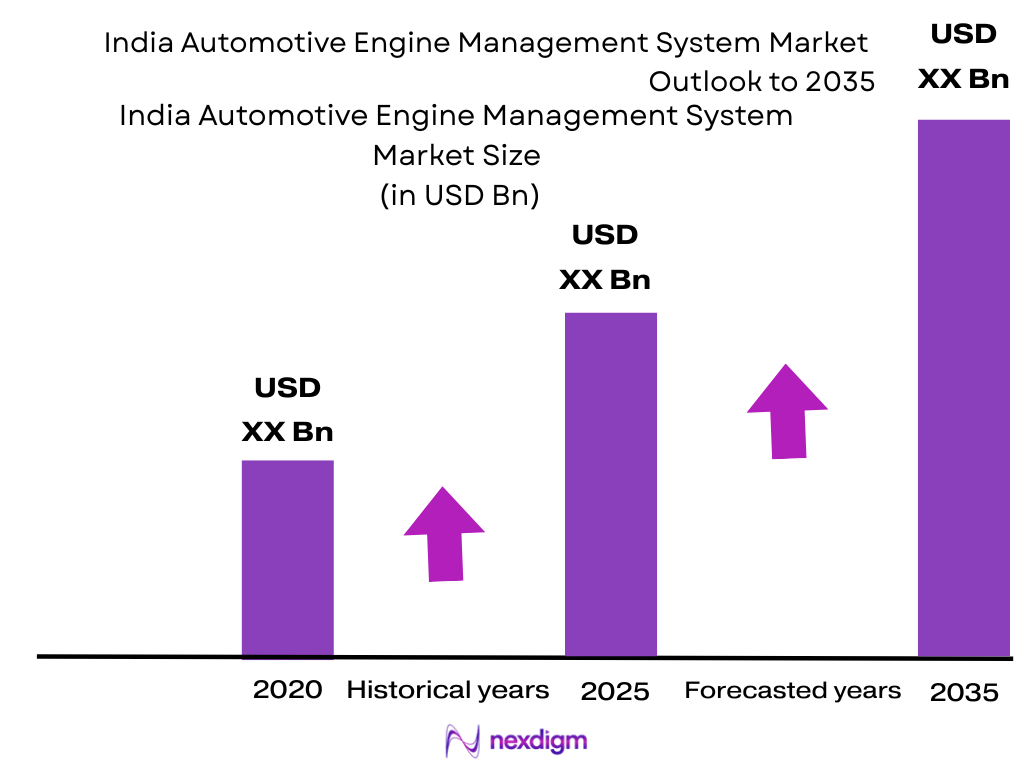
The India Automotive Engine Management System Market is valued at ~ billion. Demand is supported by vehicle production rising from 25,931,867 units to 28,434,742 units, while passenger-vehicle domestic sales increased from 3,890,114 units to 4,218,746 units. India’s combination of passenger vehicles, two-wheelers, commercial vehicles, BS6 electronics, electronic fuel injection, CNG powertrains and increasingly sophisticated turbo-petrol and diesel systems creates broad demand for ECUs, sensors, injectors and actuators. Chennai-Hosur, Pune-Chakan, Delhi NCR-Manesar, Bengaluru and Gujarat-Sanand dominate India’s engine-management ecosystem because these clusters combine high-volume vehicle assembly, powertrain manufacturing, Tier-1 production, electronics engineering and supplier localization. National two-wheeler domestic sales increased from 15,862,087 units to 17,974,365 units, while three-wheeler sales increased from 488,768 units to 691,749 units, creating unusually broad ECU demand spanning motorcycles, scooters, passenger vehicles, CNG three-wheelers and commercial platforms.
Market Segmentation
By Component Type
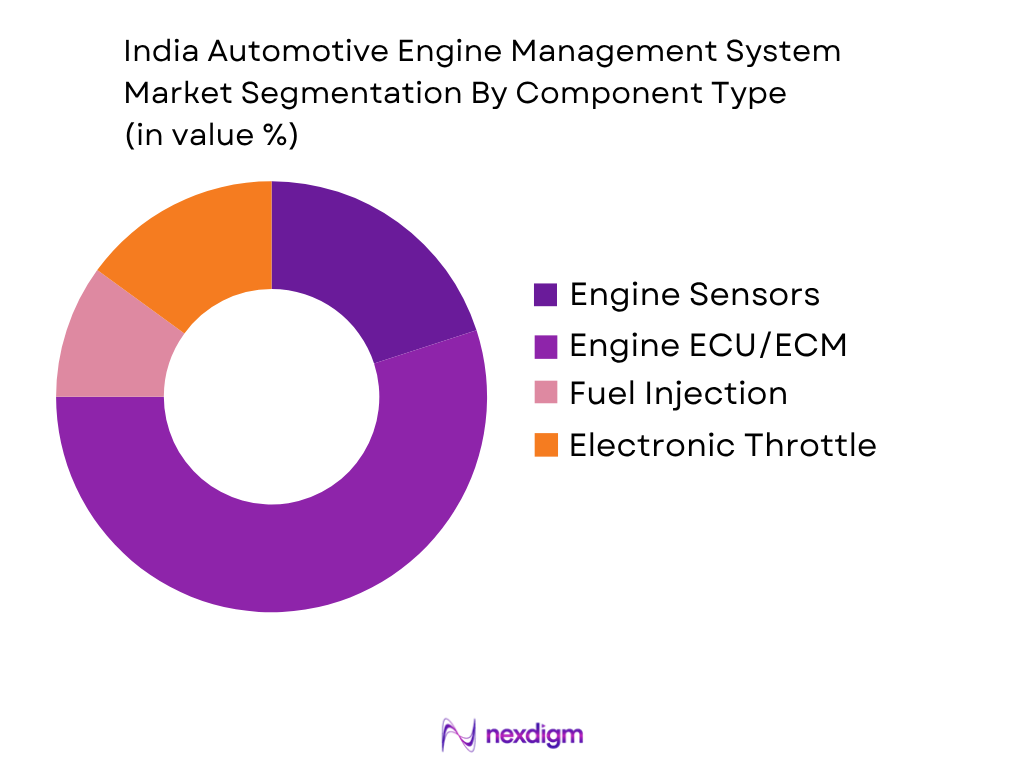
The India Automotive Engine Management System Market is segmented into engine control units, sensors, fuel-injection systems, ignition-management components, electronic throttle and air-management components, and other engine electronics. Engine control units and integrated controllers hold the dominant value position because virtually every BS6-compliant electronically fuel-injected petrol, diesel, CNG and hybrid powertrain requires computational control of fueling, ignition, airflow, emissions and diagnostic functions. Bosch describes the ECU as the central engine-management controller governing fuel supply, air management, injection and ignition across gasoline, diesel, CNG, ethanol, flex-fuel and hybrid applications. India’s unusually large two-wheeler base further enlarges controller volumes because modern motorcycles and scooters increasingly use integrated electronic fuel injection rather than carburetors. Sensors remain the second major segment because each engine can use multiple crankshaft, camshaft, MAP, temperature, lambda, pressure and emissions sensors.
By Powertrain Type
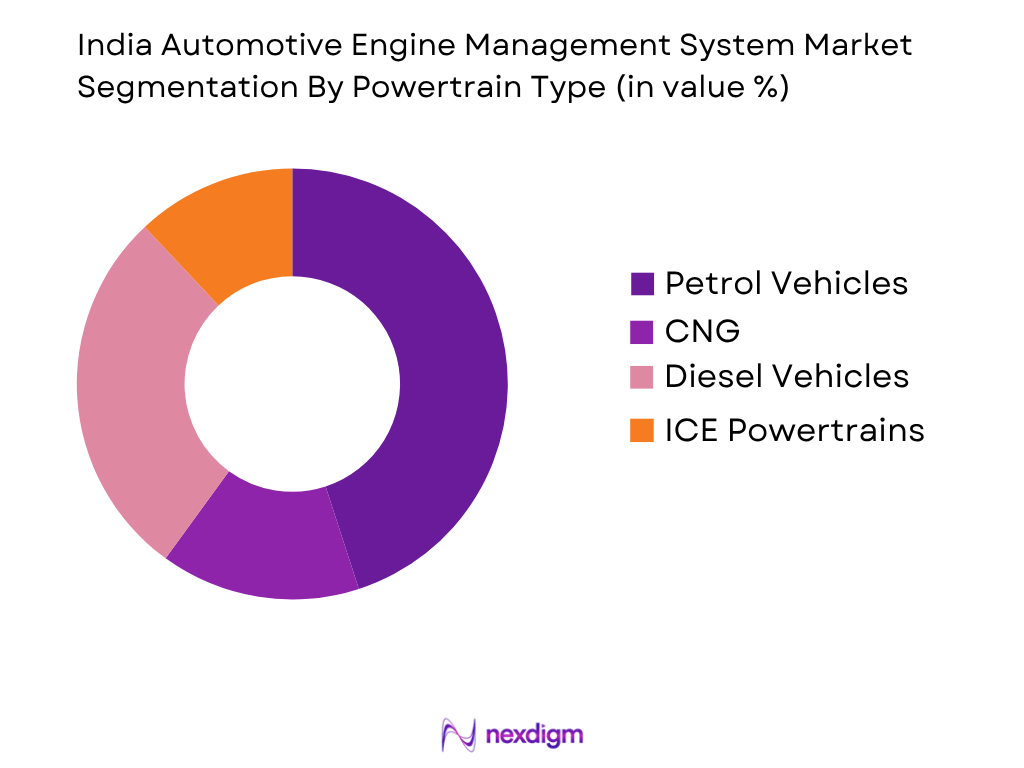
The India Automotive Engine Management System Market is segmented into conventional petrol, diesel, CNG/bi-fuel, hybrid and other alternative-fuel powertrains. Petrol powertrains currently dominate engine-management demand, supported by their extensive use across passenger cars and two-wheelers. Petrol systems require electronic fuel injection, spark management, throttle control, lambda feedback and increasingly turbocharger and high-pressure fuel control. Diesel retains substantial importance in commercial vehicles, SUVs and utility applications because common-rail injection, EGR, turbocharging, DPF and SCR systems create high engine-management content per vehicle. CNG is particularly India-specific: dedicated and bi-fuel systems require electronic control of gas injectors, mixture formation, ignition, pressure regulation and fuel switching. Bosch’s CNG controller, for example, controls injected gas mass, injection timing, ignition, exhaust treatment and petrol-CNG switching. Hybrid systems form a smaller but higher-value emerging category due to additional supervisory software and engine-motor coordination.
Competitive Landscape
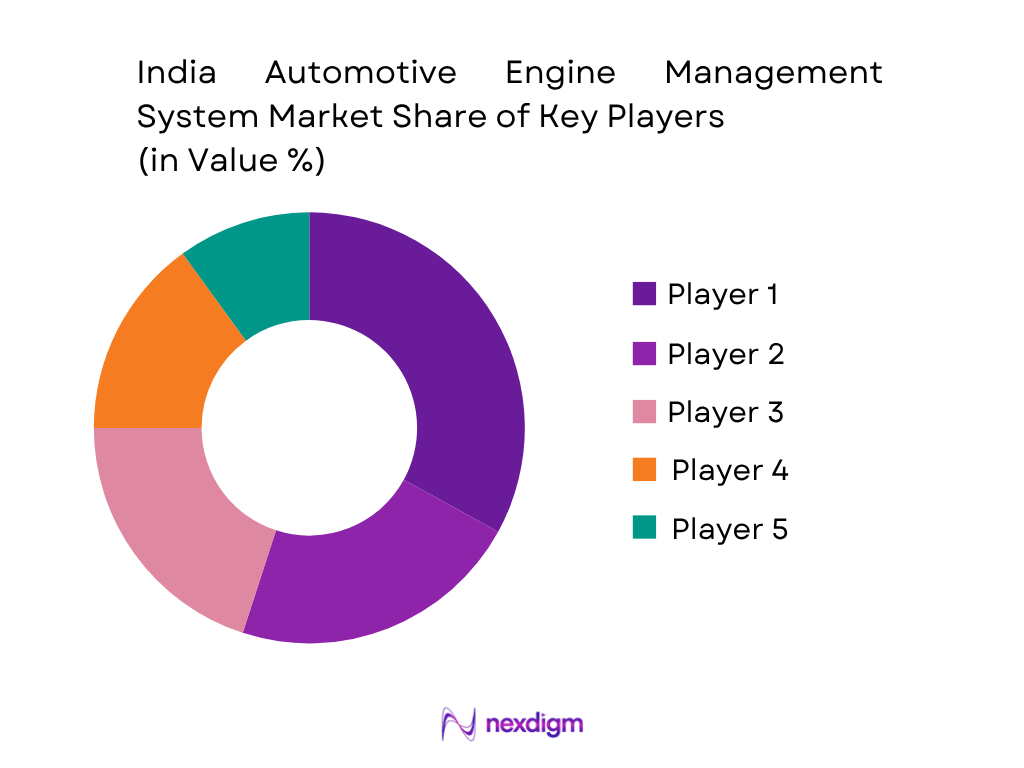
The India Automotive Engine Management System Market combines global powertrain-electronics leaders with strong domestic component manufacturers. Bosch and DENSO possess broad ECU, sensing and fuel-management expertise, while BorgWarner participates through advanced propulsion, boosting and control systems. Uno Minda brings extensive Indian OEM relationships and localized automotive electronics manufacturing. Astemo participates across powertrain and electronic-control technologies. Competition increasingly depends on BS6 calibration, two-wheeler coverage, CNG compatibility, localization, software capability and access to India’s high-volume OEM platforms. DENSO’s Indian operations manufacture products including 2W ECUs, while its broader portfolio includes engine ECUs and injectors.
| Major Player | Establishment | Headquarters | Engine ECU Capability | Two-Wheeler Coverage | Fuel-System Capability | CNG/Alt-Fuel Capability | India Manufacturing | Software/Calibration Capability |
| Bosch | 1886 | Gerlingen, Germany | ~ | ~ | ~ | ~ | ~ | ~ |
| DENSO | 1949 | Kariya, Japan | ~ | ~ | ~ | ~ | ~ | ~ |
| BorgWarner | 1928 | Auburn Hills, USA | ~ | ~ | ~ | ~ | ~ | ~ |
| Uno Minda | 1958 origin | Gurugram, India | ~ | ~ | ~ | ~ | ~ | ~ |
| Astemo | Modern integrated entity | Tokyo, Japan | ~ | ~ | ~ | ~ | ~ | ~ |
India Automotive Engine Management System Market Analysis
Growth Drivers
Expansion of High-Volume Vehicle Production and Electronic Fuel Injection
India’s exceptionally large vehicle-production base is a direct growth driver for automotive engine-management systems because every BS6-compliant petrol, diesel, CNG or hybrid vehicle requires electronic management of fueling, ignition, airflow, emissions diagnostics and increasingly aftertreatment. SIAM reported total production of 30,610,778 vehicles during calendar 2024 across passenger vehicles, commercial vehicles, three-wheelers, two-wheelers and quadricycles. During the same period, domestic sales included 4,274,793 passenger vehicles, 951,991 commercial vehicles, 728,670 three-wheelers and 19,543,093 two-wheelers. These volumes create substantial demand for engine control units, crankshaft and camshaft sensors, MAP sensors, oxygen sensors, electronic throttles, ignition drivers, injectors and associated wiring electronics. The scale increased further: calendar-2025 production reached 33,191,967 vehicles, while domestic passenger-vehicle sales rose to 4,489,717 units, commercial vehicles to 1,027,877 units, three-wheelers to 788,429 units and two-wheelers to 20,500,639 units. Two-wheelers are particularly important for India’s engine-management market because electronic fuel injection and closed-loop emissions control must be delivered at extremely high production volumes and low per-vehicle electronic complexity compared with passenger cars. Even relatively compact motorcycle ECUs must manage injection duration, spark timing, throttle position, manifold pressure, crankshaft position, oxygen feedback and diagnostic functions. Passenger vehicles add greater electronic content through turbo-petrol engines, high-pressure fuel injection, variable valve timing and more extensive sensor networks. Diesel commercial vehicles add further control requirements for common-rail injection, EGR, boost management, DPF regeneration and SCR coordination. The macroeconomic environment supports continued automotive production and household mobility demand. World Bank data show India’s GDP at approximately USD 3.96 trillion in 2025, GDP per capita at USD 2,702.5, and a population of about 1.46 billion. The IMF’s latest India profile places the population at 1,476.626 million and projects real GDP growth of 6.4 in 2026, reinforcing the scale of the domestic consumption and industrial base supporting vehicle manufacturing. SIAM also reported 2.17 crore two-wheeler sales, 46.43 lakh passenger-vehicle sales, 10.80 lakh commercial-vehicle sales and 8.36 lakh three-wheeler sales in FY2025-26. These volumes mean that engine-management growth is not dependent on one narrow vehicle category. Instead, demand is distributed across low-cost two-wheeler ECUs, passenger-car controllers, CNG three-wheelers, diesel commercial vehicles and emerging hybrid architectures. The key implication for suppliers is that India rewards scalable, highly localized ECU and sensor platforms capable of serving multiple engine displacements and fuel types. Suppliers that can reuse microcontroller architectures and software across motorcycles, passenger cars and utility vehicles can reduce engineering complexity while addressing tens of millions of applicable vehicles. This high-volume production ecosystem therefore remains one of the strongest structural drivers for India’s engine-management electronics industry.
BS6 Compliance, OBD Sophistication and Localization of Advanced Automotive Electronics
The increasing sophistication of BS6 emissions compliance and onboard diagnostics is another major growth driver because modern Indian engine-management systems must do considerably more than meter fuel and trigger ignition. They must continuously monitor combustion quality, catalyst performance, oxygen sensing, fuel pressure, EGR operation, exhaust temperature, particulate-filter behavior and numerous electrical circuits, generating diagnostic trouble codes when performance moves outside calibrated limits. ARAI’s current emissions-development capability explicitly includes BS-VI emissions and combustion development together with onboard-diagnostic calibration, illustrating how ECU calibration and diagnostic logic have become inseparable from emissions compliance. For petrol engines, the ECU manages lambda feedback, ignition timing, throttle position, knock control and increasingly turbocharger boost and direct-injection pressure. Diesel systems require common-rail timing, multiple injection events, EGR management, turbocharger actuation, DPF regeneration and SCR-related monitoring. CNG engines require separate gas-injection and fuel-switching algorithms. These requirements raise the number of sensors and control functions per applicable vehicle and increase the value of embedded software, calibration engineering and automotive-grade semiconductor content. India’s manufacturing policy is simultaneously encouraging domestic production of these advanced technologies. The Ministry of Heavy Industries’ PLI-Auto scheme has a budgetary outlay of ₹25,938 crore and targets Advanced Automotive Technology products while promoting deeper localization and domestic/global supply-chain development. Government documentation published in 2026 states that qualifying Advanced Automotive Technology products are linked to a minimum 50 units of domestic value addition per 100 units of product value, strengthening the commercial incentive to localize electronics, sensors, control modules and associated automotive systems. This is directly relevant to engine management because ECUs incorporate microcontrollers, memory, power-management ICs, analog interfaces, injector drivers and communication transceivers, while engine sensors require automotive-grade signal conditioning and packaging. Greater localization can shorten supplier lead times, improve engineering collaboration with OEMs and reduce dependence on fully imported modules. India’s broader economic base supports investment in such manufacturing. World Bank data show GDP reaching about USD 3.96 trillion in 2025 and real GDP growth of 7.6, while the IMF projects 6.4 real GDP growth in 2026. The manufacturing opportunity is amplified by rising vehicle output. SIAM reported 33,191,967 vehicles produced during calendar 2025, compared with 30,610,778 vehicles in calendar 2024, providing a large installed production base over which localized electronic content can be spread. For engine-management suppliers, this combination of stricter electronic compliance and localization creates a dual growth mechanism. OEMs need more capable controllers and more numerous sensors, while government policy encourages those technologies to be engineered and manufactured domestically. Companies capable of providing ECU hardware, embedded software, calibration, sensor integration and local application engineering are therefore positioned more strongly than suppliers selling isolated imported components. The opportunity is especially important in India because cost sensitivity forces OEMs to integrate advanced emissions functionality without adopting unnecessarily expensive electronics. Scalable software platforms, localized sensors and application-specific controller designs will consequently be central to future engine-management growth.
Market Challenges
Accelerating Battery-Electric Adoption Removing Combustion-Specific Electronics
Battery-electric vehicle adoption is the most direct structural challenge to India’s automotive engine-management system market because every BEV eliminates the internal-combustion engine and therefore removes most conventional engine-management content. A battery-electric two-wheeler does not require fuel injectors, ignition coils, crankshaft engine-position sensing, oxygen sensors, electronic throttle control for combustion, or a conventional engine ECU. The same applies to battery-electric passenger cars and three-wheelers. SIAM reported that EV registrations increased from 1.68 million units in FY2023-24 to 1.97 million units in FY2024-25. Electric two-wheeler registrations alone reached 11.5 lakh units, while electric passenger-vehicle registrations exceeded 1 lakh units. This matters disproportionately in India because two-wheelers represent the largest addressable engine-management volume pool. Conventional motorcycles and scooters require compact ECUs, injectors, throttle-position sensors, manifold-pressure sensors, crankshaft sensors, oxygen sensors and ignition electronics. When an electric two-wheeler replaces an ICE model, nearly this entire engine-management content disappears rather than merely being upgraded. The three-wheeler market presents a similar challenge because electric auto-rickshaws are expanding rapidly in urban and semi-urban mobility. SIAM’s 2026 industry reporting specifically identified expansion of electric autorickshaws as a driver within the three-wheeler market. This creates a structural shift in electronic value: instead of engine ECUs and injection hardware, spending moves toward battery management systems, motor controllers, inverters and charging electronics. Suppliers concentrated narrowly in combustion-specific sensors therefore face greater technology-transition risk than diversified electronics manufacturers. The problem is complicated by India’s simultaneously expanding overall vehicle market. SIAM reported 21.7 million two-wheeler sales, 4.643 million passenger-vehicle sales, 1.080 million commercial-vehicle sales and 836,000 three-wheeler sales in FY2025-26. This means suppliers cannot simply exit combustion technologies immediately: tens of millions of new and existing petrol, diesel and CNG vehicles will still require engine-management components while EV penetration increases. The industry therefore faces parallel investment requirements—supporting high-volume ICE platforms while developing electronics relevant to electrification. Macroeconomic conditions suggest the transition is occurring within a growing economy rather than because conventional mobility demand is collapsing. World Bank data report India’s GDP at USD 3.96 trillion in 2025, while the IMF projects 6.4 real GDP growth in 2026 and a population of 1,476.626 million. The strategic difficulty for engine-management vendors is therefore capital allocation. Continued investment is needed in BS6 calibration, CNG, diesel aftertreatment, sensors and two-wheeler ECUs, even though some of those product categories face long-term substitution. Suppliers with capabilities in semiconductors, embedded software, hybrid controllers and broader propulsion electronics can transfer technology into electrified vehicles more easily. Firms focused solely on ignition coils, conventional injectors or standalone ICE ECUs face a narrower transition path.
Semiconductor Dependence, Software Complexity and Fragmented Diagnostic Capability
Increasing semiconductor and software complexity presents a second important challenge for India’s automotive engine-management ecosystem. Modern ECUs depend on automotive-grade microcontrollers, memory, power-management circuits, injector-driver ICs, analog interfaces and communication transceivers, while BS6 diagnostics require increasingly sophisticated embedded software. This creates a supply-chain vulnerability because substitution of an automotive microcontroller is not equivalent to replacing a consumer-electronics component. Engine-control hardware and software are calibrated together, so a new microcontroller or sensor interface can require software redevelopment, validation, emissions testing and vehicle-level certification. Government policy recognizes the need for greater domestic capability: the PLI-Auto program carries an outlay of ₹25,938 crore and specifically aims to strengthen India’s advanced automotive technology manufacturing and supply chain. Government documentation in 2026 reiterated the scheme’s role in attracting investment into advanced automotive manufacturing and achieving deeper domestic value addition. The challenge extends beyond manufacturing into service and diagnostics. A modern engine warning lamp may be caused by a faulty oxygen sensor, fuel-pressure sensor, injector, EGR actuator, throttle-body position circuit, wiring harness, boost-pressure fault, DPF differential-pressure sensor or ECU software issue. In a diesel commercial vehicle, technicians may need to interpret common-rail pressure, injector correction values, EGR commanded versus actual position, DPF soot loading, exhaust temperature and SCR behavior before accurately identifying the defective component. CNG and hybrid platforms add further control layers. India’s enormous service ecosystem makes diagnostic standardization difficult because OEM authorized workshops coexist with independent garages, roadside mechanics, fleet workshops and multi-brand service networks with widely differing equipment and skill levels. The scale of the vehicle base intensifies this problem. Calendar-2025 domestic sales included 20,500,639 two-wheelers, 4,489,717 passenger vehicles, 1,027,877 commercial vehicles and 788,429 three-wheelers. Every additional electronically controlled vehicle increases the future diagnostic workload and parts-identification complexity. ARAI’s continuing emphasis on OBD calibration demonstrates that diagnostic performance is now an engineering discipline rather than a simple fault-code function. Macroeconomic conditions magnify the requirement for scalable service capability. India’s population is approximately 1.46 billion according to the World Bank and 1,476.626 million in the IMF’s latest profile, while 2025 GDP reached about USD 3.96 trillion. Supporting such a large vehicle and consumer base requires millions of technicians and service touchpoints to move from mechanical diagnosis toward electronic fault isolation. Cost sensitivity creates another constraint: workshops cannot always justify advanced diagnostic tools or OEM-specific software subscriptions, while customers may favor low-cost replacement parts. That can encourage use of non-OE sensors or improperly calibrated electronics, potentially leading to repeat repairs or emissions failures. For suppliers, this means product quality alone is insufficient. Market success increasingly requires diagnostic databases, technical training, coding support, software flashing capability, application lookup and strong distributor networks. The engine-management ecosystem is therefore becoming more technically demanding at exactly the point when India must maintain affordability across mass-market two-wheelers, passenger cars and commercial fleets.
Market Opportunities
CNG, Hybrid, Flex-Fuel and Alternative-Fuel Engine-Control Architectures
India’s diversified fuel strategy creates a significant future opportunity for engine-management suppliers because CNG, hybrids, flex-fuel vehicles and other alternative-fuel ICE architectures require additional control sophistication rather than removing electronic engine management. CNG is particularly relevant because dedicated and bi-fuel vehicles require electronically controlled gas injection, pressure monitoring, air-fuel-ratio management, ignition adaptation and seamless switching between petrol and gas. This increases demand for dedicated ECUs, injectors, pressure-temperature sensors, lambda sensors and calibration software. Hybrid vehicles add another layer: the combustion engine remains present but must coordinate with a traction motor, battery and transmission, requiring engine start-stop logic, torque arbitration, thermal management and catalyst-temperature control. Flex-fuel vehicles similarly require the ECU to adapt injection quantity and ignition timing as ethanol concentration changes. India’s installed vehicle and production scale provides a large base for these technologies. SIAM reported 4,274,793 passenger-vehicle sales, 951,991 commercial vehicles, 728,670 three-wheelers and 19,543,093 two-wheelers during calendar 2024. By calendar 2025, passenger-vehicle sales increased to 4,489,717 units, commercial vehicles to 1,027,877 units, three-wheelers to 788,429 units and two-wheelers to 20,500,639 units. Even modest penetration of alternative-fuel architectures across these volumes can produce substantial controller and sensor demand. The policy environment also supports advanced automotive technology localization. The Ministry of Heavy Industries’ PLI-Auto scheme allocates ₹25,938 crore to promote domestic manufacturing of Advanced Automotive Technology products and deepen supply-chain localization. This creates an opportunity to localize specialized CNG controllers, gas injectors, pressure sensors, hybrid supervisory controllers and related electronics rather than relying heavily on imported modules. India’s economic scale further supports long-term engineering investment. World Bank data show GDP at USD 3.96 trillion in 2025, GDP per capita of USD 2,702.5, and economic growth of 7.6, while the IMF projects 6.4 real GDP growth in 2026. The most attractive aspect of alternative-fuel engine management is its software intensity. A supplier can use common ECU hardware while differentiating through calibration and control algorithms for petrol, CNG, ethanol or hybrid operating modes. That allows engineering costs to be spread across multiple vehicle platforms. Hybrid control is especially strategic because the software expertise needed for torque arbitration, thermal management, CAN communication and functional safety can later be transferred into broader electrified propulsion systems. Flex-fuel and CNG architectures also protect engine-management suppliers from depending solely on conventional petrol and diesel vehicles. For India, where energy security, affordability and diverse use cases favor multiple propulsion pathways rather than a single technology, multi-fuel ECU platforms represent a practical opportunity for future growth.
Localization of ECUs, Smart Sensors and Software-Defined Powertrain Electronics
Localization of engine controllers, smart sensors and embedded software represents another major future opportunity because India combines very high vehicle volumes with a policy environment focused on domestic advanced-technology manufacturing. The PLI-Auto scheme has a budgetary allocation of ₹25,938 crore and explicitly supports Advanced Automotive Technology products, while government documentation states that participating products are tied to significant domestic value-addition requirements. This creates a strong commercial rationale for local production of engine ECUs, sensor modules, injector electronics, power-management circuitry and embedded control software. The potential production base is substantial. SIAM reported 30,610,778 vehicles produced in calendar 2024 and 33,191,967 in calendar 2025. FY2025-26 then produced record sales across major categories, including 2.17 crore two-wheelers, 46.43 lakh passenger vehicles, 10.80 lakh commercial vehicles and 8.36 lakh three-wheelers. Such volumes allow suppliers to amortize ECU tooling, calibration development, sensor-packaging lines and testing infrastructure across a much larger addressable base than in many smaller automotive markets. The technology itself is also becoming more valuable. Modern engine control is moving from separate low-function modules toward multicore controllers that integrate fuel injection, ignition, air-path management, aftertreatment coordination, transmission interaction and hybrid supervision. Smart sensors can incorporate digital processing, self-diagnostics and communication capability rather than sending only basic analog signals. These architectures require stronger domestic capability in microcontrollers, embedded software, cybersecurity, AUTOSAR, CAN/CAN-FD communication and functional validation. ARAI maintains capabilities in emissions development, combustion and OBD calibration, providing India with domestic technical infrastructure for validating these increasingly sophisticated control systems. The macroeconomic backdrop is supportive: World Bank data place India’s 2025 GDP at approximately USD 3.96 trillion, while the IMF projects 6.4 real GDP growth for 2026 and reports a population of 1,476.626 million. The strategic opportunity is larger than replacement of imported hardware. India can become an engineering and export base for high-volume ECU platforms, especially for two-wheelers, small cars, CNG vehicles and emerging markets that share similar affordability and emissions requirements. SIAM reported 51.8 lakh two-wheeler exports in FY2025-26, indicating that domestic engine-management platforms can potentially serve substantial overseas demand alongside local OEM programs. Localized software also allows faster calibration changes for Indian fuels, climatic conditions, driving cycles and alternative-fuel strategies. Companies that combine domestic ECU manufacturing with calibration engineering, sensor integration and software support can therefore capture a larger share of the vehicle electronics value chain. Over time, those capabilities can migrate from combustion ECUs into hybrid controllers, centralized powertrain domains and other software-defined vehicle architectures, reducing long-term dependence on conventional ICE hardware.
Future Outlook
The India Automotive Engine Management System Market is forecast to expand at ~ CAGR during 2026–2035 under the requested placeholder framework. Future demand will be shaped by rising electronic content per ICE/hybrid vehicle, expansion of two-wheeler fuel injection, CNG adoption, advanced BS6 diagnostics, localized automotive electronics and gradual movement toward software-defined powertrains. India’s scale provides a fundamentally different demand structure from mature passenger-car markets. SIAM reported production of 28,434,742 vehicles across passenger vehicles, commercial vehicles, three-wheelers, two-wheelers and quadricycles in the FY2023-24 period. Two-wheelers alone recorded 17,974,365 domestic sales, meaning low-cost compact ECUs, electronic injection and sensor systems represent a major volume opportunity. This base has continued expanding. SIAM reported two-wheeler domestic sales of 19.6 million units in FY2024-25. Passenger vehicles, commercial vehicles and three-wheelers create additional requirements spanning petrol, diesel and gaseous-fuel control.
CNG engine management offers an India-specific opportunity. CNG engines require ECU-controlled air-gas mixture formation, injector actuation, ignition timing, pressure monitoring and exhaust treatment. Bi-fuel vehicles add another layer because the engine controller must manage both gasoline and CNG operation. These requirements create demand for dedicated injectors, pressure/temperature sensors and calibration software rather than simply adapting conventional petrol hardware. Two-wheelers remain equally important. Dedicated motorcycle engine-management systems integrate injection and ignition into compact ECU architectures designed around low displacement, cost sensitivity and strict emissions requirements. India’s enormous motorcycle and scooter production base means even modest increases in electronic content can translate into substantial component volumes.
Major Players
- Bosch Limited / Bosch Mobility
- DENSO India
- AUMOVIO India
- PHINIA / Delphi India
- BorgWarner India
- Uno Minda Limited
- Minda Corporation Limited
- Pricol Limited
- Lucas TVS Limited
- Astemo India
- Marelli India
- Schaeffler India
- Valeo India
- Sensata Technologies India
- Infineon Technologies India
Key Target Audience
- Automotive OEMs
- Two-Wheeler and Three-Wheeler Manufacturers
- Automotive Tier-1 and Tier-2 Powertrain Suppliers
- ECU, Engine Sensor and Fuel-Injection Manufacturers
- Automotive Semiconductor and Embedded Software Companies
- Automotive Parts Distributors and Fleet Maintenance Networks
- Investments and Venture Capitalist Firms
- Government and Regulatory Bodies (Ministry of Road Transport & Highways, Ministry of Heavy Industries, Automotive Research Association of India, International Centre for Automotive Technology)
Research Methodology
Step 1: Identification of Key Variables
The first phase establishes an India-specific ecosystem map covering passenger vehicle, two-wheeler, three-wheeler and commercial vehicle OEMs; ECU suppliers; fuel-system companies; sensor manufacturers; semiconductor vendors; distributors and repair networks.
Core variables include vehicle production, powertrain mix, ECU content per vehicle, BS6 control architecture, CNG penetration, fuel-injection technology, sensor count, vehicle age, replacement cycles and the transition toward electrified propulsion.
Step 2: Market Analysis and Construction
The top-down model begins with SIAM vehicle production and sales and allocates engine-management content across petrol, diesel, CNG, hybrid and alternative-fuel powertrains. Battery-electric platforms are separated because they do not use conventional combustion engine-management systems.
Bottom-up modelling measures ECU shipments, injectors, sensors, ignition components, throttle controls and aftertreatment electronics across representative two-wheeler, passenger and commercial-vehicle platforms. OEM and aftermarket demand are calculated separately before triangulation.
Step 3: Hypothesis Validation and Expert Consultation
Market hypotheses are validated through CATIs with vehicle OEMs, Tier-1 suppliers, ECU manufacturers, injection-system companies, semiconductor suppliers, distributors, fleet operators and automotive workshops.
The consultations test assumptions around ECU localization, two-wheeler EMS content, CNG calibration, BS6-related sensor requirements, aftermarket replacement, controller pricing structures, semiconductor sourcing and the migration toward hybrid and software-defined architectures.
Step 4: Research Synthesis and Final Output
The final phase integrates vehicle-production indicators, supplier portfolios, regulatory requirements and primary-industry inputs. Results are segmented by component, vehicle class, powertrain, fuel type, injection architecture, application, distribution channel and geography.
Forecast scenarios incorporate vehicle production, CNG penetration, strong-hybrid adoption, flex-fuel development, EV substitution, semiconductor localization, PLI-Auto participation, ECU consolidation and increasing embedded-software content.

- Executive Summary
- Research Methodology (Market Definitions and Assumptions, Abbreviations, Engine Management System Market Boundary, Vehicle-Parc Mapping, Powertrain Mapping, ECU-per-Vehicle Assessment, Sensor Content Assessment, Petrol-Diesel-CNG-Hybrid Architecture Mapping, Two-Wheeler Engine Management Assessment, OEM Fitment Analysis, Replacement Cycle Assessment, Vehicle Age Mapping, BS6 Technology Mapping, OBD Failure Mapping, Top-Down Analysis, Bottom-Up Analysis, Demand-Side Assessment, Supply-Side Assessment, OEM-Tier-1-Distributor-Workshop Interviews, Data Triangulation, Forecasting Framework, Electrification Substitution Scenarios, Limitations and Future Conclusions)

- Definition and Scope
- Evolution of Electronic Engine Management in India
- Transition from Carburetion to Electronic Fuel Injection
- Evolution from BS4 to BS6 Engine Control Architecture
- Evolution of OBD-Based Emissions Monitoring

- Growth Drivers (Large Two-Wheeler and Passenger Vehicle Production Base, BS6 and OBD Compliance, Increasing Electronic Fuel Injection, Turbocharged Petrol Engines, Diesel Common-Rail Systems, Factory-Fitted CNG Growth, Hybrid Powertrain Adoption, Increasing Sensor Content, Automotive Electronics Localization)
- Market Challenges (Battery-Electric Vehicle Substitution, Semiconductor Dependence, ECU Software Complexity, Price Sensitivity, Diagnostic Skill Gaps, Fragmented Aftermarket, Counterfeit Sensors and Electronics, Legacy ECU Support)
- Market Opportunities (CNG Engine Management, Strong Hybrid Control, Flex-Fuel EMS, Hydrogen ICE Control, Two-Wheeler Electronic Fuel Injection, Smart Sensors, ECU Localization, Predictive Diagnostics, Remanufactured Electronics)
- Market Trends (Electronic Fuel Injection in Two-Wheelers, Downsized Turbo Petrol Engines, CNG Expansion, Multicore ECUs, AUTOSAR Adoption, Smart Sensors, Connected Diagnostics, Domain-Controlled Powertrains)
- SWOT Analysis
- Porter’s Five Forces Analysis
- PESTLE Analysis

- By Market Value (2020-2025)
- By Engine Management System Unit Volume (2020-2025)
- By Engine ECU/ECM Volume (2020-2025)

- By Component Type (In Value %)
Engine Control Unit / Engine Control Module
Powertrain Control Module
Two-Wheeler Engine Control Unit
Fuel Injectors
High-Pressure Fuel Pumps - By Vehicle Type (In Value %)
Passenger Cars
Utility Vehicles and SUVs
Multi-Purpose Vehicles
Two-Wheelers
Scooters - By Powertrain Type (In Value %)
Conventional Petrol Vehicles
Conventional Diesel Vehicles
CNG Vehicles
Petrol-CNG Bi-Fuel Vehicles
Full Hybrid Electric Vehicles - By Application (In Value %)
Fuel Injection Management
Ignition Management
Electronic Throttle Management
Air-Path Management
Turbocharger Boost Management - By Region (In Value %)
North India
West India
South India
East India

- Market Share of Major Players by Value
- Cross Comparison Parameters (Engine ECU and Powertrain Controller Portfolio Breadth, Passenger Vehicle-Two-Wheeler-Commercial Vehicle Coverage, Petrol-Diesel-CNG-Hybrid-Flex-Fuel Capability, Fuel Injection and Engine Sensor Portfolio Depth, BS6-OBD Calibration and Embedded Software Capability, India Manufacturing and Localization Footprint, OEM-Dealer-Independent Aftermarket Reach, Semiconductor and Software-Defined Powertrain Integration Capability)
- SWOT Analysis of Major Players
- Detailed Profiles of Major Companies
Bosch Limited / Bosch Mobility
DENSO India
AUMOVIO India
PHINIA / Delphi India
BorgWarner India
Uno Minda Limited
Minda Corporation Limited
Pricol Limited
Lucas TVS Limited
Hitachi Astemo India
Marelli India
Schaeffler India
Valeo India
Sensata Technologies India
Infineon Technologies India

- Passenger Vehicle OEM Procurement
- Two-Wheeler OEM Procurement
- Three-Wheeler OEM Procurement
- Commercial Vehicle OEM Procurement
- CNG Vehicle OEM Procurement

- By Market Value (2026-2035)
- By Engine Management System Unit Volume (2026-2035)
- By Engine ECU/ECM Volume (2026-2035)


 Request a Sample
 Ask for Customization
 Get a Quote
 Enquire Now