

 Download PDF
Market Overview
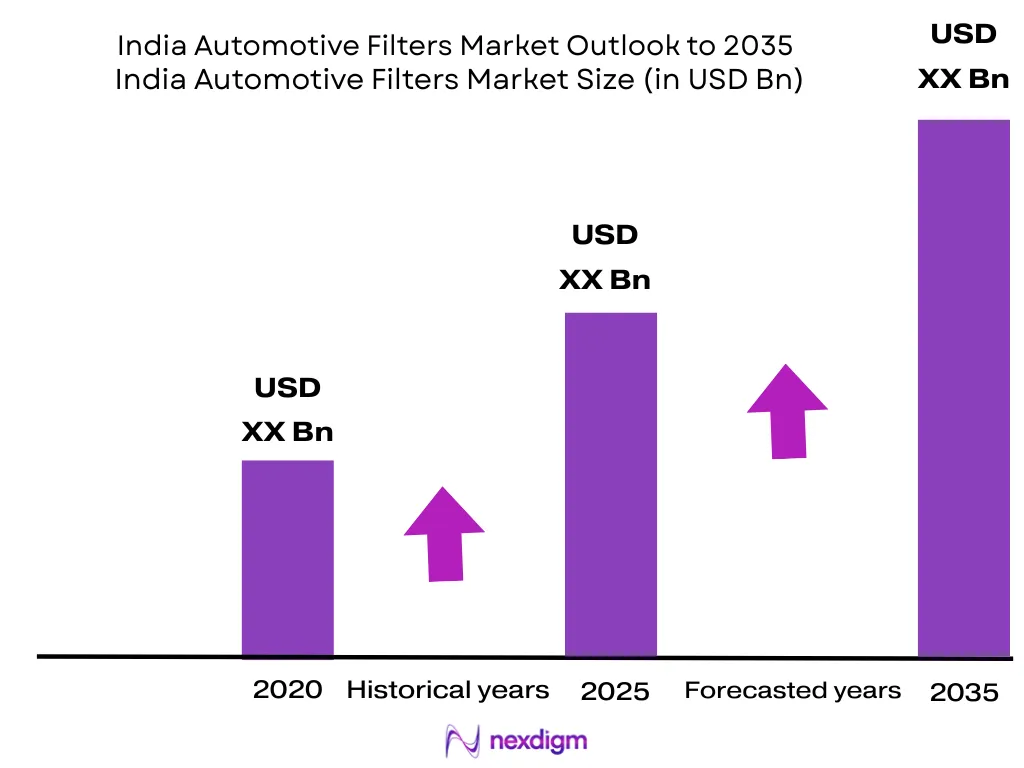
The India Automotive Filters Market is valued at approximately ~ billion, compared with ~ billion in the preceding reporting period. Demand is supported by passenger-vehicle sales rising from approximately 4.22 million units to 4.30 million units, while two-wheeler sales increased from around 17.97 million units to 19.60 million units. Expanding vehicle ownership, preventive maintenance, BS VI after-treatment systems, dusty operating conditions, and high commercial-vehicle utilisation sustain filter replacement. Delhi NCR, Pune, Chennai, Bengaluru, Mumbai, Ahmedabad, Sanand, Hosur, Pithampur, and the National Capital Region dominate the India Automotive Filters Market because they combine dense vehicle populations, automotive manufacturing, component clusters, distributor warehouses, and workshop networks. Chennai–Hosur and Pune support major vehicle and filtration manufacturing, while Delhi NCR, Mumbai, Bengaluru, and Ahmedabad generate substantial passenger, taxi, delivery, commercial-fleet, and replacement demand through intensive road usage and broad service-channel coverage. The India Automotive Filters Market covers products that remove dust, soot, metal particles, fuel contaminants, water, oil mist, allergens, gases, and other impurities from vehicle air, lubricant, fuel, transmission, hydraulic, thermal-management, and emission-control systems. Major products include engine-air filters, oil filters, fuel filters, cabin-air filters, transmission filters, coolant filters, hydraulic filters, crankcase filters, diesel particulate filters, diesel exhaust fluid filters, compressed-natural-gas filters, and electric-vehicle cooling filters.
Market Segmentation
By Filter Type
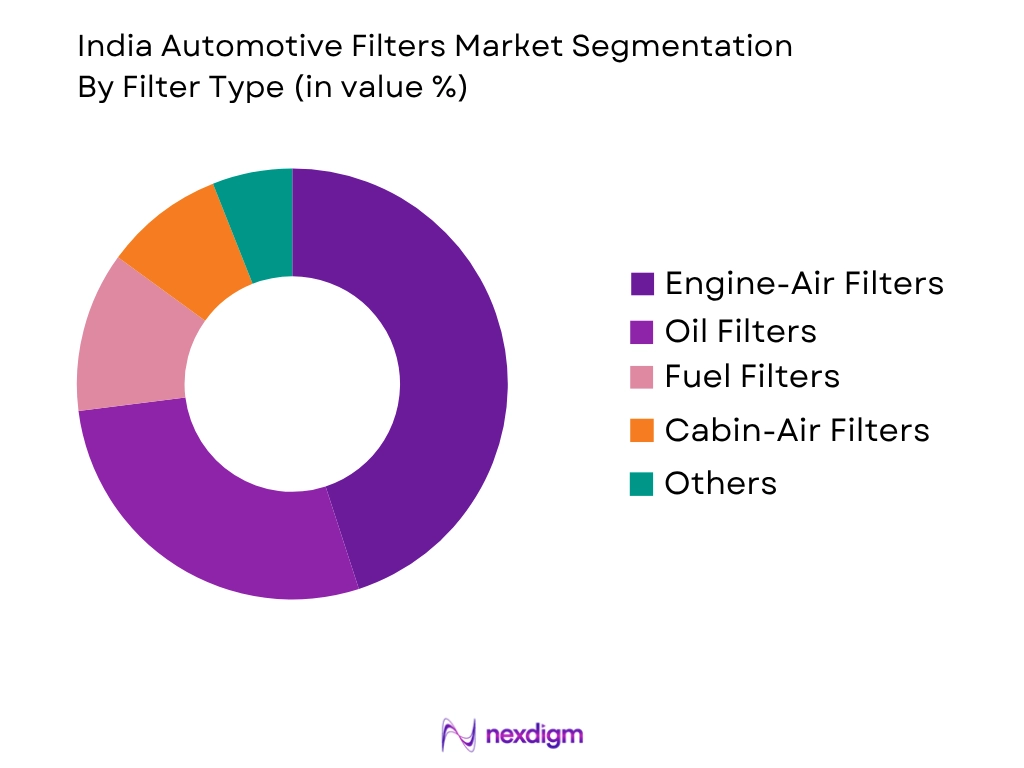
By filter type, the India Automotive Filters Market is segmented into engine-air filters, oil filters, fuel filters, cabin-air filters, emission-control filters, transmission and hydraulic filters, and other filtration products. Engine-air filters hold the dominant market share, supported by India’s dusty operating environment, large two-wheeler population, commercial-vehicle utilisation, and frequent exposure to unpaved or mixed-quality roads. Engine-air filters protect cylinders, pistons, turbochargers, and airflow sensors from abrasive particles. Their replacement is particularly important for motorcycles, scooters, utility vehicles, trucks, buses, tractors, and construction equipment operating under high dust loading. Passenger vehicles increasingly use panel and integrated intake filters, while commercial equipment uses primary and safety elements with greater dirt-holding capacity. Air-filter demand is also less directly affected by lubricant-drain intervals than oil filters. Although battery-electric vehicles do not use combustion-air filters, India’s large petrol, diesel, CNG, and hybrid population will preserve broad replacement demand.
By Vehicle Type
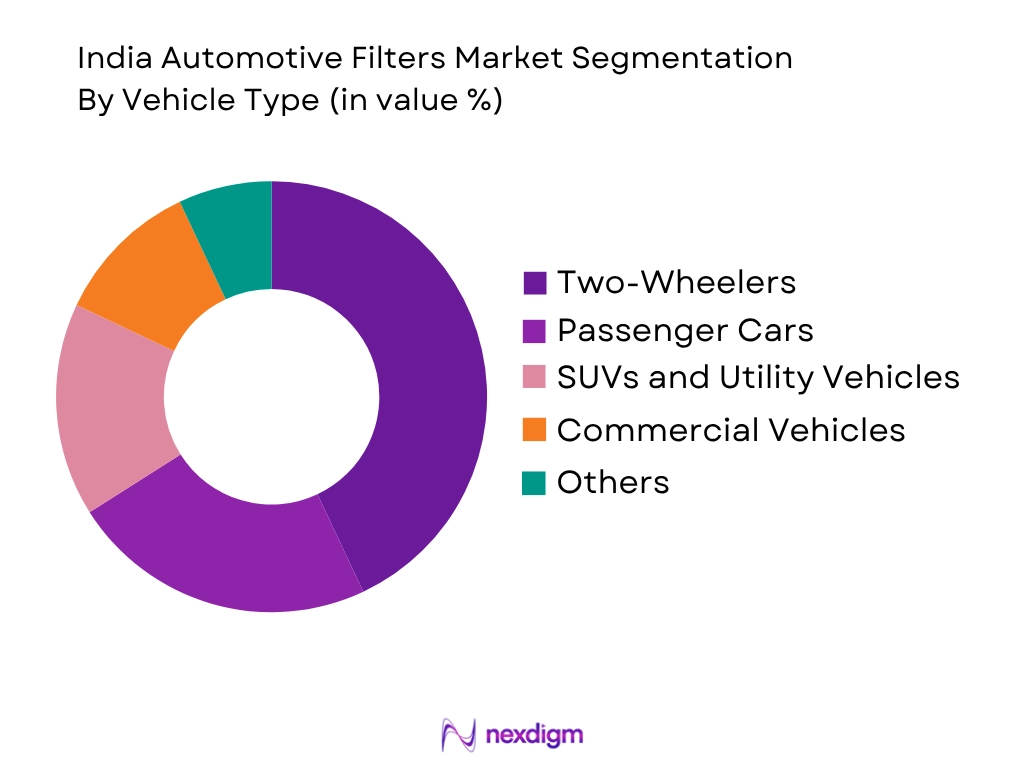
By vehicle type, the India Automotive Filters Market is segmented into two-wheelers, passenger cars, SUVs and utility vehicles, three-wheelers, light commercial vehicles, medium and heavy commercial vehicles, buses, and off-highway equipment. Two-wheelers hold the dominant unit-volume share, reflecting sales of approximately 19.6 million units in the latest financial reporting period. Motorcycles and scooters require recurring engine-air, oil, and fuel-system filtration and are commonly serviced through authorised workshops, local mechanics, and independent parts retailers. Their high population creates a large volume of relatively low-value filter transactions. Passenger cars and SUVs generate higher value per vehicle because they use multiple filters, including cabin-air, oil, engine-air, fuel, and transmission products. Commercial vehicles contribute disproportionately to premium fuel, lube, crankcase, coolant, and emission-control filtration because of high mileage and severe-duty operation.
Competitive Landscape
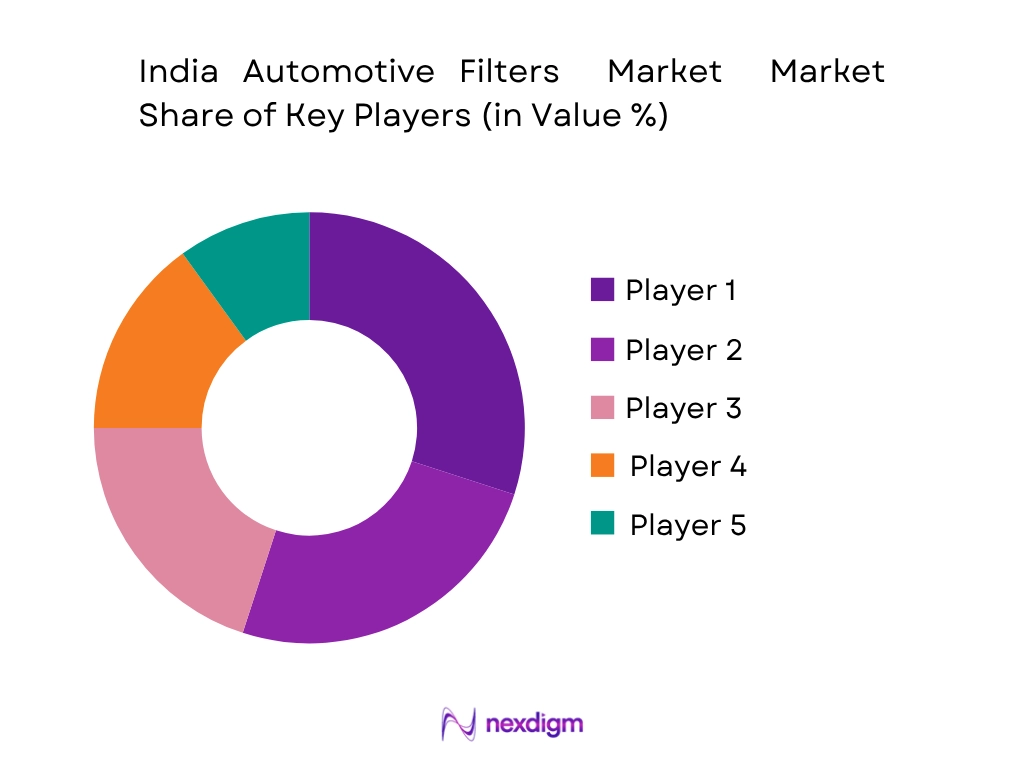
The India Automotive Filters Market combines global filtration specialists, domestic manufacturers, automotive component groups, and heavy-duty filter suppliers. MANN+HUMMEL, MAHLE, Bosch, Fleetguard, and Elofic are prominent because of their OEM relationships, product breadth, manufacturing capability, and aftermarket reach. Competition is influenced by filtration efficiency, pressure drop, dirt-holding capacity, BS VI compatibility, vehicle coverage, workshop availability, price positioning, and resistance to counterfeit or unverified products.
| Company | Establishment Year | Headquarters | Core Filter Portfolio | Vehicle Coverage | OEM Position | Aftermarket Reach | BS VI Capability | EV and Future-Mobility Readiness |
| MANN+HUMMEL | 1941 | Ludwigsburg, Germany | ~ | ~ | ~ | ~ | ~ | ~ |
| MAHLE | 1920 | Stuttgart, Germany | ~ | ~ | ~ | ~ | ~ | ~ |
| Bosch Limited | 1951 in India | Bengaluru, Karnataka | ~ | ~ | ~ | ~ | ~ | ~ |
| Fleetguard Filters | 1958 heritage | Pune, Maharashtra | ~ | ~ | ~ | ~ | ~ | ~ |
| Elofic Industries | 1951 | Faridabad, Haryana | ~ | ~ | ~ | ~ | ~ | ~ |
India Automotive Filters Market Analysis
Growth Drivers
Expansion of the Vehicle Parc and Recurring Preventive Maintenance Demand
India’s expanding vehicle population creates recurring demand for engine-air, oil, fuel, cabin, transmission, crankcase, coolant, and emission-control filters across passenger vehicles, two-wheelers, three-wheelers, trucks, buses, tractors, and construction equipment. The Society of Indian Automobile Manufacturers recorded passenger-vehicle sales of 4.3 million units during 2024–25, representing the highest annual volume achieved by the segment. Two-wheeler sales reached approximately 19.6 million units, while three-wheeler sales reached 740,000 units. Utility vehicles accounted for approximately 65 vehicles out of every 100 passenger vehicles sold, increasing the installed base of larger engines, turbocharged systems, and multi-filter architectures. Every newly sold combustion or hybrid vehicle generates original-equipment filter demand and subsequently enters the replacement cycle through authorised service centres, independent workshops, parts retailers, or roadside mechanics. India’s dusty roads, construction activity, high ambient temperatures, congestion, and mixed rural operating conditions increase air-filter loading and lubricant contamination, making periodic replacement essential for engine protection. Commercial vehicles and app-based mobility fleets create particularly intensive demand because high annual mileage shortens practical service intervals. The IMF projects India’s population at 1,476.626 million people and real GDP growth of 6.4% in 2026, supporting continued mobility, freight activity, vehicle ownership, and automotive servicing. Filter suppliers with broad vehicle coverage, regional distribution, and technically accurate fitment catalogues are therefore positioned to benefit from both new-vehicle additions and the growing out-of-warranty vehicle parc.
BS VI Emission Architecture and Protection of Advanced Diesel Systems
India’s BS VI regulatory architecture is increasing the technical value of automotive filtration, particularly in diesel passenger vehicles, utility vehicles, commercial fleets, buses, and off-highway equipment. The transition from BS IV to BS VI reduced permissible sulphur content in automotive fuel from 50 parts per million to 10 parts per million, enabling advanced exhaust after-treatment and more precise fuel-injection systems. Modern BS VI diesel vehicles commonly integrate diesel particulate filters, selective catalytic reduction, exhaust-gas recirculation, crankcase ventilation, diesel exhaust fluid delivery, and high-pressure common-rail injection. These technologies depend on effective fuel filtration, water separation, clean intake air, controlled oil mist, and correctly maintained particulate systems. Microscopic contamination or water in diesel can damage injectors and pumps operating at high pressure, while restricted air filters can increase fuel consumption, soot formation, and turbocharger stress. Commercial-vehicle operators also require coolant filters, lube filters, air-dryer cartridges, and extended-service filtration to preserve uptime. SIAM recorded commercial-vehicle sales close to 1 million units during 2024–25, while three-wheeler sales reached 740,000 units, adding to the serviceable population of high-utilisation vehicles. India’s economy is projected by the IMF to expand by 6.4% in 2026, with consumer-price growth of 4.7%, indicating sustained logistics and industrial activity alongside cost pressure on fleet operators. This environment favours suppliers that can demonstrate longer service life, low pressure drop, superior dirt capacity, and compatibility with BS VI engines rather than competing solely on initial product price.
Market Challenges
Growth of Battery-Electric Vehicles and Reduction in Conventional Filter Content
The expansion of battery-electric mobility creates a structural challenge for conventional engine-air, oil, fuel, and exhaust-filtration suppliers. A battery-electric vehicle does not require engine lubricant filtration, combustion-air filtration, petrol or diesel fuel filtration, crankcase ventilation, or tailpipe particulate filtration. India’s electric-vehicle transition is especially significant in two-wheelers and three-wheelers, which are also major consumers of low-value replacement air and oil filters in the internal-combustion market. The PM E-DRIVE scheme aims to support approximately 2.479 million electric two-wheelers and around 320,000 electric three-wheelers, while its operating framework covers electric buses, trucks, ambulances, and charging infrastructure. The scheme has been active since 1 October 2024, broadening the future installed base of vehicles with fewer conventional filtration components. This transition does not eliminate filtration demand, but it shifts the product mix toward cabin-air filters, battery-cooling filters, high-voltage battery vent protection, electric-drive lubricant filters, desiccant systems, and thermal-management fluid filtration. Suppliers concentrated in spin-on oil filters, motorcycle air filters, or conventional fuel filters face greater displacement risk than diversified filtration companies. The challenge is complicated by coexistence: India will retain a very large petrol, diesel, CNG, hybrid, and off-highway population while EV penetration rises unevenly by vehicle category and state. With the IMF projecting 6.4% real GDP growth in 2026 for a population exceeding 1.47 billion, automotive demand will remain substantial, but capital allocation must become more selective. Manufacturers must preserve legacy replacement coverage while investing in EV-specific filtration, advanced cabin-air products, and thermal-management systems without creating excess capacity in declining product categories.
Informal Aftermarket Competition, Counterfeit Products, and Fitment Complexity
India’s fragmented replacement ecosystem creates challenges relating to product quality, counterfeiting, price competition, technical fitment, and inventory management. Filters are distributed through authorised dealerships, national distributors, regional stockists, multi-brand retailers, independent garages, two-wheeler workshops, commercial-vehicle parts markets, roadside mechanics, and online platforms. This broad structure improves access but makes quality control uneven. Economy or counterfeit products may use low-grade paper, inadequate pleat counts, weak adhesives, poor seals, incorrect bypass valves, or insufficient water-separation media. Such products can appear visually similar to genuine filters but may cause restricted airflow, unfiltered oil bypass, injector damage, premature engine wear, or warranty disputes. Fitment complexity is also increasing as manufacturers introduce new engine families, turbochargers, BS VI after-treatment systems, hybrid platforms, automatic transmissions, and model-specific cartridge housings. India sold 4.3 million passenger vehicles, approximately 19.6 million two-wheelers, and 740,000 three-wheelers during 2024–25, adding millions of future service applications to an already extensive catalogue. A single vehicle model may use different filters by engine, production batch, fuel type, or emission package, increasing the risk of workshop error and distributor inventory obsolescence. Inflation adds further pressure: the IMF projects consumer-price growth of 4.7% in 2026, which may encourage consumers and small fleet operators to postpone preventive maintenance or select the lowest-priced option. Organised suppliers must therefore invest in QR-based authentication, VIN and registration lookup, technician training, tamper-resistant packaging, same-day parts delivery, and clear specifications for filtration efficiency, pressure drop, micron rating, and replacement interval.
Market Opportunities
Premium Cabin-Air Filtration for Urban Pollution and High-Dust Conditions
Cabin-air filtration represents a major opportunity because it remains relevant across petrol, diesel, CNG, hybrid, and battery-electric vehicles. India’s passenger-vehicle sales reached 4.3 million units during 2024–25, while utility vehicles represented approximately 65 out of every 100 passenger vehicles sold. These additions expand the future replacement base for particulate, activated-carbon, allergen-reduction, antimicrobial, and multilayer cabin filters. Metropolitan regions such as Delhi NCR, Mumbai, Bengaluru, Chennai, Hyderabad, Pune, Ahmedabad, and Kolkata expose vehicles to road dust, construction particles, pollen, traffic emissions, odours, and seasonal smoke. Standard particulate filters can be upgraded with activated carbon or biofunctional layers that adsorb selected gases and odours while capturing finer airborne contaminants. Electric vehicles provide an additional premium segment because their quiet cabins make HVAC airflow, odour, and air quality more noticeable to occupants. Taxi, app-based mobility, corporate fleet, and delivery operators also run HVAC systems for extended periods, increasing filter loading and creating shorter practical replacement intervals. PM E-DRIVE aims to support approximately 2.479 million electric two-wheelers and 320,000 electric three-wheelers, while electric passenger and commercial mobility continues to develop beyond the scheme’s largest categories. Although many electric two-wheelers do not use cabin filters, wider EV adoption encourages consumer awareness of energy-efficient HVAC and interior air quality across passenger vehicles. With India’s population projected at 1,476.626 million in 2026, the addressable consumer base is substantial. Suppliers can capture this opportunity through seasonal replacement campaigns, digital reminders, inspection-led service upselling, model-specific premium products, and independently verified particle and gas-filtration performance.
Connected Commercial-Vehicle Filtration and Condition-Based Maintenance
India’s road-freight, bus, construction, mining, and agricultural fleets create an opportunity for connected filtration systems that combine physical filters with sensors, telematics, predictive maintenance, and automatic replenishment. Commercial vehicles operate over long distances and under high dust, heat, load, and fuel-quality variability, making filter condition directly relevant to vehicle uptime and cost per kilometre. SIAM recorded commercial-vehicle sales close to 1 million units during 2024–25, while three-wheeler sales reached 740,000 units, reflecting continued demand from freight, passenger transport, and last-mile mobility. High-utilisation fleets require engine-air filters, safety elements, fuel-water separators, oil filters, coolant filters, crankcase filters, air-dryer cartridges, hydraulic filters, diesel particulate filters, and diesel exhaust fluid filters. Air-restriction sensors can indicate when dust loading is approaching a critical level; fuel-system sensors can detect water or pressure loss; and oil-condition monitoring can support replacement based on actual contamination rather than fixed calendars. These systems reduce premature filter changes while helping prevent injector damage, turbocharger stress, excessive soot, and roadside breakdowns. PM E-DRIVE also covers electric buses and trucks, creating an adjacent opportunity for battery-cooling, cabin, vent, and thermal-management filtration within fleet-service contracts. India’s projected 6.4% economic growth in 2026 supports freight and infrastructure activity, while 4.7% consumer-price growth increases pressure on operators to control operating costs. Filter manufacturers can move beyond component sales by offering kilometre-based contracts, remote monitoring dashboards, mobile service, DPF cleaning, casing and core exchange, and guaranteed fleet availability supported by national distributor networks.
Future Outlook
The India Automotive Filters Market is forecast to expand at approximately ~ CAGR during the forecast period. Growth will be supported by vehicle production, increasing vehicle retention, expansion of service networks, BS VI system complexity, high commercial mileage, cabin-air-quality demand, and advanced filtration media. The product mix will evolve as battery-electric vehicles reduce conventional oil, fuel, and combustion-air filter content. However, the installed internal-combustion fleet will continue generating substantial replacement demand, while hybrids, CNG vehicles, commercial fleets, and off-highway machinery preserve complex filtration requirements. Passenger-vehicle sales reached approximately 4.3 million units, while two-wheeler sales reached 19.6 million units in the latest financial reporting period. Commercial-vehicle sales remained close to 1 million units, creating a large new population that will progressively enter the replacement cycle. India’s operating environment will favour high dirt-holding capacity and severe-duty filter designs. Dust, construction activity, high temperatures, traffic congestion, rural operation, and inconsistent maintenance practices can accelerate filter loading.
Major Players
- MANN+HUMMEL Filter Systems India
- MAHLE Filter Systems India
- Bosch Limited
- Fleetguard Filters Private Limited
- Donaldson India Filter Systems
- Elofic Industries Limited
- Uno Minda–Roki
- Sogefi India
- DENSO India
- Parker Hannifin India
- Hengst Filtration India
- UFI Filters India
- Filtrak BrandT India
- Zenith Auto Industries
- K&N Engineering India
Key Target Audience
- Automotive filter and filtration-module manufacturers
- Passenger, two-wheeler, commercial, and off-highway vehicle manufacturers
- Automotive parts distributors and regional stockists
- Authorised service centres and independent workshops
- Logistics, taxi, delivery, bus, construction, and municipal fleets
- Filter-media, activated-carbon, housing, adhesive, and sensor suppliers
- Investments and venture capitalist firms
- Government and regulatory bodies (Ministry of Road Transport and Highways, Ministry of Heavy Industries, Bureau of Indian Standards, Automotive Research Association of India, International Centre for Automotive Technology, Central Pollution Control Board, and state pollution control boards)
Research Methodology
Step 1: Identification of Key Variables
The initial phase constructs an ecosystem map covering filter manufacturers, vehicle OEMs, media suppliers, distributors, stockists, service centres, mechanics, fleets, and recyclers. Key variables include vehicle sales, vehicle age, filter content per vehicle, replacement frequency, engine type, service-channel migration, BS VI architecture, and product price tier.
Step 2: Market Analysis and Construction
Historical vehicle-production, domestic-sales, registration, servicing, and fleet-utilisation data are compiled. Top-down analysis assesses filtration revenue within the wider automotive-component and maintenance ecosystem, while bottom-up analysis applies filter quantities, replacement intervals, vehicle populations, channel markups, and average selling values.
Step 3: Supply-Side Assessment
Manufacturers are evaluated by domestic capacity, OEM contracts, product portfolio, filter-media technology, distribution reach, commercial-vehicle exposure, and BS VI capability. Product catalogues, plant disclosures, distributor availability, and private-label participation are used to reconstruct organised supply.
Step 4: Demand-Side Assessment
Passenger owners, two-wheeler users, three-wheeler operators, workshops, taxi fleets, logistics companies, bus operators, and off-highway users are assessed by annual mileage, maintenance frequency, duty cycle, brand preference, and price sensitivity.

- Executive Summary
- Research Methodology (Market Definitions and Assumptions, Automotive Filter Market Boundary, Abbreviations, Market Sizing Approach, Top-Down Analysis, Bottom-Up Analysis, Vehicle Parc–Based Demand Modelling, Filter Replacement Interval Assessment, OEM Installation Assessment, Aftermarket Sell-Out Assessment, Fleet Maintenance Assessment, Primary Industry Interviews, Data Triangulation, Forecasting Framework, Limitations and Future Conclusions)

- Definition and Scope
- Market Evolution and Industry Genesis
- Timeline of Major Industry Developments
- Automotive Filtration Technology Evolution
- Passenger, Two-Wheeler and Commercial Vehicle Filtration Ecosystem

- Growth Drivers (Vehicle Production Expansion, Ageing Vehicle Parc, Preventive Maintenance Demand, Commercial Fleet Utilisation, BS VI Compliance, Cabin Air Quality Awareness)
- Market Challenges (EV Transition, Extended Service Intervals, Informal Aftermarket, Counterfeit Risk, Fitment Complexity, Raw Material Volatility)
- Market Opportunities (Cabin Filtration, Connected Filters, EV Thermal Management, Fleet Analytics, DPF Services, Sustainable Materials)
- Market Trends (Digital Fitment, Premium Cabin Filtration, Connected Maintenance, Longer Service Life, Sustainable Media, Omnichannel Retail)
- Government Regulations (BS VI Emission Standards, Type Approval, Product Safety, Waste Management, Workshop Compliance)
- SWOT Analysis
- Porter’s Five Forces Analysis
- PESTLE Analysis

- By Market Value (2020-2025)
- By Filter Unit Sales (2020-2025)
- By Original Equipment Revenue (2020-2025)

- By Filter Type (In Value %)
Engine Air Filters
Oil Filters
Fuel Filters
Cabin Air Filters
Transmission Filters - By Vehicle Type (In Value %)
Passenger Cars
Sports Utility Vehicles
Multi-Purpose Vehicles
Pickup and Utility Vehicles
Motorcycles - By Sales Channel (In Value %)
Vehicle Manufacturers
Tier-One Filtration System Suppliers
Authorised Vehicle Dealerships
Company-Owned Service Networks
National Automotive Parts Distributors - By Geographic Region (In Value %)
North India
South India
West India
East India
Central India
Northeast India

- Market Share of Major Players (By Value, Unit Volume, Filter Type, Vehicle Application, Sales Channel)
- Cross Comparison Parameters (Engine Air–Oil–Fuel–Cabin–Transmission–Emission Filter Portfolio Breadth, Passenger–SUV–Two-Wheeler–Three-Wheeler–Commercial–Off-Highway Vehicle Coverage, India OEM Fitment and Integrated Filtration Module Capability, Filtration Efficiency–Pressure Drop–Dirt-Holding Capacity–Service-Life Performance, National Distributor–Workshop–Commercial Dealer–Rural Network Reach, Synthetic–Nanofibre–Activated Carbon–Biofunctional Media Capability, BS VI DPF–SCR–Crankcase–Fuel Filtration Capability, EV Battery Cooling–Connected Monitoring–Private-Label–Sustainable Product Innovation)
- SWOT Analysis of Major Players
- Detailed Profiles of Major Companies
MANN+HUMMEL Filter Systems India
MAHLE Filter Systems India
Bosch Limited
Fleetguard Filters Private Limited
Donaldson India Filter Systems
Elofic Industries Limited
Uno Minda–Roki
Sogefi India
DENSO India
Parker Hannifin India
Hengst Filtration India
UFI Filters India
Filtrak BrandT India
Zenith Auto Industries
K&N Engineering India

- Individual Passenger Car Owner Analysis
- SUV and Utility Vehicle Owner Analysis
- Two-Wheeler Owner Analysis
- Three-Wheeler Operator Analysis
- Battery Electric Vehicle Owner Analysis

- By Market Value (2026-2035)
- By Filter Unit Sales (2026-2035)
- By Original Equipment Revenue (2026-2035)


 Request a Sample
 Ask for Customization
 Get a Quote
 Enquire Now