

 Download PDF
Market Overview
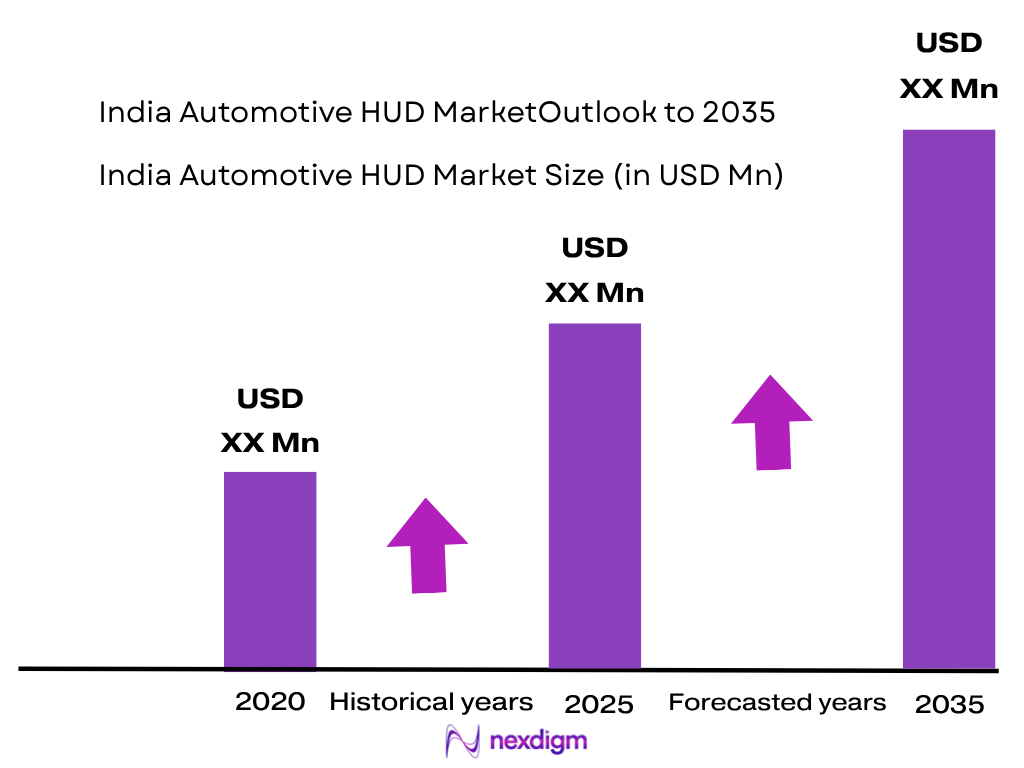
The India Automotive Head-Up Display (HUD) market is valued at ~USD 50 million, based on a five-year historical analysis, with market expansion driven by increasing premium vehicle penetration, rising adoption of Advanced Driver Assistance Systems (ADAS), and growing integration of digital cockpit technologies. The market recorded a valuation of USD 42 million in 2023 and reached ~USD 50 million in 2024, supported by higher installation of HUD systems in premium SUVs, luxury vehicles, and electric vehicles. Increasing consumer preference for enhanced driving safety and connected vehicle experiences is further accelerating OEM adoption.
The India Automotive HUD market is concentrated across major automotive manufacturing and consumption hubs including Mumbai, Pune, Chennai, Bengaluru, Gurugram, and Delhi NCR, due to the presence of leading automobile manufacturers, technology suppliers, R&D centres, and premium vehicle buyers. Cities such as Pune and Chennai dominate because of established automotive production ecosystems, while Bengaluru and Gurugram contribute through software development capabilities, connected vehicle innovation, and increasing adoption of technologically advanced vehicles.
Market Segmentation
By HUD Type
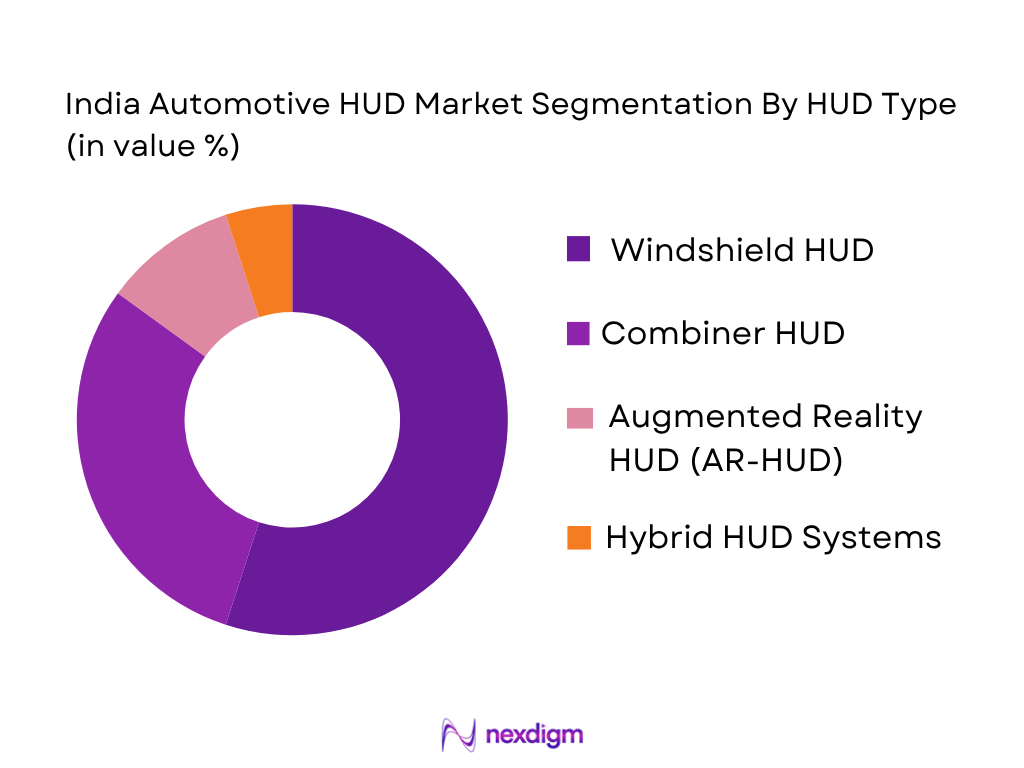
The India Automotive HUD market is segmented by HUD type into Combiner HUD, Windshield HUD, Augmented Reality HUD (AR-HUD), and Hybrid HUD systems. Among these, Windshield HUD holds a dominant market position due to its wider adoption across premium passenger vehicles, improved visibility, and enhanced driver information projection capabilities. Automotive manufacturers prefer windshield-based systems as they provide a larger display area, better integration with navigation systems, and improved user experience compared to conventional combiner displays. The increasing availability of advanced windshield HUD solutions from global Tier-1 suppliers and their integration with ADAS features such as lane departure warnings, collision alerts, and navigation guidance are further supporting segment growth. AR-HUD adoption is increasing; however, higher cost and technological complexity limit widespread deployment in mass-market vehicles.
By Vehicle Type
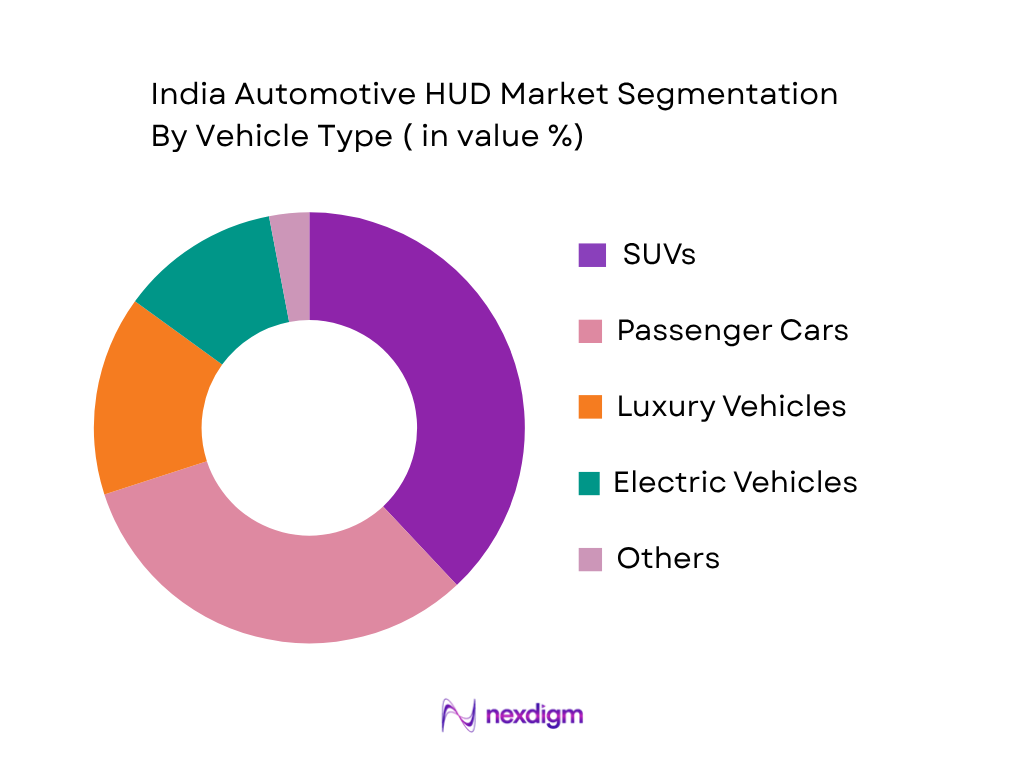
The India Automotive HUD market is segmented by vehicle type into Passenger Cars, SUVs, Luxury Vehicles, Electric Vehicles, and Commercial Vehicles. Passenger cars and SUVs dominate the market due to increasing consumer demand for premium interiors, safety features, and connected technologies. SUVs particularly contribute significantly as automotive manufacturers are introducing advanced cockpit features in mid-premium and premium SUV models to differentiate their offerings. Luxury vehicles continue to maintain strong HUD adoption due to higher feature availability and consumer willingness to pay for advanced driving technologies. Electric vehicles are emerging as a high-growth segment as EV manufacturers integrate digital displays, intelligent cockpits, and software-driven features as core differentiators.
Competitive Landscape
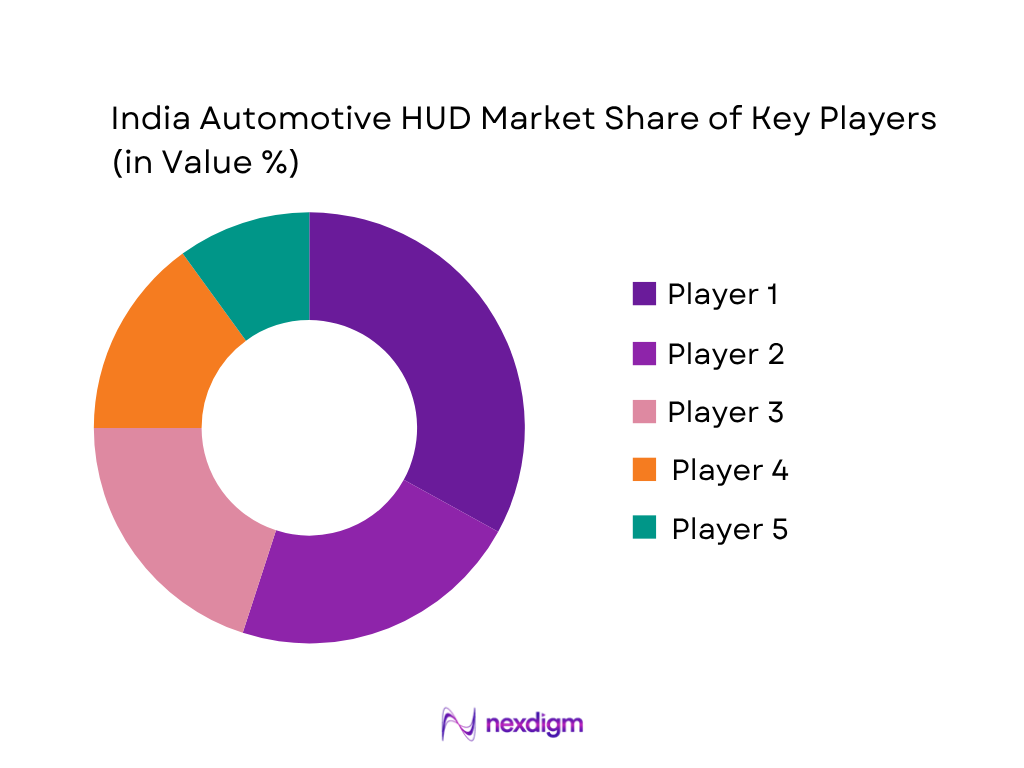
The India Automotive HUD market is moderately consolidated, with global automotive technology suppliers dominating the ecosystem through partnerships with vehicle manufacturers. Major players including Continental, Bosch, Denso, Panasonic Automotive Systems, and Visteon have established strong positions through advanced display technologies, OEM collaborations, and integrated cockpit solutions. Competition is increasing as automotive manufacturers seek localized electronics solutions and affordable HUD systems for broader vehicle adoption.
| Company | Establishment Year | Headquarters | Key Parameters |
| Continental AG | 1871 | Hanover, Germany | ~ |
| Robert Bosch GmbH | 1886 | Gerlingen, Germany | ~ |
| Denso Corporation | 1949 | Kariya, Japan | ~ |
| Panasonic Automotive Systems | 2003 | Yokohama, Japan | ~ |
| Visteon Corporation | 2000 | Van Buren Township, USA | ~ |
India Automotive HUD Market Analysis
Growth Drivers
Increasing Premium Vehicle Demand and Rising SUV Penetration
The increasing adoption of premium vehicles and SUVs is one of the key growth drivers for the India Automotive HUD market, as these vehicle categories are the primary platforms for advanced cockpit technologies. India recorded total passenger vehicle sales of 4.23 million units in 2024, according to the Society of Indian Automobile Manufacturers (SIAM), reflecting continued expansion of personal mobility demand. SUVs and utility vehicles contributed significantly to overall passenger vehicle growth, supported by consumer preference for larger vehicles equipped with advanced safety and convenience features. The Ministry of Heavy Industries reported that India’s automotive sector continues to receive investments under initiatives such as the Production Linked Incentive (PLI) scheme for automobiles and auto components, encouraging development of advanced automotive electronics. The increasing integration of features such as ADAS, digital instrument clusters, connected infotainment systems, and intelligent driver interfaces in premium SUVs is creating demand for HUD solutions. As vehicle manufacturers increasingly differentiate models through technology-driven interiors, HUD systems are becoming an important feature within premium cockpit architectures, particularly for SUVs, electric vehicles, and higher-end passenger cars.
Expansion of ADAS Features and Connected Vehicle Adoption
The expansion of Advanced Driver Assistance Systems (ADAS) and connected vehicle technologies is accelerating demand for automotive HUD solutions by increasing the requirement for real-time driver information display. India’s digital infrastructure growth has created favourable conditions for connected mobility adoption, with the Ministry of Electronics and Information Technology reporting that India had more than 954 million internet subscribers in 2024, supporting connected vehicle ecosystems and cloud-based automotive services. The Ministry of Road Transport and Highways recorded more than 4.8 million road accidents-related vehicle registrations and transport activity indicators through national road safety databases, highlighting the increasing importance of vehicle safety technologies. HUD systems enable drivers to receive critical information such as navigation guidance, collision warnings, lane departure alerts, and traffic sign recognition without diverting attention from the road. Additionally, India’s electric vehicle ecosystem is expanding, with the Ministry of Heavy Industries reporting cumulative electric vehicle sales exceeding 5 million units under national EV adoption initiatives, encouraging manufacturers to integrate advanced digital cockpit solutions. The combination of connected mobility, safety requirements, and intelligent vehicle platforms is strengthening the role of HUD technology in next-generation vehicles.
Market Challenges
High System Integration Complexity and Limited Adoption Beyond Premium Vehicles
The India Automotive HUD market faces challenges due to the complexity involved in integrating display systems with vehicle electronics, windshields, sensors, and software platforms. HUD technology requires precise optical calibration, compatibility with vehicle architectures, and integration with ADAS systems, making deployment more difficult compared with conventional displays. India’s automotive manufacturing ecosystem is still transitioning toward advanced electronics integration, with the Ministry of Heavy Industries focusing on increasing domestic capabilities through the Automotive and Auto Component PLI scheme. The challenge is further influenced by the structure of the Indian vehicle market, where entry-level and mid-segment vehicles continue to represent a significant portion of passenger vehicle demand. According to SIAM, India produced more than 28 million vehicles across categories in 2024, creating a diverse market where advanced electronic features are primarily concentrated in higher-end models. The requirement for specialized optical components, software compatibility, and vehicle-specific engineering increases implementation complexity, limiting faster adoption of HUD systems across mass-market vehicle platforms.
Semiconductor Supply Dependency and Automotive Electronics Manufacturing Constraints
Dependence on imported semiconductor components and advanced automotive electronics remains a significant challenge for the India Automotive HUD market. HUD systems require components including microcontrollers, display processors, optical modules, projection units, and semiconductor-based control systems, making supply chain resilience critical. India imported electronic components and semiconductor-related products worth significant volumes in 2024, highlighting continued dependence on global supply networks. The Government of India has introduced semiconductor manufacturing initiatives under the India Semiconductor Mission with approved investments aimed at strengthening domestic chip manufacturing and reducing dependency on external suppliers. The automotive sector’s increasing electronic content further intensifies demand for reliable semiconductor availability, with modern vehicles integrating multiple electronic control units, sensors, and digital displays. The lack of large-scale domestic production capabilities for specialized automotive-grade semiconductors and optical display components creates supply risks for HUD manufacturers. These constraints affect localization efforts and may slow the transition of HUD technology from premium vehicles into broader vehicle categories.
Market Opportunities
Local Automotive Electronics Manufacturing and HUD Component Localization
The development of domestic automotive electronics manufacturing capabilities presents a significant opportunity for the India Automotive HUD market. The Government of India has been promoting automotive component localization through initiatives such as the Automotive and Auto Component Production Linked Incentive scheme, which received applications from leading automotive and component manufacturers for technology-focused investments. India’s electronics manufacturing sector is expanding, supported by the Ministry of Electronics and Information Technology’s semiconductor and electronics manufacturing programs. The country recorded electronics production exceeding ₹9 lakh crore in 2024, indicating strengthening domestic capability across electronic hardware categories. Increased localization of display modules, optical components, embedded systems, and automotive software can help create a stronger HUD supply ecosystem within India. Domestic manufacturing development can enable suppliers to support OEM requirements for affordable HUD solutions, improve supply chain reliability, and encourage integration of advanced cockpit technologies into a wider range of vehicles. The growing focus on automotive technology localization creates opportunities for Indian component manufacturers and global suppliers establishing local production capabilities.
EV Platform Integration and Growth of Intelligent Digital Cockpit Solutions
The rapid development of electric vehicle platforms creates opportunities for HUD adoption as EV manufacturers increasingly position digital experience and connected technology as key product differentiators. The Ministry of Heavy Industries reported continued expansion of electric mobility adoption through national programs supporting EV manufacturing and deployment. India recorded more than 1.9 million electric vehicle registrations in 2024, according to government vehicle registration data, reflecting increasing acceptance of electric mobility across two-wheelers, three-wheelers, and passenger vehicle segments. Electric vehicles generally incorporate higher levels of software integration, digital displays, connected services, and intelligent vehicle interfaces, creating favourable conditions for HUD deployment. Manufacturers are increasingly designing EV platforms around centralized electronic architectures, enabling easier integration of advanced cockpit technologies. HUD systems can enhance EV user experience by displaying battery range information, charging locations, navigation assistance, and energy management data directly within the driver’s view. The combination of EV expansion, connected mobility development, and software-defined vehicle architecture provides a strong opportunity for HUD technology providers to expand their presence in India’s evolving automotive ecosystem.
Future Outlook
Over the next decade, the India Automotive HUD market is expected to witness significant growth driven by rising ADAS adoption, increasing electric vehicle penetration, and growing demand for intelligent cockpit systems. Automotive manufacturers are expected to expand HUD availability beyond luxury vehicles into premium mass-market segments. Advancements in AR-HUD technology, display miniaturization, and localization of automotive electronics will further support market expansion.
Major Player
- Continental AG
- Robert Bosch GmbH
- Denso Corporation
- Panasonic Automotive Systems
- Harman International
- LG Electronics
- Garmin Ltd.
- Nippon Seiki Co., Ltd.
- Valeo
- Visteon Corporation
- Yazaki Corporation
- Texas Instruments
- Toshiba Electronic Devices & Storage Corporation
- MicroVision Inc.
- Fujitsu Limited
Key Target Audience
- Automotive OEMs (Passenger Vehicle Manufacturers, Electric Vehicle Manufacturers, Luxury Vehicle Brands)
- Tier-1 Automotive Component Suppliers (Cockpit Electronics and Display System Suppliers)
- Automotive Electronics Manufacturers (HUD Hardware and Semiconductor Solution Providers)
- Investments and Venture Capitalist Firms (Automotive Technology Funds, Mobility Investment Firms, EV Technology Investors)
- Government and Regulatory Bodies (Ministry of Heavy Industries, Ministry of Road Transport and Highways, Automotive Research Association of India)
- Automotive Software and Connected Vehicle Solution Providers
- Electric Vehicle Infrastructure and Technology Companies
- Automotive Aftermarket Electronics Companies
Research Methodology
Step 1: Identification of Key Variables
The initial phase involves developing an ecosystem map covering automotive OEMs, HUD manufacturers, Tier-1 suppliers, semiconductor providers, software developers, and technology integrators operating within the India Automotive HUD market. Extensive secondary research is conducted using industry databases, company filings, automotive associations, and proprietary market intelligence sources to identify critical market variables.
Step 2: Market Analysis and Construction
This phase involves collecting and analysing historical market data related to HUD installation volumes, vehicle penetration, technology adoption, OEM integration, and pricing trends. The market structure is evaluated through assessment of vehicle segments, technology categories, supplier landscape, and revenue contribution from different application areas.
Step 3: Hypothesis Validation and Expert Consultation
Market assumptions are validated through discussions with automotive industry professionals, OEM executives, Tier-1 suppliers, technology providers, and component manufacturers. Primary interviews provide operational insights related to adoption trends, pricing dynamics, technology developments, and future deployment strategies.
Step 4: Research Synthesis and Final Output
The final phase includes validation of collected information through triangulation of primary and secondary research findings. Insights from automotive manufacturers, technology suppliers, and ecosystem participants are integrated to develop a comprehensive analysis of market size, competitive landscape, segmentation, and future outlook.

- Executive Summary
- Research Methodology (Market Definition and Scope, Automotive HUD Classification Framework, Display Technology Taxonomy, OEM and Tier Supplier Mapping, Market Sizing Methodology, Revenue Estimation Approach, Vehicle Installation Base Analysis, Top-Down Market Assessment, Bottom-Up Market Assessment, Demand-Side Analysis, Supply-Side Analysis, Primary Interviews with OEMs, Tier-1 Suppliers, Component Manufacturers and Industry Experts, Secondary Research Framework, Data Validation and Triangulation, Forecasting Model, Assumptions and Limitations)

- Definition and Scope
- Automotive HUD Technology Evolution in India
- Market Genesis and Adoption Timeline
- Evolution from Conventional Instrument Clusters to Advanced Driver Display Systems
- India Automotive HUD Ecosystem Overview

- Market Growth Drivers (Increasing Premium Vehicle Demand, Rising SUV Penetration, Expansion of ADAS Features, Growth of Electric Vehicle Market, Increasing Consumer Preference for Advanced Cockpit Technologies, Government Road Safety Initiatives, Connected Vehicle Adoption, Premiumization of Indian Automotive Market)
- Market Challenges (High HUD System Cost, Limited Consumer Awareness, Complex Windshield Integration Requirements, Semiconductor Supply Dependency, Calibration Complexity, Low Adoption in Entry-Level Vehicles, Infrastructure Limitations for AR-Based Navigation)
- Market Opportunities (Local HUD Manufacturing Development, EV Platform Integration, Affordable HUD Solutions for Mass Market Vehicles, AR Navigation Expansion, Aftermarket HUD Growth, Software-Based Display Innovation, India-Based Automotive Electronics Manufacturing)
- Market Trends (AR-HUD Deployment, Digital Cockpit Integration, Driver Monitoring System Integration, AI-Based Contextual Information Display, Voice-Controlled HUD Interfaces, Wireless Connectivity Integration, Personalized Driver Display Experience)
- Government Regulations and Industry Standards (Automotive Electronics Safety Standards, Vehicle Display Regulations, ADAS Guidelines, Electric Vehicle Policy Framework, Automotive Component Localization Initiatives, Functional Safety Requirements)
- SWOT Analysis
- Porter’s Five Forces Analysis
- PESTLE Analysis

- By Market Value (2020-2025)
- By HUD System Installation Volume (2020-2025)
- By Vehicle Penetration Rate (2020-2025)
- By Average Selling Price (ASP) of HUD Systems (2020-2025)
- By OEM Fitment Revenue Contribution (2020-2025)
- By Vehicle Segment Revenue Contribution (2020-2025)

- By HUD Type (In Value %)
Combiner HUD
Windshield HUD
Augmented Reality HUD (AR-HUD)
Head-Mounted Display Based HUD Systems
Hybrid HUD Solutions - By Display Technology (In Value %)
Digital Micromirror Device (DMD) Based HUD
Liquid Crystal Display (LCD) HUD
Liquid Crystal on Silicon (LCoS) HUD
MicroLED HUD
OLED-Based HUD Systems - By Vehicle Type (In Value %)
Passenger Cars
Premium Passenger Vehicles
Luxury Vehicles
SUVs and Crossovers
Electric Passenger Vehicles
Commercial Vehicles
Light Commercial Vehicles
Heavy Commercial Vehicles - By Vehicle Price Segment (In Value %)
Entry-Level Vehicles
Mid-Range Vehicles
Premium Vehicles
Luxury Vehicles - By Technology Integration Level (In Value %)
Basic Information HUD
Navigation Integrated HUD
ADAS Integrated HUD
Augmented Reality Navigation HUD
Fully Connected Intelligent HUD - By Propulsion Type (In Value %)
Internal Combustion Engine Vehicles (ICE)
Hybrid Electric Vehicles (HEV)
Battery Electric Vehicles (BEV)
Fuel Cell Electric Vehicles (FCEV)

- Market Share Analysis of Major Players (By Revenue, HUD Technology Type, Vehicle Segment, OEM Partnership, Production Capability)
- Cross Comparison Parameters (HUD Technology Portfolio, AR-HUD Development Capability, OEM Integration Partnerships, Display Resolution Capability, Optical System Expertise, Automotive Grade Semiconductor Integration, Software and Connectivity Capability, Manufacturing Localization Capability)
- Pricing Analysis (By HUD Type, Technology Level, Vehicle Segment, OEM Fitment Category)
- SWOT Analysis
- Detailed Profiles of Major Companies
Continental AG
Denso Corporation
Panasonic Automotive Systems
Robert Bosch GmbH
Harman International
LG Electronics
Garmin Ltd.
Nippon Seiki Co., Ltd.
Yazaki Corporation
Visteon Corporation
Valeo
Fujitsu Limited
Toshiba Electronic Devices & Storage Corporation
Texas Instruments
MicroVision, Inc.

- Consumer Adoption Behaviour
- Vehicle Buyer Preference Analysis
- Regional Consumer Adoption Trends
- Vehicle Segment Adoption Analysis

- By Market Value (2026-2035)
- By HUD System Installation Volume (2026-2035)
- By Vehicle Penetration Rate (2026-2035)
- By Average Selling Price (ASP) of HUD Systems (2026-2035)
- By OEM Fitment Revenue Contribution (2026-2035)
- By Vehicle Segment Revenue Contribution (2026-2035)


 Request a Sample
 Ask for Customization
 Get a Quote
 Enquire Now