

 Download PDF
Market Overview
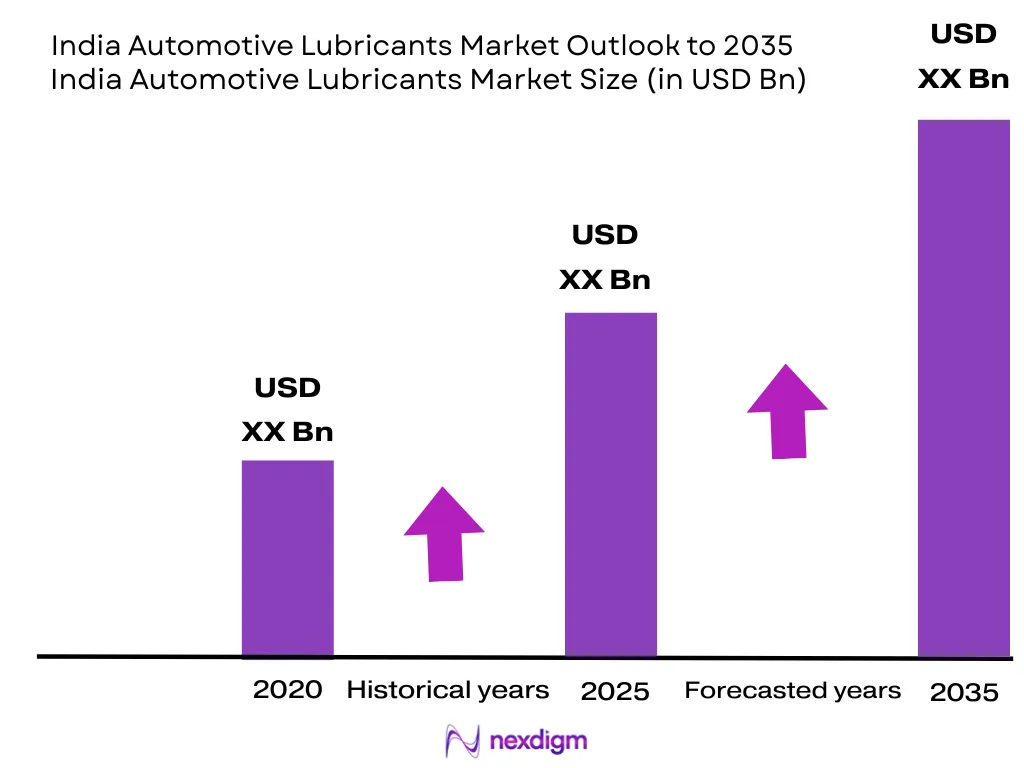
The India Automotive Lubricants Market is valued at approximately ~ billion, compared with ~ billion in the preceding reporting cycle. Automotive demand strengthened as total vehicle production increased from 27.14 million units to 30.61 million units, while passenger-vehicle sales advanced from 4.10 million to 4.27 million units. Two-wheeler sales increased from 17.08 million to 19.54 million units, supporting recurring engine-oil, gear-oil and transmission-fluid consumption. Maharashtra, Tamil Nadu, Haryana, Karnataka, Gujarat and Delhi NCR dominate India Automotive Lubricants Market demand because they combine major automotive manufacturing clusters, dense vehicle populations, commercial-freight corridors, lubricant blending infrastructure and extensive dealer-workshop networks. Total vehicle production increased from 27.14 million to 30.61 million units, while commercial-vehicle sales remained close to 1 million units in both reporting cycles, reinforcing lubricant requirements around Pune, Chennai, Gurugram-Manesar, Bengaluru, Sanand and major logistics corridors.
Market Segmentation
By Vehicle Type
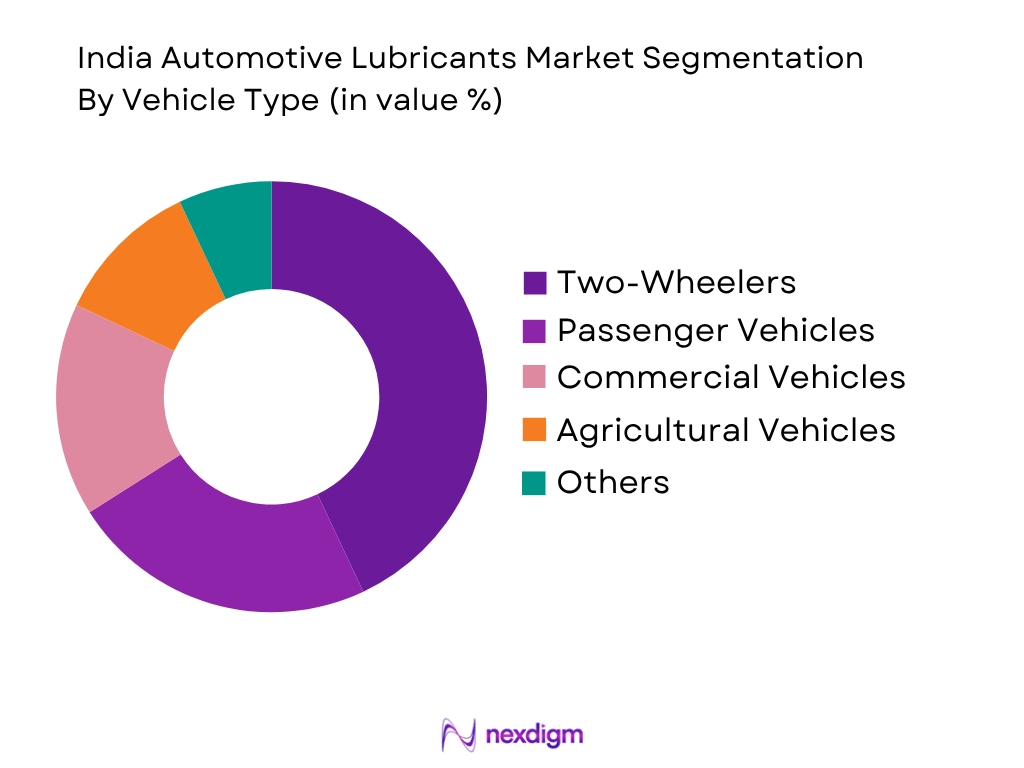
By vehicle type, the India Automotive Lubricants Market is segmented into two-wheelers, passenger vehicles, commercial vehicles, three-wheelers, tractors and off-highway vehicles. Two-wheelers hold the dominant market share because motorcycles and scooters form the country’s largest annual vehicle-sales category and require comparatively frequent service-fill lubricant replacement. Domestic two-wheeler sales reached 19.54 million units in the latest reporting cycle, compared with passenger-vehicle sales of 4.27 million units, commercial-vehicle sales of 951,991 units and three-wheeler sales of 728,670 units. Motorcycles additionally use wet-clutch-compatible JASO MA/MA2 formulations, while scooters increasingly require dedicated JASO MB products. High utilisation among commuter motorcycles and app-based delivery riders increases oil-change frequency. The extensive network of independent mechanics, two-wheeler dealerships, fuel stations and spare-parts retailers makes packaged one-litre lubricant products accessible across urban, semi-urban and rural markets.
By Lubricant Technology
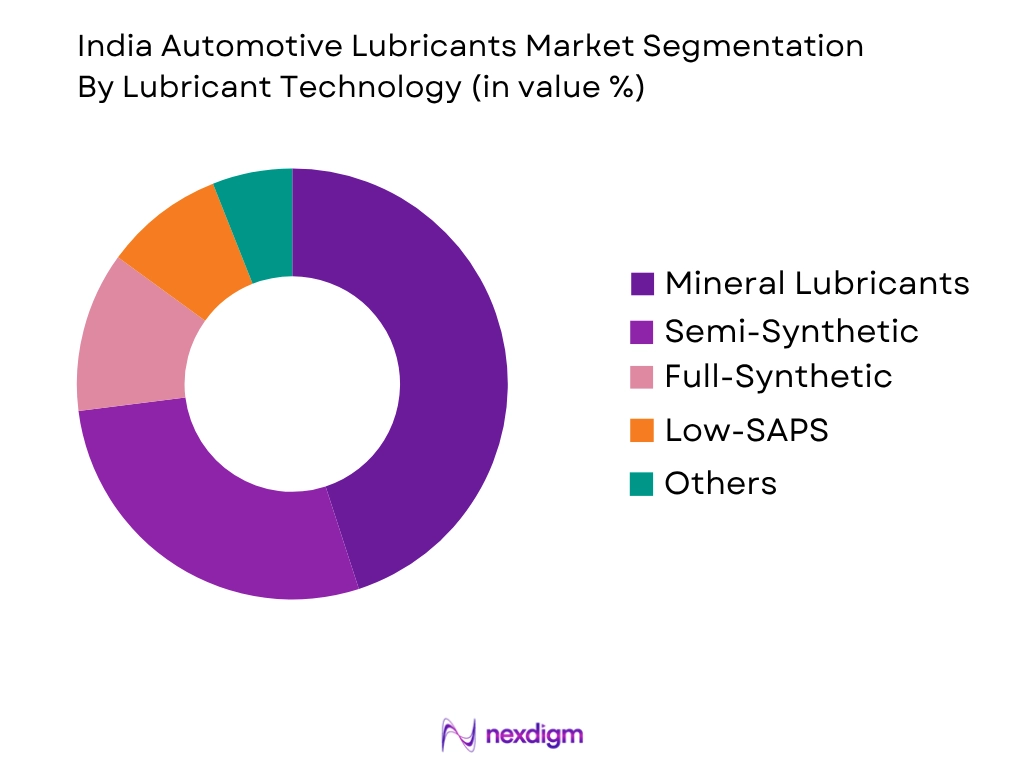
By lubricant technology, the India Automotive Lubricants Market is segmented into mineral, semi-synthetic, full-synthetic, low-SAPS, re-refined and hybrid/EV-specific lubricants. Mineral lubricants currently retain the dominant market share, supported by India’s very large installed population of commuter motorcycles, older passenger vehicles, tractors, commercial vehicles and price-sensitive service applications. However, the category is progressively losing strategic importance to semi-synthetic and full-synthetic products as BS VI engines, turbocharging, tighter tolerances and longer drain intervals increase performance requirements. Premium motorcycles and newer passenger cars are driving SAE 0W-20, 5W-30 and synthetic formulations, while heavy-duty fleets increasingly require advanced diesel oils compatible with exhaust-after-treatment systems. India’s used-oil Extended Producer Responsibility framework is also strengthening the long-term role of re-refined base oils by formally linking producers, collection agents and registered recyclers through CPCB’s centralized EPR system.
Competitive Landscape
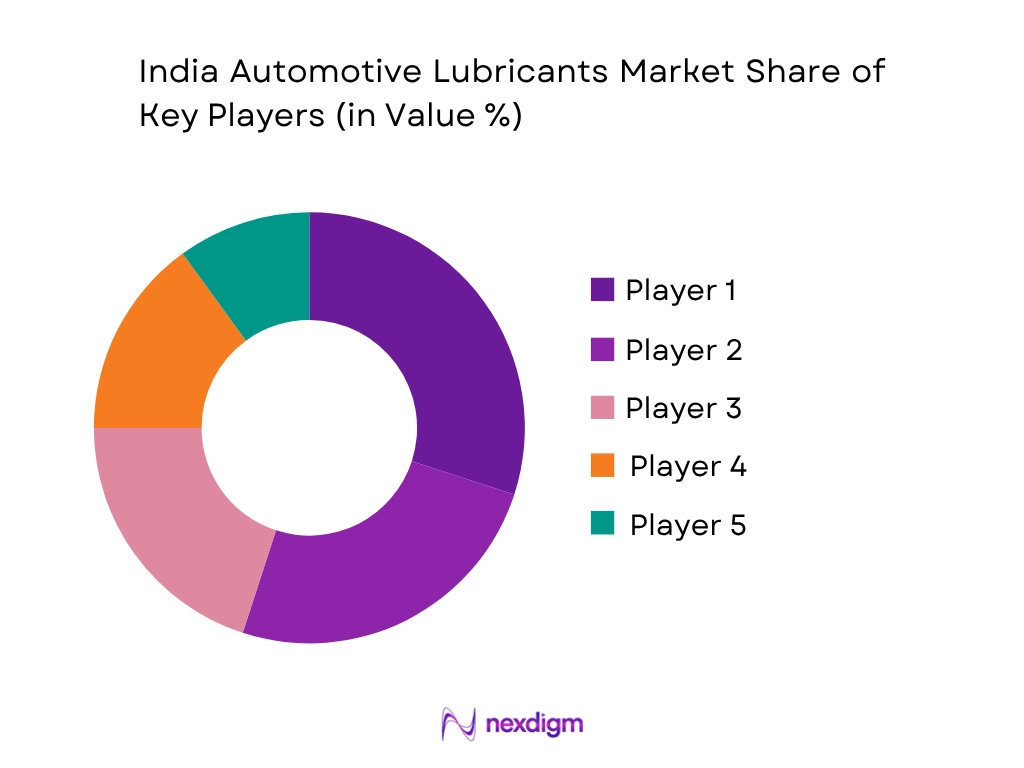
The India Automotive Lubricants Market combines large public-sector petroleum companies, established multinational lubricant brands and specialised private-sector suppliers. IndianOil, Castrol India, Hindustan Petroleum, Bharat Petroleum and Gulf Oil compete through passenger-car oils, motorcycle lubricants, heavy-duty diesel products, tractor oils, transmission fluids, greases and coolants. Competitive differentiation is increasingly based on OEM relationships, mechanic influence, synthetic-product depth, BS VI compatibility, distribution reach, fleet servicing and used-oil circularity rather than conventional mineral-oil availability alone.
| Company | Establishment Year | Headquarters | Key Lubricant Brand | Two-Wheeler Capability | Passenger-Car Capability | Heavy-Duty Capability | Distribution / Service Strength | Technology Focus |
| Indian Oil Corporation | 1959 | New Delhi / Mumbai | ~ | ~ | ~ | ~ | ~ | ~ |
| Castrol India | 1979 | Mumbai | ~ | ~ | ~ | ~ | ~ | ~ |
| Hindustan Petroleum Corporation | 1974 | Mumbai | ~ | ~ | ~ | ~ | ~ | ~ |
| Bharat Petroleum Corporation | 1952 | Mumbai | ~ | ~ | ~ | ~ | ~ | ~ |
| Gulf Oil Lubricants India | 2008 | Mumbai | ~ | ~ | ~ | ~ | ~ | ~ |
India Automotive Lubricants Market Analysis
Growth Drivers
Expansion of the Two-Wheeler and Passenger Vehicle Base
India’s expanding vehicle population is a primary structural driver for automotive lubricant demand because every new internal-combustion motorcycle, scooter, passenger car, utility vehicle and commercial vehicle adds recurring requirements for engine oil, transmission fluid, gear oil, grease, coolant and brake fluid. SIAM recorded total automotive production of 31,036,476 units in FY2024-25, comprising 23,883,857 two-wheelers, 5,061,164 passenger vehicles, 1,034,947 commercial vehicles, 1,050,020 three-wheelers and 6,488 quadricycles. The subsequent FY2025-26 production cycle reached 34,708,984 units, including 26,691,916 two-wheelers, 5,539,115 passenger vehicles and 1,170,150 commercial vehicles, demonstrating continued expansion of the future service-fill lubricant population. VAHAN data separately recorded 26,000,880 vehicle registrations in calendar 2024 and 28,203,387 registrations in 2025, which indicates a large volume of vehicles entering operation and eventually requiring scheduled fluid replacement. This is particularly important for lubricant companies because India’s two-wheeler ecosystem operates differently from passenger-car markets. Motorcycles require dedicated JASO MA or MA2 oils compatible with wet clutches, scooters increasingly use JASO MB formulations, and high-utilisation delivery motorcycles can experience substantially more stop-start operation than privately owned vehicles. Passenger vehicles are simultaneously migrating toward turbocharged petrol engines, BS VI diesel systems, automatic transmissions and lower-viscosity oils, expanding demand for synthetic formulations and specialised transmission fluids. Commercial vehicles create another technically demanding consumption base because higher engine loads, longer operating hours and freight utilisation require heavy-duty diesel oils, differential lubricants, transmission oils, greases and coolants. India’s broader macroeconomic scale reinforces the opportunity. World Bank data place national GDP at USD 3.91 trillion in 2024, GDP per capita at USD 2,694.7, and population at approximately 1.45 billion people. GDP increased to approximately USD 3.96 trillion in 2025, while population reached approximately 1.46 billion. These figures indicate a large mobility and freight ecosystem capable of sustaining lubricant consumption through dealerships, independent mechanics, fuel stations, spare-parts retailers, fleet depots and rural automotive channels. The strongest implication for the India Automotive Lubricants Market is that demand growth is supported not merely by vehicle sales but by the cumulative installed base created when tens of millions of new vehicles enter service each year. This expands the addressable replacement cycle for engine oils and other fluids for several years after the original vehicle sale.
Premiumisation toward Synthetic, Low-Viscosity and BS VI-Compatible Lubricants
The technological progression of India’s vehicle fleet is creating a second major growth driver by shifting lubricant consumption from basic mineral formulations toward semi-synthetic, full-synthetic, low-viscosity and emission-system-compatible products. SIAM recorded 5,061,164 passenger vehicles produced in FY2024-25, increasing to 5,539,115 units in FY2025-26, while commercial-vehicle production increased from 1,034,947 units to 1,170,150 units. These vehicles increasingly incorporate turbocharging, direct injection, exhaust gas recirculation, diesel particulate filters, selective catalytic reduction systems, automatic transmissions and electronically managed engine architectures. Such technologies require tighter lubricant performance parameters, particularly around oxidation stability, deposit control, low-temperature flow, turbocharger protection and after-treatment compatibility. The same dynamic applies to two-wheelers: production increased from 23,883,857 units in FY2024-25 to 26,691,916 units in FY2025-26, expanding demand for specialised motorcycle and scooter lubricants rather than generic automotive oils. Manufacturers therefore have opportunities across SAE 0W-20, 5W-30 and other lower-viscosity passenger-car grades, API SP-category oils, API CK-4 heavy-duty products, JASO MA2 motorcycle lubricants and JASO MB scooter oils. The requirement for distinct formulations is especially important in India because workshops routinely service vehicles spanning older Bharat Stage generations, BS VI engines, CNG powertrains, turbo-petrol engines, hybrids and electric vehicles. This increases SKU depth and makes technical specification more important in purchase decisions. Macroeconomic expansion further strengthens premiumisation. World Bank data report India’s GDP at USD 3.91 trillion in 2024, while GDP per capita reached USD 2,694.7. The IMF’s 2024 Article IV consultation reported real GDP growth of 6.5 in FY2024-25 and projected 6.5 for FY2025-26, indicating continued expansion of economic activity, transport demand and consumer spending capacity. Even without assuming higher litres consumed per vehicle, modern engines allow lubricant suppliers to increase their participation in technically advanced categories because each replacement increasingly requires exact SAE, API, JASO or OEM specifications. The growing penetration of automatic transmissions also expands opportunities for ATF, CVT fluids and DCT fluids alongside engine oil. Commercial fleets add another layer because BS VI trucks and buses require low-ash lubricants that protect after-treatment systems while supporting longer drain intervals. For lubricant companies, the growth mechanism is therefore a combination of increasing vehicle numbers and rising technical value per maintenance event. Producers with formulation capability, OEM approvals, mechanic education programmes, vehicle-lookup tools and distribution across both organized and independent service channels are positioned to capture this shift from commodity lubrication toward specification-driven automotive fluids.
Market Challenges
Rapid Electric Vehicle Adoption Reducing Conventional Engine-Oil Intensity
Electric vehicle adoption is the most important structural challenge for India’s automotive lubricant industry because battery-electric vehicles eliminate recurring crankcase engine-oil replacement and reduce several other combustion-related fluid requirements. Ministry of Heavy Industries data show that 1,950,490 electric vehicles were registered in calendar 2024, while total vehicle registrations reached 26,207,453 units during the same year. On a financial-year basis, registered EVs increased from 1,681,000 in FY2023-24 to 1,968,000 in FY2024-25, demonstrating that electrified vehicles are moving from a niche segment toward a sizeable installed population. The transition is especially significant for the lubricant industry because electrification in India is concentrated heavily in two-wheelers and three-wheelers, categories that historically support frequent service-fill engine-oil consumption. Under the PM E-DRIVE implementation period, 1,010,101 electric two-wheelers and 122,982 L5 electric three-wheelers were registered in FY2024-25 under relevant scheme-linked categories. Every electric scooter or motorcycle replacing an internal-combustion equivalent removes repeated engine-oil changes and, depending on drivetrain design, can also reduce demand for conventional clutch and transmission lubricants. At the same time, the challenge is not an immediate collapse in lubricant demand because India continues to register very large numbers of combustion vehicles. Ministry of Heavy Industries data show 24.284 million ICE vehicles registered in FY2024-25, compared with 1.968 million electric vehicles. This forces lubricant manufacturers to operate dual portfolios: traditional engine oils must remain widely available across millions of existing and newly registered ICE vehicles, while research and development spending must increasingly support e-drive fluids, reduction-gear lubricants, electric motor bearing greases, battery coolants and compressor oils. The requirement to serve both technologies increases product-development, inventory and technical-training complexity. India’s macroeconomic scale magnifies the transition. The World Bank reports GDP of USD 3.91 trillion in 2024 and a population of approximately 1.45 billion, while the IMF reports continuing strong economic expansion through FY2025-26. Therefore, electrification is occurring within one of the world’s largest mobility markets rather than replacing a small vehicle base. Lubricant suppliers with disproportionate exposure to packaged motorcycle engine oil face particular strategic pressure because electric two-wheelers eliminate one of the industry’s most frequent oil-change applications. The challenge is consequently to protect the large legacy ICE business while developing profitable specialist-fluid categories before electric vehicles materially reduce conventional oil volumes across urban mobility segments.
Fragmented Aftermarket, Product Authenticity and Specification Complexity
India’s automotive lubricant aftermarket is highly fragmented, creating significant challenges around correct product selection, distribution control, used-oil handling and technical consistency across workshops. VAHAN recorded 26,000,880 vehicle registrations during 2024 and 28,203,387 during 2025, while SIAM production data show 31,036,476 vehicles produced in FY2024-25 and 34,708,984 vehicles in FY2025-26. Such volumes create an enormous service network involving OEM dealerships, organized workshops, roadside mechanics, lubricant retailers, fuel stations, parts dealers and rural service outlets. The same network must support an increasingly complex mixture of motorcycle, scooter, petrol passenger-car, diesel, CNG, hybrid, BS VI commercial and older vehicle technologies. Product-selection errors become more consequential as manufacturers specify precise viscosity and performance categories. A motorcycle may require JASO MA2 wet-clutch oil, while a scooter may require JASO MB; modern passenger cars can require API SP, SAE 0W-20 or 5W-30 formulations, and BS VI commercial vehicles can need specialised low-ash heavy-duty engine oils compatible with particulate filters and selective catalytic reduction systems. This creates a substantial training requirement for mechanics and distributors, especially outside large metropolitan areas. Environmental regulation adds another operational layer. India’s Used Oil Extended Producer Responsibility framework came into force on 1 April 2024. CPCB requires producers of base oil or lubricating oil and importers covered by the framework to register on the centralized Used Oil EPR Portal, while recyclers and re-refiners generate EPR certificates based on eligible quantities processed. The system means lubricant companies must increasingly monitor both the forward sale of lubricating oil and downstream recovery of used oil. The challenge grows because automobile servicing generates dispersed quantities of waste oil across thousands of workshops rather than only at centralized industrial facilities. Collection, documentation and transfer to registered recyclers therefore require structured logistics. India’s large geography and consumer base intensify these challenges: World Bank data place the country’s population at approximately 1.45 billion in 2024 and 1.46 billion in 2025, while GDP reached USD 3.91 trillion in 2024. The market scale is commercially attractive but expensive to serve consistently. Lubricant manufacturers must manage distributor governance, authenticity measures, mechanic training, technical support, vehicle-compatibility databases and EPR documentation simultaneously. Companies unable to maintain these capabilities may struggle as buyers move toward more technically demanding oils and environmental compliance becomes more formalized.
Market Opportunities
Used-Oil Collection, Re-Refining and Circular Lubricant Business Models
India’s new regulatory framework for used lubricating oil creates a major future opportunity for lubricant producers, re-refiners, fleet operators and organized workshops to build circular automotive lubricant supply chains. The Extended Producer Responsibility framework for used oil became effective on 1 April 2024, requiring eligible producers of base oil or lubrication oil and importers to register with CPCB and fulfil recycling obligations through certificates generated by registered recyclers. CPCB guidelines also connect collection agents, recyclers and re-refiners through a centralized portal designed to record procurement of used oil, sale of re-refined oil, certificate generation and compliance transactions. This creates a formal commercial pathway for recovering automotive engine oil and returning processed base material to the lubricant value chain. The potential feedstock base is substantial. SIAM recorded 31,036,476 vehicles produced in FY2024-25 and 34,708,984 vehicles in FY2025-26, while VAHAN recorded 26,000,880 registrations in 2024 and 28,203,387 in 2025. Most newly registered combustion vehicles will generate used engine oil repeatedly during their operating lives, while commercial fleets, bus depots, construction operators and dealerships can create concentrated used-oil streams suitable for organized collection. This gives lubricant manufacturers an opportunity to move beyond one-way product distribution. A supplier can provide bulk or packaged lubricant, collect drained used oil through authorized partners, support digital documentation and procure re-refined base oil for new formulations where technical specifications allow. Fleet customers are particularly suitable for such models because vehicles are maintained at centralized depots and lubricant consumption can be forecast from mileage or engine hours. CPCB’s framework strengthens the business case by creating formal traceability and compliance requirements rather than relying solely on voluntary sustainability programmes. The broader macroeconomic environment supports investment in recycling infrastructure: World Bank data place India’s GDP at USD 3.91 trillion in 2024, increasing to approximately USD 3.96 trillion in 2025, while population rose from approximately 1.45 billion to 1.46 billion. The opportunity therefore lies in combining lubricant sales, collection logistics, EPR management and re-refined product development. Companies that secure relationships with authorized recyclers, large workshops, commercial fleets and OEM dealerships can create closed-loop arrangements that improve customer retention while supporting regulatory compliance. Over time, circularity can also reduce dependence on virgin base stocks and differentiate suppliers in institutional and fleet procurement. Current regulatory infrastructure and current vehicle volumes—not speculative future statistics—already provide a strong foundation for expansion of this segment.
Hybrid, Electric-Drive and Advanced Thermal-Management Fluids
India’s shift toward electrified mobility creates a future growth opportunity for lubricant companies capable of developing products beyond traditional crankcase oil. Ministry of Heavy Industries data show 1,950,490 electric vehicles registered during calendar 2024, while FY2024-25 registrations reached approximately 1.968 million EVs. Within the PM E-DRIVE implementation environment, 1,010,101 electric two-wheelers and 122,982 electric three-wheelers were registered in FY2024-25 under relevant categories, demonstrating that electrified drivetrains are already present at sufficient scale to justify dedicated fluid-development strategies. Battery-electric vehicles do not require conventional engine oil, but they still contain mechanical and thermal systems that can benefit from specialised lubrication. Potential categories include reduction-gear fluids, e-axle lubricants, electric motor bearing greases, high-voltage compressor oils, battery coolants and low-conductivity thermal-management fluids. These applications demand characteristics that differ significantly from traditional engine oils, including electrical compatibility, copper protection, low foaming, thermal stability and controlled conductivity. Hybrid vehicles provide another opportunity because they retain combustion engines but operate under unusual conditions involving frequent engine shutdown, intermittent running, repeated cold starts and potentially lower average oil temperatures. These operating patterns increase the value of oxidation control, moisture management and low-temperature protection. India’s domestic manufacturing policy also creates a supportive industrial platform. The Production Linked Incentive Scheme for Automobile and Auto Components carries an approved outlay of ₹25,938 crore for advanced automotive technology manufacturing, while the PM E-DRIVE scheme has an outlay of ₹10,900 crore through its implementation period to strengthen electric mobility and supporting ecosystems. These current policy commitments encourage localization of advanced vehicle components and indirectly expand opportunities for fluids engineered alongside motors, transmissions, thermal systems and battery architectures. At the same time, conventional lubricant suppliers retain a large transitional base: Ministry of Heavy Industries data report 24.284 million ICE vehicles registered in FY2024-25, meaning hybrid and EV products can be added without immediately abandoning passenger-car, motorcycle and commercial engine-oil demand. World Bank data further place India’s GDP at USD 3.91 trillion in 2024 and population at approximately 1.45 billion, providing the economic scale required for localized e-fluid development and distribution. The strongest future opportunity is therefore technological diversification: suppliers that obtain OEM approvals, establish electrical-fluid testing capability and build partnerships with Indian EV manufacturers can develop a position in categories that will become increasingly important as traditional engine-oil intensity declines.
Future Outlook
The India Automotive Lubricants Market is projected to expand at approximately ~ CAGR during 2026-2035. The market will progressively move from conventional mineral products toward semi-synthetic, full-synthetic, low-viscosity and powertrain-specific fluids. The transition will be shaped by continued growth in two-wheelers and passenger vehicles, commercial-freight activity, tighter emission systems, changing OEM specifications and rapid electrification. Two-wheelers will remain central to the lubricant ecosystem. India recorded 19.54 million domestic two-wheeler sales in the latest calendar-year reporting cycle and accounted for roughly one-third of global two-wheeler sales, making motorcycle and scooter lubricants strategically important for manufacturers, distributors and workshop networks. Passenger cars will increasingly support premiumisation. Newer gasoline engines, turbochargers and hybrids require lower-viscosity formulations, while older vehicles create demand for high-mileage oils. Suppliers therefore need portfolios spanning economical mineral products, semi-synthetic commuter formulations and technically advanced full synthetics. Commercial vehicles provide another durable application. Domestic commercial-vehicle sales reached 951,991 units, while India remained one of the world’s largest commercial-vehicle markets. Truck and bus fleets require diesel engine oils, transmission fluids, differential oils, greases and coolants, creating opportunities for bulk delivery, oil analysis and extended-drain fleet programs.
Major Players
- Indian Oil Corporation – SERVO
- Castrol India
- Hindustan Petroleum Corporation – HP Lubricants
- Bharat Petroleum Corporation – MAK Lubricants
- Shell India Lubricants
- Gulf Oil Lubricants India
- Valvoline Cummins
- ExxonMobil Lubricants – Mobil
- TotalEnergies Marketing India
- Motul India
- Veedol Corporation
- Savita Oil Technologies – Savsol
- Idemitsu Lube India
- ENEOS India
- GP Petroleums – IPOL
Key Target Audience
- Automotive lubricant manufacturers and blenders
- Base-oil refiners and lubricant additive suppliers
- Passenger vehicle, two-wheeler, commercial vehicle and tractor OEMs
- Automotive lubricant distributors, dealers, mechanics and workshop networks
- Trucking, bus, taxi, delivery and vehicle-leasing fleet operators
- Used-oil collection, recycling and re-refining companies
- Investments and venture capitalist firms
- Government and regulatory bodies (Ministry of Road Transport and Highways, Ministry of Petroleum and Natural Gas, Ministry of Heavy Industries, Central Pollution Control Board and Bureau of Indian Standards)
Research Methodology
Step 1: Identification of Key Variables
The initial phase constructs an ecosystem map covering base-oil refiners, lubricant blenders, additive suppliers, distributors, retailers, mechanics, OEM dealerships, fleet operators, collection agents and re-refiners. Key variables include vehicle parc, annual sales, lubricant consumption per vehicle, drain interval, sump capacity, viscosity, API/JASO classification and distribution channel.
Step 2: Market Analysis and Construction
Historical vehicle production and sales are mapped against estimated lubricant consumption across two-wheelers, passenger cars, commercial vehicles, tractors and off-highway vehicles. Factory-fill and service-fill requirements are analysed separately to avoid double counting and to establish product-level demand patterns.
Step 3: Two-Wheeler and Passenger-Vehicle Assessment
Two-wheeler analysis evaluates commuter motorcycles, scooters, premium motorcycles and delivery fleets using JASO specification, engine displacement, oil-change frequency and synthetic penetration. Passenger-vehicle analysis assesses gasoline, diesel, CNG, hybrid and electric architectures alongside SAE viscosity migration and OEM-specific requirements.
Step 4: Commercial and Agricultural Vehicle Assessment
Truck, bus, LCV, tractor and construction-equipment demand is assessed using duty cycle, operating hours, engine capacity, lubricant sump size, transmission requirements and drain intervals. Fleet procurement, bulk supply and lubricant-analysis programs are separately evaluated.

- Executive Summary
- Research Methodology (Market Definitions and Assumptions, Abbreviations, Market Sizing Approach, Top-Down Analysis, Bottom-Up Analysis, Vehicle Parc Mapping, Annual Vehicle Utilization, Lubricant Consumption per Vehicle, Oil Drain Interval Assessment, Factory-Fill Assessment, Service-Fill Assessment, Two-Wheeler Demand Assessment, Commercial Fleet Assessment, Supply-Side Assessment, Primary Industry Interviews, Distributor and Mechanic Interviews, Data Triangulation, Forecasting Framework, Limitations and Future Conclusions)

- Definition and Scope
- Market Evolution and Industry Genesis
- Evolution of Automotive Engine Oil Specifications
- Transition from Mineral to Semi-Synthetic and Full-Synthetic Lubricants
- Evolution of BS VI-Compatible Lubricants

- Growth Drivers (Two-Wheeler Fleet Expansion, Passenger Vehicle Ownership, Road Freight Activity, Infrastructure Development, Synthetic Conversion, Rural Mechanization)
- Market Challenges (Base Oil Import Dependence, Informal Lubricant Market, Counterfeit Products, Extended Drain Intervals, EV Transition, Specification Complexity)
- Market Opportunities (EV Fluids, Two-Wheeler Premiumization, Low-Viscosity Oils, Long-Drain Fleet Oils, Re-Refined Lubricants, Rural Penetration)
- Market Trends (Synthetic Premiumization, Low Viscosity, BS VI Compatibility, Motorcycle Specialization, Circular Lubricants, Digital Aftermarket)
- Government Regulations (Used-Oil EPR, CPCB Registration, Hazardous Waste Rules, BIS Standards, Environmental Compliance, Product Labeling)
- SWOT Analysis
- Porter’s Five Forces Analysis
- PESTLE Analysis

- By Market Value (2020-2025)
- By Lubricant Consumption Volume (2020-2025)
- By Passenger Vehicle Lubricant Value (2020-2025)

- By Product Type (In Value %)
Passenger Car Motor Oil
Motorcycle Engine Oil
Scooter Engine Oil
Heavy-Duty Diesel Engine Oil
Three-Wheeler Engine Oil - By Lubricant Technology (In Value %)
Mineral Lubricants
Semi-Synthetic Lubricants
Full-Synthetic Lubricants
High-Mileage Lubricants
Extended-Drain Lubricants - By Vehicle Type (In Value %)
Passenger Cars
Utility Vehicles and SUVs
Vans
Light Commercial Vehicles
Medium Commercial Vehicles - By Region (In Value %)
North India
South India
West India
East India
Central India
Northeast India

- Market Share of Major Players (By Value, Volume, Product Category, Vehicle Type, Distribution Channel)
- Cross Comparison Parameters (Two-Wheeler and Passenger-Car Lubricant SKU Breadth, Heavy-Duty and Tractor Lubricant Capability, API–JASO–ACEA and OEM Approval Portfolio, Distributor–Dealer–Mechanic Network Reach, Base Oil–Blending–Packaging Footprint, OEM Factory-Fill and Service-Fill Relationships, Used-Oil EPR and Re-Refining Capability, Hybrid–EV Fluid and Low-Viscosity Product Readiness)
- SWOT Analysis of Major Players
- Detailed Profiles of Major Companies
Indian Oil Corporation – SERVO
Castrol India
Hindustan Petroleum Corporation – HP Lubricants
Bharat Petroleum Corporation – MAK Lubricants
Shell India Lubricants
Gulf Oil Lubricants India
Valvoline Cummins
ExxonMobil Lubricants – Mobil
TotalEnergies Marketing India
Motul India
Veedol Corporation
Savita Oil Technologies – Savsol
Idemitsu Lube India
ENEOS India
GP Petroleums – IPOL

- Two-Wheeler Owner Analysis
- Scooter User Analysis
- Passenger Car Owner Analysis
- SUV and Utility Vehicle Owner Analysis
- Three-Wheeler Operator Analysis
- Taxi and App-Based Mobility Fleet Analysis

- By Market Value (2026-2035)
- By Lubricant Consumption Volume (2026-2035)
- By Two-Wheeler Lubricant Value (2026-2035)


 Request a Sample
 Ask for Customization
 Get a Quote
 Enquire Now