

 Download PDF
Market Overview
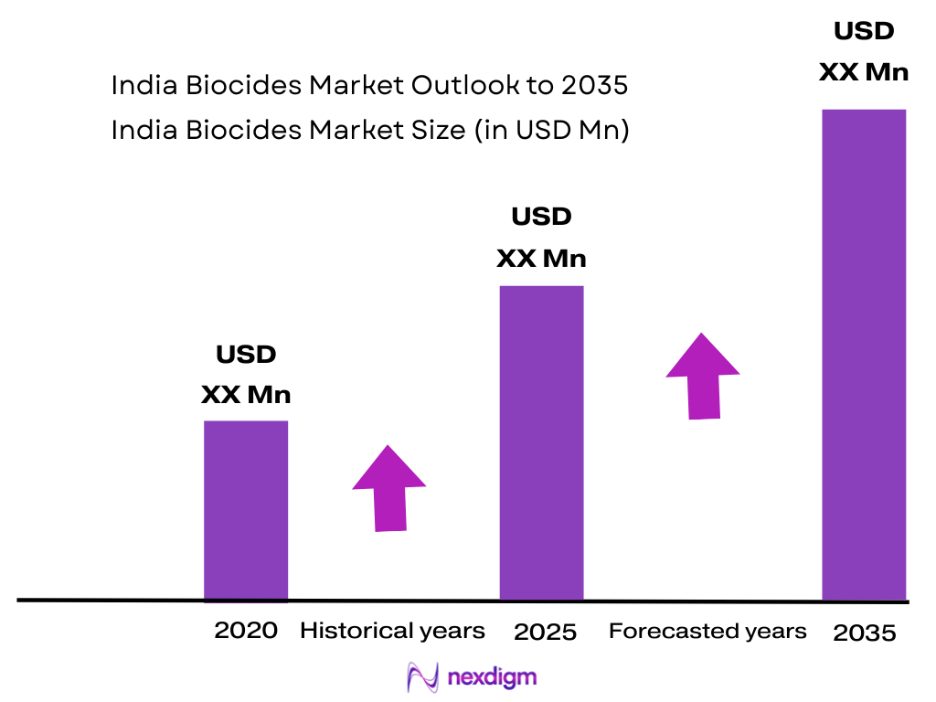
The India Biocides Market is valued at USD 779.4 million, with demand supported by water treatment, cleaning products, paints and coatings, wood preservation and industrial microbial control. Organosulfurs generated 51.58% of 2024 market revenue, making them the largest chemistry segment. India’s broader chemical sector provides a substantial industrial base: chemical and chemical-product output excluding pharmaceuticals reached INR 15.14 lakh crore in FY2023–24, while chemicals and pharmaceuticals together represented INR 21.77 lakh crore of manufacturing-sector output.
India’s principal biocide-demand centres are concentrated around Mumbai–Pune, Ahmedabad–Vadodara, Chennai, Hyderabad, Bengaluru, Delhi-NCR, Surat and Kolkata, reflecting concentrations of chemical manufacturing, pharmaceuticals, paints and coatings, food processing, textiles, water-intensive industries and specialty chemicals. Western India is particularly important because Gujarat and Maharashtra combine chemical production, pharmaceutical manufacturing, ports and industrial water-treatment requirements. Southern clusters add pharmaceutical, biotechnology, food-processing and advanced manufacturing demand. India’s pharmaceutical market was valued at USD 50 billion in FY2023–24, further supporting demand for preservation and microbial-control technologies.
Market Segmentation
By Active Substance Chemistry
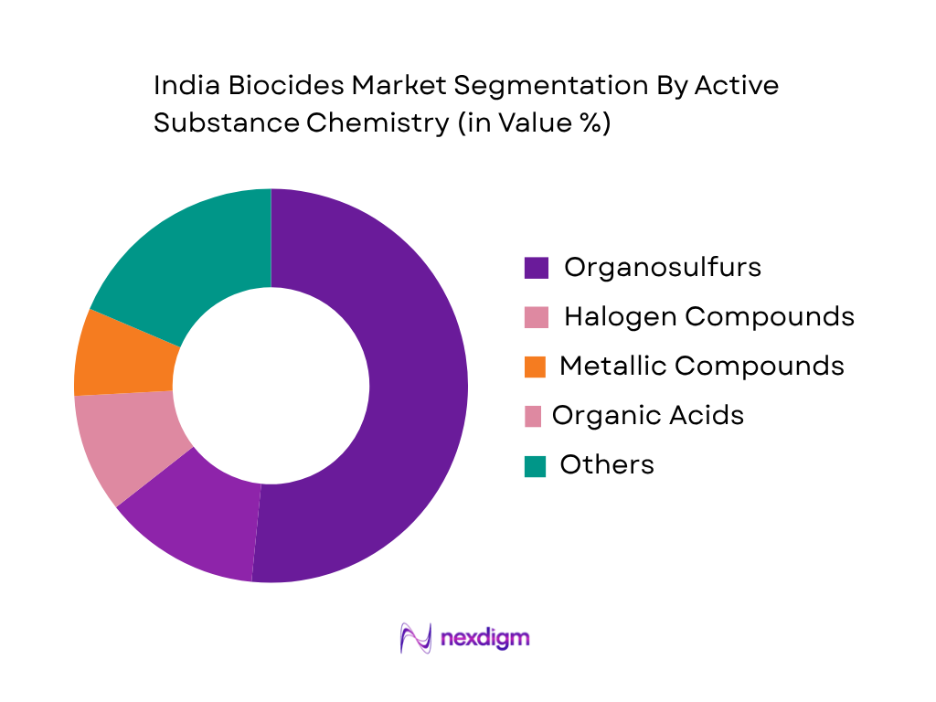
The India Biocides Market is segmented into halogen compounds, metallic compounds, organosulfurs, organic acids, quaternary ammonium compounds, phenolic compounds, nitrogen compounds and glutaraldehyde. Organosulfurs dominate this segmentation with a 51.58% revenue share in 2024, supported by their established use across industrial water treatment, cleaning, preservation and microbial-control applications. Their broad industrial applicability and effectiveness in demanding treatment environments support their established position. Quaternary ammonium compounds represent the fastest-growing product category, reflecting increasing demand for disinfection, surface sanitation and institutional hygiene applications. The broader Indian chemical ecosystem strengthens availability of specialty intermediates and formulation capabilities. Government data show that chemical and chemical-product output reached INR 15.14 lakh crore in FY2023–24, while the chemical sector’s GVA represented 8.1% of manufacturing GVA. This industrial base provides manufacturers with downstream customers across water treatment, coatings, pharmaceuticals, food processing, textiles and other sectors.
By Application
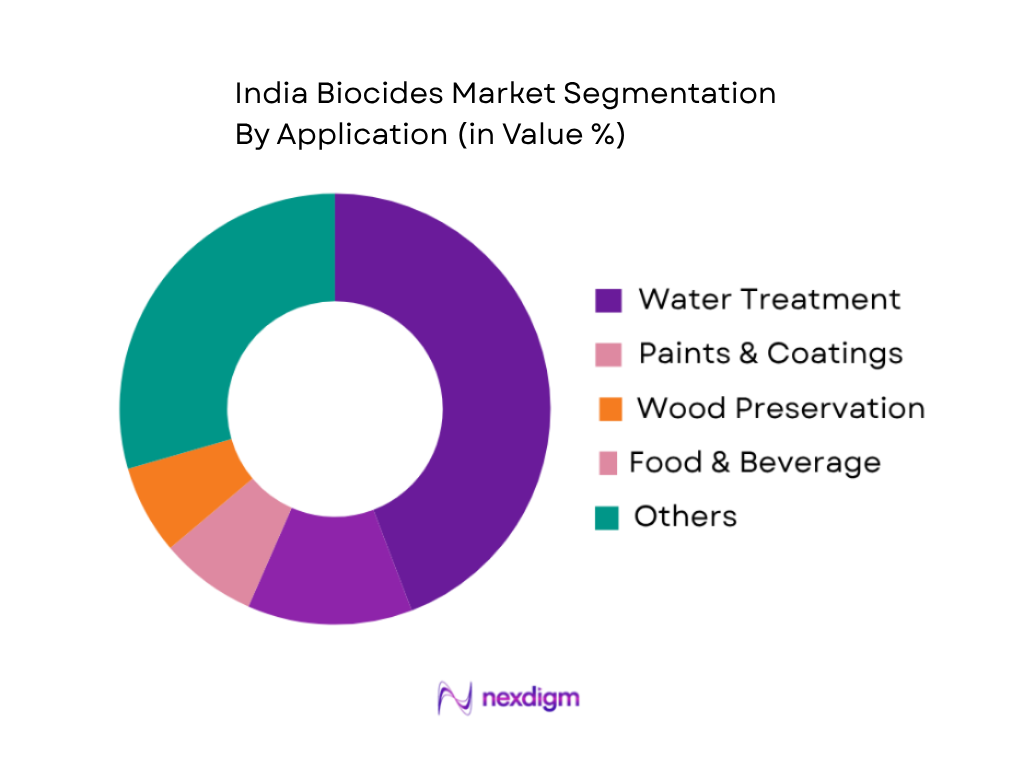
The India Biocides Market is segmented by application into water treatment, paints and coatings, wood preservation, food and beverage, personal care, agriculture, oil and gas, marine, metalworking fluids, plastics, HVAC, fuels, leather and industrial cooling and boiler systems. Water treatment represents a strategically important application because India’s expanding industrial and municipal water infrastructure requires microbial control in process water, wastewater, cooling systems and cleaning operations. The source specifically identifies water treatment and cleaning products as dominant demand areas, while paints and coatings and wood preservation benefit from India’s construction expansion. The application base is strengthened by India’s large chemical and manufacturing ecosystem: government data report 55.13 million tonnes of major chemicals and petrochemicals produced during FY2023–24. Pharmaceutical manufacturing also creates demand for specialised preservation systems, with India’s pharmaceutical market reaching USD 50 billion in FY2023–24.
Competitive Landscape
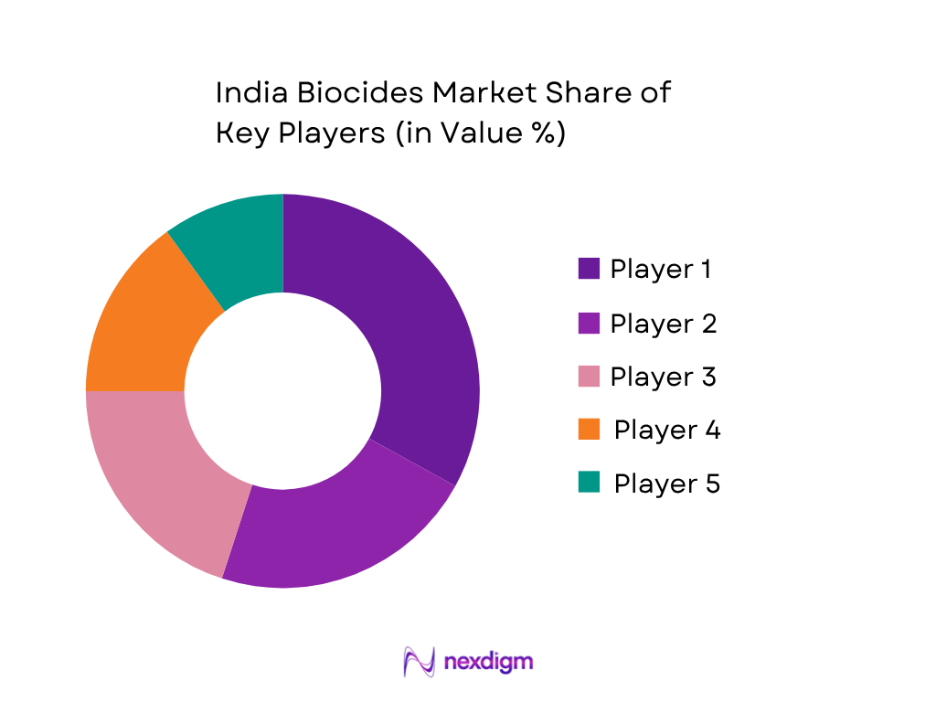
The India Biocides Market includes multinational chemical companies, specialist antimicrobial suppliers, Indian specialty-chemical manufacturers, water-treatment companies and industrial formulation providers. Competition is shaped by active-substance portfolios, formulation capabilities, regulatory compliance, technical support, domestic manufacturing capacity and distribution reach. Organosulfur chemistry provides a major competitive battleground, while water treatment, paints and coatings, pharmaceuticals and industrial preservation represent important application areas. India’s chemical industry provides a large downstream customer base, with chemical and pharmaceutical output together reaching INR 21.77 lakh crore in FY2023–24.
| Company | Established | Headquarters | Active Substance Portfolio | Water Treatment | Industrial Biocides | Coatings Preservation | Pharmaceutical / Personal-Care Applications | India Manufacturing / Distribution |
| BASF SE | 1865 | Ludwigshafen, Germany | ~ | ~ | ~ | ~ | ~ | ~ |
| LANXESS AG | 2004 | Cologne, Germany | ~ | ~ | ~ | ~ | ~ | ~ |
| Ecolab Inc. | 1923 | St. Paul, USA | ~ | ~ | ~ | ~ | ~ | ~ |
| Solvay SA | 1863 | Brussels, Belgium | ~ | ~ | ~ | ~ | ~ | ~ |
| Atul Ltd. | 1947 | Valsad, India | ~ | ~ | ~ | ~ | ~ | ~ |
India Biocides Market Analysis
Market Growth Drivers
Industrial and Municipal Water-Treatment Expansion
Industrial and municipal water-treatment expansion is a major growth driver for the India Biocides Market because microbial control is required in sewage-treatment plants, industrial effluent systems, cooling towers, boilers, process-water circuits and water-reuse facilities. The Central Pollution Control Board’s latest national assessment reports 61,754 MLD of sewage generation, 22,963 MLD of installed sewage-treatment capacity, and 38,791 MLD of untreated sewage, indicating a substantial treatment requirement that supports demand for disinfectants, oxidising and non-oxidising biocides, algaecides and biofilm-control chemicals. Maharashtra, Tamil Nadu, Uttar Pradesh, Delhi and Gujarat together account for approximately 50% of national sewage generation, creating concentrated regional demand for water-treatment chemicals. The Department of Chemicals and Petrochemicals also maintains monthly production reporting covering chemical production, installed capacity, consumption, imports and exports, demonstrating the breadth of India’s chemical manufacturing ecosystem. At the macroeconomic level, the IMF recorded 8.2% real GDP growth in FY2023/24, while private consumption increased 4% in that period and investment reached 33.3% of GDP, supporting continued industrial and infrastructure activity. The IMF’s subsequent assessment recorded 6.5% real GDP growth for FY2024/25, while India’s broad money and private-sector credit remained supportive of industrial activity. For biocide suppliers, expanding treatment infrastructure and industrial water consumption create recurring chemical demand rather than one-time requirements, particularly for cooling-water management, wastewater disinfection and microbial-control programmes.
Expansion of Pharmaceutical and Food-Processing Manufacturing
Expansion of pharmaceutical and food-processing manufacturing is strengthening demand for specialised biocides, preservatives, disinfectants and microbial-control formulations in India. Government data place India’s pharmaceutical market at USD 50 billion in FY2023–24, comprising USD 23.5 billion of domestic consumption and USD 26.5 billion of exports. The pharmaceutical industry is the world’s third largest by volume, creating a large manufacturing base where microbial control is relevant to production environments, water systems, raw-material handling and preservation of selected formulations. Food processing provides another substantial demand pool. The Ministry of Food Processing Industries reported that 558 food-processing units had been taken up for implementation under the CEFPPC scheme by 31 December 2024, with 283 units completed and 275 units at various implementation stages. The completed units had created 59.87 lakh MT per annum of processing capacity, while total sanctioned project cost across the 558 units reached INR 8,963.11 crore, including INR 6,806.97 crore of private investment. The macroeconomic environment reinforces this industrial expansion: IMF data show 8.2% real GDP growth in FY2023/24, while gross investment reached 33.3% of GDP and private consumption growth recovered to 6.7% during the first half of FY2024/25. These conditions support expansion of manufacturing facilities where controlled hygiene, preservation and microbial management are operational requirements. Consequently, biocide demand can increase through pharmaceutical-grade preservatives, production-area disinfectants, food-processing sanitation chemicals and microbial-control products for associated water systems.
Market Challenges
Regulatory, Environmental and Product-Compliance Complexity
Regulatory and environmental compliance represents a significant challenge for the India Biocides Market because suppliers must satisfy different requirements depending on whether products are used as disinfectants, preservatives, agricultural products, water-treatment chemicals, food-processing chemicals, pharmaceuticals or personal-care ingredients. The Department of Chemicals and Petrochemicals maintains national chemical statistics covering production, installed capacity, consumption, imports and exports, while India’s broader chemical-management ecosystem involves environmental, occupational-safety and end-use regulations. This creates additional compliance requirements for manufacturers that sell the same active substance into multiple applications. The challenge is particularly relevant for water-treatment biocides because environmental discharge requirements can affect formulation selection, dosing and wastewater management. India’s treatment infrastructure also highlights the scale of the environmental issue: CPCB reports 61,754 MLD of sewage generation against 22,963 MLD of treatment capacity, leaving 38,791 MLD untreated in its latest national assessment. Such a large treatment gap increases the need for effective microbial control while simultaneously increasing scrutiny of chemicals entering aquatic environments. From the macroeconomic side, the IMF recorded 5.4% average consumer-price inflation in FY2023/24, with real GDP growth of 8.2%, while its later assessment estimated 6.5% real GDP growth in FY2024/25 and 4.6% average inflation. Manufacturers therefore face a dual requirement: maintain cost-effective industrial performance while investing in compliance, testing, documentation and environmentally improved formulations. These pressures can disproportionately affect smaller Indian formulators that lack dedicated regulatory and technical teams.
Dependence on Imported Active Substances and Chemical Supply-Chain Exposure
Dependence on imported active substances and chemical intermediates creates supply-chain vulnerability for the India Biocides Market, particularly where specialised microbial-control chemistries are not produced domestically at sufficient scale. India’s Department of Chemicals and Petrochemicals explicitly tracks chemical production, installed capacity, consumption, imports and exports, reflecting the importance of international trade in the country’s chemical supply chain. Biocide formulators can therefore be exposed to overseas availability of active ingredients, intermediates, specialty additives and formulation components, with disruption potentially affecting production schedules and customer deliveries. The issue is amplified by the breadth of India’s downstream industrial base. Government data show 55.13 million tonnes of major chemicals and petrochemicals production in FY2023/24, while the pharmaceutical industry generated a USD 50 billion market during the same fiscal period, including USD 26.5 billion of exports. Food-processing investment provides another demand channel, with INR 8,963.11 crore of total project cost associated with 558 sanctioned processing units under the CEFPPC scheme as of December 2024. Macroeconomic conditions remain supportive but expose manufacturers to international trade conditions: IMF data show merchandise imports were projected to grow 6.2% in US-dollar terms during FY2024/25, following a 4.9% contraction in FY2023/24, while real GDP growth was estimated at 6.5% in FY2024/25. For biocide manufacturers, these conditions increase the importance of dual sourcing, domestic intermediate production, inventory planning and supplier diversification. Companies dependent on a single overseas source can face longer replenishment cycles and greater formulation continuity risk when international logistics or chemical availability changes.
Market Opportunities
Advanced Water Treatment and Industrial Water Reuse
Advanced water treatment and industrial water reuse represent a significant opportunity for the India Biocides Market because the country has a large gap between wastewater generation and available treatment infrastructure. CPCB’s latest national assessment records 61,754 MLD of sewage generation, 22,963 MLD of sewage-treatment capacity and 38,791 MLD of untreated sewage. Five states—Maharashtra, Tamil Nadu, Uttar Pradesh, Delhi and Gujarat—collectively account for approximately 50% of national sewage generation, creating concentrated opportunities for treatment-chemical suppliers around major urban and industrial clusters. The opportunity extends beyond municipal wastewater into industrial cooling towers, boilers, process-water systems, desalination, reverse-osmosis pretreatment and water-reuse facilities. India’s industrial and chemical ecosystem provides a large installed base for these applications, with the Department of Chemicals and Petrochemicals maintaining production and consumption statistics across numerous chemical categories. The macroeconomic environment supports infrastructure investment: IMF data record 8.2% real GDP growth in FY2023/24, gross investment of 33.3% of GDP, and 6.5% real GDP growth in FY2024/25. The IMF also reported 7.2% private-consumption growth in FY2024/25, indicating continued domestic economic activity. For biocide manufacturers, the opportunity is to move beyond conventional commodity products toward application-specific microbial-control programmes incorporating non-oxidising biocides, biofilm control, automated dosing, microbial monitoring and lower-residual formulations. Current treatment infrastructure requirements therefore provide the demand foundation for future adoption without relying on speculative future market statistics.
Sustainable Biocides for Pharmaceuticals, Food Processing and Specialty Manufacturing
Sustainable and application-specific biocides offer an important growth opportunity as India’s pharmaceutical, food-processing and specialty-manufacturing bases expand and customers require microbial-control products that combine efficacy with improved environmental and operational profiles. India’s pharmaceutical market reached USD 50 billion in FY2023–24, comprising USD 26.5 billion in exports and USD 23.5 billion in domestic consumption. Food-processing infrastructure also expanded: by 31 December 2024, 283 food-processing units supported through the CEFPPC programme had been completed, creating 59.87 lakh MT per annum of processing capacity, while 275 additional units were under implementation. The sanctioned portfolio involved INR 8,963.11 crore of total project cost and INR 6,806.97 crore of private investment. These manufacturing environments create opportunities for high-purity preservatives, controlled-environment disinfectants, surface sanitation chemicals, process-water biocides and formulation-specific antimicrobial systems. The macroeconomic backdrop is favourable for industrial expansion: IMF data show 6.5% real GDP growth in FY2024/25, 7.1% investment growth, and 7.2% private-consumption growth. The opportunity is therefore not simply higher biocide consumption; it is a shift toward products designed around specific formulation, efficacy, residue and environmental requirements. Suppliers able to provide lower-toxicity chemistries, efficient dosing, validated microbial-control performance and application-specific technical support can address increasingly sophisticated requirements from pharmaceutical plants, food processors, coatings manufacturers, personal-care companies and other specialty-chemical users.
Future Outlook
The India Biocides Market is expected to benefit from continued industrialisation, water-treatment requirements, pharmaceutical manufacturing, paints and coatings production and increasing microbial-control requirements. The market’s publicly reported base is USD 779.4 million in 2024, with the published forecast reaching USD 1,468.4 million by 2030. Future opportunities are expected in advanced water treatment, specialty preservatives, sustainable formulations, pharmaceutical-grade preservation and industrial cooling-water management. India’s chemical industry provides an extensive downstream opportunity base, with chemical and chemical-product output of INR 15.14 lakh crore in FY2023–24.
Major Players
- BASF SE
- LANXESS AG
- Ecolab Inc.
- Solvay SA
- Atul Ltd.
- Thermax Limited
- Chembond Chemicals Limited
- Vapi Organics Limited
- Acuro Organics Limited
- Melzer Chemicals Pvt. Ltd.
- Dow Inc.
- Nouryon
- Clariant AG
- Lonza Group Ltd.
- Neogen Corporation
Key Target Audience
- Biocide active-substance manufacturers and formulators
- Water-treatment chemical manufacturers and industrial water-treatment operators
- Paints, coatings, construction-material and wood-preservation manufacturers
- Pharmaceutical, personal-care and cosmetics manufacturers
- Food and beverage processing companies
- Investments and venture capitalist firms (specialty chemicals, sustainable chemistry, water treatment and antimicrobial technologies)
- Government and regulatory bodies (Central Insecticides Board & Registration Committee, Central Pollution Control Board, Food Safety and Standards Authority of India, Department of Chemicals and Petrochemicals)
- Industrial procurement and corporate strategy divisions (chemical manufacturers, pharmaceutical companies, water utilities and large industrial consumers)
Research Methodology
Step 1: Identification of Key Variables
The initial phase maps India’s biocides ecosystem across active-substance producers, formulators, importers, distributors and industrial end users. Key variables include chemistry, application, formulation, production capacity, imports, exports, regulatory status, industrial consumption and regional demand. The chemical-sector framework is cross-checked against government statistics covering production, trade, GVA and industrial output.
Step 2: Market Analysis and Construction
The market model begins with the published USD 779.4 million 2024 India biocides revenue base and decomposes demand by chemistry and application. Bottom-up analysis assesses water treatment, paints and coatings, cleaning, wood preservation, food processing, pharmaceuticals and industrial applications. Government chemical-production and trade data are used to validate the broader supply and demand environment.
Step 3: Hypothesis Validation and Expert Consultation
Market hypotheses are validated through engagement with biocide manufacturers, specialty-chemical companies, water-treatment operators, coatings manufacturers, pharmaceutical formulators and distributors. Discussions examine active-substance selection, formulation requirements, product qualification, procurement patterns, regulatory constraints and application-specific consumption. Particular attention is given to organosulfur and quaternary ammonium chemistry.
Step 4: Research Synthesis and Final Output
The final analysis triangulates market revenue, chemistry-level segmentation, application demand, chemical-production statistics, trade flows and company-level information. The published market base is reconciled against government data on India’s chemical sector, whose chemical and chemical-product output reached INR 15.14 lakh crore in FY2023–24. The resulting model provides a bottom-up and top-down view of India’s biocide ecosystem.

- Executive Summary
- Research Methodology (Market Definition, Scope and Boundary Conditions, Market Sizing Framework, Top-Down Market Reconstruction , Bottom-Up Market Construction , Demand-Side Assessment, Supply-Side Assessment, Regulatory Database Mapping, Primary Industry Interviews, Data Triangulation , Forecasting Framework, Market Model Validation, Limitations and Future Conclusions)

- Definition and Scope
- Definition of Biocides and Biocidal Products
- India Biocides Industry Evolution
- Development of India’s Industrial Biocides Industry
- Evolution of Water-Treatment Biocides

- Market Growth Drivers (Expansion of Industrial and Municipal Water Treatment, Rising Healthcare, Food Processing and Institutional Hygiene Requirements, Expansion of Paints, Coatings and Construction Materials, Growth of Pharmaceutical and Personal Care Manufacturing , Increasing Industrial Production and Manufacturing Activity)
- Market Challenges (Regulatory and Registration Complexity, Dependence on Imported Active Ingredients, Raw-Material Availability and Chemical Supply Volatility, Environmental and Toxicological Constraints, Technical Formulation Complexity )
- Market Opportunities (Advanced Water-Treatment Biocides, Bio-Based and Lower-Toxicity Biocides, Specialty Paints and Coatings Preservation, Pharmaceutical-Grade and Personal-Care Preservatives, Industrial Biocides Localization, Mining and Mineral-Processing Biocides, Oil and Gas Microbial Control , Advanced Disinfection Technologies)
- Market Trends (Shift Toward Lower-Toxicity Formulations, Growth of Quaternary Ammonium Compound Applications, Expansion of Non-Oxidizing Industrial Biocides, Increased Water-Based Coatings Preservation, Development of Bio-Based Preservatives, Growth of Specialty Water-Treatment Formulations, Increasing Formulation Customization, Import Substitution and Domestic Manufacturing, Automated Biocide Dosing Systems, Integrated Microbial Monitoring and Treatment)
- Government Regulations and Standards (Central Insecticides Board & Registration Committee Requirements, Insecticides Act and Registration Framework, BIS Standards for Disinfectants and Chemical Products, Central Pollution Control Board Effluent Requirements, State Pollution Control Board Compliance, FSSAI Food-Contact and Food-Processing Hygiene Requirements, Drugs and Cosmetics Regulatory Requirements for Relevant Applications, Environmental Protection Act Requirements, Hazardous Chemical Handling and Storage Requirements, Occupational Health and Chemical Exposure Controls)
- SWOT Analysis
- Porter’s Five Forces Analysis
- PESTLE Analysis

- By Market Value (2020-2025)
- By Volume Consumption (2020-2025)
- By Average Realization (2020-2025)
- By Domestic Production and Trade (2020-2025)

- By Active Substance Chemistry (In Value %)
Organosulfur Compounds
Halogen Compounds
Metallic Compounds
Phenolic Compounds
Organic Acids
Quaternary Ammonium Compounds
Nitrogen-Based Biocides
Glutaraldehyde - By Application (In Value %)
Water Treatment
Paints and Coatings
Wood Preservation
Food and Beverage
Personal Care
Agriculture
Oil and Gas
Marine Industry - By Product Function (In Value %)
Oxidizing Biocides
Non-Oxidizing Biocides
Preservatives
Disinfectants
Algaecides
Fungicides
Bactericides
Antimicrobial Surface Treatments - By End-Use Industry (In Value %)
Municipal Water Treatment
Power Generation
Oil and Gas
Chemical Manufacturing
Paints and Coatings
Food and Beverage
Pharmaceuticals
Pulp and Paper
Textile Manufacturing
Mining and Mineral Processing
Construction Materials
Personal Care and Cosmetics - By Region (In Value %)
North India
South India
West India
East India
Central India
Northeast India
Regional Demand Mapping
Maharashtra
Gujarat
Tamil Nadu
Karnataka
Telangana
Andhra Pradesh
Uttar Pradesh
West Bengal
Rajasthan
Haryana

- Market Share of Major Players (Market Share by Revenue, Market Share by Active-Substance Chemistry, Market Share by Application, Market Share by End-Use Industry, Market Share by Region, Market Share by Domestic versus Imported Products, Market Concentration and HHI Assessment)
- Cross Comparison Parameters (Active Substance Portfolio Breadth, Biocide Formulation Capacity, Product Registration and Regulatory Coverage, Water-Treatment Application Coverage, Paints and Coatings Preservation Portfolio, Pharmaceutical and Personal-Care Preservation Capability, Domestic Manufacturing Footprint, Import and Distribution Network Reach)
- SWOT Analysis of Major Players
- Detailed Profiles of Major Companies
BASF India Limited
LANXESS India Private Limited
Dow Chemical International Private Limited
Ecolab India Private Limited
Thermax Limited
Atul Limited
Chembond Chemicals Limited|
Vapi Organics Limited
Vansa Biotech Private Limited
Acuro Organics Limited
Melzer Chemicals Private Limited
Godrej Consumer Products Limited
Reckitt Benckiser India Private Limited
Nouryon Chemicals India Private Limited
Solenis India Private Limited

- Purchase Frequency and Replenishment Patterns
- Product Selection Criteria
- Procurement Decision-Making
- Water Treatment Operators
- Paints and Coatings Manufacturers
- Food and Beverage Manufacturers

- By Market Value (2026-2035)
- By Volume Consumption (2026-2035)
- By Average Realization (2026-2035)
- By Domestic Production and Trade (2026-2035)


 Request a Sample
 Ask for Customization
 Get a Quote
 Enquire Now