

 Download PDF
Market Overview
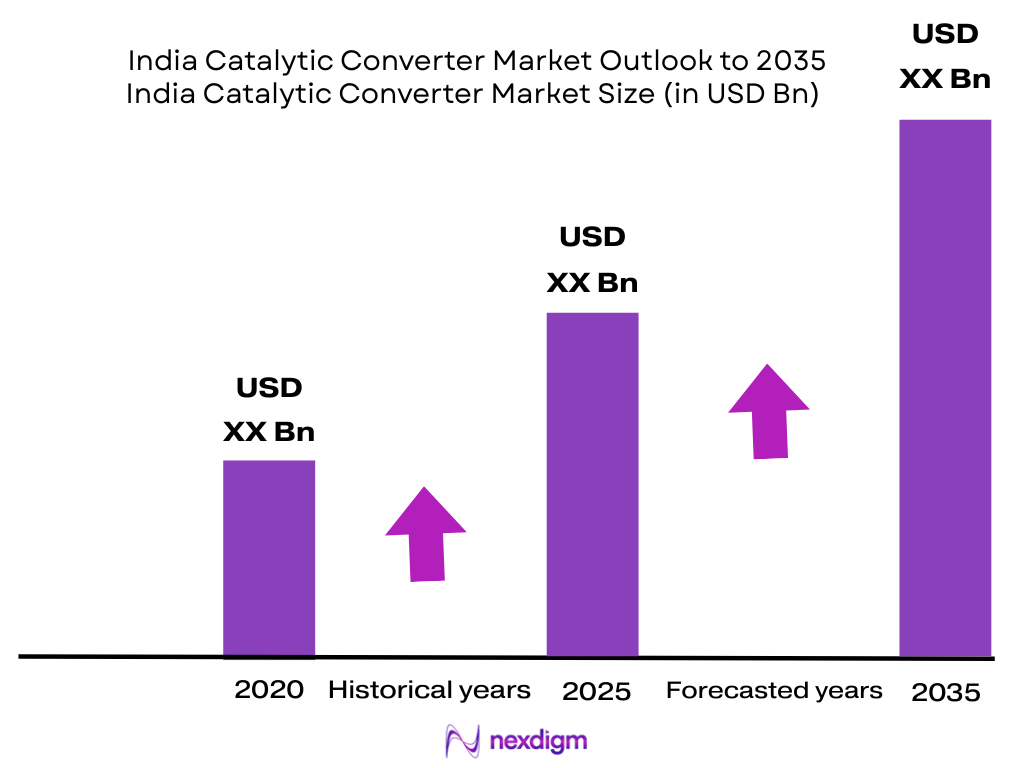
The India Catalytic Converter Market is valued at USD ~ billion, supported by large-scale two-wheeler, passenger-vehicle, three-wheeler and commercial-vehicle production under BS6 emission requirements. Passenger-vehicle sales increased from roughly 4.22 million units to 4.30 million units, while two-wheeler volumes remained above 17 million units. These production volumes sustain OEM demand for three-way catalysts, motorcycle catalysts, diesel oxidation catalysts and integrated BS6 exhaust-aftertreatment systems. Pune-Chakan, Chennai-Sriperumbudur, Gurugram-Manesar, Bengaluru-Bidadi, Sanand-Ahmedabad and Hosur dominate India Catalytic Converter Market activity because these clusters combine vehicle assembly, Tier-1 exhaust suppliers, catalyst-coating facilities and automotive-component manufacturing. Pune is particularly important because Umicore operates automotive-catalyst manufacturing near the city, while western and southern India contain dense passenger-vehicle, commercial-vehicle and two-wheeler supply chains. Automotive production also exceeded 23 million units during the first nine months of one recent fiscal period, reinforcing cluster-level catalyst demand.
Market Segmentation
By Vehicle Type
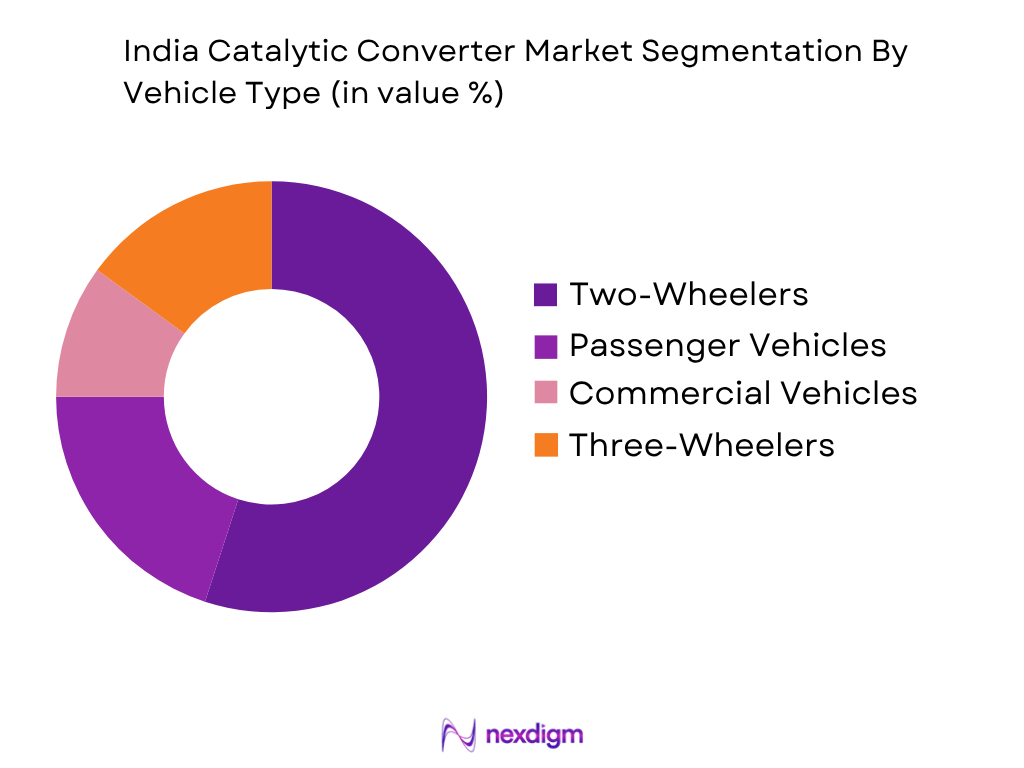
The India Catalytic Converter Market is segmented into two-wheelers, passenger vehicles, commercial vehicles, three-wheelers and off-highway vehicles. Two-wheelers dominate the market by unit demand because India operates the world’s largest motorcycle and scooter manufacturing ecosystem, and BS6-compliant petrol two-wheelers require catalytic exhaust treatment. During April–December of a recent fiscal period, domestic two-wheeler sales reached 15.04 million units, compared with 3.14 million passenger vehicles, 683,471 commercial vehicles and 562,652 three-wheelers. This difference in absolute vehicle volumes makes motorcycle and scooter catalysts one of the largest recurring OEM applications. Two-wheelers generally use compact, close-coupled catalytic substrates with lower individual precious-metal loading than passenger cars, but their very high production volumes compensate through scale. Manufacturers such as Cataler operate dedicated Indian capacity for both automotive and motorcycle catalyst applications, reinforcing the segment’s importance.
By Converter Type
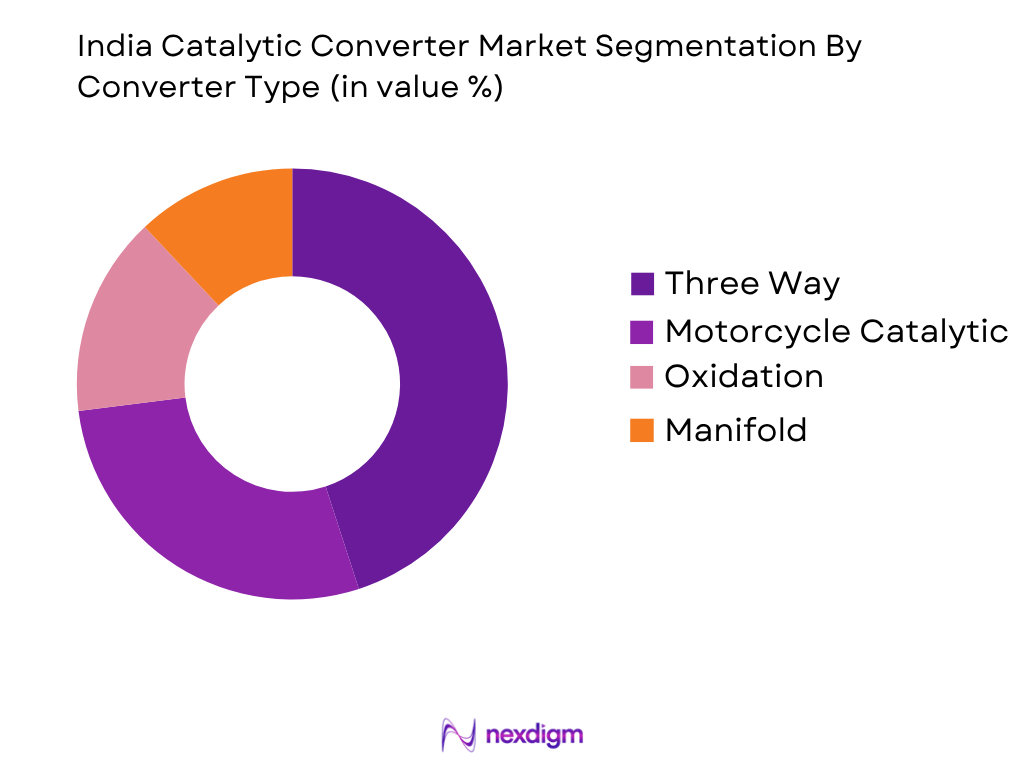
The India Catalytic Converter Market is segmented into three-way catalytic converters, motorcycle catalytic converters, diesel oxidation catalysts, close-coupled catalytic converters, manifold-integrated converters and multi-brick aftertreatment systems. Three-way catalytic converters dominate by value because petrol passenger vehicles, CNG vehicles and a significant portion of two-wheelers require simultaneous conversion of carbon monoxide, hydrocarbons and nitrogen oxides. BS6 emission control has increased the importance of rapid catalyst light-off, oxygen-storage capability and carefully optimized palladium-rhodium formulations. Gasoline applications also increasingly combine close-coupled converters with additional downstream catalyst bricks depending on engine architecture and emission calibration. India’s large petrol passenger-vehicle base, combined with hybrid and CNG applications, therefore gives three-way catalysts a broad addressable market spanning OEM fitment and eventual replacement. The shift to BS6 and later OBD requirements has also increased application-specific catalyst engineering and durability expectations.
Competitive Landscape
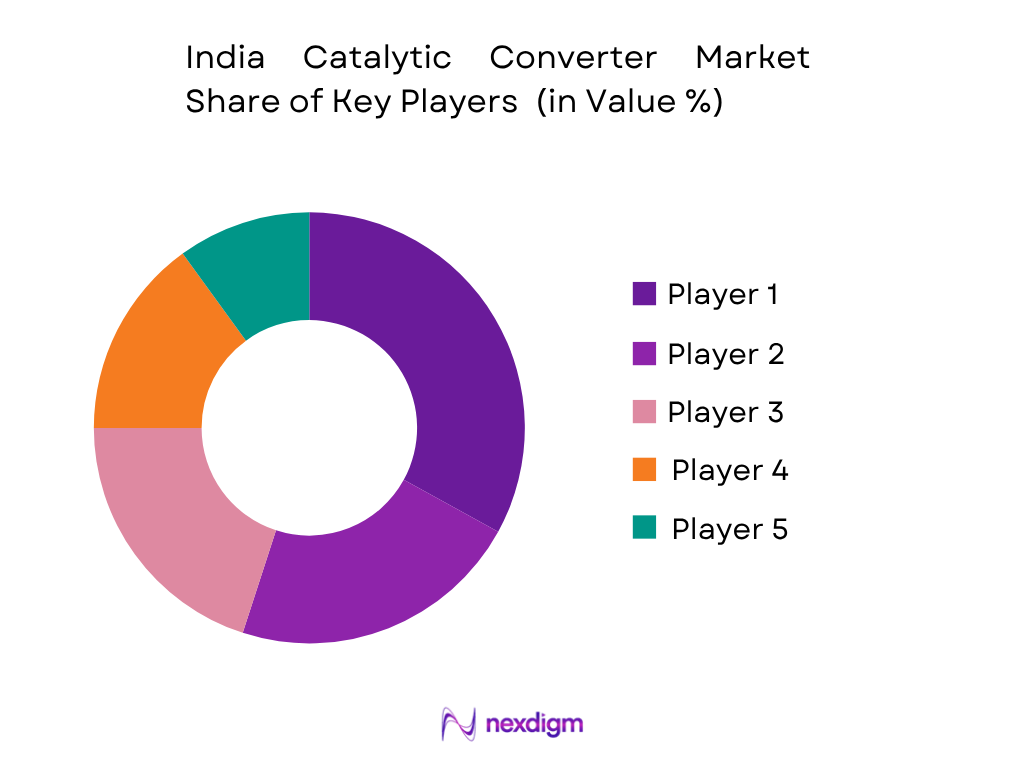
The India Catalytic Converter Market is led by a combination of domestic exhaust-system suppliers and global catalyst-technology companies. Sharda Motor and Tata AutoComp Katcon participate deeply in vehicle exhaust integration, while Umicore, Cataler, BASF, Johnson Matthey and Corning provide catalyst chemistry, substrates or advanced emissions-control technology. Competition is closely tied to OEM nomination, BS6 compliance, localization, PGM formulation, substrate technology and the ability to integrate catalyst systems with DPF and SCR hardware for diesel applications.
| Company | Establishment | Headquarters | Main Catalyst Focus | Vehicle Coverage | BS6 Capability | PGM Technology | Indian Manufacturing | OEM Integration |
| Sharda Motor Industries | 1986 | New Delhi, India | ~ | ~ | ~ | ~ | ~ | ~ |
| Tata AutoComp Katcon | Tata AutoComp JV platform | Pune, India | ~ | ~ | ~ | ~ | ~ | ~ |
| Umicore Autocat India | Global group roots 1805 | Shirwal, Maharashtra | ~ | ~ | ~ | ~ | ~ | ~ |
| Cataler India | Global group roots 1967 | Karnataka operations | ~ | ~ | ~ | ~ | ~ | ~ |
| FORVIA Clean Mobility India | FORVIA formed 2022 | India operations / France group HQ | ~ | ~ | ~ | ~ | ~ | ~ |
India Catalytic Converter Market Analysis
Growth Drivers
BS6 Phase-II, OBD-II and In-Use Emission Compliance Increasing Catalyst Technology Intensity
India’s progressively tighter emissions framework is a major growth driver for catalytic converters because BS6 Phase-II and OBD-linked requirements increase the technical content needed in petrol, CNG, two-wheeler and diesel aftertreatment systems. The Ministry of Road Transport and Highways’ regulatory framework places BS VI Stage II-A requirements on vehicles manufactured from April 2023 and extends onboard diagnostic requirements into the subsequent Stage II-B regime, making continuous monitoring of catalyst efficiency, oxygen sensors and exhaust-system performance increasingly important. India simultaneously operates a very large vehicle-production and sales base: SIAM reported 4.3 million passenger vehicles sold in FY2024-25, the highest annual volume recorded for the segment, while three-wheelers reached 0.74 million units and two-wheeler sales remained several times larger than passenger-vehicle volumes. These volumes matter directly to catalyst suppliers because virtually every new combustion-powered petrol or CNG vehicle needs a three-way catalyst, while BS6 diesel vehicles require oxidation catalysts integrated with DPF and SCR architecture. More stringent diagnostics also increase the importance of catalyst durability because deterioration must be detected by onboard systems rather than remaining invisible during normal vehicle operation. The macroeconomic environment reinforces this automotive demand base. The IMF’s 2024 Article IV assessment reported that India had recorded 8.2 real GDP growth in FY2023-24, while growth moderated to 6.0 in the first half of FY2024-25; World Bank data subsequently place India’s GDP at USD 3.96 trillion in 2025, GDP per capita at USD 2,702.5, and real GDP growth at 7.6. The result for the catalytic-converter industry is not merely more converter units but higher engineering content per combustion vehicle. Catalyst suppliers must optimize palladium-rhodium loading for gasoline engines, improve light-off performance, develop durable washcoats, integrate sensors and ensure compatibility with real-driving and OBD requirements. Two-wheelers create an especially important scale effect because even compact catalysts are produced in very large numbers. Passenger vehicles create higher per-unit catalyst value because larger engines, multiple catalyst bricks and more complex exhaust layouts increase substrate and PGM requirements. Commercial vehicles contribute another technology-intensive segment through DOC-DPF-SCR systems. As BS6-compliant vehicles continue accumulating across the road parc, the same regulatory architecture also creates future aftermarket replacement demand when catalyst-efficiency thresholds are no longer met. This combination of high annual vehicle volumes, increasingly stringent emissions diagnostics and a large expanding economy supports sustained demand for catalyst coatings, ceramic substrates, metallic substrates, converter canning and complete aftertreatment assemblies.
Large Two-Wheeler and Passenger-Vehicle Production Base Supporting OEM Catalyst Demand
India’s exceptionally large road-vehicle manufacturing base provides a second structural driver for the Catalytic Converter Market because catalytic aftertreatment is fitted at the point of manufacture across virtually all new combustion-powered two-wheelers, passenger vehicles, three-wheelers and commercial vehicles. SIAM reported that passenger-vehicle sales reached 4.3 million units in FY2024-25, compared with approximately 4.22 million units in the preceding fiscal period, while three-wheelers reached approximately 0.74 million units. Two-wheelers operate at an even larger scale. During July-September 2025 alone, SIAM recorded 5,562,077 two-wheelers, 1,039,200 passenger vehicles, 239,781 commercial vehicles and 229,239 three-wheelers sold; total production across passenger vehicles, commercial vehicles, three-wheelers, two-wheelers and quadricycles during April-September 2025 reached 16,534,997 units. These volumes translate directly into substantial annual demand for catalytic substrates, washcoats, PGM formulations, stainless-steel canisters and exhaust assemblies. Two-wheelers are particularly important for unit demand because India’s motorcycle and scooter market requires compact catalysts integrated close to the engine, while passenger vehicles consume larger and often more sophisticated catalyst systems. Petrol and CNG passenger vehicles generally use three-way catalysts containing palladium and rhodium, while diesel commercial vehicles use oxidation catalysts as part of multi-component aftertreatment systems. The macroeconomic backdrop supports continued automotive activity. The IMF’s 2024 Article IV report states that India’s real GDP expanded 8.2 in FY2023-24, while World Bank data show economic output of USD 3.96 trillion in 2025 and GDP per capita of USD 2,702.5. This combination of manufacturing scale and income growth allows the catalyst industry to benefit from several vehicle categories simultaneously rather than depending on passenger cars alone. Two-wheelers provide high unit volume; SUVs and utility vehicles provide larger engine and catalyst content; CNG vehicles preserve three-way catalyst demand while diversifying fuel use; commercial vehicles require expensive diesel aftertreatment; and strong hybrids retain catalytic converters despite partial electrification. Domestic localization further strengthens the demand mechanism because catalyst coating and converter manufacturing can occur close to OEM assembly clusters in Pune, Chennai, Bengaluru, Gurugram-Manesar, Sanand and Hosur. This reduces logistics complexity and enables suppliers to coordinate catalyst formulation directly with OEM engine calibration. The scale of India’s vehicle sector also supports dedicated catalyst lines for motorcycles, passenger vehicles and commercial applications rather than relying on imported universal products. For catalytic-converter manufacturers, the most important implication is that India offers both volume and product diversity: a supplier can participate in compact motorcycle catalysts, conventional three-way converters, CNG aftertreatment, hybrid catalysts and integrated diesel systems within the same national market. As long as combustion and hybrid platforms account for a substantial portion of annual vehicle production, this large OEM manufacturing base will remain a primary demand engine for the India Catalytic Converter Market.
Market Challenges
Rapid Electric Two-Wheeler and Three-Wheeler Adoption Reducing Future Converter Fitment
Electrification represents the clearest structural challenge to the India Catalytic Converter Market because battery-electric vehicles eliminate the combustion engine, exhaust pipe and catalytic converter entirely. The substitution effect is already material in the two- and three-wheeler segments that account for a large proportion of India’s vehicle volumes. Government data show that 1,950,490 electric vehicles were registered during calendar 2024, out of 26,207,453 total vehicle registrations, while the Ministry of Heavy Industries reported 1,010,101 electric two-wheelers and 122,982 electric L5 three-wheelers registered under PM E-DRIVE-related activity during FY2024-25. The EV population is expanding rapidly beyond those annual flows: as of February 2025, the e-Vahan portal recorded 5.675 million total registered EVs against 389.771 million total registered vehicles. NITI Aayog subsequently reported that EV sales increased to 2.08 million units in 2024, while government reporting in August 2026 stated that 2.3 million EVs were sold in 2025. These numbers are highly relevant to catalytic converters because electric two-wheelers are replacing precisely the category that otherwise generates India’s largest number of compact catalyst installations. Each electric scooter or motorcycle removes an OEM catalytic converter, a future replacement converter and the associated end-of-life PGM recovery opportunity. Electric three-wheelers create a similar effect in urban and semi-urban last-mile mobility, where battery-powered platforms are already commercially competitive. The macroeconomic context enables this transition. World Bank data show India’s GDP at USD 3.96 trillion in 2025, GDP per capita at USD 2,702.5, and real GDP growth at 7.6, providing an expanding economic base for charging infrastructure, battery manufacturing and vehicle electrification. Government policy reinforces the substitution pressure. PM E-DRIVE carries an outlay of INR 10,900 crore through March 2026, while the scheme targets large volumes of electric two- and three-wheelers. For catalyst suppliers, the risk is therefore concentrated in high-volume small-engine applications first rather than evenly distributed across all vehicles. Heavy commercial vehicles, CNG vehicles and strong hybrids retain aftertreatment, but scooters and three-wheelers can transition relatively quickly because their driving patterns and battery requirements are more compatible with electrification. Suppliers heavily exposed to two-wheeler catalysts need to diversify toward passenger-vehicle hybrids, CNG three-way catalysts, commercial diesel aftertreatment and PGM recycling. The transition does not eliminate near-term catalyst demand because India still sells tens of millions of combustion-powered vehicles, but it progressively caps new-fitment growth in categories where electrification is moving fastest.
PGM Dependence, Catalyst Formulation Complexity and Recycling Formalization
Dependence on platinum-group metals and the technical complexity of BS6 catalyst systems create a second important challenge for India’s catalytic-converter industry. Three-way gasoline catalysts depend principally on palladium and rhodium, while diesel oxidation catalysts use platinum-containing formulations; these metals are not produced in sufficient domestic quantities to support India’s large automotive requirement, leaving manufacturers exposed to imported material availability and global refining concentration. The strategic importance of recovering these metals is visible in Ministry of Environment approvals. In May 2024, an Expert Committee recommended the export of exactly 150 metric tonnes of spent or used automobile catalytic converters containing platinum, palladium and rhodium, demonstrating that India already generates commercially significant quantities of PGM-bearing catalyst waste. Another MoEFCC decision published in December 2024 referred to authorized activities involving automobile catalytic converters and platinum/palladium catalyst material, indicating continued regulatory oversight of secondary catalyst flows. A later government document from November 2025 again lists spent or used automobile catalytic converters containing platinum, palladium and rhodium, confirming the persistence of this material stream. The challenge is that recovering these metals efficiently requires collection, assay, decanning, monolith processing, refining and regulatory compliance, while India’s end-of-life vehicle and scrap ecosystem remains more fragmented than the highly integrated OEM supply chain. At the manufacturing end, BS6 increases the precision required in catalyst formulation. PGM loading cannot simply be minimized to reduce import exposure because catalyst conversion efficiency, thermal durability and OBD performance must remain within regulatory thresholds across the vehicle’s operating life. OEM suppliers must therefore balance palladium-rhodium or platinum formulations against substrate cell density, washcoat chemistry, oxygen-storage capacity and engine calibration. The same complexity multiplies across India’s diverse vehicle categories: motorcycles need compact low-mass catalysts, passenger petrol vehicles require three-way catalyst systems, CNG engines require tailored stoichiometric formulations, and commercial diesels need DOC units integrated with DPF and SCR systems. The macroeconomic setting emphasizes the importance of material productivity. The IMF’s 2024 consultation recorded 8.2 real GDP growth in FY2023-24, with growth moderating to 6.0 in the first half of FY2024-25, while the World Bank reports a USD 3.96 trillion economy in 2025. A rapidly expanding automotive economy requires large volumes of catalyst material, making imported-PGM exposure strategically significant. For manufacturers, this creates a need for precious-metal thrifting, improved dispersion, formulation substitution where technically feasible and closer partnerships with refiners. For policymakers and recyclers, formalizing spent-converter collection can reduce material leakage and increase secondary PGM recovery. Until collection, assay and domestic refining become more standardized, however, India will continue to face a mismatch between a highly engineered catalyst-manufacturing sector and a comparatively fragmented end-of-life converter ecosystem.
Market Opportunities
Strong Hybrid, CNG and BS6 Passenger-Vehicle Applications Expanding High-Value Catalyst Demand
Strong hybrids, CNG vehicles and increasingly sophisticated BS6 passenger vehicles create a significant future opportunity because each retains an internal-combustion engine while requiring advanced catalytic aftertreatment. India’s passenger-vehicle segment reached a record 4.3 million units in FY2024-25, compared with approximately 4.22 million units in the preceding year, demonstrating a large current platform base from which higher-content catalyst applications can expand. Utility vehicles are increasingly important within this mix, and their larger engines can require greater substrate volume and catalyst loading than small entry-level cars. Strong hybrids add a distinct engineering opportunity because the combustion engine shuts down and restarts repeatedly during operation. Catalyst temperature can fall during electric-only driving, so the exhaust system must recover conversion efficiency rapidly when combustion resumes. This creates opportunities for low-light-off washcoats, high oxygen-storage capacity, close-coupled substrates and carefully optimized palladium-rhodium formulations. CNG vehicles provide another durable opportunity because they offer lower-carbon combustion without removing the exhaust system; stoichiometric CNG engines still need three-way catalysts for control of carbon monoxide, hydrocarbons and nitrogen oxides. SIAM’s automotive transition material indicates a significant increase in CNG participation within relevant vehicle categories, demonstrating that alternative gaseous fuels are already an established part of India’s powertrain mix rather than a hypothetical future technology. The opportunity is strengthened by BS6 and OBD requirements, which make catalyst quality and durability more important for every combustion-powered vehicle. Suppliers can capture more value through application-specific catalyst formulations rather than commodity converter shells. Passenger-vehicle growth also supports localization of high-value catalyst coating, substrate canning and complete hot-end exhaust assemblies around major automotive manufacturing clusters. The macroeconomic environment provides a supportive demand base: the World Bank reports India’s GDP at USD 3.96 trillion in 2025, GDP per capita at USD 2,702.5, and real GDP growth at 7.6, while the IMF’s 2024 consultation documented 8.2 growth in FY2023-24. The opportunity should therefore be viewed as a shift in catalyst mix rather than simple expansion of conventional petrol converters. Electric vehicles will take some volumes out of the market, particularly in small mobility segments, but strong hybrids and CNG vehicles preserve the catalytic-converter requirement while increasing the importance of thermal management, OBD compatibility and application-specific engineering. Manufacturers that can serve petrol, CNG and hybrid platforms from common domestic coating and canning facilities can diversify against EV substitution while participating in higher-technology catalyst categories.
Formal PGM Recycling and Domestic Closed-Loop Catalyst Supply
Formal recycling of spent catalytic converters represents a substantial future opportunity because India already generates measurable quantities of platinum-, palladium- and rhodium-bearing automotive waste while simultaneously depending on these materials for BS6 catalyst production. The strongest current evidence comes from the Ministry of Environment, Forest and Climate Change: in May 2024, its Expert Committee recommended the export of 150 metric tonnes of spent or used automobile catalytic converters containing platinum, palladium and rhodium. Further MoEFCC decisions issued in December 2024 and November 2025 continued to document regulatory handling of automobile catalytic converters and PGM-containing catalyst waste, demonstrating that the stream is recurring rather than isolated. These current volumes provide a tangible resource base for building more domestic decanning, sampling, assay and precious-metal recovery capacity. The opportunity grows as the BS4 and early BS6 vehicle populations age because more catalytic converters will enter end-of-life and replacement cycles. India’s annual production base means even modest replacement or scrappage rates can generate large numbers of spent catalyst units. SIAM recorded 4.3 million passenger-vehicle sales in FY2024-25, while production across passenger vehicles, commercial vehicles, three-wheelers, two-wheelers and quadricycles reached 16,534,997 units during April-September 2025 alone. Those current production flows will eventually become a secondary resource stream. Closed-loop recovery would allow scrap converters collected from authorized vehicle dismantlers, service centres and exhaust-repair networks to be processed into secondary platinum-group metals that can return to catalyst manufacturers. This can reduce exposure to imported raw materials, improve traceability and create additional revenue for organized recyclers. Formalization also matters because PGM-bearing converters have high material value and can otherwise leak into informal scrap channels where identification, environmental controls and assay accuracy are weak. The macroeconomic context supports investment in specialized recovery infrastructure. World Bank data show India operating a USD 3.96 trillion economy in 2025, with GDP per capita of USD 2,702.5 and real GDP growth of 7.6. The future opportunity should therefore extend beyond simply exporting spent converters. Domestic collection networks, digital batch traceability, XRF or laboratory assay, ceramic-monolith processing and PGM refining can connect the end-of-life vehicle sector with India’s existing catalyst manufacturing clusters. OEMs and Tier-1 suppliers could also establish take-back agreements with authorized service centres, ensuring that failed converters are captured rather than dispersed through informal scrap dealers. As catalyst demand becomes more technologically sophisticated and PGM sourcing remains strategically sensitive, companies with closed-loop recycling partnerships can strengthen supply resilience while positioning themselves around circular automotive manufacturing.
Future Outlook
The India Catalytic Converter Market is forecast to expand at ~ CAGR during 2026–2035 under the placeholder scenario. Growth will increasingly depend on tougher emissions compliance, hybridization, two-wheeler catalyst demand, commercial-vehicle aftertreatment and the replacement of ageing BS6 vehicles, while battery-electric penetration creates a long-term substitution risk. BS6 Phase-II and OBD implementation increase the technical content required per combustion vehicle. MoRTH’s regulatory roadmap specifies BS VI Stage II-A for vehicles manufactured from April 2023 and subsequent OBD Stage II-B requirements, strengthening continuous emissions-system monitoring. These requirements make catalyst efficiency, oxygen sensors, exhaust temperature management and on-board diagnostic compatibility increasingly important. Two-wheelers should remain one of the most important volume opportunities. Domestic two-wheeler sales reached more than 15 million units during April–December 2024, and India continues to operate at far greater two-wheeler volumes than any other road-vehicle segment. Even modest catalyst-content improvements across such a large production pool can materially affect total demand.
Major Players
- Sharda Motor Industries Limited
- Tata AutoComp Katcon Exhaust Systems
- Umicore Autocat India Private Limited
- Cataler India Auto Parts Private Limited
- FORVIA Clean Mobility India
- Tenneco Clean Air India
- BASF Environmental Catalyst and Metal Solutions India
- Johnson Matthey India
- Corning India
- DENSO India
- Süd-Chemie India
- Ecocat India
- Futaba Industrial India
- Purem by Eberspächer India
- Cummins Emission Solutions India
Key Target Audience
- Automotive Catalytic Converter and Exhaust-System Manufacturers
- Passenger Vehicle, Two-Wheeler and Commercial Vehicle OEMs
- Platinum-Group-Metal Suppliers, Refiners and Recyclers
- Automotive Substrate, Washcoat and Catalyst-Chemistry Suppliers
- Automotive Component Distributors and Replacement-Part Companies
- Fleet Operators and Authorized Vehicle Service Networks
- Investments and Venture Capitalist Firms
- Government and Regulatory Bodies (Ministry of Road Transport and Highways, Central Pollution Control Board, Ministry of Environment Forest and Climate Change, Automotive Research Association of India)
Research Methodology
Step 1: Identification of Key Variables
The initial phase develops an ecosystem map encompassing vehicle OEMs, catalyst manufacturers, PGM suppliers, substrate producers, exhaust-system Tier-1 companies, replacement-part distributors and recyclers. Important variables include vehicle production by segment, BS6 compliance, converters per vehicle, PGM loading, substrate type, powertrain, replacement lifecycle and regional manufacturing concentration. Secondary research incorporates SIAM production statistics, MoRTH emission regulations, environmental permissions, OEM disclosures and catalyst-company technical information. Vehicle and catalyst categories are clearly separated to avoid double-counting DOC, DPF and SCR components within broader diesel-aftertreatment systems.
Step 2: Market Analysis and Construction
The top-down model begins with passenger vehicles, two-wheelers, commercial vehicles and three-wheelers requiring catalytic aftertreatment. Vehicle production is multiplied by average catalyst content, powertrain-specific converter configuration and PGM architecture to construct theoretical OEM demand. The bottom-up model maps catalyst manufacturing capacity, major OEM nominations, plant footprints, replacement-product activity and spent-catalyst recovery. Two-wheeler catalysts are modeled separately because their extremely high unit volume but lower per-unit catalyst content creates economics different from passenger vehicles.
Step 3: Hypothesis Validation and Expert Consultation
Market assumptions are validated through CATIs and structured interviews with catalyst producers, exhaust-system manufacturers, vehicle OEM procurement teams, component distributors, service networks and PGM recyclers. Discussions assess BS6 catalyst architecture, PGM loading, localization, OEM nomination cycles, replacement demand and competitive positioning. Additional validation covers hybrid catalysts, CNG applications, OBD-II deterioration monitoring, two-wheeler emission control and diesel DOC-DPF-SCR integration. Data inconsistencies identified between supplier interviews and secondary sources are re-examined before inclusion.
Step 4: Research Synthesis and Final Output
The final phase triangulates vehicle-production data, catalyst-manufacturing activity, technology mapping, regulatory requirements and industry interviews. The India Catalytic Converter Market is segmented by vehicle type, converter type, powertrain, emission standard, substrate, catalyst metal composition, fitment and distribution channel. Forecast scenarios incorporate BS6 replacement demand, hybrid penetration, EV adoption, two-wheeler electrification, CNG expansion, commercial-vehicle production, PGM substitution and formal recycling. Base-case, accelerated-EV and hybrid-led scenarios are used to assess long-term market resilience.

- Executive Summary
- Research Methodology (Market Definitions and Assumptions, Abbreviations, Catalytic Converter Market Boundary, Vehicle-Parc Mapping, BS6 Vehicle Mapping, Converter-per-Vehicle Assessment, Two-Wheeler Catalyst Mapping, Passenger Vehicle Catalyst Mapping, OEM Production Assessment, Replacement Cycle Analysis, PGM Loading Assessment, Market Sizing Approach, Top-Down Analysis, Bottom-Up Analysis, Demand-Side Assessment, Supply-Side Assessment, Manufacturer and OEM Interviews, Recycler Assessment, Data Triangulation, Forecasting Framework, Scenario Analysis, Limitations and Future Conclusions)

- Definition and Scope
- Evolution of Automotive Catalytic Emission Control in India
- Transition from Earlier Bharat Stage Norms to BS6 Aftertreatment
- Evolution of Three-Way Catalyst Technology
- Catalytic Converter Role in Petrol, CNG, LPG, Hybrid and Diesel Powertrains

- Growth Drivers (BS6 and BS6 Phase-II Compliance, Large Two-Wheeler Vehicle Base, Passenger Vehicle Production, Hybrid Vehicle Expansion, CNG Vehicle Penetration, OBD-II Adoption, OEM Localization, In-Use Emission Compliance)
- Market Challenges (Battery-Electric Vehicle Adoption, PGM Import Dependence, Catalyst Material Volatility, BS6 Technical Complexity, Counterfeit and Low-Quality Replacement Parts, Fragmented Aftermarket, Limited Converter Recycling Formalization, Application-Specific Engineering)
- Market Opportunities (Hybrid Catalytic Converters, Two-Wheeler Catalyst Upgradation, BS6 Replacement Demand, PGM Recycling, Commercial Vehicle Aftertreatment, CNG Three-Way Catalysts, Low-PGM Catalyst Formulations, Domestic Catalyst Localization)
- Market Trends (PGM Thrifting, Palladium-Platinum Substitution, High-Cell-Density Substrates, Close-Coupled Catalysts, Integrated DOC-DPF-SCR Systems, Recycled PGM Usage, OBD-Based Catalyst Monitoring, Localized Catalyst Production)
- SWOT Analysis
- Porter’s Five Forces Analysis
- PESTLE Analysis

- By Market Value (2020-2025)
- By Catalytic Converter Unit Volume (2020-2025)
- By OEM-Fitted Converter Volume (2020-2025)

- By Converter Type (In Value %)
Three-Way Catalytic Converters
Two-Way Oxidation Catalysts
Close-Coupled Catalytic Converters
Manifold-Integrated Catalytic Converters
Underfloor Catalytic Converters - By Vehicle Type (In Value %)
Passenger Cars
Utility Vehicles and SUVs
Two-Wheelers
Three-Wheelers
Light Commercial Vehicles - By Powertrain Type (In Value %)
Petrol Vehicles
Petrol Hybrid Vehicles
Plug-in Hybrid Vehicles
CNG Vehicles
LPG Vehicles - By Sales Channel (In Value %)
OEM Vehicle Manufacturing
OEM Dealership Replacement
Tier-1/OES Replacement
Independent Automotive Parts Distribution
Authorized Service Centres

- Market Share of Major Players by Value
- Cross Comparison Parameters (BS6/BS6 Phase-II Vehicle Application Coverage, Passenger Vehicle-Two-Wheeler-Commercial Vehicle Catalyst Portfolio Breadth, Platinum-Palladium-Rhodium Formulation Capability, Ceramic/Metallic Substrate and Washcoat Engineering Capability, OBD-II/RDE and Catalyst-Durability Compliance Capability, India Manufacturing and Catalyst-Coating Footprint, OEM Integration and Automotive-Cluster Reach, PGM Recycling and Closed-Loop Material Capability)
- SWOT Analysis of Major Players
- Detailed Profiles of Major Companies
Sharda Motor Industries Limited
Tata AutoComp Katcon Exhaust Systems
Umicore Autocat India Private Limited
Cataler India Auto Parts Private Limited
FORVIA Clean Mobility India
Tenneco Clean Air India
BASF Environmental Catalyst and Metal Solutions India
Johnson Matthey India
Corning India
DENSO India
Süd-Chemie India
Ecocat India
Futaba Industrial India
Purem by Eberspächer India
Cummins Emission Solutions India

- Automotive OEM Procurement
- Tier-1 Exhaust Supplier Procurement
- National Motor Factor Demand
- Independent Distributor Demand
- Garage Procurement

- By Market Value (2026-2035)
- By Catalytic Converter Unit Volume (2026-2035)
- By OEM-Fitted Converter Volume (2026-2035)


 Request a Sample
 Ask for Customization
 Get a Quote
 Enquire Now