

 Download PDF
Market Overview
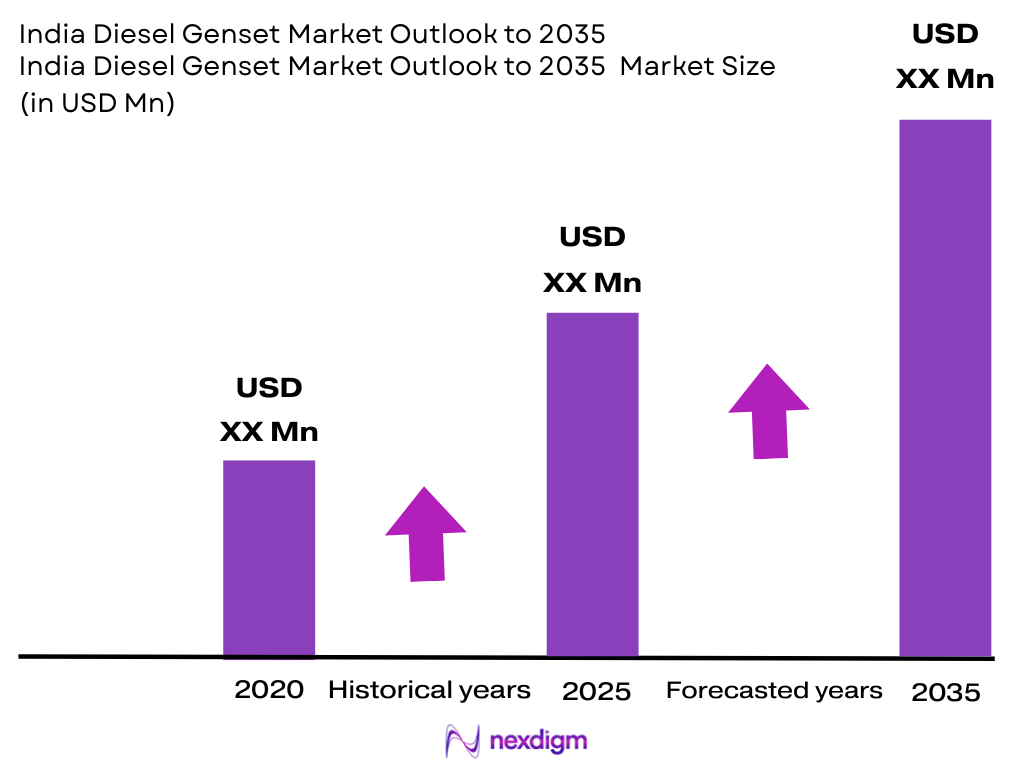
The India Diesel Genset Market is valued at approximately ~ million, supported by rapid infrastructure development, manufacturing expansion, telecom uptime requirements and demand for dependable backup electricity. India’s installed power generation capacity crossed 454 GW, while GDP reached approximately USD 3.9 trillion, creating a large base of factories, commercial buildings, construction sites, hospitals and logistics facilities requiring standby or prime power. CPCB IV+ compliant diesel gensets increasingly shape replacement and new-equipment demand. Delhi NCR, Mumbai-Pune, Bengaluru, Chennai, Hyderabad, Ahmedabad and industrial corridors across Maharashtra, Gujarat, Tamil Nadu and Uttar Pradesh dominate India Diesel Genset demand because they contain concentrated construction, manufacturing, data-centre, telecom, healthcare and commercial activity. India also operates a substantial installed DG-set base, with approximately 1.47 million diesel generator sets above 5 kVA identified nationally. Large urban and industrial clusters consequently support intensive demand for backup-generation equipment, replacement units and emission-control upgrades.
Market Segmentation
By Power Rating
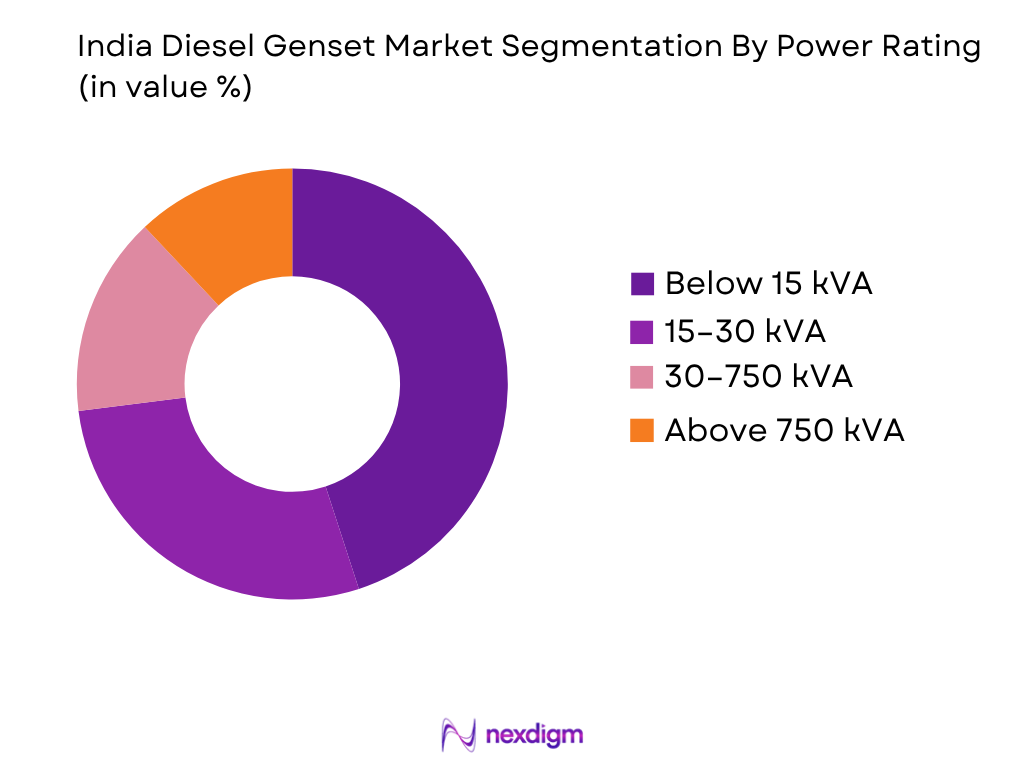
The India Diesel Genset Market is segmented into below 15 kVA, 15–30 kVA, 30–75 kVA, 75–160 kVA, 160–375 kVA, 375–750 kVA and above 750 kVA systems. The 30–75 kVA category holds a dominant position because it addresses a broad combination of telecom sites, retail outlets, small industrial facilities, workshops, construction sites, offices and residential-commercial backup applications. This range provides substantially greater usable load than very small portable units while avoiding the footprint and complexity of larger industrial gensets. India’s approximately 1.47 million operational DG sets above 5 kVA illustrate the scale of the installed backup-power ecosystem. Manufacturers including Mahindra Powerol maintain broad portfolios starting at 5 kVA and extending to 625 kVA, reflecting the diversified demand structure. CPCB IV+ standards additionally encourage buyers to replace legacy equipment with compliant models rather than simply extending older generator life indefinitely.
By Application
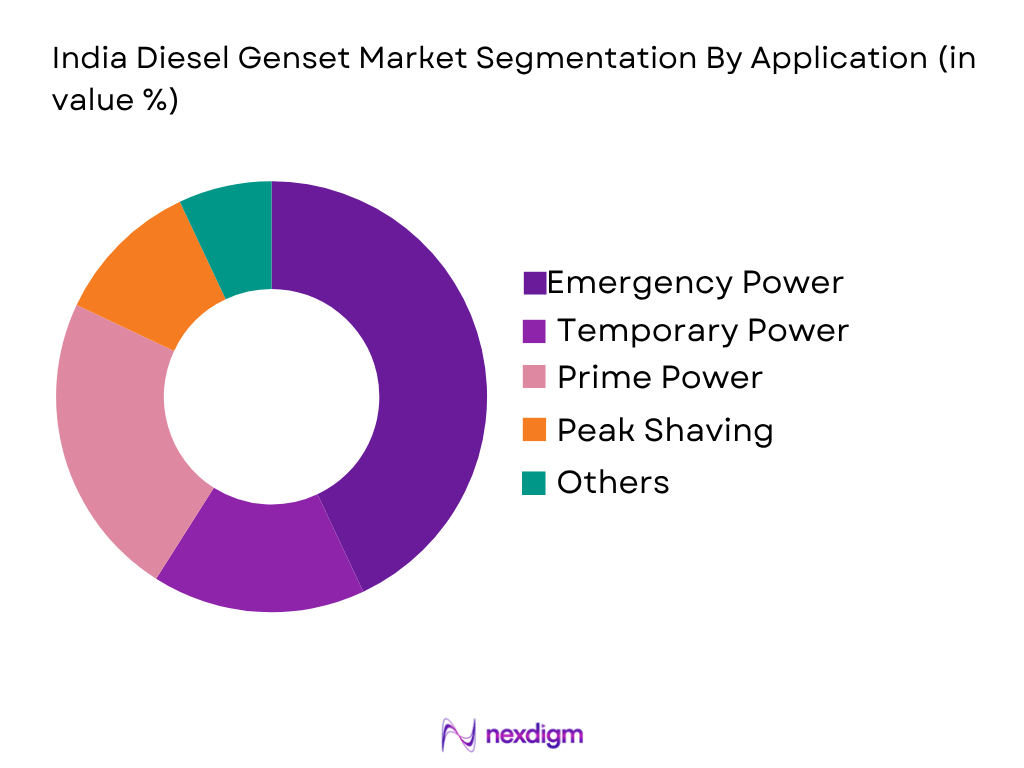
The India Diesel Genset Market is segmented into standby power, prime power, peak shaving and mobile/temporary power applications. Standby power represents the dominant application because diesel gensets are primarily purchased to protect critical operations against grid interruptions, voltage instability and localized electrical failures. Hospitals, telecom facilities, data centres, commercial complexes, manufacturing plants, warehouses and residential developments often require immediately available backup capacity even where grid access is generally reliable. India’s large installed DG-set population indicates that emergency generation remains deeply embedded across the economy. Construction projects additionally require temporary electricity before permanent grid connections are commissioned, while factories and remote facilities use gensets for prime or supplementary power. CPCB IV+ standards have made new standby systems more technologically sophisticated through tighter emission requirements, electronic engine controls and after-treatment integration, supporting replacement demand among users operating older CPCB II-era equipment.
Competitive Landscape
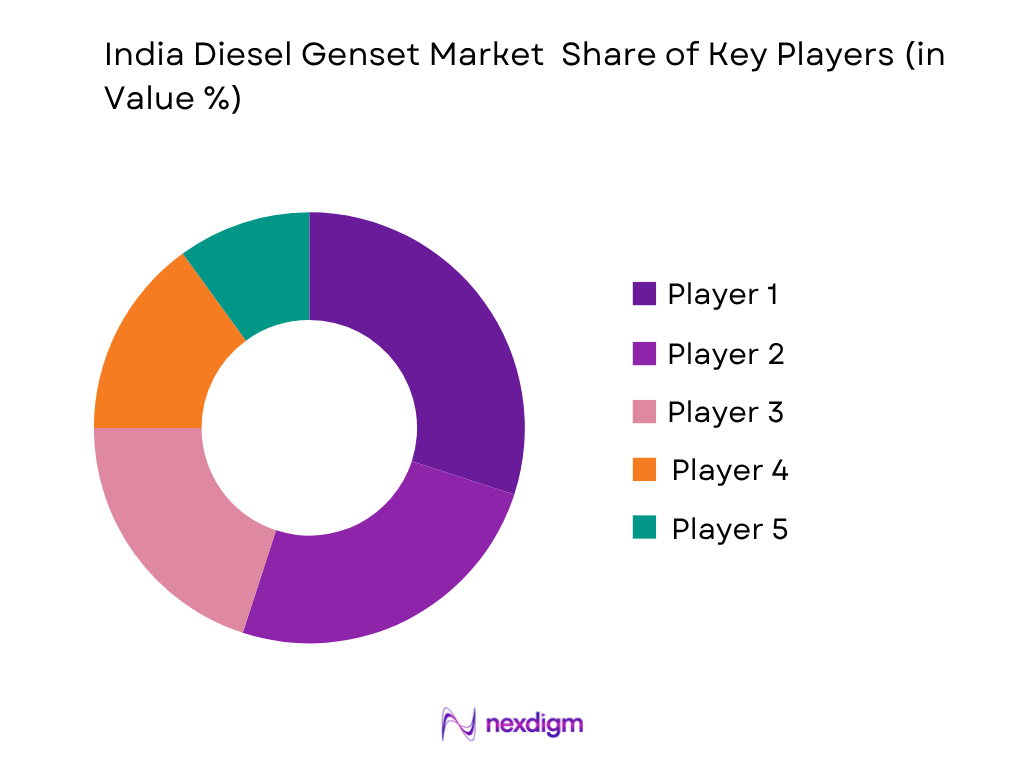
The India Diesel Genset Market is characterized by strong domestic manufacturing, established diesel-engine expertise and nationwide dealer-service networks. Kirloskar Oil Engines, Cummins India, Mahindra Powerol, Greaves and Jakson are among the prominent participants, while additional international and domestic equipment companies compete across industrial and commercial power ranges. Competition increasingly centres on CPCB IV+ compliance, fuel efficiency, acoustic performance, remote monitoring, engine reliability, service response and availability of replacement parts rather than generator output alone. Mahindra Powerol, for example, offers gensets from 5 kVA to 625 kVA through more than 200 dealers and service centres.
| Major Player | Establishment Year | Headquarters | Power Range Presence | CPCB IV+ Capability | Silent Gensets | Remote Monitoring | Dealer / Service Network | Key End-Use Strength |
| Kirloskar Oil Engines Ltd. | 1946 | Pune, India | ~ | ~ | ~ | ~ | ~ | ~ |
| Cummins India Ltd. | 1962 | Pune, India | ~ | ~ | ~ | ~ | ~ | ~ |
| Mahindra Powerol | 2001 | Mumbai/Pune, India | ~ | ~ | ~ | ~ | ~ | ~ |
| Greaves Cotton Ltd. | 1859 | Mumbai, India | ~ | ~ | ~ | ~ | ~ | ~ |
| Jakson Group | 1947 | Noida, India | ~ | ~ | ~ | ~ | ~ | ~ |
India Diesel Genset Market Analysis
Growth Drivers
Rising Power Loads from Industrial, Commercial and Digital Infrastructure
India’s Diesel Genset Market is supported by rapidly increasing electricity loads across manufacturing plants, commercial buildings, telecom infrastructure, hospitals, logistics facilities and data centres, where backup power continuity remains operationally critical. India successfully met a record 250 GW peak electricity demand in May 2024, while total installed generation capacity reached 446,190 MW in June 2024, according to the Ministry of Power. These figures indicate the enormous scale of electricity-dependent activity requiring contingency power systems even as grid capacity expands. India’s digital infrastructure further strengthens high-reliability backup requirements. The Ministry of Electronics and Information Technology reported approximately 1,000 MW of data-centre IT-load capacity in 2024, rising to around 1,280 MW in 2025. Data centres, telecom sites and cloud facilities commonly require multiple layers of power redundancy, keeping diesel generator systems relevant for emergency operation because of their rapid start-up characteristics and established fuel infrastructure. Macroeconomic scale reinforces this demand base: World Bank data places India’s GDP at approximately USD 3.96 trillion in 2025, with GDP per capita at approximately USD 2,702.5. For genset manufacturers, increasing electrical loads create opportunities across compact backup units, medium-capacity commercial installations and large synchronized generator systems. Manufacturing plants need emergency power for production controls and safety systems; hospitals require uninterrupted operation of critical equipment; warehouses need refrigeration and automation continuity; and digital facilities require dependable power during grid failures or maintenance. Consequently, expanding electricity consumption creates diesel-generator demand even in a progressively stronger national grid because businesses increasingly place economic value on power quality, resilience and uninterrupted operations. Principal supporting sources are the Ministry of Power, Ministry of Electronics and Information Technology and World Bank.
Infrastructure Construction and Expansion of Power-Critical Facilities
India’s continuing infrastructure and construction expansion provides another major demand foundation for diesel gensets because construction sites, highways, industrial projects, rail infrastructure and newly developed facilities frequently require temporary or standby electricity before permanent grid connections become fully operational. The Ministry of Statistics and Programme Implementation reported that the construction sector continued expanding strongly during FY 2024-25, while nominal gross value added for the overall economy reached ₹300.22 lakh crore in FY 2024-25. For FY 2025-26, nominal GVA was estimated at ₹323.48 lakh crore, demonstrating the increasing scale of productive activity requiring dependable electrical infrastructure. Electricity infrastructure itself is operating at unprecedented loads: India met 250 GW of peak demand in May 2024, while peak demand of approximately 242 GW had already been served during part of 2025, according to the Ministry of Power. Diesel generators remain relevant at construction sites because they can power welding equipment, compressors, concrete machinery, pumps, temporary lighting, site offices and electrically controlled equipment independently of fixed grid connections. They also provide emergency backup once industrial and commercial facilities become operational. India’s expanding data-centre footprint illustrates how new infrastructure directly creates high-reliability backup applications: installed data-centre capacity was approximately 1,000 MW in 2024, while government information places later cloud capacity at around 1,280 MW in 2025. World Bank data places India’s economy at about USD 3.96 trillion in 2025, giving the country sufficient scale for continued investment in factories, logistics parks, transportation infrastructure, commercial buildings and digital facilities. For diesel genset suppliers, the opportunity therefore extends beyond emergency residential power. Construction contractors require mobile units, manufacturing projects need temporary commissioning power, commercial facilities require standby installations, and critical infrastructure often needs generator redundancy even where utility reliability is high. Principal supporting sources are MoSPI, Ministry of Power, MeitY and World Bank.
Market Challenges
CPCB IV+ Compliance and Tightening Diesel-Generator Emission Controls
Emission regulation represents one of the most important structural challenges for India’s Diesel Genset Market because manufacturers must continually invest in cleaner combustion, after-treatment and control technologies while users of older equipment increasingly face operational restrictions. The Central Pollution Control Board maintains the CPCB IV+ framework governing generator-set emissions, while the Commission for Air Quality Management applies additional rules within the National Capital Region. Under the NCR operating schedule, generator sets meeting the latest notified standards up to 800 kW, equivalent to approximately 1,000 kVA, may operate without the restrictions applicable to older configurations. Older diesel sets between 41 kW and below 800 kW require dual-fuel operation or certified retrofit emission-control devices under applicable restrictions, while older portable sets below 19 kW face tighter use limitations during severe pollution-control periods. CAQM directives also specifically require that diesel generators not become a regular source of electricity in NCR and direct distribution companies to minimise grid interruptions that could trigger generator usage. These requirements increase engineering complexity for generator manufacturers. Engines must achieve increasingly stringent limits through improved fuel injection, combustion optimisation, electronic control and exhaust after-treatment while still maintaining reliability under emergency start-stop operation. For owners of legacy units, compliance can involve retrofit devices, dual-fuel conversion or equipment replacement. The challenge becomes more significant as India expands renewable generation. Renewable installed capacity reached 195,013 MW in June 2024 and surpassed 253,000 MW by November 2025, according to government energy statistics. As cleaner grid capacity expands and air-quality regulation becomes more restrictive, diesel generators must increasingly justify their role as emergency rather than routine power assets. This pushes suppliers toward lower-emission engines, remote monitoring, optimized fuel use and hybrid integration. Principal supporting sources are the CPCB, CAQM, Ministry of Environment and Ministry of Power.
Improving Grid Capacity and Competition from Cleaner Backup Technologies
A stronger Indian electricity system creates a long-term challenge for conventional diesel gensets because improvements in generation capacity, transmission availability, renewable energy and battery storage reduce the number of applications where diesel generation is required for routine power support. India’s installed generation capacity reached 446,190 MW in June 2024, including 195,013 MW of renewable capacity, while the Ministry of Power reported the successful supply of a record 250 GW peak demand in May 2024. The system expanded further during 2024-25 with 34 GW of additional generation capacity, of which 29.5 GW came from renewable sources. By November 2025, total renewable capacity had reached approximately 253.96 GW, including 132.85 GW of solar and 53.99 GW of wind capacity. These developments reduce dependence on diesel generation for applications that historically experienced unreliable utility supply. Diesel gensets also face growing competition from battery energy-storage systems, solar-plus-storage configurations, gas-based generating systems and hybrid power architectures. The challenge is particularly visible in regulated regions such as NCR, where CAQM requires diesel generator sets not to be used as a regular source of power and encourages uninterrupted utility supply to discourage alternate generating equipment. Macroeconomic expansion does not automatically translate into proportional diesel-generator operating hours. World Bank data places India’s GDP at around USD 3.96 trillion in 2025, but an increasingly modern economy also demands cleaner and more efficient power infrastructure. Consequently, manufacturers cannot rely solely on grid inadequacy as a demand proposition. They must reposition diesel gensets around emergency resilience, mission-critical redundancy, construction mobility and black-start capability. Products with lower fuel consumption, CPCB IV+ compliance, automated controls and battery integration are better positioned than conventional standalone machines. Principal supporting sources are the Ministry of Power, CAQM and World Bank.
Market Opportunities
CPCB IV+ Generators, Electronic Controls and Hybrid Backup System
Tighter environmental regulation creates a technology-led opportunity for manufacturers capable of replacing older diesel sets with CPCB IV+-compliant generators incorporating advanced fuel injection, electronic engine management, after-treatment systems and intelligent load controls. The current installed power environment demonstrates why backup equipment will remain necessary even while the technology changes. India served 250 GW of peak electricity demand in May 2024, and Ministry of Power data shows installed generation capacity of 446,190 MW in June 2024. At the same time, renewable capacity reached 195,013 MW in June 2024 and expanded to 253.96 GW by November 2025. This combination supports an opportunity for hybrid backup systems in which batteries or renewable power manage normal fluctuations while diesel engines are reserved for extended outages and critical loads. Such configurations can reduce diesel-engine running hours while preserving the dependable long-duration energy supply required by hospitals, industrial operations and data centres. Regulatory requirements strengthen the replacement opportunity. CAQM rules permit latest-standard generator sets up to 800 kW without the additional operating restrictions imposed on several classes of older equipment, creating a clear incentive for fleet modernization in pollution-sensitive markets. Intelligent gensets also create value through automatic transfer switches, remote start capability, digital engine controllers, load sharing, fuel monitoring and predictive maintenance. These functions become increasingly relevant as critical digital infrastructure scales. MeitY placed Indian data-centre IT load at approximately 1,000 MW in 2024, while later government information indicated cloud data-centre capacity of around 1,280 MW in 2025. Therefore, the growth opportunity lies less in conventional uncontrolled diesel machines and more in cleaner, connected and hybridized systems designed specifically for emergency operation. Principal supporting sources are the CPCB, CAQM, Ministry of Power and MeitY.
Data Centres, Telecom Networks and Mission-Critical Backup Applications
India’s expanding digital economy provides a substantial opportunity for high-reliability diesel genset suppliers because data centres, telecom sites and digital public infrastructure require power redundancy even when grid reliability improves. Government information placed installed data-centre IT-load capacity at approximately 1,000 MW in 2024. By 2025, cloud data-centre capacity was reported at about 1,280 MW, while a March 2026 government update placed total national data-centre capacity at around 1,500 MW. The 2026 Ministry of Electronics and Information Technology update also reported 38,231 GPUs onboarded through 14 empanelled service providers and data centres, illustrating the growing concentration of high-value computing loads that cannot tolerate prolonged electricity interruptions. Telecommunications provides another large critical-power ecosystem. Government information recorded 116.895 crore wireless subscribers and 93.513 crore broadband subscribers as of May 2024, requiring extensive network infrastructure and backup systems across urban and remote locations. These facilities favour generators with automatic start, rapid load acceptance, synchronized operation, remote monitoring and reliable fuel-management systems. India’s broader economic scale supports continued digital infrastructure investment: World Bank data records GDP of approximately USD 3.96 trillion in 2025. The opportunity is particularly attractive for high-capacity diesel generator packages operating alongside UPS systems and battery storage because data centres commonly require layered redundancy rather than a single backup technology. Suppliers can differentiate through modular generator architecture, synchronized multi-set configurations, digital controllers, condition monitoring, acoustic enclosures and emissions-compliant engines. Telecom applications additionally create demand for smaller remotely managed sets capable of operating in locations where maintenance access is limited. Thus, digital infrastructure transforms diesel gensets from generalized backup equipment into specialized resilience assets supporting India’s rapidly growing computing and communications network. Principal supporting sources are MeitY, Department of Telecommunications, Ministry of Power and World Bank.
Future Outlook
The India Diesel Genset Market is forecast to expand at approximately ~ CAGR during 2026–2035, although its product architecture will change substantially as emission regulations tighten and alternative backup-power technologies become more competitive. CPCB IV+ compliant systems will increasingly replace older diesel gensets, supporting demand for electronic fuel injection, exhaust after-treatment, advanced engine controls and optimized combustion systems. The regulatory transition covers gensets up to 800 kW, making compliance a central product-development requirement across a large portion of the Indian market.
Demand will remain concentrated in applications where immediate power availability is critical, including hospitals, data centres, telecom, industrial facilities, commercial buildings and construction sites. At the same time, solar-plus-storage systems and gas gensets will compete more actively for low-runtime backup applications. The long-term opportunity will therefore shift from conventional standalone diesel systems toward cleaner, digitally monitored and potentially hybridized generator solutions capable of integrating batteries, remote-control systems and distributed energy-management platforms.
Major Players
- Kirloskar Oil Engines Limited
- Cummins India Limited
- Mahindra Powerol
- Greaves Cotton Limited
- Jakson Group
- Caterpillar India
- Ashok Leyland Power Solutions
- Cooper Corporation
- KOEL Green
- Sudhir Power Limited
- Sterling Generators
- Atlas Copco India
- Powerica Limited
- FG Wilson
- TMTL Engines / Eicher Engines
Key Target Audience
- Diesel genset manufacturers and engine OEMs
- Generator assemblers and acoustic-enclosure manufacturers
- Telecom tower and digital-infrastructure operators
- Data-centre developers and operators
- Construction, EPC and infrastructure companies
- Industrial and commercial facility operators
- Investments and venture capitalist firms
- Government and regulatory bodies (Central Pollution Control Board, Ministry of Environment, Forest and Climate Change, Central Electricity Authority, Ministry of Power, Bureau of Indian Standards)
Research Methodology
Step 1: Identification of Key Variables
The initial phase develops an ecosystem map of the India Diesel Genset Market encompassing engine manufacturers, alternator suppliers, genset assemblers, distributors, EPC companies, telecom operators, contractors, industrial facilities and regulatory agencies. Critical variables include kVA rating, engine displacement, fuel consumption, emission stage, acoustic level, application, operating hours, load factor, service interval and replacement cycle.
Step 2: Market Analysis and Construction
Historical demand is constructed using top-down and bottom-up analysis across standby, prime, temporary and supplementary power applications. Installed DG-set population, commercial and industrial electricity requirements, infrastructure activity, manufacturing capacity and product ranges are evaluated alongside power-rating penetration. Regulatory transitions from CPCB II to CPCB IV+ are incorporated into replacement and new-equipment demand modelling.
Step 3: Hypothesis Validation and Expert Consultation
Market assumptions are validated through CATIs and structured interviews with genset manufacturers, engine OEMs, distributors, electrical contractors, telecom operators, data-centre developers and facility managers. Primary interviews examine purchasing criteria including fuel efficiency, load characteristics, service response, acoustic performance, CPCB compliance, generator runtime and automatic transfer requirements.
Step 4: Research Synthesis and Final Output
Demand-side estimates are reconciled with manufacturer power ranges, production capability, dealer networks and installed-base evidence. Information on the approximately 1.47 million DG sets above 5 kVA is used to understand replacement potential, while CPCB IV+ requirements are integrated into future product-mix analysis. The final framework triangulates regulatory, industrial, infrastructure and power-sector evidence to create a validated outlook.

- Executive Summary
- Research Methodology (Market Definitions and Assumptions, Diesel Genset Scope, kVA-Based Market Sizing, Shipment and Installation Assessment, Top-Down Analysis, Bottom-Up Analysis, Engine-OEM Assessment, Genset-OEM Assessment, Dealer and Rental Fleet Interviews, End-User Demand Validation, CPCB Compliance Mapping, Data Triangulation, Forecasting Framework, Limitations and Future Conclusions)

- Definition and Scope
- Market Evolution and Industry Genesis
- Evolution of Diesel Genset Emission Architecture
- Timeline of Major Industry Developments
- Diesel Engine-to-Genset Ecosystem

- Growth Drivers (Critical Power Requirement, Commercial Infrastructure Expansion, Manufacturing Demand, Telecom and Data Centre Backup, Construction Activity)
- Market Challenges (CPCB IV+ Compliance Complexity, After-Treatment Requirements, Diesel Dependency, Noise Control, Maintenance and Technology Transition)
- Market Opportunities (Hybridization, Remote Monitoring, High-Efficiency Engines, Rental Power, Low-Emission Backup and Intelligent Load Management)
- Market Trends (CRDi Adoption, Smart Controllers, Hybrid Power, Compact Footprint, Acoustic Optimization, Alternate Fuels)
- Government Regulations (CPCB IV+ Norms, Emission Certification, Noise Limits, Diesel Genset Operation, Pollution-Control Compliance)
- Porter’s Five Forces Analysis
- PESTLE Analysis
- SWOT Analysis

- By Market Value (2020-2025)
- By Genset Shipment Volume (2020-2025)
- By Installed kVA Capacity (2020-2025)

- By Power Rating (In Value %)
Up to 7.5 kVA
Above 7.5 kVA–25 kVA
Above 25 kVA–75 kVA
Above 75 kVA–125 kVA
Above 125 kVA–250 kVA
Above 250 kVA–500 kVA - By Application (In Value %)
Residential and Housing Societies
Commercial Offices and Business Parks
Retail Stores and Shopping Centres
Hotels and Hospitality
Hospitals and Healthcare Facilities - By End-User Procurement Model (In Value %)
Direct Genset Purchase
Dealer-Supplied Gensets
Rental and Leasing
Power-as-a-Service
Annual Maintenance Contract-Based Procurement - By Region (In Value %)
North India
South India
West India
East India
Central India

- Market Share of Major Players
- Cross Comparison Parameters (kVA Portfolio Breadth, CPCB IV+ Product Coverage, Engine Technology Architecture, Specific Fuel Consumption, Acoustic Enclosure Capability, Remote Monitoring Capability, Dealer and Service Network Reach, Genset Manufacturing and Assembly Capacity)
- SWOT Analysis of Major Players
- Detailed Profiles of Major Companies
Kirloskar Oil Engines Limited – Kirloskar Green
Cummins India Limited
Mahindra Powerol
Ashok Leyland – Leypower
Greaves Cotton Limited – Greaves Power
Caterpillar India
Perkins Engines / Perkins-Powered Genset Ecosystem
Kohler Power Systems
Tata Motors Genset Engine Ecosystem
TMTL Engines – Eicher Engines
Cooper Corporation
Jakson Group
Sudhir Power Limited
Sterling Generators
Powerica Limited

- Residential Backup Power Requirement
- Commercial Building Backup Power Requirement
- Hospital Critical-Load Requirement
- Telecom Tower Backup Requirement
- Data Centre Redundancy Requirement

- By Market Value (2026-2035)
- By Shipment Volume (2026-2035)
- By Installed kVA Capacity (2026-2035)


 Request a Sample
 Ask for Customization
 Get a Quote
 Enquire Now