

 Download PDF
Market Overview
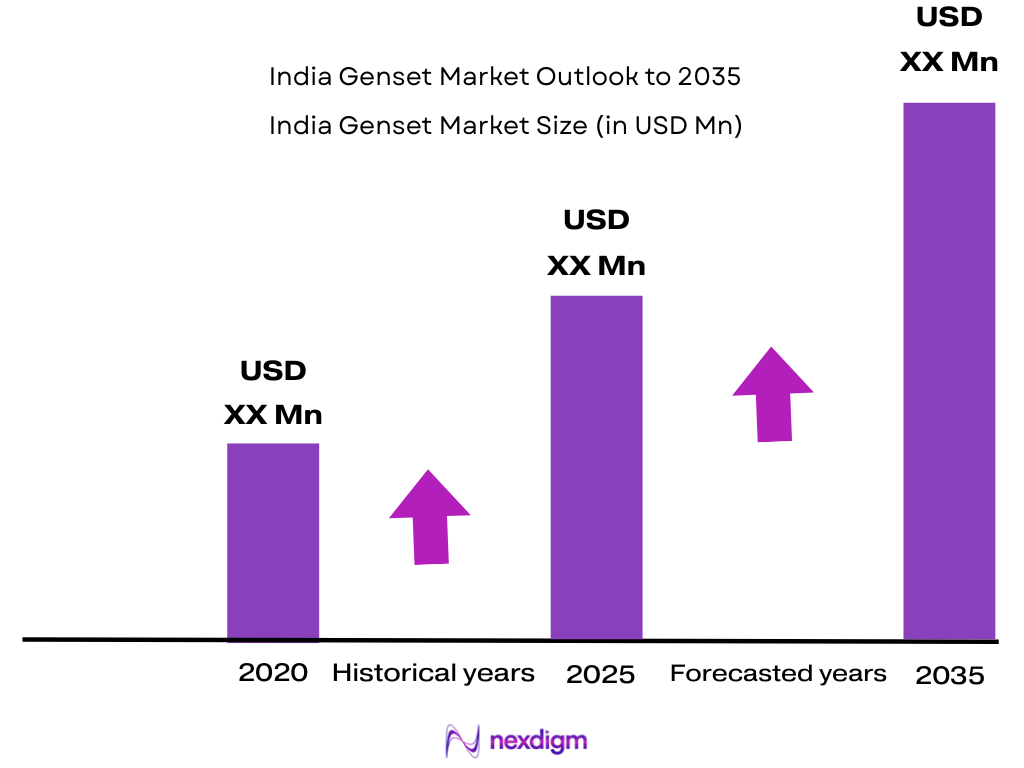
The India Genset Market is valued at approximately ~ million, supported by electricity demand reaching 230,144 MW in the preceding period and approximately 249,854 MW in the subsequent comparable peak-demand period. Demand originates from construction sites, automotive workshops, roadside infrastructure, logistics facilities, dealerships, small businesses and mobile applications requiring dependable standby or portable electricity. Expanding construction activity and increasing loads on electrical infrastructure reinforce requirements for backup and temporary generating systems. Delhi-NCR, Mumbai-Pune, Bengaluru, Hyderabad, Chennai, Ahmedabad and other major industrial corridors dominate genset deployment because they concentrate construction, manufacturing, automotive facilities, commercial buildings and logistics operations. India’s construction sector expanded strongly, while national transmission infrastructure reached approximately 494,732 circuit kilometres with 1,350,953 MVA of transformation capacity. High-density commercial activity and critical power requirements make these metropolitan and industrial corridors important centres for standby, mobile and construction-oriented gensets.
Market Segmentation
By Power Rating
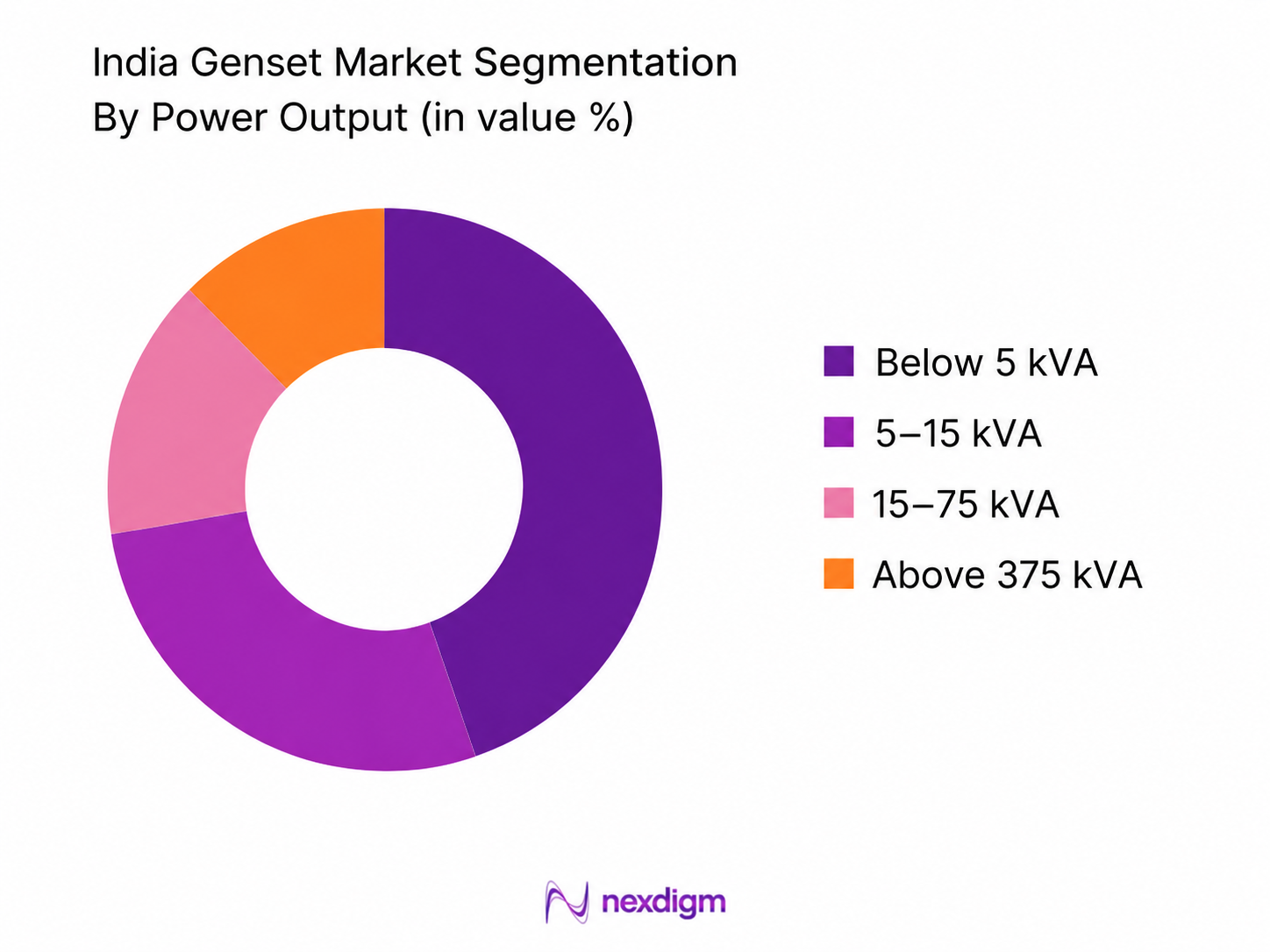
The India Genset Market is segmented into below 5 kVA, 5–15 kVA, 15–75 kVA, 75–375 kVA and above 375 kVA systems. The 15–75 kVA segment has a dominant position because these generators can support a diverse range of automotive workshops, small industrial plants, retail facilities, construction operations, fuel stations, warehouses and commercial premises without requiring the infrastructure associated with very large industrial gensets. Major manufacturers maintain extensive product portfolios within this operating range. Greaves, for example, offers CPCB-IV+ compliant units including 15 kVA and 45 kVA systems, while Cummins maintains a broad India-specific product range beginning at relatively low capacities. Mahindra Powerol similarly offers gensets beginning at 5 kVA and extending into substantially larger industrial ratings. This broad supplier participation increases equipment availability, dealer servicing and replacement support. Mid-capacity gensets also provide sufficient headroom for motors, compressors, lifts, workshop equipment and building electrical loads, making them adaptable across both standby and prime-power applications.
By Application
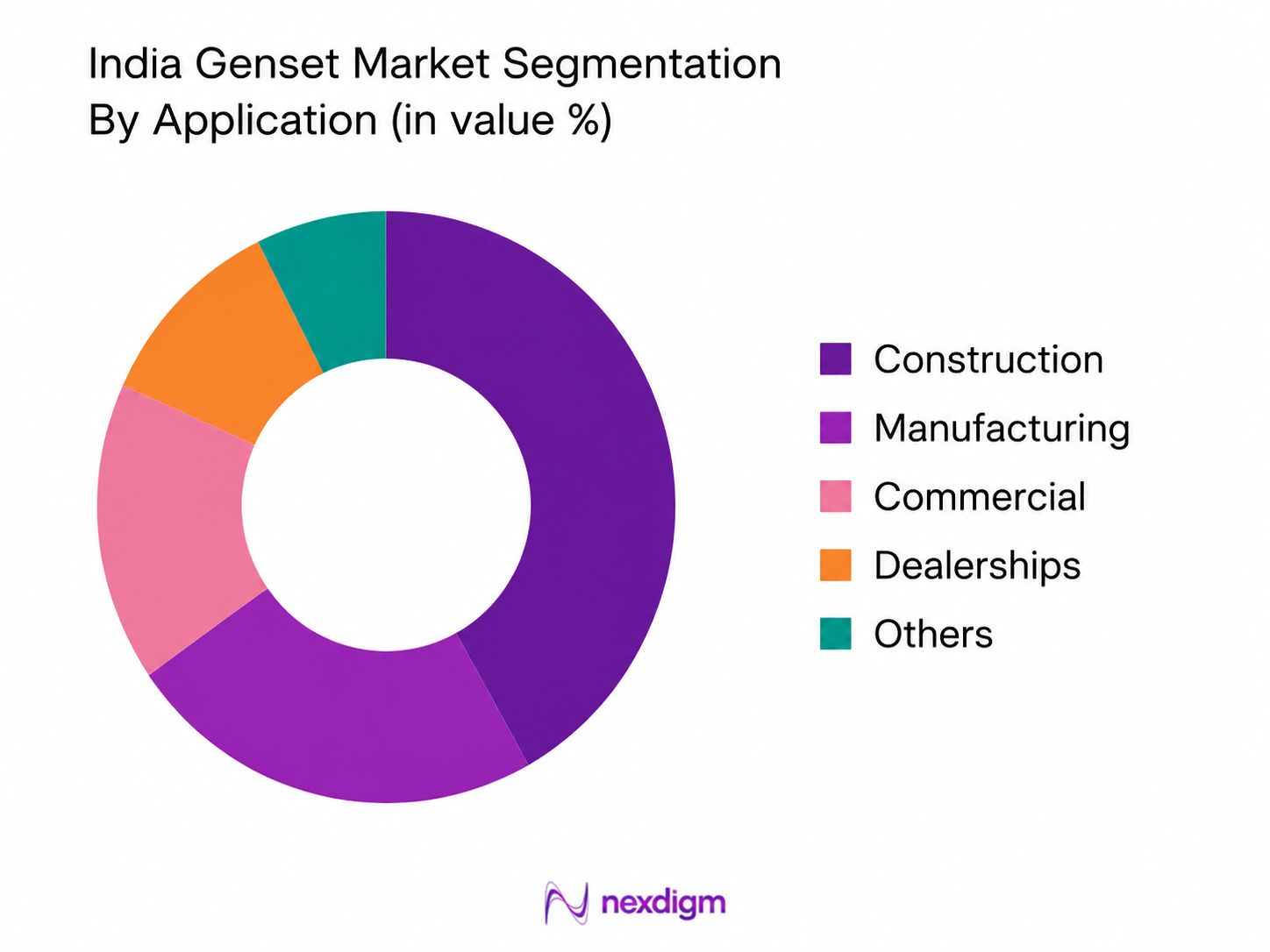
The India Genset Market is segmented into construction and infrastructure, automotive workshops and dealerships, industrial and manufacturing facilities, logistics and warehousing, commercial establishments, residential backup and mobile/rental applications. Construction and infrastructure applications hold the dominant position because gensets are routinely required where permanent grid connections are unavailable, temporary electrical loads move across worksites or continuity is necessary for equipment operation. India’s construction sector recorded strong expansion, with MoSPI estimating 9.4% real growth during FY2024-25, reinforcing requirements for temporary power across building, road, metro, industrial and infrastructure projects. Gensets support lighting, pumps, welding machines, fabrication systems, compressors, tools and temporary site offices. Manufacturers explicitly position their systems for construction applications: Mahindra identifies construction sites among major genset use cases, while Cummins has developed newer CPCB-IV+ products targeting infrastructure and construction requirements. The diversity of construction loads also supports several genset capacities, from portable units used by contractors to larger stationary units supporting major project sites.
Competitive Landscape
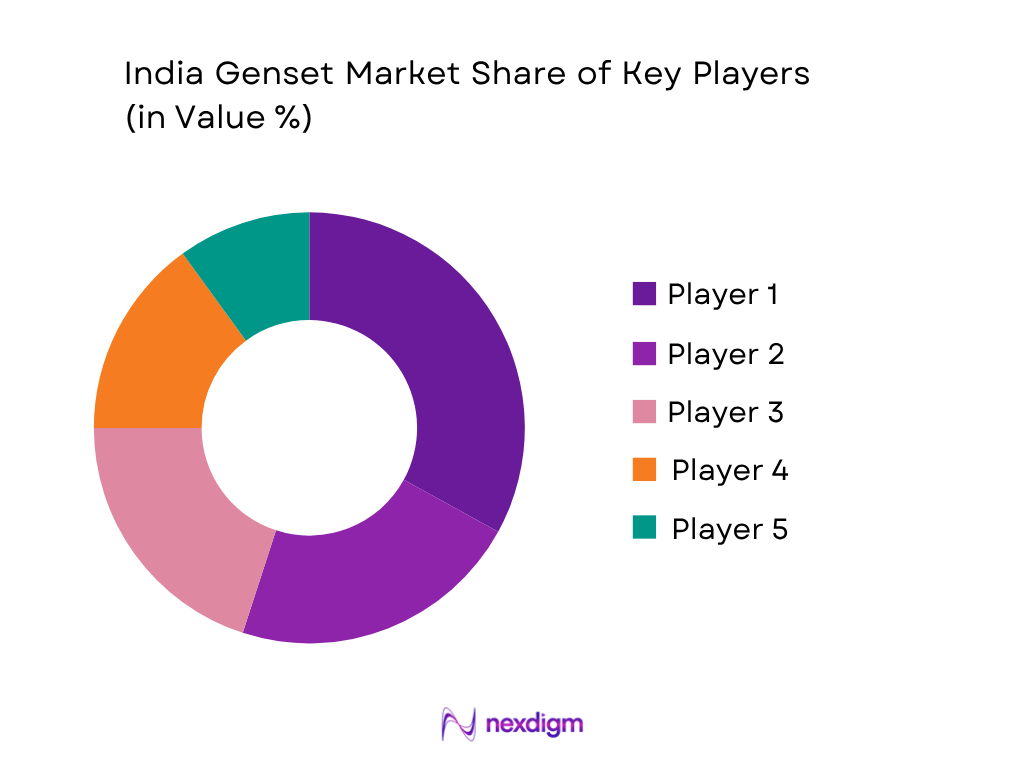
The India Genset Market contains established domestic engineering companies and international power-system manufacturers. Kirloskar Oil Engines, Cummins India, Mahindra Powerol, Greaves Cotton and Ashok Leyland maintain strong positions through broad power-rating portfolios, CPCB-compliant product development and nationwide servicing capabilities. Competition increasingly centres on emissions compliance, fuel efficiency, compactness, acoustic performance, digital monitoring and alternate-fuel capability rather than generator output alone. CPCB-IV+ requirements are consequently reshaping engine, after-treatment and genset enclosure design.
| Company | Established | Headquarters | Power Range | Key Fuel Types | CPCB-IV+ Capability | Portable Gensets | Digital/Smart Capability | Key End-Use Strength |
| Kirloskar Oil Engines | 1946 | Pune, Maharashtra | ~ | ~ | ~ | ~ | ~ | ~ |
| Cummins India | 1962 | Pune, Maharashtra | ~ | ~ | ~ | ~ | ~ | ~ |
| Mahindra Powerol | 2001 | Pune, Maharashtra | ~ | ~ | ~ | ~ | ~ | ~ |
| Greaves Cotton | 1859 | Mumbai, Maharashtra | ~ | ~ | ~ | ~ | ~ | ~ |
| Ashok Leyland – LEYPOWER | 1948 | Chennai, Tamil Nadu | ~ | ~ | ~ | ~ | ~ | ~ |
India Genset Market Analysis
Growth Drivers
Infrastructure Construction and Mobile Power Requirement
India’s genset demand is being supported by large-scale road, logistics and infrastructure construction, where mobile generator sets are required for temporary electricity at work sites, maintenance locations, remote project corridors and equipment-support vehicles. The National Highways Authority of India constructed 5,614 km of National Highways during FY 2024–25, while its capital expenditure exceeded ₹2,50,000 crore. India’s National Highway network stood at approximately 1,46,145 km in 2024, with 18,926 km completed under Bharatmala Pariyojana by November 2024. These projects create recurring requirements for vehicle-mounted and portable gensets used for lighting towers, welding equipment, pumps, power tools, road-maintenance machinery and temporary construction facilities. The wider economic environment provides additional support. World Bank data places India’s GDP at around USD 3.96 trillion in 2025, demonstrating the scale of economic activity supporting construction, manufacturing, logistics and transportation demand. Infrastructure activity is increasingly spread across highways, industrial corridors, logistics parks, ports and urban projects rather than concentrated in a limited number of metropolitan areas, strengthening demand for mobile electricity solutions that can be relocated as projects progress. Petrol gensets have particular relevance in low-output applications because compact units are lighter and easier to transport than larger stationary generating systems. They can be mounted on utility vehicles or transported in service vans for road repairs, emergency work, small construction sites and temporary power requirements. The government’s infrastructure pipeline continues to expand this application base: the Ministry of Road Transport and Highways identified 13,400 km of public-private partnership road projects valued at approximately ₹8.3 lakh crore in its 2025 programme, while 35 multimodal logistics parks are planned under Bharatmala with approximately ₹46,000 crore of investment. For genset manufacturers, these developments support demand for compact petrol models featuring wheel kits, electric start, alternator protection, low-oil shutdown, high-capacity fuel tanks and rugged frames suitable for transportation between sites. The opportunity is particularly relevant for lower-kVA mobile sets that can support contractor vehicles and maintenance fleets without requiring permanent electrical connections. Consequently, infrastructure expansion acts as a direct physical driver of genset utilisation by increasing the number of dispersed work locations requiring temporary and mobile electricity.
Rising Critical-Power Demand Across Telecom, Digital and Commercial Infrastructure
India’s expanding digital and telecommunications ecosystem is increasing the requirement for standby and transportable generator systems capable of maintaining power continuity at distributed infrastructure locations. Department of Telecommunications data published in 2026 shows approximately 710,040 mobile towers and 2,542,213 base transceiver stations, indicating the enormous geographic footprint of communications infrastructure requiring dependable electricity. Although large telecom sites often use diesel or hybrid systems, compact petrol gensets remain relevant for field maintenance teams, temporary tower commissioning, emergency restoration, small repeater sites and mobile technical units. The same resilience requirement is increasingly important for data centres and digital infrastructure. Government information published in 2026 states that India’s data-centre capacity reached approximately 1,500 MW in 2025, compared with a much smaller installed base earlier in the decade, while approximately 38,231 GPUs had been onboarded through 14 empanelled service providers and data centres under the national AI compute framework. This digital expansion creates secondary demand for maintenance vehicles, temporary commissioning power, emergency field systems and supporting infrastructure where compact gensets can supplement large stationary backup systems. India’s underlying electricity system is also operating at unprecedented demand levels. The Ministry of Power reported that the country successfully met an all-time peak electricity requirement of approximately 250 GW in May 2024, while another government review reported 242 GW of peak demand met during 2025 up to the reporting period. A power system serving this level of demand must maintain reliability across telecom towers, hospitals, commercial facilities, logistics networks and construction sites. Automotive gensets address applications where fixed standby generation is either impractical or unnecessary, particularly for short-duration field work and emergency interventions. World Bank data places national economic output near USD 3.96 trillion in 2025, supporting continued expansion of communications, commercial facilities and service infrastructure. Generator manufacturers can therefore position mobile petrol gensets not merely as outage equipment but as part of a distributed field-power architecture. Relevant products include inverter-based sets for sensitive electronics, compact wheeled systems for telecom maintenance crews, low-noise units for urban service work and vehicle-integrated generating packages for emergency response fleets. Continued expansion of telecom towers, BTS sites and digital infrastructure means more technicians, service vehicles and commissioning locations require temporary electricity, providing a measurable and market-specific driver for the India Automotive Genset Market.
Market Challenges
Improving Grid Availability Reducing Routine Backup Generator Dependence
A central challenge for India’s genset market is the continuing improvement in grid availability and generation capacity, which reduces the number of situations where a generator is needed solely because normal electricity supply is insufficient. The Ministry of Power reported that India successfully met approximately 250 GW of peak electricity demand in May 2024, highlighting a power system that is increasingly capable of meeting very high load levels. India also added approximately 34 GW of generation capacity during FY 2024–25, including around 29.5 GW of renewable capacity, strengthening the national supply base. The Economic Survey additionally notes that electrification programmes have supplied electricity connections to approximately 2.9 crore households and electrified 18,374 villages, substantially reducing the geographic areas where generator sets represent the primary source of electricity rather than emergency or temporary power. For the automotive genset industry, this means market demand is increasingly shifting away from continuous household or small-business backup toward construction mobility, field service, disaster response, events, telecom maintenance and specialist temporary-power applications. That shift raises performance expectations because users purchasing a genset less frequently for emergency use increasingly value reliability, fast starting, low noise, fuel efficiency and portability rather than basic electricity production. Renewable capacity further reinforces this structural transition. Government data shows renewable installed capacity reaching approximately 253.96 GW in November 2025, compared with 205.52 GW in November 2024. As solar-plus-storage solutions expand, some low-output petrol genset applications can be replaced by batteries, portable power stations or hybrid systems, especially where load duration is short and charging infrastructure is available. Mobile generator manufacturers therefore face competition from technologies that have no local combustion emissions and lower acoustic output. At the macroeconomic level, India’s approximately USD 3.96 trillion economy can support adoption of increasingly sophisticated power technologies, accelerating the shift toward hybrid and battery-supported solutions in premium customer segments. The genset market is not eliminated by grid improvement because temporary work sites and mobile applications remain difficult to electrify permanently, but manufacturers can no longer depend on widespread poor grid reliability as the principal demand argument. Successful companies will need to target specific applications where energy mobility, power density, rapid refuelling and long-duration operation remain advantages of internal-combustion generating equipment.
Tightening Emission and Operating Compliance for Internal-Combustion Gensets
Stricter environmental regulation is increasing technical and compliance pressure across India’s genset industry. The Central Pollution Control Board maintains dedicated generator-set standards covering emissions, noise and type approval, requiring manufacturers to design products that comply with increasingly demanding environmental parameters. The regulatory burden is particularly visible in the National Capital Region, where generator operation is controlled under the Graded Response Action Plan. From January 2024, even generator sets used for specified emergency services became subject to stipulated emission-control requirements. For power-generating sets up to 800 kW, the regulatory framework recognises equipment complying with the latest notified standards, while sets between 125 kW and below 800 kW may require approved emission-control measures depending on technology and configuration. Portable sets below 19 kW face operating restrictions during specified GRAP conditions except for permitted emergency applications. Although these NCR provisions primarily affect diesel sets, the policy direction is relevant to petrol genset manufacturers because regulators are increasingly treating combustion-powered backup generation as an air-quality and noise-management issue rather than an unrestricted utility product. Petrol units used in urban environments therefore face growing pressure to improve combustion efficiency, carbon-monoxide protection, acoustic insulation and exhaust performance. The challenge becomes more important as India’s electricity demand increases. The country met approximately 250 GW of peak demand in 2024, meaning the cumulative emissions impact of distributed backup equipment receives greater regulatory scrutiny even when individual gensets are small. At the same time, India’s road and construction network continues expanding, creating demand for portable generation exactly in environments where urban air-quality standards are becoming more stringent. National Highway infrastructure reached approximately 1,46,145 km in 2024, and contractors increasingly work near metropolitan and densely populated corridors. Manufacturers must therefore balance portability and output with improved mufflers, engine calibration, catalytic after-treatment where applicable, low-emission combustion strategies and automatic shutdown technology. Compliance also increases certification, engineering and dealer-training requirements because products sold across different states and usage environments must meet national technical standards while operators remain responsible for local restrictions. Smaller assemblers that compete mainly on basic engine-generator packages can face greater difficulty absorbing testing and certification requirements. Conversely, compliant branded suppliers may benefit from a gradual shift toward certified equipment. Regulation therefore represents both a barrier and a market-quality filter, but in the near term it increases product-development complexity across the India Automotive Genset Market.
Market Opportunities
Compact Inverter Petrol Gensets for Mobile and Sensitive Electronic Loads
Technological advancement creates a significant opportunity for compact petrol gensets incorporating inverter electronics, automatic voltage regulation, electronic engine management and improved safety systems. India’s digital infrastructure increasingly depends on electronics that require more stable power quality than conventional contractor equipment. Department of Telecommunications data shows approximately 2,542,213 base transceiver stations supported by around 710,040 mobile towers, creating a large field-maintenance ecosystem in which technicians regularly work with sensitive telecommunications hardware. India’s data-centre capacity also reached around 1,500 MW in 2025, while the national AI compute programme had onboarded approximately 38,231 GPUs through 14 service-provider/data-centre participants, illustrating how rapidly electronic and digital infrastructure is expanding. These current indicators support future demand for cleaner-output mobile electricity sources used during equipment installation, network maintenance, temporary testing, disaster recovery and commissioning activities. Conventional alternator-based petrol generators can experience frequency and voltage fluctuations when loads change rapidly. Inverter gensets convert generated electricity electronically, allowing more tightly controlled output suitable for computers, communication tools and diagnostic equipment while enabling engine speed to adjust according to load. This architecture can also reduce fuel consumption, vibration and noise in partial-load applications. The opportunity extends beyond telecom. India’s 1,46,145 km National Highway system and continuing construction programme create mobile demand from contractors, survey teams, road-maintenance vehicles and utility crews that increasingly use battery chargers, electronic measurement systems and precision power tools. Compact inverter products can serve these customers while remaining transportable in vans and utility vehicles. Product differentiation can include parallel operation capability, USB and DC outputs, low-oil shutdown, overload protection, electric start and carbon-monoxide monitoring. The development opportunity is reinforced by India’s economic scale, with World Bank data placing GDP at approximately USD 3.96 trillion in 2025. A larger economy supports greater expenditure on professional equipment rather than only basic low-cost generators. For manufacturers, future growth can therefore come from replacing conventional petrol gensets with technologically upgraded models rather than relying exclusively on higher unit penetration. Companies able to combine compact engine platforms with inverter electronics, remote diagnostics and connected monitoring can target telecom technicians, construction contractors, emergency fleets and mobile commercial users. These applications retain the core advantages of petrol generation—mobility, quick refuelling and long operating duration—while addressing increasing customer demand for power quality, lower acoustic output and enhanced safety.
Mobile Backup Power for Expanding Infrastructure and Emergency-Service Networks
India’s continuing expansion of transportation, telecom, logistics and digital infrastructure creates a forward-looking opportunity for vehicle-mounted and easily transportable gensets used where permanent electrical connections are unavailable or disrupted. Current infrastructure statistics provide a strong demand foundation. NHAI constructed 5,614 km of National Highways during FY 2024–25, while capital expenditure surpassed ₹2,50,000 crore. India’s National Highway network stood near 1,46,145 km, and approximately 18,926 km under Bharatmala had been completed by November 2024. Each additional road corridor creates maintenance requirements involving utility vehicles, roadside assistance equipment, mobile lighting, pumping, welding and emergency repair systems. Portable petrol gensets can power these functions without waiting for grid connections, making mobility a key competitive characteristic. The same logic applies to telecommunications. India operates approximately 710,040 mobile towers and more than 2.54 million BTS units, requiring nationwide maintenance across metropolitan, highway and remote locations. During storms, equipment failures or grid disruptions, service teams may require temporary generating equipment before permanent backup systems are restored. India’s rapidly expanding digital economy broadens this resilience requirement further. Government information indicates around 1,500 MW of data-centre capacity in 2025, alongside extensive deployment of AI computing hardware. Large data centres rely on industrial stationary backup systems rather than petrol gensets, but supporting facilities, network nodes, field engineering teams and smaller distributed sites create secondary mobile-power opportunities. Infrastructure expansion is also set against very high electricity utilisation: India met approximately 250 GW of peak demand in May 2024, demonstrating the scale and criticality of uninterrupted electricity for commercial activity. For genset suppliers, this opens opportunities to develop products specifically for fleet deployment rather than household backup. Suitable configurations include compact skid-mounted units, trailer-compatible sets, weather-resistant enclosures, low-noise mobile gensets and equipment designed for rapid loading and unloading from service vehicles. Remote monitoring can allow fleet managers to track running hours, maintenance intervals, fuel status and fault conditions across distributed equipment. Rental companies are another potential customer group because infrastructure contractors may require temporary power only during certain project stages. Demand can therefore be captured through rental fleets and maintenance contracts rather than outright end-user ownership alone. The opportunity is supported by ongoing road investment, with 13,400 km of PPP road projects worth approximately ₹8.3 lakh crore identified in the government’s 2025 pipeline. This creates a measurable installed base of work sites and maintenance corridors where portable energy will remain necessary even as national grid reliability improves.
Future Outlook
The India Genset Market is expected to expand at approximately ~ CAGR during 2026–2035, supported by infrastructure development, construction activity, logistics expansion and rising electricity requirements. However, future demand will increasingly shift from conventional mechanical generators toward cleaner, digitally controlled and fuel-flexible systems. India has already demonstrated the ability to meet peak electricity demand approaching 250 GW, reducing dependence on gensets solely as a response to systematic grid shortages. Consequently, future purchases are likely to become more application-specific, centred on emergency continuity, construction power, remote operations and mission-critical backup. CPCB-IV+ regulations will continue influencing product development. Manufacturers are responding with improved combustion systems, electronic engine control, diesel particulate filtration, selective catalytic reduction and advanced acoustic enclosures. Newer gensets therefore increasingly compete on emissions, fuel efficiency and operating intelligence rather than simple installed capacity. Alternative fuels will become more important. Kirloskar already describes its power-generation portfolio as capable of operating on diesel, ethanol, methanol, hythane, PNG, petrol and dual-fuel configurations, while Mahindra offers dedicated gas-powered gensets. Such platforms could help operators comply with stricter urban emission requirements while maintaining backup-power capability.
Major Players
- Kirloskar Oil Engines Limited
- Cummins India Limited
- Mahindra Powerol
- Greaves Cotton Limited
- Ashok Leyland – LEYPOWER
- Caterpillar India
- Honda India Power Products
- Rehlko Power Systems
- Perkins Engines
- Atlas Copco India
- Generac Power Systems
- Mitsubishi Heavy Industries
- Rolls-Royce Power Systems / mtu
- Sudhir Power Limited
- FG Wilson
Key Target Audience
- Genset manufacturers and engine manufacturers
- Automotive workshops, dealerships and service networks
- Construction and infrastructure developers
- Industrial manufacturing and engineering companies
- Genset rental and temporary-power providers
- Logistics, warehousing and commercial facility operators
- Investments and venture capitalist firms
- Government and regulatory bodies (Central Pollution Control Board, Ministry of Power, Central Electricity Authority, Ministry of Environment, Forest and Climate Change, Bureau of Indian Standards)
Research Methodology
Step 1: Identification of Key Variables
The initial phase constructs an ecosystem map covering genset manufacturers, engine suppliers, alternator producers, distributors, rental companies, construction contractors, automotive workshops and commercial users. Key variables include installed kVA, fuel type, duty cycle, operating hours, application, CPCB classification, acoustic requirements, replacement cycles, grid reliability and geographical demand concentration.
Step 2: Market Analysis and Construction
Historical demand is analysed through both top-down and bottom-up approaches. Top-down assessment uses construction GVA, power demand, industrial activity and infrastructure development, while bottom-up analysis estimates installed units across power bands and applications. Manufacturer capacities, distributor networks, rental fleets and product portfolios are reviewed to reconcile the supply side with end-user genset requirements.
Step 3: Hypothesis Validation and Expert Consultation
Market hypotheses are validated through CATIs and structured discussions with generator manufacturers, engine suppliers, dealers, EPC companies, contractors, rental operators and facility managers. Discussions focus on preferred kVA ranges, fuel consumption, CPCB-IV+ adoption, replacement patterns, rental utilisation, inverter technology, after-treatment systems, alternate fuels and maintenance requirements.
Step 4: Research Synthesis and Final Output
The final stage triangulates primary findings against Central Electricity Authority, Ministry of Power, MoSPI and CPCB information together with manufacturer specifications. Bottom-up installed-unit modelling is reconciled with construction activity, industrial electricity demand and backup-power applications to develop the final market structure, segmentation and long-term forecast.

- Executive Summary
- Research Methodology (Market Definitions and Assumptions, Automotive Genset Scope, Power Rating Classification, Fuel-Type Classification, Top-Down Market Sizing, Bottom-Up Genset Shipment Assessment, OEM Production Assessment, Dealer and Rental Fleet Assessment, Import-Export Analysis, Primary Interviews with Genset Manufacturers and Fleet Operators, Data Triangulation, Forecasting Framework, Limitations and Future Conclusions)

- Definition and Scope
- Market Evolution and Industry Genesis
- Evolution from Conventional DG Sets to CPCB IV+ Gensets
- Automotive and Mobile Genset Ecosystem
- Genset Industry Value Chain Analysis

- Growth Drivers (Infrastructure Construction, Expansion of Data Centers, Manufacturing Capacity Additions, Commercial Realty Development, Telecom Infrastructure, Critical Power Requirements, Logistics Expansion, Increasing Automation)
- Market Challenges (CPCB IV+ Compliance Complexity, After-Treatment Maintenance, Fuel Consumption, DEF Management, Higher Component Complexity, Alternative Backup Technologies, Battery Storage Competition)
- Market Opportunities (CPCB IV+ Replacement Cycle, Hybrid Gensets, Rental Power, Remote Monitoring, Gas Gensets, Mobile Power, Data Center Redundancy and Export-Oriented Manufacturing)
- Market Trends (Telematics, Predictive Maintenance, Compact Gensets, Lower Fuel Consumption, Acoustic Optimization, Hybrid Power, Modular Genset Architecture and Remote Fleet Management)
- Government Regulations (CPCB IV+ Standards, CPCB Noise Norms, ARAI Type Approval, Conformity of Production, Environmental Compliance, State Pollution Control Requirements and Fuel Standards)
- SWOT Analysis
- Porter’s Five Forces Analysis
- PESTLE Analysis

- By Market Value (2020-2025)
- By Unit Shipments (2020-2025)
- By Installed Genset Capacity (2020-2025)

- By Power Rating (In Value %)
Up to 5 kVA
Above 5 kVA–15 kVA
Above 15 kVA–30 kVA
Above 30 kVA–75 kVA
Above 75 kVA–125 kVA - By End-User Industry (In Value %)
Construction and Infrastructure
Manufacturing Plants
Data Centers and IT Infrastructure
Telecommunications Towers
Commercial Buildings and Retail - By Region (In Value %)
North India
South India
West India
East India
Central India
Northeast India

- Market Share of Major Players
- Cross Comparison Parameters (Power Rating Coverage, CPCB IV+ Product Coverage, Engine Technology and After-Treatment System, Fuel Portfolio, Remote Monitoring and Telematics Capability, Dealer and Service Network Reach, Acoustic/Silent Genset Capability, Warranty and After-Sales Support)
- SWOT Analysis of Major Players
- Detailed Profiles of Major Companies
Kirloskar Oil Engines Limited – KOEL Green
Cummins India Limited
Mahindra Powerol
Greaves Engineering
Ashok Leyland Power Solutions – Leypower
Caterpillar India
Atlas Copco India
Jakson Group
Sudhir Power Limited
Rehlko Power Systems India
Honda India Power Products Limited
Cooper Corporation
Powerica Limited
Sterling Generators
Baudouin India

- Construction and Infrastructure Demand
- Manufacturing Facility Demand
- Data Center Backup Power Demand
- Telecom Infrastructure Demand
- Healthcare Facility Demand

- By Market Value (2026-2035)
- By Unit Shipments (2026-2035)
- By Installed Genset Capacity (2026-2035)


 Request a Sample
 Ask for Customization
 Get a Quote
 Enquire Now