

 Download PDF
Market Overview
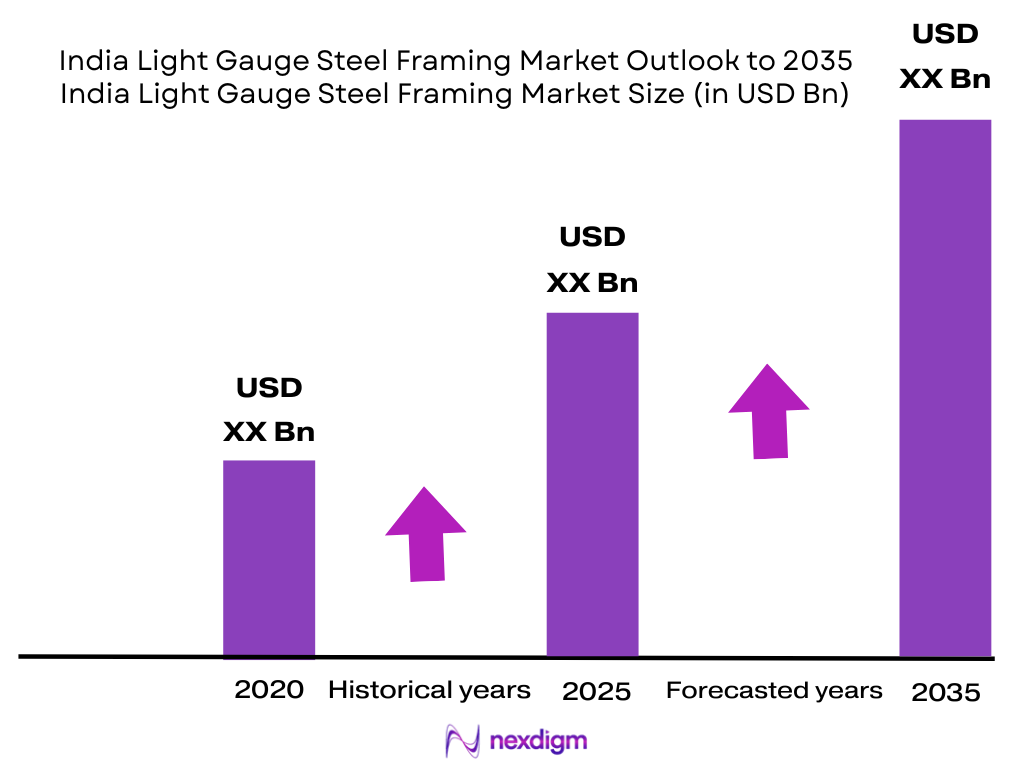
The India Light Gauge Steel Framing Market is valued at USD ~ billion, supported by prefabricated housing, industrial buildings, institutional facilities, worker accommodation, rooftop extensions, and rapid-construction projects. India’s finished-steel consumption increased from 136.3 million tonnes to 152.1 million tonnes across the two latest comparable fiscal observations, while PMAY-G had 2.94 crore houses sanctioned and 2.62 crore completed at the latest 2024 reporting point, underpinning demand for alternative steel-intensive construction technologies. Delhi NCR, Mumbai–Pune, Bengaluru, Hyderabad, Chennai, Ahmedabad, and industrial corridors in Gujarat and Maharashtra dominate India Light Gauge Steel Framing demand because they concentrate real-estate development, industrial facilities, logistics parks, prefab manufacturers, engineering talent, and steel distribution. India’s economy supported this construction intensity with a very large national output base, while current LGSF manufacturing is already established around Pune, North India, and other industrial clusters through companies supplying residential, commercial, institutional, and modular projects.
Market Segmentation
By Component Type
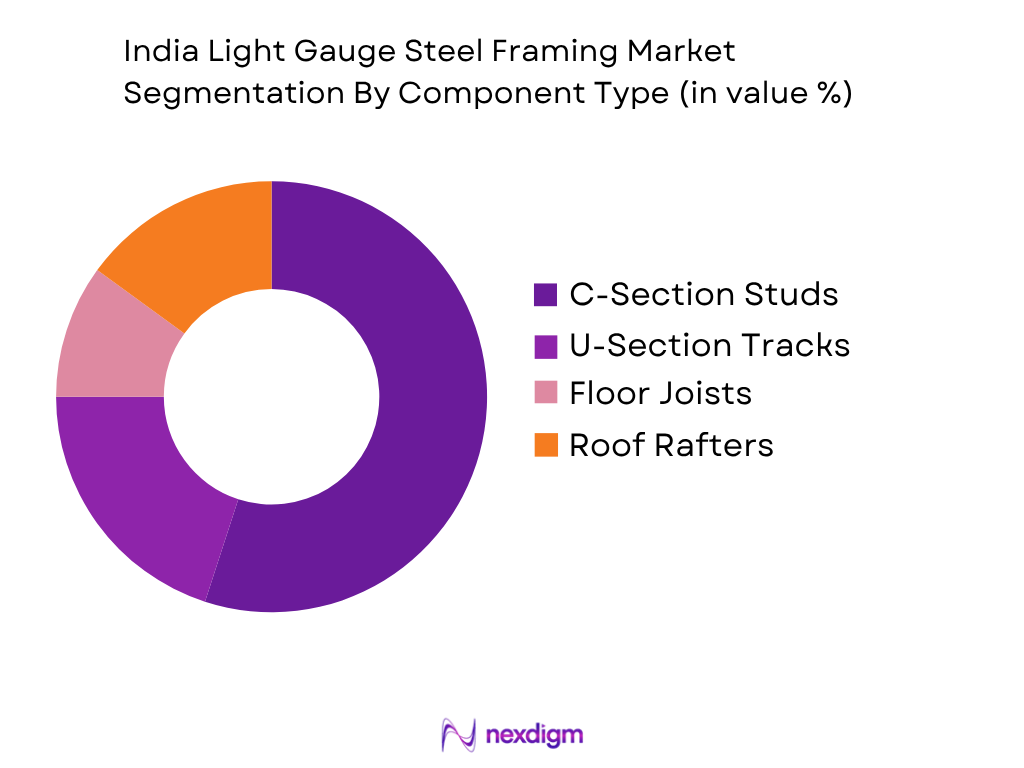
The India Light Gauge Steel Framing Market is segmented into C-section studs, U-section tracks, floor joists, roof rafters and trusses, wall panels, bracing systems, and clips/connectors. C-section studs hold the dominant share in the report model because they form the primary vertical structural members in load-bearing walls, façade framing, partitions, and prefabricated wall panels. Indian LGSF systems are commonly manufactured from high-strength galvanized or aluminium-zinc coated steel, with Tata Steel Colors offering sections based on AZ150 G550 steel with 550 MPa minimum yield strength and standard lengths of 3 m, 4 m, 5 m, and 6 m, extendable to 12 m. This makes studs highly adaptable to residential, industrial, commercial, and institutional projects. Their recurring use across nearly every framed wall also generates greater tonnage than specialized accessories or roof members.
By Application
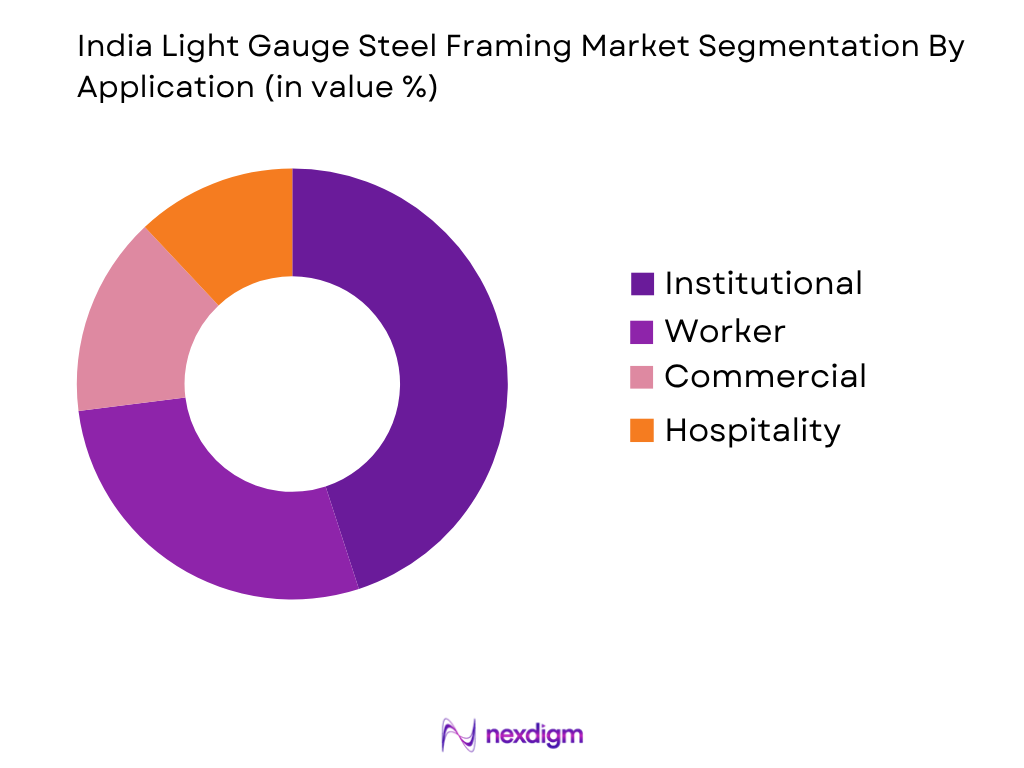
The India Light Gauge Steel Framing Market is segmented into residential housing, industrial and warehousing, institutional buildings, worker accommodation, commercial buildings, hospitality, and defence/remote infrastructure. Residential and housing applications represent the dominant segment in the report model because India has a very large housing-construction pipeline and LGSF can address independent homes, villas, low-rise apartments, affordable housing, rooftop extensions, and prefabricated accommodation. Under PMAY-G, 2.94 crore houses had been sanctioned and 2.62 crore completed as of June 2024, demonstrating the scale of the country’s housing requirement. LGSF is especially relevant where faster completion, reduced structural dead load, off-site fabrication, and dry construction are valued. Tata Steel’s HabiNest platform specifically positions LGSF for modular residential, institutional, healthcare, and industrial structures, while Indian specialist manufacturers also target houses, schools, hospitals, warehouses, and building extensions.
Competitive Landscape
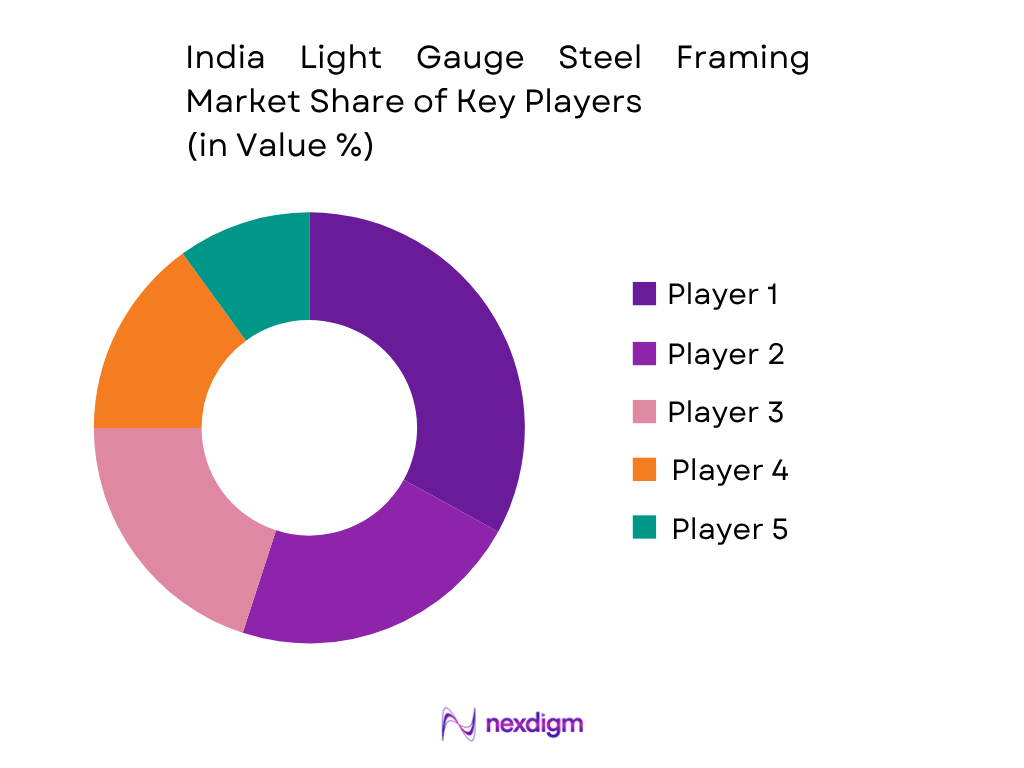
The India Light Gauge Steel Framing Market is fragmented between large integrated steel companies, prefabricated building companies, and specialized LGSF design-and-build contractors. Tata Steel participates through Nest-In/HabiNest, while Tata Steel Colors supplies high-strength light structural members and prefabricated steel solutions. Stratus Steel focuses specifically on engineered LGSF and reports close to 500 completed projects, while EPACK Prefab and Indue Prefab combine prefabrication, engineering, and turnkey execution. Competition increasingly depends on automated roll forming, engineering integration, coating quality, panel fabrication, project execution capability, and national delivery reach.
| Major Player | Establishment | Headquarters | LGSF / Prefab Offering | Steel / Section Capability | Manufacturing & Automation | Engineering Capability | Project Applications | Geographic Reach |
| Tata Steel Nest-In | Tata Steel platform | Delhi marketing office / Tata Steel ecosystem | ~ | ~ | ~ | ~ | ~ | ~ |
| Tata Steel Colors / formerly Tata BlueScope Steel | 2005 legacy platform | Pune, Maharashtra | ~ | ~ | ~ | ~ | ~ | ~ |
| Stratus Steel | 14+ years in LGSF operations | India | ~ | ~ | ~ | ~ | ~ | ~ |
| EPACK Prefab Technologies | 1999 | Greater Noida / NCR | ~ | ~ | ~ | ~ | ~ | ~ |
| Indue Prefab | 2017 | Mandi / North India operations | ~ | ~ | ~ | ~ | ~ | ~ |
India Light Gauge Steel Framing Market Analysis
Growth Drivers
Large Housing Pipeline and Rising Adoption of Modern Construction Technologies
India’s large housing-development pipeline is one of the strongest structural drivers for light gauge steel framing because the country requires construction systems capable of delivering high volumes of housing with tighter control over material use, construction time, structural weight and site labour. The Ministry of Housing and Urban Affairs reported that 1.18 crore houses had been sanctioned under PMAY-Urban, 1.14 crore had been grounded and 83.67 lakh had been completed as of June 2024. Importantly for LGSF suppliers, approximately 16 lakh houses were being constructed using new technologies, providing direct evidence that government-backed housing has already created an addressable pool for industrialised construction methods. PMAY-Gramin separately recorded 2.94 crore sanctioned houses and 2.62 crore completed houses in June 2024, demonstrating the scale of residential construction extending beyond metropolitan markets. The pipeline remains active: the Ministry of Housing and Urban Affairs approved another 2.88 lakh houses under PMAY-U 2.0 in February 2026, taking cumulative sanctions under the second phase to 13.61 lakh units. The latest sanction included 1.66 lakh Beneficiary-Led Construction homes, 1.09 lakh Affordable Housing in Partnership homes and 12,846 affordable rental homes, while three Demonstration Housing Projects comprising 40 dwelling units each were approved specifically to showcase modern construction practices that improve speed, quality and durability. These programmes do not imply automatic LGSF adoption, but they materially enlarge the project universe where panelised, prefabricated and lightweight steel construction can compete against RCC and brick masonry. LGSF is particularly suited to repetitive housing, worker accommodation, affordable rental housing and rapid institutional developments because cold-formed sections can be cut, punched and assembled in controlled factories before erection. The macroeconomic backdrop supports continued construction demand. The IMF estimated India’s real GDP growth at 6.4 in FY2024/25, while the World Bank reports that economic output subsequently reached USD 3.96 trillion in 2025 with GDP per capita of USD 2,702.5. For the India Light Gauge Steel Framing Market, this combination of a very large housing deficit, sustained public housing delivery and formal government experimentation with modern technologies creates a credible demand driver for steel studs, tracks, joists, roof trusses and factory-assembled wall panels. The opportunity is especially strong where developers must reduce wet construction, shorten site programmes and minimize foundation loads. LGSF can also be deployed independently of complete modular construction, allowing developers to use it for roof systems, walls, building additions or façade structures while retaining conventional foundations and selected RCC elements. As PMAY and other urban development programmes increasingly emphasize timely delivery and repeatable construction quality, LGSF suppliers with turnkey engineering, panel fabrication and installation capability are better positioned than firms selling only raw cold-formed sections.
Expansion of Domestic Steel Supply and Industrialised Prefabrication Capacity
The growth of India’s domestic steel ecosystem provides a second important driver for the Light Gauge Steel Framing Market because LGSF depends on reliable availability of high-strength galvanized or metallic-coated flat steel that can be converted into precision cold-formed members. Ministry of Steel data show that India consumed 136.3 million tonnes of finished steel in FY2023-24, while crude-steel production stood at approximately 144.3 million tonnes and installed crude-steel capacity reached 179.5 million tonnes around the beginning of the following fiscal period. More recent Ministry data show the steel industry continuing to expand: India’s crude-steel production reached 164.89 million tonnes in calendar 2025, while monthly production stood at 14.09 million tonnes in June 2026. This scale matters for LGSF because greater domestic flat-steel production and coating capability reduce the structural dependence on imported finished framing systems and create a foundation for localized roll-forming investment. India’s building regulations explicitly recognize cold-formed structural steel: BIS Standardized Development and Building Regulations identify IS 801 and IS 811 for cold-formed structural materials and require minimum metal thickness for corrosion protection, while also referencing structural connection, fire-rating and seismic requirements. The presence of a formal engineering framework lowers one barrier to wider adoption by giving structural engineers and approval authorities recognized reference standards for member design and safety assessment. Domestic manufacturers are simultaneously moving toward automated design-to-production workflows, in which digital structural models control CNC roll formers that cut sections to length, punch service holes and identify members before site shipment. This shifts LGSF from manually fabricated steel framing toward a repeatable manufacturing system. The macroeconomic environment reinforces the importance of industrialised construction. The IMF’s 2024 Article IV assessment estimated economic growth at 6.4 in FY2024/25, while India’s later World Bank-reported economy reached USD 3.96 trillion in 2025 and GDP per capita of USD 2,702.5. The construction sector must serve this expanding economy across housing, factories, logistics facilities, healthcare buildings, schools, hospitality and industrial corridors. LGSF can benefit because its production model aligns more closely with manufacturing than conventional brick masonry: coils are transformed into standardized sections, panels can be assembled away from site and material quantities can be generated directly from engineering software. The steel supply base also enables Indian manufacturers to offer multiple thicknesses and coated grades for different building requirements, ranging from internal partitions and lightweight roofs to load-bearing walls and multi-storey low-rise structures. For industrial and logistics applications, LGSF can complement conventional pre-engineered buildings by providing office blocks, control rooms, mezzanine partitions, security buildings, utility rooms and workforce accommodation. For residential projects, domestic roll-forming capacity reduces lead-time risks associated with imported frame kits. The combination of high national steel output, recognized structural standards and increasing fabrication automation therefore supports deeper localization of the LGSF value chain, creating growth opportunities for steel producers, coil service centres, roll-forming companies, panelizers, engineering firms and turnkey contractors.
Market Challenges
Entrenched RCC and Brick-Masonry Construction Practices and Technical Acceptance Barriers
The largest market-development challenge for light gauge steel framing in India is the deeply entrenched use of reinforced concrete frames and brick or block masonry across residential and commercial construction. India’s current housing programmes illustrate how large this incumbent ecosystem is: PMAY-Urban had 1.18 crore houses sanctioned, 1.14 crore grounded and 83.67 lakh completed as of June 2024, while PMAY-Gramin had 2.94 crore sanctioned and 2.62 crore completed houses. The overwhelming majority of construction professionals, local contractors and workers serving this enormous building base are familiar with cement, reinforcement, masonry units and wet trades, creating strong behavioral and procurement inertia against alternative framing methods. LGSF therefore requires more than technical availability; it requires architects, structural engineers, developers, lenders, approval authorities and end users to understand how thin-gauge cold-formed steel performs under gravity loads, seismic forces, wind, fire, corrosion and thermal conditions. BIS regulations provide recognized guidance but also illustrate the technical complexity involved. The 2024-published Standardized Development and Building Regulations identify cold-formed steel under IS 801 and IS 811, require minimum thickness criteria related to corrosion protection and reference structural connection standards, seismic design and fire-rating provisions. This means an LGSF building cannot be treated as a simple collection of lightweight studs. Member slenderness, bracing, connection design, hold-down forces, sheathing contribution, wall openings, racking resistance and roof-to-wall interfaces all require engineering. India’s geographic diversity adds complexity because projects span high seismic regions, cyclone-prone coasts, hot-dry interiors, warm-humid zones and cold mountain environments. Wall buildup and insulation therefore need to address thermal bridging and condensation as well as structural strength. Public housing data also show how geographically broad the opportunity—and challenge—is: in June 2024 PMAY-U sanctions included 21,37,028 houses in Andhra Pradesh, 17,76,823 in Uttar Pradesh, 13,64,923 in Maharashtra, 10,05,204 in Gujarat and 9,61,147 in Madhya Pradesh. A technology expected to compete nationally must therefore be supported by regional engineering, installation and service capabilities rather than a small number of metropolitan fabricators. The macroeconomic context increases the pressure for scalable solutions but does not automatically remove conservative construction preferences. IMF data indicate India’s economy was growing at around 6.4 in FY2024/25, while the World Bank records GDP of USD 3.96 trillion in 2025. In such a large construction economy, project stakeholders often prioritize familiar systems with established contractor availability and local material supply. The challenge for LGSF suppliers is therefore to convert technical benefits—lower weight, dry assembly, faster erection and dimensional precision—into project-level confidence. Demonstration buildings, structural test data, fire-rated assemblies, climate-specific wall details, installer training and successful reference projects become essential commercial tools. Without these, LGSF risks remaining concentrated in prefabricated or specialized buildings rather than transitioning into mainstream permanent construction.
Skilled Workforce, Installation Quality and Fragmented Fabricator Capability
Limited availability of trained LGSF designers, detailers, fabricators and erection crews creates a significant execution challenge because the performance of a cold-formed steel building depends heavily on accurate manufacturing and correct site assembly. India’s broader construction base is enormous: PMAY schemes alone accounted for 83.67 lakh completed urban homes and 2.62 crore completed rural homes at the June 2024 reporting point, while another 13.61 lakh PMAY-U 2.0 homes had been sanctioned by February 2026. Serving even a small portion of that construction pipeline through LGSF would require a much deeper ecosystem of trained installers than currently exists in specialist prefab clusters. The technology depends on correct identification of studs and tracks, screw spacing, bracing, hold-down installation, opening reinforcement, panel alignment and foundation anchorage. Errors that may appear minor during erection can change structural load paths or compromise wall performance. The problem becomes greater where LGSF is combined with gypsum boards, cement boards, insulation, vapor control layers or exterior cladding because the complete assembly must satisfy fire, moisture, acoustic and thermal requirements. BIS’s Standardized Development and Building Regulations explicitly identify structural safety obligations for cold-formed steel, including IS 801/811, corrosion-protection thickness requirements, structural connection provisions and fire-rating documentation. This regulatory recognition is positive for the market but raises the competence threshold for fabricators and contractors. In conventional masonry construction, many activities can be adjusted or corrected relatively easily on site; digitally manufactured LGSF systems instead rely on dimensional coordination before production. Incorrect architectural inputs, late MEP changes or inconsistencies between structural and architectural models can therefore create site rework. Fragmentation among smaller prefabrication companies adds another challenge because not every supplier has in-house structural engineering, BIM coordination, automated roll forming and trained erection teams. The housing programmes themselves acknowledge the importance of construction skills: the government noted in 2024 that pan-India training and certification programmes for rural masons had been introduced to improve PMAY-G construction quality. LGSF requires an equivalent emphasis on specialist skills if it is to scale beyond isolated turnkey projects. Macroeconomic expansion increases the urgency. The IMF estimated 6.4 real GDP growth for FY2024/25, while the World Bank reports India’s economy at USD 3.96 trillion in 2025, meaning construction labour is simultaneously required across infrastructure, housing, factories, logistics facilities and commercial projects. LGSF can ultimately reduce site labour intensity through factory fabrication, but during the adoption phase it needs trained engineers and supervisors to establish repeatable workflows. The commercial implication is that successful suppliers cannot depend purely on section manufacturing. They need standardized design libraries, erection manuals, installer certification, BIM coordination, site supervision and quality inspection. Companies able to supply complete design-manufacture-installation packages have an advantage over fragmented vendors offering individual frames without full construction responsibility. Until the installer base becomes broader and technically consistent, workforce and quality-control limitations will constrain the speed at which LGSF penetrates mainstream Indian building construction.
Market Opportunities
Affordable Housing, Rental Housing and Public Demonstration Projects
India’s government-backed affordable housing pipeline creates a significant future opportunity for the Light Gauge Steel Framing Market because current programmes are actively generating large volumes of repeatable housing while explicitly encouraging modern construction practices in selected projects. As of June 2024, PMAY-Urban had sanctioned 1.18 crore houses, grounded 1.14 crore and completed 83.67 lakh, including 16 lakh houses being constructed using new technologies. This last figure is particularly relevant for LGSF because it demonstrates that alternative building systems have already entered government-supported housing rather than remaining limited to private prefab projects. The current PMAY-U 2.0 programme expands that opportunity further. In February 2026, the Ministry of Housing and Urban Affairs approved another 2,87,618 homes, lifting total PMAY-U 2.0 sanctions above 13.61 lakh units. The latest approval comprised 1.66 lakh Beneficiary-Led Construction houses, 1.09 lakh Affordable Housing in Partnership units and 12,846 Affordable Rental Housing units. Rental housing is particularly compatible with industrialized building systems because urban migrants, construction workers, working women and industrial employees often require standardized, repeatable accommodation that can be delivered quickly near employment centres. The same February 2026 programme also approved three Demonstration Housing Projects of 40 units each in Chhattisgarh, Puducherry and Rajasthan, explicitly intended to showcase construction practices that improve speed, quality and durability and can be replicated at larger scale. For LGSF manufacturers, demonstration-led procurement is strategically important because unfamiliarity remains one of the technology’s biggest barriers. A completed government project allows developers and state agencies to assess structural behavior, thermal performance, fire design, maintenance requirements and construction sequencing under Indian conditions. State-level housing concentration also gives suppliers clear geographic opportunities. PMAY-U had sanctioned 21.37 lakh homes in Andhra Pradesh, 17.77 lakh in Uttar Pradesh, 13.65 lakh in Maharashtra and 10.05 lakh in Gujarat by June 2024. These states contain major urban-development and industrial corridors where local or regional roll-forming capacity can potentially serve both housing and non-residential projects. India’s macroeconomic expansion reinforces housing requirements: IMF data indicate real GDP growth of around 6.4 in FY2024/25, while the World Bank records the economy at USD 3.96 trillion in 2025. The market opportunity is therefore not based on assuming that government housing will universally switch to LGSF. Instead, it lies in capturing applications where rapid delivery, low structural weight and factory production provide measurable project advantages. Affordable rental housing, worker accommodation, demonstration housing, schools, health centres and low-rise residential blocks are particularly suitable. Suppliers that develop standardized housing modules, locally sourced coated-steel frames, region-specific insulation packages and turnkey engineering can position LGSF as a practical modern-construction option rather than an imported niche technology.
Automated Roll Forming, Panelisation and Localized Industrial Construction
Automation and panelised construction offer another substantial growth opportunity because India already has the steel-production scale and construction demand required to support more industrialized LGSF manufacturing. Ministry of Steel data show finished-steel consumption of 136.3 million tonnes in FY2023-24, crude-steel production of approximately 144.3 million tonnes, and installed crude-steel capacity of 179.5 million tonnes around April 2024. By calendar 2025 crude-steel production had reached 164.89 million tonnes, with 14.09 million tonnes produced in June 2026 alone. These current indicators provide a robust domestic raw-material platform for cold-formed construction, especially as coating lines and high-strength flat-steel supply develop. The opportunity is to move beyond selling individual studs and tracks toward digitally manufactured building systems. Modern LGSF workflows can convert structural models directly into roll-forming instructions, producing cut-to-length members with punched holes and identifiers before assembly. Wall panels, floor cassettes and roof trusses can then be manufactured in factories and shipped in erection sequence. This is particularly relevant to India’s industrial, logistics and institutional construction, where projects often need site offices, worker accommodation, utility structures, warehouses, clinics, schools and administrative buildings delivered rapidly alongside larger facilities. The housing pipeline also supplies scale for standardized panel production: PMAY-U had 1.18 crore sanctioned homes in June 2024, while PMAY-U 2.0 had more than 13.61 lakh sanctioned units by February 2026. Even limited penetration into this pool could justify regional panel plants and automated production capacity. Regulatory recognition further supports the opportunity. BIS’s standardized building regulations identify cold-formed steel and reference IS 801 and IS 811, while also requiring appropriate corrosion-protection thickness, structural connection design and fire-rating provisions. Suppliers that embed these requirements into software-based engineering libraries can reduce design variability and accelerate approvals. The macroeconomic base is also favourable to factory construction methods: the IMF estimated India’s economic growth at 6.4 in FY2024/25, and the World Bank reports output of USD 3.96 trillion in 2025. As manufacturing, warehousing and urban infrastructure expand alongside GDP, project owners increasingly value predictable schedules and repeatable quality. LGSF manufacturers can exploit this by locating fabrication capacity near steel-producing and high-construction regions such as Maharashtra, Gujarat, NCR, Karnataka, Telangana and Tamil Nadu. Automated roll forming also enables manufacturers to serve smaller regional projects through flat-packed kits rather than maintaining large fabrication teams at every site. In addition, lightweight LGSF systems are suitable for rooftop additions and brownfield extensions because they impose lower incremental dead loads than conventional masonry construction, creating a distinct urban redevelopment niche. The future growth opportunity therefore centres on transforming LGSF from a specialist prefabrication product into a digitally engineered manufacturing platform. Companies combining local coated-steel sourcing, structural engineering, BIM/DfMA, automated production, panel assembly and trained erection teams can serve residential, industrial and institutional markets with a more defensible value proposition than conventional section-only suppliers.
Future Outlook
The India Light Gauge Steel Framing Market is forecast to expand at ~ CAGR during 2026–2035 under the placeholder forecast framework. Future demand is expected to shift from relatively specialized prefab applications toward a broader mix of permanent housing, industrial buildings, institutional construction, rooftop additions, modular accommodation, and rapid public infrastructure. Government housing activity provides a substantial underlying construction pool. PMAY-U 2.0, launched in September 2024, is structured around Beneficiary Led Construction, Affordable Housing in Partnership, Affordable Rental Housing, and interest-support mechanisms. By August 2025, 8.56 lakh houses had already been sanctioned under PMAY-U 2.0, while the total subsequently crossed 10 lakh sanctioned houses. This does not imply those houses will use LGSF, but it expands the universe of projects in which faster construction technologies can potentially compete. India’s steel ecosystem strengthens the supply-side opportunity. Finished-steel consumption increased from 136.3 million tonnes in FY2023-24 to 152.1 million tonnes in FY2024-25, indicating substantial domestic steel absorption across construction, infrastructure, manufacturing, and other end markets. For LGSF manufacturers, the significance lies in access to galvanized and aluminium-zinc coated flat products that can be transformed into high-strength structural sections. Automation will be another important development. Specialist Indian LGSF suppliers increasingly use software-integrated roll-forming equipment that converts digital structural models into cut, punched, and labelled framing members. Stratus Steel uses in-house FRAMECAD machines, while S2S-related Indian operations have also used FRAMECAD design-to-manufacturing workflows. This enables greater dimensional consistency and makes panelized construction more scalable than manual site fabrication.
Major Players
- Tata Steel Nest-In / HabiNest
- Tata Steel Colors / EZYBUILD
- EPACK Prefab Technologies
- Everest Industries Limited
- Stratus Steel
- S2S Designs
- Indue Prefab
- SEAS Homes
- Pressmach Infrastructure
- Mitsumi Housing
- Durocon Buildtech
- Panjetani Buildwell
- Akash Engimech India
- FRAMECAD
- Howick Ltd.
Key Target Audience
- Light Gauge Steel Framing Manufacturers and Fabricators
- Prefab and Modular Building Manufacturers
- Real Estate Developers and Housing Companies
- EPC Contractors and Industrial Construction Companies
- Galvanized Steel Coil and Cold-Formed Section Suppliers
- Investments and Venture Capitalist Firms
- Industrial, Warehousing and Institutional Project Owners
- Government and Regulatory Bodies (Ministry of Housing and Urban Affairs, Ministry of Rural Development, Ministry of Steel, Bureau of Indian Standards, Building Materials and Technology Promotion Council)
Research Methodology
Step 1: Identification of Key Variables
The initial phase involves constructing an ecosystem map of the India Light Gauge Steel Framing Market covering steel producers, galvanized-coil suppliers, roll-forming companies, LGSF fabricators, prefab manufacturers, EPC contractors, developers, government agencies, and installers. Critical variables include construction floor area, steel intensity, member thickness, building type, framing system, panelization, project completion time, and regional demand. Government housing data, Ministry of Steel statistics, BIS standards, manufacturer product specifications, and project information are used to establish the market boundary. Structural LGSF, non-load-bearing framing, prefab steel buildings, and conventional PEB systems are separated to avoid category overlap.
Step 2: Market Analysis and Construction
The top-down model begins with India’s residential, institutional, commercial, and industrial construction pipeline and allocates addressable floor area to applications suitable for light steel framing. Steel intensity per square metre, framing penetration, member type, and building height are applied to construct theoretical demand. The bottom-up model maps manufacturer capacities, automated roll-forming lines, completed projects, steel consumption, panel output, and project values. Domestic section manufacturing and imported technology inputs are reconciled with distributor and contractor activity so that the same framing volume is not counted at multiple supply-chain stages.
Step 3: Hypothesis Validation and Expert Consultation
Market hypotheses are validated through CATIs and structured interviews with LGSF manufacturers, prefab companies, structural engineers, architects, EPC contractors, developers, steel suppliers, and installation specialists. Interviews assess section thickness, coating type, steel usage, project execution time, capacity utilization, contractor preferences, and competitive alternatives. Primary discussions also evaluate climate-specific insulation, seismic applications, rooftop extensions, panelization, automated roll forming, and the willingness of developers to substitute RCC or masonry with LGSF. Assumptions inconsistent with manufacturer or project evidence are revalidated before inclusion.
Step 4: Research Synthesis and Final Output
The final phase triangulates housing and construction activity, steel-consumption statistics, supplier capacity, project bill-of-materials, technical specifications, and industry interviews. The resulting market is structured by component type, application, framing system, construction method, steel thickness, coating type, building height, and geography. Forecast scenarios incorporate housing delivery, industrial construction, prefab penetration, steel availability, automation, RCC substitution, labor productivity, and government acceptance of modern construction technologies. Base-case, accelerated-prefabrication, and slower-adoption scenarios are used to test long-term market resilience.

- Executive Summary
- Research Methodology (Market Definitions and Assumptions, Abbreviations, LGSF System Boundary, Cold-Formed Steel Product Mapping, Project Floor-Area Assessment, Steel Tonnage Conversion, Construction Pipeline Mapping, Market Sizing Approach, Top-Down Analysis, Bottom-Up Analysis, Demand-Side Assessment, Supply-Side Assessment, Manufacturer Capacity Assessment, Fabricator and Contractor Interviews, Project Bill-of-Materials Analysis, Government Project Mapping, Data Triangulation, Forecasting Framework, Scenario Analysis, Limitations and Future Conclusions)

- Definition and Scope
- Evolution of Light Gauge Steel Framing in India
- Transition from RCC-Brick Construction to Dry and Prefabricated Steel Construction
- Cold-Formed Steel Framing Technology Evolution
- Structural LGSF versus Non-Load-Bearing Framing Ecosystem

- Growth Drivers (Rapid Construction Requirements, Prefabricated Building Adoption, Urban Housing Demand, Industrial and Warehousing Expansion, Rooftop Construction, Lightweight Structural Requirements, Steel Availability, Factory-Controlled Manufacturing)
- Market Challenges (RCC and Masonry Preference, Limited LGSF Awareness, Steel Price Volatility, Contractor Skill Gaps, Thermal Performance Requirements, Corrosion Protection, Design Standardisation, Fragmented Fabricator Base)
- Market Opportunities (Affordable Housing, Modular Worker Accommodation, Government Buildings, Schools and Healthcare, Rooftop Extensions, Industrial Buildings, Remote Infrastructure, Disaster-Relief Construction, Automated LGSF Manufacturing)
- Market Trends (Panelised Construction, Automated Roll Forming, BIM-to-Manufacturing, High-Strength Coated Steel, Flat-Pack Construction, Hybrid LGSF-PEB Systems, Factory-Assembled Frames, Digital Project Engineering)
- Technology Substitution Analysis (RCC Framing, Brick Masonry, AAC Block Construction, Precast Concrete, PEB Systems, Structural Steel, Timber, Sandwich-Panel Construction)
- SWOT Analysis
- Porter’s Five Forces Analysis
- PESTLE Analysis

- By Market Value (2020-2025)
- By Cold-Formed Steel Tonnage (2020-2025)
- By Linear Metres of Framing Members (2020-2025)

- By Component Type (In Value %)
C-Section Studs
U-Section Tracks
Floor Joists
Roof Rafters and Trusses
Wall Panels - By Framing System (In Value %)
Load-Bearing Light Gauge Steel Framing
Non-Load-Bearing LGSF Walls
External Infill Wall Systems
Internal Partition Framing
Floor Framing Systems - By Application (In Value %)
Residential Housing
Villas and Independent Houses
Affordable and Mass Housing
Worker and Labour Accommodation
Commercial Buildings - By Region (In Value %)
North India
West India
South India
East India
Central India

- Market Share of Major Players by Value
- Cross Comparison Parameters (LGSF Product and Structural System Portfolio Breadth, Steel Thickness and Section-Size Range, Galvanised/Al-Zn Coating Capability, Automated Roll-Forming and Manufacturing Capacity, Structural Engineering and BIM/DfMA Capability, Panelised and Modular Building Execution Capability, India-Wide Project and Installation Reach, Residential-Industrial-Institutional Project Experience)
- SWOT Analysis of Major Players
- Detailed Profiles of Major Companies
Tata Steel Nest-In / HabiNest
Tata Steel Colors / EZYBUILD
EPACK Prefab
Everest Industries Limited
Stratus Steel
S2S Designs
Indue Prefab
SEAS Homes
Pressmach Infrastructure
Mitsumi Housing
Durocon Buildtech
Panjetani Buildwell
Akash Engimech India
FRAMECAD
Howick Ltd.

- Residential Developer Demand
- Affordable Housing Developer Demand
- Industrial Corporate Demand
- Warehouse Developer Demand
- Institutional Project Demand

- By Market Value (2026-2035)
- By Cold-Formed Steel Tonnage (2026-2035)
- By Linear Metres of Framing Members (2026-2035)


 Request a Sample
 Ask for Customization
 Get a Quote
 Enquire Now