

 Download PDF
Market Overview
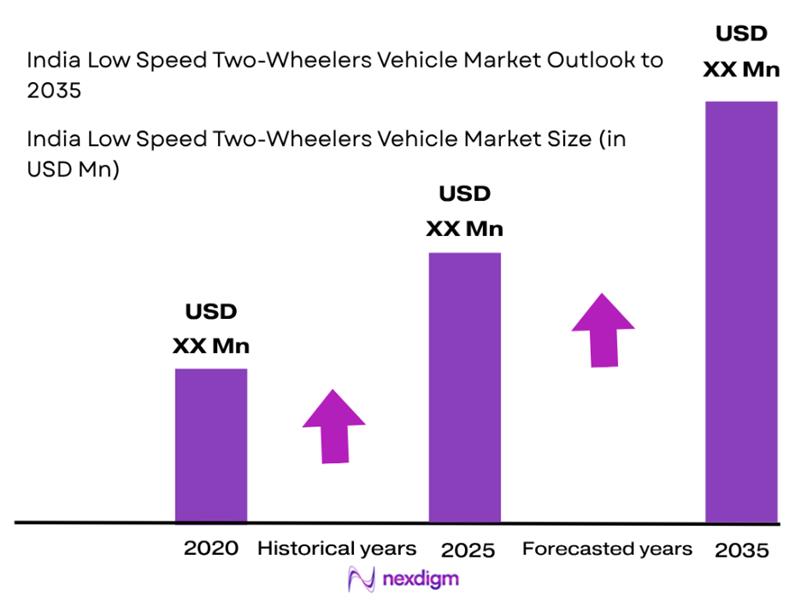
Market Size and Demand Dynamics: The India Low Speed Two-Wheelers Vehicle Market is valued at approximately ~USD XX million, based on historical demand analysis and the placeholder convention adopted for this report. SMEV reported 120,000 low-speed electric scooters in an earlier annual benchmark, while the broader electric two-wheeler ecosystem subsequently reached 1.14 million units. Demand is supported by affordable acquisition costs, home charging, low operating expenditure, short-distance commuting and exemption-oriented low-speed vehicle architecture.
Geographical Demand Concentration: Demand is concentrated across Delhi NCR, Jaipur, Lucknow-Kanpur, Ahmedabad, Pune, Hyderabad and Bengaluru, alongside rapidly expanding Tier-II and Tier-III markets. Northern and western markets benefit from dense distributor networks, price-sensitive commuter demand and strong availability of entry-level scooters, while southern urban centres benefit from established EV awareness and service ecosystems. National adoption is increasingly extending beyond metros, with smaller cities becoming more important as dealers, financing and affordable electric mobility penetrate deeper into India.
Market Segmentation
By Battery Type
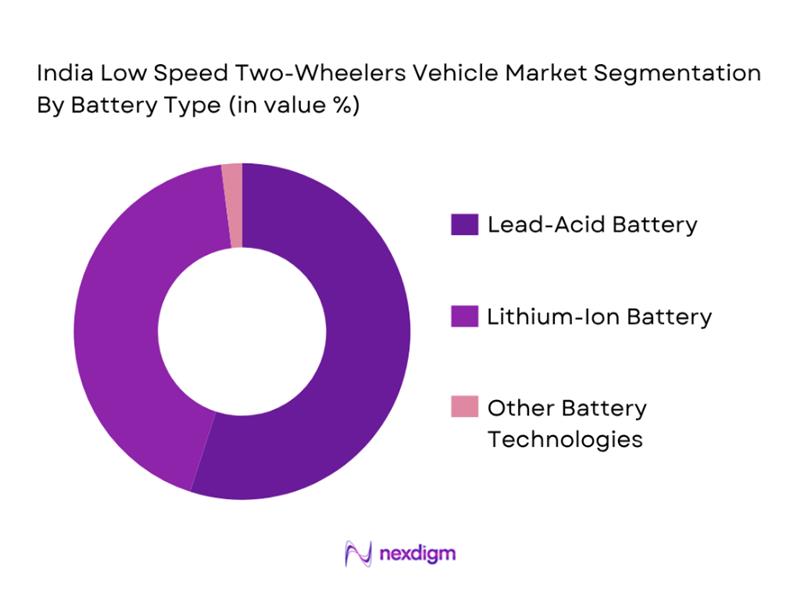
The India Low Speed Two-Wheelers Vehicle Market is segmented by battery type into lead-acid battery, lithium-ion battery and other battery technologies. Lead-acid batteries have historically held a substantial position in the low-speed category because their lower initial cost enables manufacturers to reach highly price-sensitive buyers. Arizton notes that lead-acid batteries have traditionally been important in Indian electric two-wheelers because they are inexpensive and readily available, although lithium-ion adoption is expanding rapidly. Lithium-ion is progressively becoming more influential because lower weight, better energy density, improved range and longer lifecycle economics make it attractive for organized OEMs and customers willing to pay a higher upfront price.
By End-Use/Application
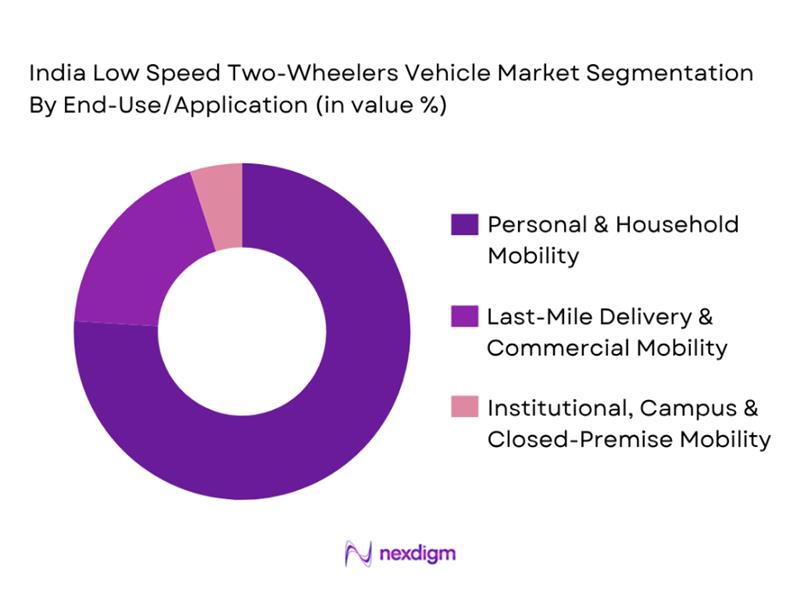
The India Low Speed Two-Wheelers Vehicle Market is segmented by application into personal and household mobility, last-mile delivery and commercial mobility, and institutional/campus mobility. Personal mobility represents the dominant application because the 25-km/h architecture is naturally suited to neighbourhood travel, education-related journeys, shopping trips and short workplace commutes. The segment benefits from straightforward home charging and comparatively simple operation. Commercial demand is becoming strategically important, particularly for food delivery, quick commerce and hyperlocal logistics, where predictable routes and high daily utilization strengthen the economic case for electric propulsion.
Competitive Landscape
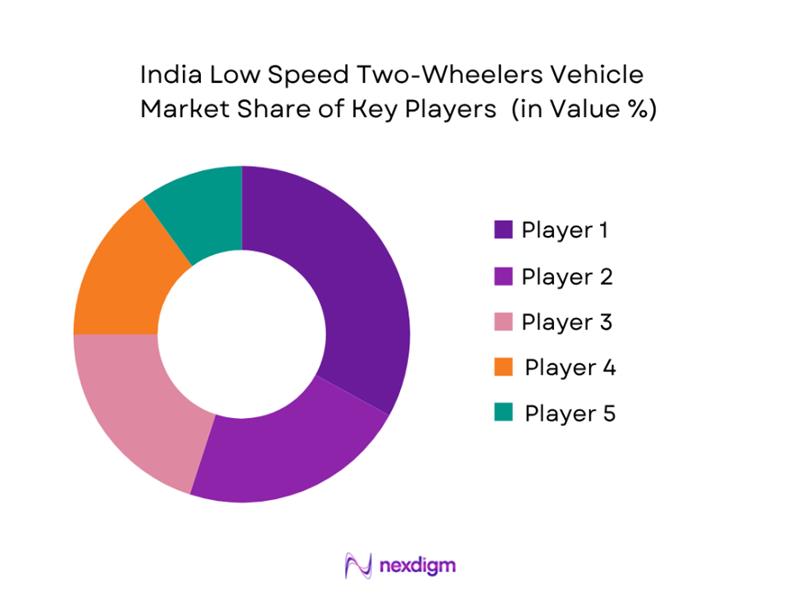
India’s low-speed two-wheeler landscape remains more fragmented than the registered high-speed electric scooter market. Competition includes established EV brands, specialist low-speed manufacturers, regional assemblers and multi-brand dealer-led companies. Players such as Komaki, Zelio, Tunwal, Ampere and Hero Electric have participated in affordable urban mobility, while Joy e-bike maintains dedicated low-speed models. Differentiation increasingly depends on battery technology, real-world range, dealer density, replacement-part availability, warranty coverage and the ability to maintain compliant low-speed specifications.
| Major Player | Establishment | Headquarters | Low-Speed Positioning | Battery Strategy | Representative Range Proposition | Distribution Footprint | Key User Base | Strategic Strength |
| Komaki Electric | 2017 | New Delhi | ~ | ~ | ~ | ~ | ~ | ~ |
| Zelio E-Mobility | 2021 | Hisar, Haryana | ~ | ~ | ~ | ~
|
~
|
~
|
| Tunwal E-Motors | 2018 | Pune, Maharashtra | ~
|
~
|
~
|
~
|
~
|
~
|
| Ampere / Greaves Electric Mobility | 2008 | Bengaluru, Karnataka | ~
|
~
|
~
|
~
|
~
|
~
|
| Hero Electric | 2007 | Gurugram, Haryana | ~
|
~
|
~
|
~
|
~
|
~
|
India Low Speed Two-Wheelers Vehicle Market Analysis
Growth Drivers
Low Acquisition Price and Low Running Cost
India Low Speed Two-Wheelers Vehicle Market is supported by demand for affordable electric mobility solutions among price-sensitive consumers seeking alternatives to petrol-powered two-wheelers. India’s per capita income reached approximately USD 2,695 in 2024, according to the World Bank, indicating a large consumer base where affordability remains a critical purchase consideration. The low-speed category benefits from simpler vehicle architecture, lower power requirements and suitability for short-distance travel, making it attractive for households seeking economical transportation. India recorded over 67 million registered two-wheelers in active use in 2024, according to the Ministry of Road Transport and Highways, highlighting the large existing two-wheeler user base that creates replacement and additional-vehicle demand. The World Bank reported that India’s urban population exceeded 518 million people in 2024, increasing demand for compact mobility solutions suitable for congested urban environments. Additionally, India’s electricity access reached approximately 99.5% of the population, according to World Bank energy indicators, improving the practicality of home charging-based mobility solutions. Low-speed electric vehicles benefit from reduced dependence on fuel stations, simple charging requirements and lower maintenance needs, making them relevant for daily neighbourhood commuting, household errands and short-distance mobility applications.
Short-Distance Mobility Demand and Tier-II/Tier-III Market Expansion
The India Low Speed Two-Wheelers Vehicle Market is gaining momentum due to increasing demand for localized mobility solutions across smaller cities and emerging urban centres. According to the United Nations and World Bank urban development indicators, India’s urban population continues expanding, with more than 518 million urban residents recorded in 2024, increasing the need for affordable last-mile transportation. The Ministry of Statistics and Programme Implementation reported continued expansion of household consumption activity, supporting demand for personal mobility products beyond major metropolitan regions. The Ministry of Road Transport and Highways recorded more than 30 million new vehicle registrations across categories during 2024, reflecting sustained mobility demand throughout the country. Low-speed electric vehicles are particularly suitable for Tier-II and Tier-III markets because they address short commuting distances, local shopping trips, education travel and household transportation requirements without requiring high-performance specifications. The Government of India’s rural electrification progress, with electricity access reaching approximately 99.5% of households according to World Bank energy access indicators, further supports adoption potential in semi-urban and rural areas. Expanding dealer networks, increasing awareness of electric mobility and growing acceptance of affordable electric vehicles are enabling low-speed two-wheelers to penetrate markets beyond traditional metropolitan EV adoption centres.
Market Challenges
Regulatory Uncertainty and Product Quality Variation
The India Low Speed Two-Wheelers Vehicle Market faces challenges due to evolving regulatory interpretation, compliance requirements and inconsistent product quality among fragmented manufacturers. The Ministry of Road Transport and Highways defines low-speed electric vehicles through specific technical thresholds, including motor power and maximum speed conditions, making regulatory compliance a critical factor for manufacturers. The Automotive Research Association of India and testing agencies continue to emphasize vehicle safety, battery reliability and component validation as electric mobility adoption expands. India recorded more than 1.1 million electric two-wheeler registrations across the broader EV category in 2024, according to VAHAN data, increasing regulatory attention toward battery safety, manufacturing standards and consumer protection. Product quality variation remains a concern because the low-speed segment includes organized manufacturers as well as smaller assemblers with different levels of engineering capability, testing procedures and after-sales infrastructure. The Ministry of Heavy Industries introduced stronger emphasis on advanced battery technology and safety compliance under EV support frameworks, increasing pressure on manufacturers to improve technical standards. Inconsistent battery performance, controller failures, limited spare-part availability and differences in warranty execution can affect consumer confidence and slow adoption among first-time electric vehicle buyers.
Limited Financing and Weak Resale Value
The India Low Speed Two-Wheelers Vehicle Market faces financing challenges because many non-RTO low-speed vehicles have limited availability of structured lending products compared with conventional registered vehicles. According to the Reserve Bank of India, non-banking financial companies and banks continue expanding vehicle finance portfolios, but smaller electric mobility assets often require specialized risk assessment due to uncertain residual values. India’s financial inclusion progress has improved significantly, with more than 1.4 billion bank accounts opened under financial inclusion initiatives according to Government of India data, creating a broader potential customer base; however, access to dedicated EV financing remains uneven across smaller cities. The resale market for low-speed electric vehicles remains less developed because battery health, replacement cost and brand continuity strongly influence second-hand valuation. The Ministry of Road Transport and Highways recorded a rapidly expanding vehicle ecosystem with millions of annual registrations, but low-speed non-RTO vehicles remain less visible in formal resale databases. Limited financing options can increase dependence on upfront purchases, while uncertain resale value may discourage consumers comparing electric vehicles against established petrol scooters. Strengthening lender participation, battery certification and organized resale channels will be important for improving long-term market acceptance.
Market Opportunities
Lithium-Ion Migration and Battery Leasing Models
The transition from lead-acid batteries toward lithium-ion technology represents a significant opportunity for the India Low Speed Two-Wheelers Vehicle Market by improving vehicle efficiency, usability and customer acceptance. India’s lithium-ion ecosystem is expanding through government-backed battery manufacturing initiatives, including the Ministry of Heavy Industries’ focus on advanced battery technology under electric mobility programs. India’s electricity consumption exceeded 1,700 billion kWh in 2024, according to the International Energy Agency, supporting the broader electrification ecosystem required for electric mobility adoption. Lithium-ion batteries enable lighter vehicle designs, improved range consistency, reduced maintenance requirements and better lifecycle performance compared with traditional battery technologies. Battery leasing and battery-as-a-service models can further reduce upfront ownership barriers by separating vehicle purchase from battery ownership. India’s renewable energy capacity exceeded 200 GW in 2024, according to the Ministry of New and Renewable Energy, strengthening the long-term ecosystem for electrified transportation. For low-speed vehicles, battery leasing can improve affordability for delivery riders, household users and small businesses by reducing initial purchase burden. Organized battery networks can also create recurring revenue opportunities through replacement services, refurbishment and lifecycle management. As battery technology becomes more accessible, manufacturers with strong battery ecosystems can differentiate themselves through reliability and ownership convenience.
Fleet Mobility and Organized Dealer Consolidation
Fleet mobility and dealer consolidation present major growth opportunities for the India Low Speed Two-Wheelers Vehicle Market as businesses increasingly seek economical solutions for localized transportation. India’s digital commerce and quick-commerce ecosystem has expanded rapidly, supported by a large urban consumer base exceeding 518 million people in 2024, according to World Bank population and urbanization indicators. Low-speed electric vehicles are suitable for delivery applications requiring predictable routes, lower operating distances and frequent daily usage. The Ministry of Commerce and Industry reported continued expansion of India’s e-commerce ecosystem, increasing demand for efficient last-mile transportation solutions. Fleet operators can benefit from standardized vehicles, centralized maintenance and battery management systems, creating opportunities for purpose-built low-speed models. At the retail level, dealer consolidation can improve consumer confidence by creating stronger service networks, spare-part availability and warranty support. The Government of India’s Startup ecosystem exceeded 100,000 recognized startups by 2024, according to the Department for Promotion of Industry and Internal Trade, supporting innovation in mobility services and fleet technology. As smaller manufacturers face increasing compliance and service requirements, organized players with wider dealer networks, stronger financing partnerships and better after-sales capabilities are positioned to capture future market opportunities.
Future Outlook
The India Low Speed Two-Wheelers Vehicle Market is expected to expand at a forecast CAGR of approximately ~XX% during 2026–2035. Growth will be supported by affordability-led electrification, deeper penetration into Tier-II and Tier-III cities, increasing lithium-ion adoption, improved dealer networks and greater use of lightweight electric vehicles for hyperlocal transportation. However, faster registered electric scooters will create substitution pressure as their prices decline and financing availability improves. Future development will increasingly be determined by the price gap between low-speed and high-speed EVs. Low-speed vehicles retain a meaningful advantage when buyers prioritize acquisition cost, simple ownership and local mobility.
Companies that develop dependable battery-service networks may generate recurring aftermarket revenues while simultaneously reducing consumer concerns about lifecycle cost. Commercial low-speed mobility will also expand beyond individual ownership. Quick-commerce, food delivery, campus mobility and short-distance logistics can use low-speed vehicles efficiently where routes are dense and localized. Yulu’s fleet-focused business provides evidence of this use case: the company operates primarily low-speed e-bikes for delivery-oriented applications and announced plans to substantially expand its fleet and city footprint. Regulation remains the largest structural uncertainty.
Major Players
- Komaki Electric Division
- Zelio E-Mobility
- Tunwal E-Motors
- Wardwizard Innovations & Mobility – Joy e-bike
- Greaves Electric Mobility – Ampere
- Lectrix EV
- Electrotherm – YoBykes
- Okinawa Autotech
- Hero Electric
- Gemopai Electric
- e-Ashwa Automotive
- Avon Cycles – E Scoot
- Crayon Motors
- Benling India Energy & Technology
- Warivo Motor India
Key Target Audience
- Low-Speed Electric Two-Wheeler Manufacturers
- Electric Two-Wheeler Dealers and Distributors
- Battery Cell, Battery-Pack and Battery-Management-System Manufacturers
- Electric Motor, Controller, Charger and Power-Electronics Suppliers
- Last-Mile Delivery, Quick-Commerce and Shared-Mobility Fleet Operators
- Banks, NBFCs, Vehicle Leasing and EV Financing Companies
- Investments and Venture Capitalist Firms
- Government and Regulatory Bodies (Ministry of Road Transport & Highways, Ministry of Heavy Industries, Automotive Research Association of India, International Centre for Automotive Technology, NITI Aayog and State Transport Departments)
Research Methodology
Step 1: Identification of Key Variables
The research begins with construction of an India low-speed two-wheeler ecosystem covering OEMs, battery suppliers, motor and controller manufacturers, distributors, multi-brand EV dealers, fleet operators and end users. Secondary research is used to identify the critical variables affecting the category, including rated motor power, certified maximum speed, battery chemistry, battery capacity, range, vehicle price, dealer reach and end-use characteristics. Special attention is given to separating low-speed/non-RTO vehicles from registered high-speed electric two-wheelers. This distinction is essential because government registration databases do not provide complete retail visibility for vehicles that fall outside standard registration requirements.
Step 2: Market Analysis and Construction
Historical low-speed volumes are compiled using manufacturer-reported sales, SMEV industry information, OEM disclosures, dealer checks and specialist electric-mobility databases. SMEV’s manufacturer-sourced reporting and JMK Research’s historical low-speed estimates provide external reference points for validating the scale and trajectory of the category. A bottom-up model is subsequently constructed using OEM-level product availability, estimated dealer throughput, regional dealer density, battery mix, average vehicle pricing and channel inventory. The results are cross-checked against the broader electric two-wheeler market to ensure that the low-speed model remains directionally consistent with India’s total electric mobility ecosystem.
Step 3: Hypothesis Validation and Expert Consultation
Initial hypotheses are validated through computer-assisted telephone interviews and structured discussions with low-speed vehicle manufacturers, dealers, distributors, battery assemblers, component suppliers, service workshops and fleet operators. Dealer interviews focus particularly on monthly retail throughput, lead-acid versus lithium demand, consumer price thresholds, discounting, replacement-battery demand and common service issues. Supplier interviews are used to independently verify OEM production trends through motor, controller, charger and battery procurement. This supply-side validation reduces dependence on self-reported vehicle sales and provides an additional check on the fragmented low-speed market.
Step 4: Research Synthesis and Final Output
The final research stage triangulates top-down electric two-wheeler industry data with bottom-up OEM, dealer, battery and component information. Market value is calculated from validated unit volumes and weighted average selling prices, while segmentation is developed through model-mix and primary-research evidence. Forecasts incorporate battery-cost trends, lithium conversion, dealer expansion, Tier-II/Tier-III penetration, high-speed EV cannibalization, fleet adoption and potential regulatory changes. Base, accelerated-adoption and regulatory-tightening scenarios are reviewed before producing the final market outlook and strategic recommendations.

- Executive Summary
- Research Methodology (Market Definition & Scope, ≤25 km/h Vehicle Boundary, ≤250 W Motor Classification, Non-RTO Vehicle Treatment, Primary Interviews, OEM Checks, Dealer Audits, Distributor Interviews, Component Supplier Interviews, Consumer Surveys, Model-Level Price Tracking, Top-Down Market Sizing, Bottom-Up OEM–Model Sizing, Channel Checks, Production–Dispatch Reconciliation, Battery Demand Validation, Data Triangulation, Forecasting Framework, Scenario Modelling, Assumptions & Limitations)

- Definition and Scope
- Low-Speed Two-Wheeler Industry Genesis and Evolution
- Industry Development and Product Evolution
- Low-Speed Two-Wheeler Value Chain

- Growth Drivers (Low Acquisition Price, Low Running Cost, Licence/Registration Convenience, Short-Distance Mobility Demand, Household Second-Vehicle Demand, Tier-II/Tier-III Penetration, Delivery Electrification)
- Market Challenges (Regulatory Uncertainty, Product Quality Variation, Battery Safety, Limited Financing, Resale Value, Service Gaps, Grey-Market Competition)
- Market Opportunities(Lithium-Ion Migration, Rural Expansion, Fleet Mobility, Female Ridership, Senior Mobility, Battery Leasing, Organized Dealer Consolidation)
- Market Trends (Lithium-Ion Adoption, Longer-Range Low-Speed Models, Digital Features, Premium Styling, Direct-to-Consumer Sales, Fleet Customization)
- Government regulations
- SWOT analysis
- Porters 5 forces

- By Market Value (2020-2025)
- By Unit Sales (2020-2025)
- By Average Selling Price (2020-2025)
- By Installed Vehicle Parc (2020-2025)
- By Replacement Demand (2020-2025)
- By Low-Speed Share of Total Electric Two-Wheeler Sales (2020-2025)
- By Low-Speed Share of Entry-Level Two-Wheeler Demand (2020-2025)

- By Vehicle Body Type
Low-Speed Electric Scooters
Low-Speed Electric Mopeds
Low-Speed Electric Bikes
Low-Speed Utility/Cargo Two-Wheelers
Low-Speed Shared-Mobility/Fleet Vehicles - By Battery Chemistry
Lead-Acid Battery Vehicles
Lithium-Ion Battery Vehicles
LFP Battery Vehicles
NMC-Based Battery Vehicles
Other/Emerging Battery Chemistries - By Battery Capacity
Up to 1 kWh
Above 1 kWh–1.5 kWh
Above 1.5 kWh–2 kWh
Above 2 kWh - By Price Band
Entry Price Segment
Mass-Market Segment
Upper-Mass Segment
Premium Low-Speed Segment - By End User
Students and Young Riders
Senior Citizens
Women Commuters
Household/Family Users
Gig and Last-Mile Delivery Riders
Commercial and Institutional Buyers
Rural and Semi-Urban Consumers - By Geography
North India
South India
West India
Central India
East India
Northeast India

- Market Share of Leading Players (Market Value, Unit Sales, Retail Sell-Out, Geographic Presence, Product Category)
- Cross Comparison Parameters (Low-Speed Model Portfolio, Claimed Range & Battery Capacity, Battery Chemistry & Removability, Ex-Showroom Price Positioning, Dealer & Service Network Reach, Battery & Vehicle Warranty, Manufacturing Capacity & Localization, B2C/B2B Application Coverage)
- Model-Level Competitive Benchmarking (Top Speed, Rated Motor Power, Battery Capacity, Claimed Range, Charging Time, Price, Warranty, Kerb Weight)
- SWOT Analysis of Major Players (Brand Strength, Product Breadth, Dealer Reach, Battery Technology, Pricing, Service Network, Financial Position)
- Detailed Profiles of 15 Major Companies
Komaki Electric Division
Zelio E-Mobility
Tunwal E-Motors
Wardwizard Innovations & Mobility – Joy e-bike
Greaves Electric Mobility – Ampere
Lectrix EV
Electrotherm – YoBykes
Okinawa Autotech
Hero Electric
Gemopai Electric
e-Ashwa Automotive
Avon Cycles – E Scoot
Crayon Motors
Benling India Energy & Technology
Warivo Motor India

- Consumer Purchase Behaviour Assessment
- Consumer Demographic Analysis
- Consumer Mobility Requirement Analysis
- Consumer Price Sensitivity Analysis
- Purchase Decision Factors
- Brand Preference and Loyalty Assessment
- Consumer Pain Point Analysis
- Product Feature Preference Analysis
- Online and Offline Buying Behaviour

- By Market Value (2026-2035)
- By Unit Sales (2026-2035)
- By Average Selling Price (2026-2035)
- By Installed Vehicle Parc (2026-2035)
- By Replacement Demand (2026-2035)


 Request a Sample
 Ask for Customization
 Get a Quote
 Enquire Now