

 Download PDF
Market Overview
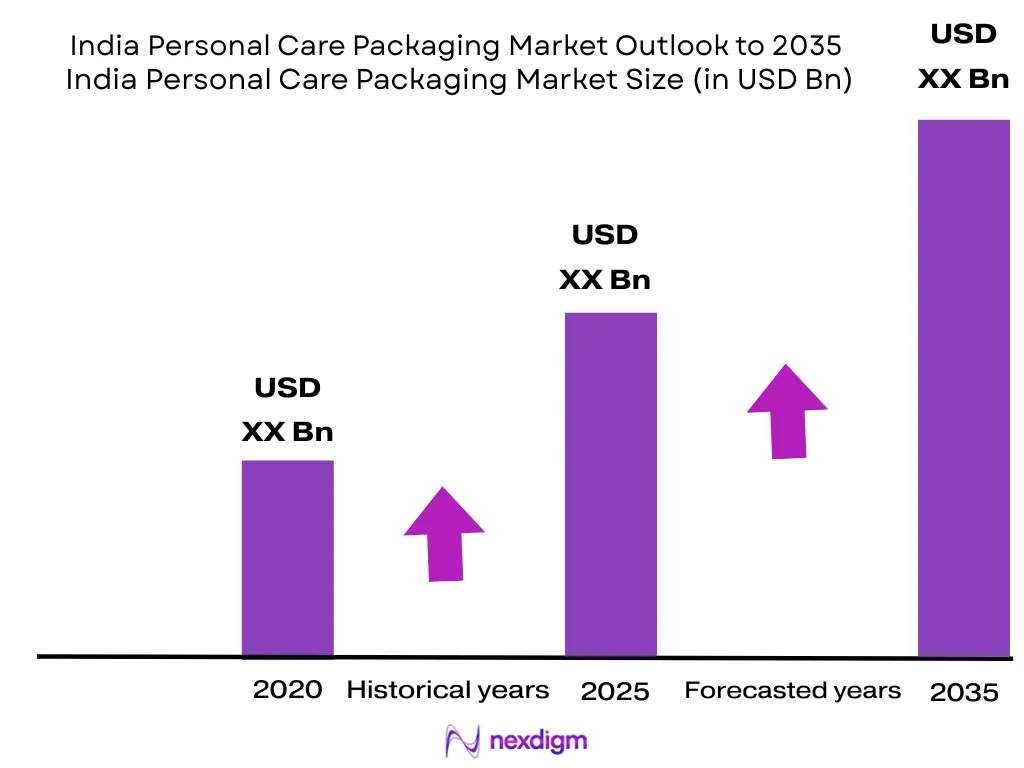
The India Personal Care Packaging Market is valued at approximately USD ~ billion, compared with USD ~ billion in the preceding annual period. These figures remain placeholders because official agencies do not isolate personal-care-packaging revenue. Demand is supported by India’s large consumer base, rising packaged-product penetration and nominal GDP of approximately ₹318.07 lakh crore, alongside real GDP growth of 7.1 units for every 100 units during the latest completed financial period. Mumbai–Pune, Delhi–NCR, Ahmedabad–Vadodara, Silvassa–Daman, Bengaluru, Hyderabad and Chennai dominate India’s personal-care-packaging activity. Mumbai and Delhi concentrate beauty brands, retail headquarters and marketing functions. Gujarat, Maharashtra and the Union Territory manufacturing belts provide rigid plastics, tubes, flexible films and contract filling. Bengaluru and Hyderabad support digital-first brands, cosmetics manufacturing and e-commerce fulfilment, while Chennai offers plastics conversion, ports and southern distribution access.
Market Segmentation
By Packaging Product Type
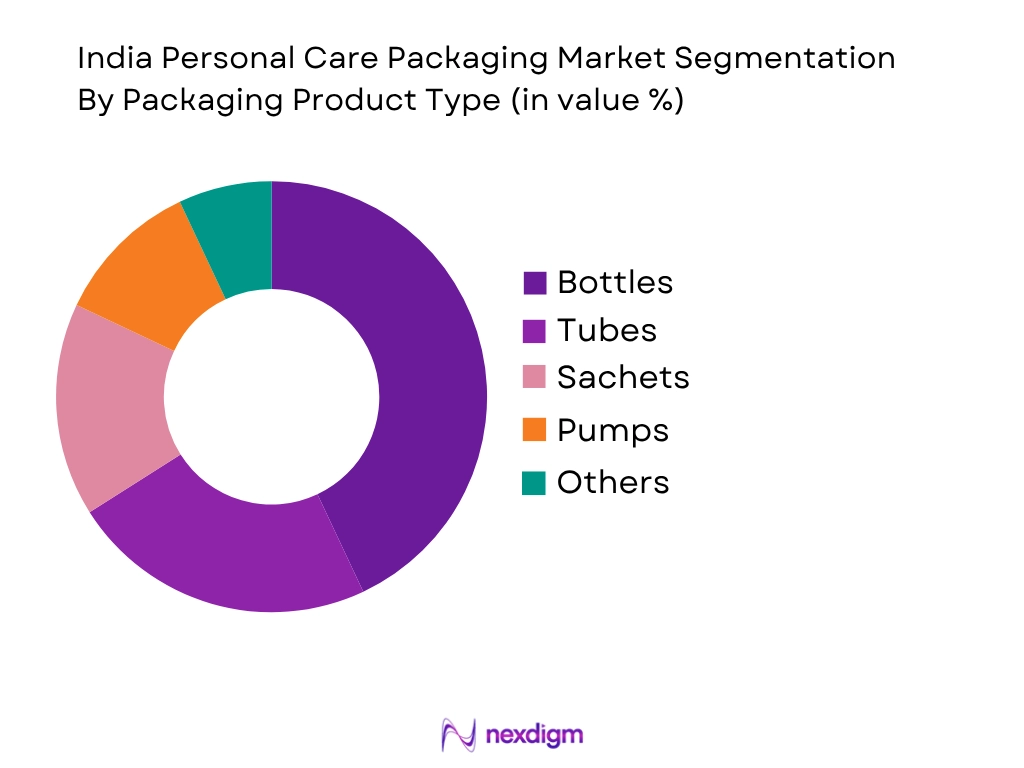
The India Personal Care Packaging Market is segmented into bottles, tubes, sachets, pouches, jars, pumps and airless packs, aerosols, roll-ons, sticks and secondary cartons. Bottles hold the dominant market share because shampoos, conditioners, hair oils, body lotions, liquid soaps, facial cleansers and baby-care products generate recurring, high-volume demand. PET, HDPE and polypropylene bottles can be produced domestically in standard neck sizes, paired with flip-top caps or pumps and distributed through both general trade and online channels. Sachets remain structurally important because they support trial, low-unit-price purchasing and rural distribution. Tubes are widely used for toothpaste, facial cleansers, sunscreens and creams, while refill pouches are gaining relevance in hand wash, shampoo and household-oriented personal care. Airless formats remain smaller but are becoming more important in premium skin care and active formulations.
By Packaging Material
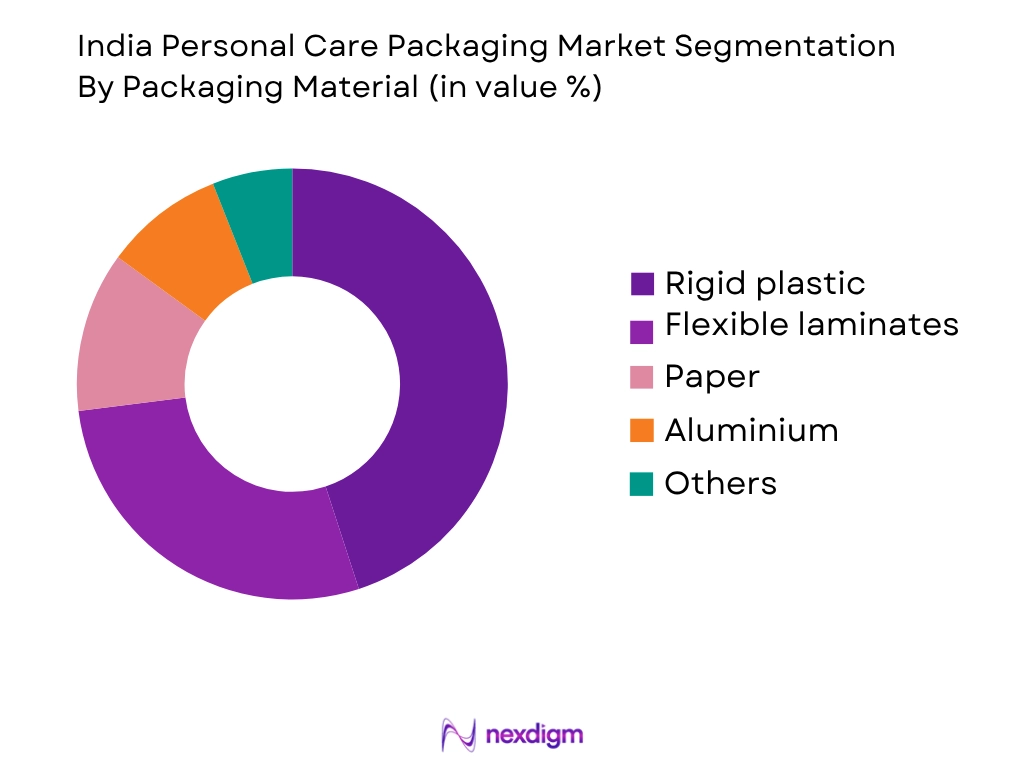
The India Personal Care Packaging Market is segmented into plastic, flexible laminates, paper and paperboard, glass, aluminium and steel, moulded fibre and bio-based materials. Plastic is the dominant material because PET, polyethylene and polypropylene provide low weight, impact resistance, compatibility with high-speed filling and broad availability through India’s conversion industry. Flexible laminates remain significant because sachets and small pouches require moisture, fragrance and oxygen barriers at low unit weight. Glass is concentrated in fragrances, facial oils and premium skin care, while aluminium supports aerosols, tubes and decorative components. Paperboard is used for secondary cartons, gift packs and e-commerce protection. Material selection is increasingly shaped by plastic-packaging EPR, mandatory recycled-content requirements, package weight, recyclability and formula compatibility.
Competitive Landscape
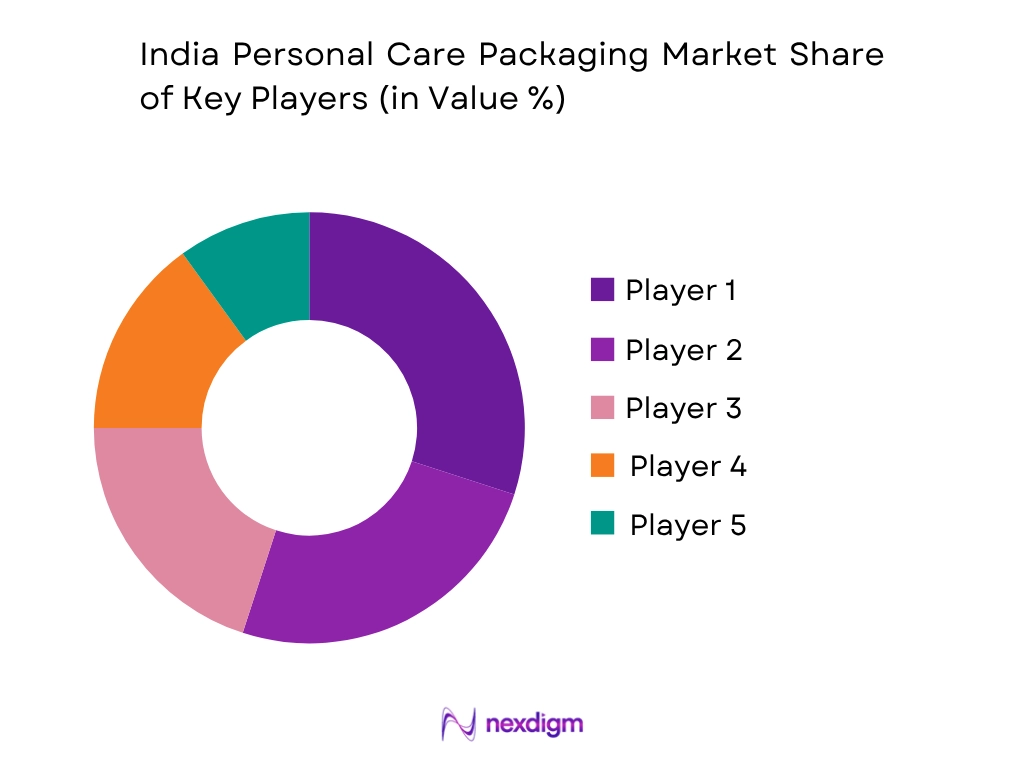
The India Personal Care Packaging Market includes large domestic rigid-packaging manufacturers, global dispensing suppliers, tube producers, flexible-packaging converters, glass manufacturers and carton companies. Manjushree Technopack, EPL, UFlex, ALPLA India and AptarGroup have differentiated positions across bottles, tubes, films, pumps and closures. Domestic scale remains important because personal-care brands require high-volume supply for mass products, while digital-first and premium brands increasingly demand low minimum orders, sophisticated decoration and rapid tooling. Competition is shifting toward PCR capability, mono-material structures, EPR documentation, e-commerce testing and local production of premium dispensing systems.
| Company | Established | Headquarters | Core portfolio | Dispensing or tube capability | Material capability | Decoration capability | Sustainability capability | India market relevance |
| Manjushree Technopack | 1983 | Bengaluru, India | ~ | ~ | ~ | ~ | ~ | ~ |
| EPL Limited | 1982 | Mumbai, India | ~ | ~ | ~ | ~ | ~ | ~ |
| UFlex Limited | 1985 | Noida, India | ~ | ~ | ~ | ~ | ~ | ~ |
| ALPLA India | 1955 | Hard, Austria | ~ | ~ | ~ | ~ | ~ | ~ |
| AptarGroup | 1992 | Crystal Lake, United States | ~ | ~ | ~ | ~ | ~ | ~ |
India Personal Care Packaging Market Analysis
Growth Drivers
Large Consumer Base and Expanding Packaged Personal Care Consumption
India’s large consumer base is increasing demand for bottles, tubes, sachets, refill pouches, jars, pumps, roll-ons and cartons used across hair care, oral care, skin care, deodorants, bath products and grooming. The World Bank recorded India’s population at approximately 1.45 billion people in 2024, providing packaging manufacturers with one of the world’s largest addressable consumer bases. India’s real GDP expanded by 6.5 units for every 100 units during 2024–2025, while nominal GDP increased by 9.8 units for every 100 units, according to the Ministry of Statistics and Programme Implementation. Rising economic activity supports broader distribution through kirana stores, pharmacies, supermarkets, salons, e-commerce platforms and quick-commerce networks. Packaging demand is not limited to full-size urban products. Sachets, miniature tubes and low-unit-price bottles remain essential for trial generation and income-sensitive consumption, while metropolitan consumers increasingly purchase premium serums, sunscreens, hair treatments and dermatologist-positioned products requiring airless pumps, droppers and high-barrier containers. This combination of mass affordability and premiumization enables converters to supply multiple pack sizes from the same product platform. Manufacturers with high-speed moulding, flexible decoration and nationwide warehousing are consequently positioned to serve both large consumer-goods companies and rapidly scaling digital-first personal-care brands.
Digital Connectivity and Omnichannel Beauty Distribution
India’s expanding digital infrastructure is strengthening online discovery and distribution of personal-care products, creating demand for parcel-ready primary packs, tamper evidence, short-run labels and rapid product customization. The Telecom Regulatory Authority of India reported 954.40 million internet subscribers at the end of March 2024, including 556.05 million urban subscribers and 398.35 million rural subscribers. The subscriber base subsequently reached 969.10 million by March 2025, while wireless-data usage increased from 194,774 petabytes to 228,779 petabytes. This connectivity enables beauty brands to reach consumers beyond conventional metropolitan retail and launch products through marketplaces, direct-to-consumer websites, social commerce and quick commerce. Packaging must perform differently in these channels: pumps need locking mechanisms, caps require higher retention, labels must resist abrasion and glass packs need protective inserts. Digital-first brands also introduce smaller production batches, frequent fragrance variants and influencer-led editions, increasing demand for stock bottles, digital printing and lower minimum-order quantities. Rural internet growth creates a further opportunity to advertise regional and affordable product formats without relying exclusively on physical shelf space. Packaging suppliers that combine design, filling, variable-data printing and fulfilment can therefore reduce commercialization time while supporting brands that move from online trial volumes to national retail distribution.
Market Challenges
Multilayer Sachet Recovery and Plastic Packaging EPR Compliance
India’s personal-care market depends heavily on sachets and flexible packs, but these formats create substantial recycling and compliance challenges. Shampoo, conditioner, face wash, hair colour and skin-care samples often require multilayer films to provide moisture, oxygen, fragrance and puncture barriers. These layers may combine polyethylene, polypropylene, polyester, aluminium or adhesives, making separation difficult in conventional recycling systems. Under India’s Plastic Waste Management framework, producers, importers and brand owners must register and meet extended-producer-responsibility obligations covering plastic-packaging collection, recycling, reuse, recycled content and end-of-life management. The 2024 amendments also expanded responsibilities across manufacturers and importers of plastic raw materials serving smaller producers. Personal-care companies must therefore classify packaging, maintain quantity records, procure valid certificates and reconcile annual obligations through the centralized portal. A lightweight sachet may use little material per unit, but billions of dispersed packs are costly to collect because each item has low recovery value. Replacing multilayer films with mono-material structures is technically complex because reduced barrier performance can cause leakage, fragrance loss, seal failure or shortened shelf life. Suppliers must conduct seal-strength, migration, transport and accelerated-aging tests before conversion. Consequently, regulatory compliance requires package engineering, recycler partnerships and traceable data rather than a simple change in resin specification.
Imported Premium Components and Formula-Compatibility Constraints
India has extensive domestic capacity for bottles, tubes, films, cartons and glass, but premium airless pumps, fragrance sprayers, specialty elastomers, metallized collars and selected barrier components may still depend on imported technology or parts. This creates lead-time, foreign-exchange and inventory risks for prestige skin-care, fragrance and treatment-product packaging. The challenge is amplified by India’s high product diversity: hair oils, herbal extracts, alcohol-based fragrances, surfactant-rich cleansers and active skin-care formulations interact differently with resins, gaskets, inks and adhesives. A substitute pump may alter dosage, fail to prime or allow evaporation, while a different bottle resin may absorb fragrance or develop stress cracks. Packaging changes therefore require compatibility studies, temperature cycling, closure-torque checks, drop tests and product-evacuation analysis. India’s nominal GDP growth of 9.8 units per 100 units during 2024–2025 supported expanding consumption, but it also increased demand for working capital across manufacturers serving fast-moving product portfolios. Custom moulds and decorated components may become obsolete when brands change claims, fragrances or pack sizes. Smaller converters face greater exposure because tooling and imported-component costs must be recovered across limited volumes. Suppliers with local mould development, multiple component sources and documented change-control procedures are consequently better placed to serve premium and digital-first brands without delaying launches.
Market Opportunities
Refill Pouches, Mono-Material Formats and Recycled Resin Adoption
India’s plastic-packaging rules create a future growth opportunity for refill systems, mono-material packs and verified recycled-content packaging. Personal-care brands can reduce rigid-plastic use by retaining a durable pump bottle and selling shampoo, conditioner, hand-wash or lotion refills in lightweight pouches. Refill formats are commercially relevant because they can serve both modern retail and e-commerce while reducing transport weight and storage space. India’s 2024 plastic-waste amendments reinforce producer responsibility and require category-specific recycling and recycled-content compliance. This encourages suppliers to develop detachable pumps, reusable bottles, polyethylene-based refill films and bottles containing PCR PET, HDPE or polypropylene where formula compatibility permits. The opportunity is supported by 954.40 million internet subscribers in 2024, which enable brands to offer repeat-purchase subscriptions and educate consumers about refilling and disposal. However, successful systems must remain affordable and intuitive. At-home pouches and replaceable cartridges are likely to scale faster than store-based refill stations because they avoid cleaning infrastructure and dedicated retail space. Packaging manufacturers can create additional value through lifecycle calculations, resin certification, leak testing and EPR documentation. Suppliers that demonstrate lower material consumption without compromising seal strength, aesthetics or filling-line efficiency can become strategic partners to brands redesigning large shampoo, body-care and liquid-soap portfolios.
Rural-Ready Packaging and Digital Short-Run Production
India’s rural and semi-urban markets present a major opportunity for packaging designed around affordability, durability and localized communication. TRAI recorded 398.35 million rural internet subscribers in 2024, rising alongside broader mobile connectivity. This creates a route for personal-care brands to advertise directly to consumers in smaller towns while distributing through kirana stores, pharmacies and regional wholesalers. Packaging suppliers can respond with compact bottles, reinforced sachets, low-unit-price tubes and family refills that tolerate heat, dust, repeated handling and long distributor journeys. Digital printing enables regional-language labels, localized promotions and smaller production runs without requiring separate printing plates for each geography. QR codes can provide usage instructions, authenticity checks, ingredient information and disposal guidance in several languages. The opportunity is particularly strong for herbal hair oils, men’s grooming, oral care, skin cleansers and sun-care products that can expand beyond metropolitan channels. Contract packagers can combine stock containers, filling, coding, cartons and dispatch, allowing regional and digital-first brands to test demand before investing in custom moulds. Suppliers should avoid treating rural packaging as merely smaller urban packaging; cap security, display visibility, retailer handling and climate resistance require dedicated engineering. Companies capable of balancing low material usage with robust seals and recognizable branding can support broader personal-care penetration while maintaining commercially viable production volumes.
Future Outlook
The India Personal Care Packaging Market is forecast to expand at approximately ~% CAGR during the 2026–2035 period. The rate remains a placeholder because official agencies do not publish an isolated market forecast. Growth will be driven by rising packaged-product penetration, digital-first beauty brands, quick commerce, rural distribution, premium skin care, refill formats and compliance-led material redesign. India’s nominal GDP is estimated at ₹318.07 lakh crore, while real GDP expanded by 7.1 units for every 100 units in the latest completed financial period. The subsequent period is estimated to reach nominal GDP of ₹346.36 lakh crore, demonstrating a larger consumption and manufacturing base for packaged consumer products. Bottles will remain the largest packaging type because hair care, body care, hand wash and baby products require robust, resealable packs. Standardised neck finishes and domestic moulding capacity will continue supporting high-volume production, although bottle weight and recycled-content specifications will become more important. Sachets will remain commercially relevant because they support product trial and affordable purchasing. However, multilayer sachets present collection and recycling challenges. Packaging suppliers will therefore invest in mono-material polyethylene or polypropylene structures, thinner barriers and improved inks and adhesives. Flexible refill pouches will expand in shampoos, conditioners, liquid soaps and lotions. They use less material than rigid bottles and are easier to transport to general-trade outlets. Commercial success will depend on puncture resistance, reliable spouts and consumer-friendly pouring.
Major Players
- Manjushree Technopack
- EPL Limited
- UFlex Limited
- AptarGroup
- Albéa Group
- ALPLA India
- Amcor India
- Huhtamaki India
- Berry Global
- Mold-Tek Packaging
- Hitech Corporation
- PGP Glass
- Parksons Packaging
- TCPL Packaging
- Cosmo First
Key Target Audience
- Personal care packaging manufacturers
- Cosmetics, toiletries and grooming brands
- Contract manufacturing and filling companies
- Pumps, closures and tube-system suppliers
- Resin, film, glass and paperboard suppliers
- Beauty retailers, e-commerce and quick-commerce platforms
- Investments and venture capitalist firms
- Government and regulatory bodies (Central Drugs Standard Control Organization, Central Pollution Control Board, Ministry of Environment Forest and Climate Change, Department of Consumer Affairs, Bureau of Indian Standards and State Pollution Control Boards)
Research Methodology
Step 1: Identification of Key Variables
The initial phase constructs an ecosystem map covering personal-care brands, rigid and flexible converters, component suppliers, contract manufacturers, retailers, recyclers and regulators. Key variables include finished-product volume, packaging units per product, sachet penetration, material mix, package size, dispensing-system usage, rural distribution and recycled-content adoption.
Step 2: Market Analysis and Construction
Historical demand is assessed through personal-care manufacturing, consumer expenditure, converter revenues, resin use and packaging shipments. The top-down model converts product-category consumption into unit demand. The bottom-up model aggregates bottles, tubes, sachets, pumps, glass packs, cartons and decoration revenues before reconciling results through packaging weight and line capacity.
Step 3: Hypothesis Validation and Expert Consultation
Market assumptions are validated through computer-assisted telephone interviews with brand owners, packaging manufacturers, tube suppliers, contract fillers, retailers and recyclers. Interviews assess pack-format penetration, component values, formula compatibility, rural-pack requirements, e-commerce failures, EPR obligations and procurement behaviour.
Step 4: Research Synthesis and Final Output
The final phase integrates MoSPI indicators, CDSCO rules, CPCB requirements, company disclosures and primary interviews. Market size is triangulated across revenue, packaging units, material consumption and component shipments. Forecast assumptions include premiumisation, rural penetration, quick commerce, PCR adoption, refill growth and regulatory compliance.

- Executive Summary
- Research Methodology (Market Definitions and Assumptions, Personal Care Packaging Taxonomy, Abbreviations, Market Sizing Approach, Top-Down Personal Care Consumption Analysis, Bottom-Up Packaging Supplier Aggregation, Packaging Units per Finished Product, Demand-Side Assessment, Supply-Side Capacity Mapping, Import–Export Reconciliation, Primary Industry Interviews, Data Triangulation, Forecasting Framework, Scenario Analysis, Limitations and Future Conclusions)

- Definition and Scope
- Market Evolution and Industry Genesis
- Timeline of Major Packaging and Regulatory Developments
- Personal Care Packaging Business Cycle
- Packaging Demand Linkage with Cosmetics and Toiletries Manufacturing
- Mass, Masstige, Prestige, Ayurvedic and Professional Packaging Ecosystem

- Growth Drivers (Large Consumer Base, Rising Urban Consumption, Expansion of Rural Distribution, Hair-Care and Skin-Care Demand, Growth of Digital-First Brands, Quick-Commerce Expansion, Premiumisation, Low-Unit-Pack Consumption and Contract Manufacturing Growth)
- Market Challenges (Virgin Resin Volatility, Multilayer Sachet Recovery, Imported Premium Dispensing Components, High Custom Tooling Costs, Short Product-Launch Cycles, Formula Compatibility Failures, E-Commerce Leakage, Informal Recycling Dependence and EPR Compliance Complexity)
- Market Opportunities (Mono-Material Sachets, Refillable Bottles, Airless Dispensing, Recycled Resin Packaging, Digital Decoration, Smart Labels, Paper-Based Tubes, Waterless Products, Rural-Ready Packaging and Contract Packaging for Emerging Brands)
- Market Trends (Low-Unit-Price Packaging, Premium Dispensing, Refill Pouches, PCR Resin, Paper-Based Secondary Packaging, Ayurvedic Design Language, Minimalist Packaging, Gender-Neutral Formats, Quick-Commerce Packaging and Omnichannel Packs)
- SWOT Analysis
- Porter’s Five Forces Analysis
- PESTLE Analysis

- By Market Value (2020-2025)
- By Packaging Units (2020-2025)
- By Packaging Material Consumption (2020-2025)

- By Packaging Product Type (In Value %)
Bottles
Jars
Plastic Tubes
Laminated Tubes
Sachets
Pouches
Stand-Up Refill Pouches
Aerosol Containers - By Packaging Material (In Value %)
Polyethylene Terephthalate
Recycled Polyethylene Terephthalate
High-Density Polyethylene
Low-Density Polyethylene
Polypropylene
Post-Consumer Recycled Polyolefins - By Brand Type (In Value %)
Multinational Personal Care Brands
Large Indian Personal Care Brands
Regional Indian Brands
Ayurvedic and Herbal Brands
Direct-Selling Brands
Retailer Private Labels
Dermatology and Clinical Brands - By Geographic Market (In Value %)
North India
West India
South India
East India
Central India

- Market Share of Major Players
- Cross Comparison Parameters (Personal Care Packaging Portfolio Breadth, Dispensing-System and Tube Technology, India Manufacturing Footprint, Sustainable Material and PCR Capability, Custom Moulding and Decoration Capability, Sachet and Refill-Pouch Capability, E-Commerce and Rural Distribution Performance, Indian Personal Care Brand Customer Coverage)
- SWOT Analysis of Major Players
- Detailed Profiles of Major Companies
Manjushree Technopack
EPL Limited
UFlex Limited
AptarGroup
Albéa Group
ALPLA India
Amcor India
Huhtamaki India
Berry Global
Mold-Tek Packaging
Hitech Corporation
PGP Glass
Parksons Packaging
TCPL Packaging
Cosmo First

- Packaging Attribute Preference Assessment
- Low-Unit-Price Pack Preference
- Convenience and Dispensing Preference
- Premium versus Functional Packaging Preference
- Refillable Packaging Acceptance
- Recycled-Content Packaging Perception
- Glass versus Plastic Preference

- By Market Value (2026-2035)
- By Packaging Units (2026-2035)
- By Packaging Material Consumption (2026-2035)


 Request a Sample
 Ask for Customization
 Get a Quote
 Enquire Now